

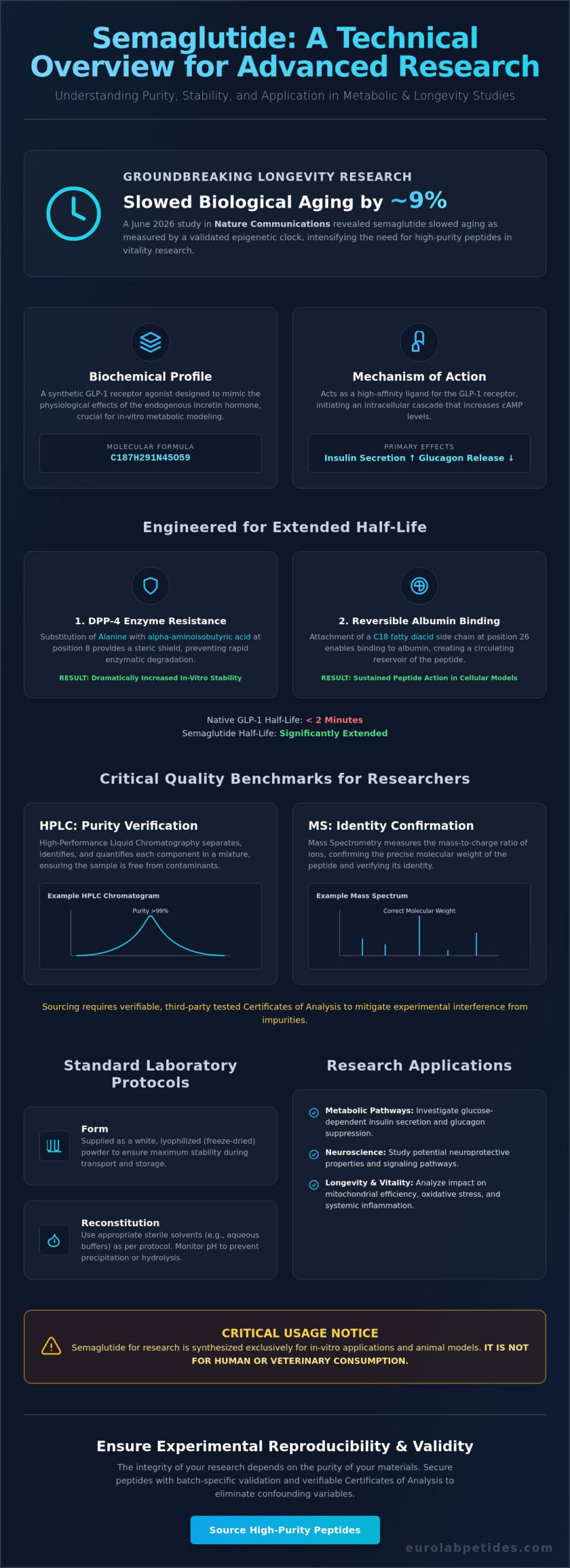
A June 2026 study published in Nature Communications demonstrated that semaglutide slowed the pace of biological aging by approximately 9% as measured by a validated epigenetic clock. This finding intensifies the demand for analytical precision when procuring semaglutide for research lab use, as experimental outcomes depend entirely on the biochemical integrity of the peptide. It’s understood that the peptide market is often obscured by regulatory ambiguity and the risk of sub-standard material. Finding a source that provides verifiable, third-party tested certificates of analysis remains a persistent challenge for serious investigators.
This article delivers a technical overview of semaglutide for in-vitro metabolic research, focusing on molecular stability and rigorous validation metrics. You’ll learn the specific laboratory handling protocols and storage requirements required to maintain peptide potency over time. The following sections provide a detailed analysis of purity validation through HPLC and Mass Spectrometry, alongside a guide to securing high-purity material for sophisticated professional inquiry.
Key Takeaways
- Understand the structural modifications of the C187H291N45O59 molecule, specifically the albumin-binding side chain that facilitates an extended half-life in metabolic models.
- Identify the critical analytical benchmarks, such as High-Performance Liquid Chromatography (HPLC) and Mass Spectrometry (MS), required to verify the purity and molecular identity of semaglutide for research lab use.
- Master standardized laboratory protocols for the reconstitution of lyophilized peptides, including the selection of appropriate solvents to ensure sample stability and experimental validity.
- Evaluate sourcing standards based on regional regulatory compliance and the availability of batch-specific testing data to mitigate the risk of experimental interference from impurities.
- Explore the application of GLP-1 receptor agonists in investigating insulin secretion pathways and their emerging role in longevity and vitality research frameworks.
Semaglutide in Modern Metabolic and Longevity Research
Semaglutide is a synthetic GLP-1 receptor agonist designed to mimic the physiological effects of the endogenous incretin hormone. Within the framework of semaglutide for research lab use, the molecule acts as a high-affinity ligand for the GLP-1 receptor. This interaction initiates an intracellular cascade that increases cyclic adenosine monophosphate (cAMP) levels. Researchers utilize this mechanism to investigate the nuances of glucose-dependent insulin secretion and the simultaneous suppression of glucagon release. The structural integrity of the peptide is paramount; its efficacy in metabolic modeling depends on its resistance to dipeptidyl peptidase-4 (DPP-4) enzymatic degradation.
Scientific inquiry has evolved beyond simple glucose homeostasis. Investigators now employ semaglutide to study its potential neuroprotective properties and its role in mitigating systemic inflammation. These models are essential for advancing longevity and vitality research. By quantifying the peptide’s impact on mitochondrial efficiency and oxidative stress, scientists can better understand the cellular hallmarks of aging. The June 2026 finding that semaglutide may slow biological aging by approximately 9% has catalyzed new interest in these non-metabolic pathways, requiring high-stakes precision in all experimental setups.
The Surge of GLP-1 Receptor Agonist Studies
The acceleration of weight management research has placed GLP-1 signaling at the center of modern metabolic modeling. Semaglutide is the preferred instrument for these studies because its structural modifications ensure a significantly longer half-life compared to native GLP-1. High-purity peptides are mandatory to maintain experimental reproducibility. Impurities within a sample can introduce confounding variables that invalidate data regarding satiety signaling and lipid metabolism. Achieving consistent results requires materials that meet rigorous analytical benchmarks.
In-Vitro Research Scope and Limitations
A rigid boundary separates pharmaceutical-grade medications from materials intended for laboratory development. Semaglutide for research lab use is synthesized specifically for in-vitro applications and animal models. It’s not for human or veterinary consumption. This distinction is legally and ethically critical. Sourcing must be conducted through providers who offer batch-specific validation to ensure regulatory compliance and the absolute security of the research environment. This proof-first approach respects the rigorous demands of the specialized community.
Biochemical Profile and Molecular Mechanism of Semaglutide
The molecular identity of semaglutide is defined by the formula C187H291N45O59, representing a sophisticated advancement in peptide engineering. As a long-acting analog of human glucagon-like peptide-1 (GLP-1), its primary function is to serve as a high-affinity ligand for the GLP-1 receptor. The utility of semaglutide for research lab use stems from its engineered resistance to metabolic breakdown, a necessity for longitudinal in-vitro assays. Unlike native GLP-1, which has a half-life of less than two minutes, semaglutide remains stable for extended periods, allowing for the precise mapping of chronic cellular responses.
The substance is typically presented as a white, lyophilized powder. This freeze-dried state is critical for maintaining molecular stability during transport and storage. Solubility is generally achieved in aqueous buffers; however, researchers must often monitor pH levels to ensure the peptide doesn’t precipitate or undergo unintended hydrolysis. For investigators requiring validated materials for metabolic modeling, sourcing through EuroLab Peptides provides the analytical certainty required for high-stakes scientific inquiry.
Structural Modifications for Stability
Structural integrity is maintained through two primary modifications. First, the substitution of alanine with alpha-aminoisobutyric acid at position 8 provides a steric shield against dipeptidyl peptidase-4 (DPP-4) enzymatic cleavage. Second, the attachment of a C18 fatty diacid side chain via a gamma-glutamic acid spacer at position 26 enables reversible binding to albumin. This binding mechanism creates a circulating reservoir of the peptide in cellular models, facilitating sustained receptor activation. Semaglutide possesses a molecular weight of approximately 4113.58 g/mol and must meet a purity threshold of ≥99% to ensure data accuracy in semaglutide for research lab use.
Cellular Signaling and Receptor Interaction
The pharmacological profile of semaglutide details its role in stimulating the adenylate cyclase pathway. Upon binding to the GLP-1 receptor, the peptide triggers an increase in intracellular cyclic adenosine monophosphate (cAMP). In pancreatic beta-cell models, this cascade results in glucose-dependent insulin secretion. Research also utilizes semaglutide to study gastric emptying rates and hypothalamic satiety signaling. Comparative studies often evaluate these effects against other agonists like Tirzepatide to determine differential impacts on glucose homeostasis and lipid metabolism pathways.
Critical Quality Benchmarks: HPLC and Mass Spectrometry Validation
Verification of semaglutide for research lab use requires a multi-faceted analytical approach to ensure data integrity. High-Performance Liquid Chromatography (HPLC) serves as the primary method for determining chemical purity. During this process, the peptide is passed through a stationary phase under high pressure; individual components are separated based on their molecular affinity. This yields a chromatogram where the area under the main peak represents the purity percentage. A comprehensive technical review of semaglutide confirms that precise molecular identity is non-negotiable for metabolic modeling.
Mass Spectrometry (MS) complements HPLC by verifying the molecular identity of the compound. While HPLC confirms the absence of contaminants, MS ensures the synthesized peptide is indeed semaglutide by measuring its mass-to-charge ratio. For this specific molecule, the expected molecular weight is approximately 4113.58 g/mol. Any significant deviation from this value indicates synthesis errors or the presence of truncated sequences. Reliable research results depend on these metrics. Purity levels of 98% or higher are the established industry standard for professional inquiry.
The Role of Third-Party Laboratory Testing
Internal quality control measures don’t provide the objective validation required for high-stakes research. Independent, third-party testing offers a layer of radical transparency that protects the investigator from sub-standard materials. Common impurities found in peptide synthesis include Trifluoroacetic acid (TFA), residual moisture, and acetate salts. These must be quantified and documented. EuroLab Peptides utilizes multi-level quality control protocols to ensure every batch meets these rigorous specifications before it enters the laboratory environment.
Purity vs. Stability in Research Samples
Degradation products within a sample can interfere with GLP-1 receptor binding assays, leading to skewed metabolic data. Residual solvents are a particular concern in-vitro; they can cause cytotoxic effects that mask the peptide’s actual biological influence. Reviewing The Importance of Third-Party Tested Peptides helps investigators identify the risks associated with unverified chemical synthesis. High-purity material ensures that observed cellular responses are a direct result of peptide interaction rather than contamination.
A Certificate of Analysis (CoA) must be scrutinized for several critical data points:
- Purity Percentage: The relative area of the target peak on the HPLC chromatogram.
- Molecular Weight: Confirmation of the 4113.58 g/mol benchmark via MS analysis.
- Physical Appearance: Verification of the lyophilized white powder state.
- Batch Traceability: A unique identifier that links the sample to its specific testing data.
Laboratory Protocols: Reconstitution, Storage, and Handling
Experimental reproducibility in semaglutide for research lab use depends heavily on standardized handling protocols. Even a 99% pure peptide can lose its biochemical activity if it’s subjected to improper reconstitution or thermal stress. Maintaining the structural integrity of the C187H291N45O59 molecule requires a meticulous approach to solvent selection and environmental control. It’s essential that researchers treat the reconstitution phase with the same level of precision as the analytical validation described in previous sections.
Selection of the reconstitution medium is the first critical step. Bacteriostatic water, containing 0.9% benzyl alcohol, is frequently employed to inhibit microbial growth in multi-use vials. However, for specific in-vitro assays where benzyl alcohol might interfere with cellular viability, sterile 0.9% sodium chloride (saline) is the preferred alternative. Saline provides an isotonic environment that closely mimics physiological conditions, although it lacks the antimicrobial properties of bacteriostatic water. The choice between these solvents should be dictated by the specific requirements of the metabolic model being studied.
Reconstitution Best Practices
Precision in concentration is vital for validating metabolic pathways. Investigators should utilize the Peptide Reconstitution Calculator to ensure accurate molarity for their specific experimental designs. Once the solvent is added, the vial shouldn’t be shaken or vortexed. Violent agitation can lead to peptide shearing or aggregation. A gentle swirling motion is sufficient to achieve a clear, colorless solution. If the solution remains cloudy, it may indicate that the peptide hasn’t fully dissolved or that the pH of the solvent requires adjustment to reach the isoelectric point.
Long-Term Stability and Storage
Lyophilized semaglutide for research lab use exhibits high stability when stored at -20°C; however, for durations exceeding six months, storage at -80°C is recommended. Reconstituted solutions are significantly more fragile. Once in liquid form, the peptide should be used within a short timeframe or divided into single-use aliquots. This practice minimizes freeze-thaw cycles, which cause molecular stress and lead to a measurable loss of potency.
Standard storage requirements include:
- Temperature: -20°C for short-term; -80°C for long-term preservation.
- Light Protection: Use of amber vials or foil wrapping to prevent UV-induced amide bond degradation.
- Atmospheric Control: Ensuring vials are hermetically sealed to prevent moisture ingress.
Monitoring for visible signs of degradation, such as precipitation or a change in color, is a standard quality assurance step. For researchers seeking high-stability compounds backed by rigorous batch testing, EuroLab Peptides provides materials engineered for professional laboratory inquiry.
Sourcing Semaglutide for Research: The EuroLab Peptides Standard
Procurement of semaglutide for research lab use requires a partner that prioritizes empirical validation over commercial narrative. In a market often characterized by regulatory ambiguity, the acquisition of high-purity peptides must be treated as a critical component of experimental design. EuroLab Peptides establishes a benchmark for reliability by integrating regional manufacturing excellence with radical transparency. Every batch is subjected to the rigorous analytical standards previously detailed, ensuring that in-vitro data remains untainted by synthesis artifacts or localized contaminants. Secure procurement is essential for maintaining the high-stakes precision required by the specialized scientific community.
The synthesis process is governed by standardized protocols where quality is presented as a verifiable metric. This methodical approach extends from the initial chemical assembly to the final lyophilization stage. By providing accessible, batch-specific testing data, EuroLab Peptides allows investigators to validate their samples before a single assay is performed. This proof-first flow respects the time and intelligence of the professional user, moving beyond anecdotal claims to objective analytical truth. It’s a system designed to instill absolute security in the professional environment.
Reliable Sourcing in the European Market
The European peptide market presents unique logistical and compliance challenges that can impact the speed and security of procurement. Localized logistics are essential for maintaining the cold chain requirements of sensitive compounds like GLP-1 agonists. By adhering to stringent regional standards, EuroLab Peptides ensures that the transition from synthesis to the laboratory is efficient and documented. Understanding How to Buy Research Peptides Safely in Europe is fundamental for investigators who require absolute certainty in their supply chain. This approach effectively mitigates the risks associated with global shipping delays and unverified international suppliers.
Commitment to Scientific Integrity
Scientific progress is built on objective data. EuroLab Peptides provides the specialized tools necessary for sophisticated professional inquiry, specifically supporting weight management research and metabolic studies. Marketing hyperbole is discarded in favor of batch-specific testing data and high-value technical descriptors. This detached, professional support ensures that researchers can focus on their primary objective: the validation of experimental protocols with high-purity material. The brand projects a persona of radical honesty, where empirical results are the non-negotiable standard for every transaction.
Investigators are encouraged to Explore our research-grade Semaglutide to secure a reliable source for metabolic or longevity models. By prioritizing technical nomenclature and methodology-based terms, EuroLab Peptides remains a meticulous partner for serious semaglutide for research lab use.
Advancing Analytical Precision in Metabolic Modeling
The integrity of metabolic research relies on the intersection of molecular stability and verified purity. This guide has detailed the biochemical profile of semaglutide, emphasizing the role of the C18 fatty diacid side chain and the necessity of standardized reconstitution protocols. Achieving reproducible data requires an objective approach to sample procurement, where every batch is defined by its specific analytical metrics rather than anecdotal claims. The acquisition of semaglutide for research lab use demands a commitment to radical transparency and regional regulatory compliance to protect the validity of in-vitro assays.
EuroLab Peptides ensures this through independent third-party HPLC and Mass Spectrometry validation, providing the empirical proof required for sophisticated professional inquiry. All materials are synthesized under rigorous European-based standards, utilizing localized logistics to maintain the cold chain and molecular potency. Each batch adheres to a strictly non-human consumption compliance mandate, reinforcing a persona of professional accountability. It’s essential that investigators seeking to secure their experimental outcomes Procure High-Purity Semaglutide for Research to ensure absolute molecular security. Meticulous sourcing remains the fundamental requirement for elite scientific discovery.
Frequently Asked Questions
Is semaglutide for research lab use the same as pharmaceutical Ozempic?
No, semaglutide for research lab use is a chemical compound synthesized specifically for in-vitro and animal model studies, whereas Ozempic is an FDA-approved pharmaceutical product. In regions where patients require access to approved medications, reputable pharmacies like Aversi offer წამლები ონლაინ to ensure clinical quality. Research-grade materials lack the clinical additives and sterile fill-finish processing required for human administration. These compounds are intended strictly for laboratory development and must never be used for human or veterinary consumption under any circumstances.
What is the recommended purity level for semaglutide in metabolic studies?
A purity level of ≥98% is the established industry standard for reliable metabolic research. High purity ensures that the observed biological responses are a direct result of GLP-1 receptor agonism rather than interference from truncated peptide sequences or residual solvents. Using material with lower purity risks introducing confounding variables that can invalidate experimental data and compromise reproducibility in sophisticated professional inquiry.
How should I store lyophilized semaglutide for maximum stability?
Lyophilized semaglutide should be stored at -20°C for short-term preservation or -80°C for long-term stability exceeding six months. The powder must be kept in an airtight, light-protected vial to prevent UV-induced degradation and moisture ingress. Maintaining these specific thermal conditions ensures the peptide remains biochemically active and prevents the formation of degradation products that could interfere with future assays.
Can I use tap water for peptide reconstitution in a lab setting?
No, tap water must never be used for peptide reconstitution because its mineral content and potential microbial contaminants will lead to immediate peptide degradation. Reconstitution requires a sterile, pH-adjusted medium such as bacteriostatic water or sterile 0.9% sodium chloride. These solvents ensure the molecular integrity of the peptide and maintain a stable environment suitable for precise laboratory measurements and in-vitro applications.
What are the most common impurities found in research-grade semaglutide?
Common impurities include residual Trifluoroacetic acid (TFA), acetate salts, and truncated peptide sequences resulting from incomplete synthesis. Residual moisture and leftover solvents from the purification process can also be present. Identifying and quantifying these contaminants through HPLC and Mass Spectrometry is a non-negotiable standard for validating the quality of semaglutide for research lab use before experimental commencement.
Is a Certificate of Analysis (CoA) provided with every batch?
Yes, a batch-specific Certificate of Analysis is provided to ensure radical transparency and accountability. The CoA documents the results of HPLC and Mass Spectrometry validation, confirming the purity percentage and molecular weight of the specific lot. This document serves as a verifiable metric of quality, allowing researchers to confirm that the material meets the rigorous demands of their specialized scientific community.
What is the shelf life of semaglutide once it has been reconstituted?
Once reconstituted, the solution should be used immediately or divided into single-use aliquots and stored at 2-8°C for a maximum of 7 to 14 days. For longer storage of the solution, aliquots can be frozen at -20°C, though this is less ideal than using the peptide promptly. Repeated freeze-thaw cycles must be avoided as they cause significant molecular stress and a measurable loss of potency.
Are there specific legal restrictions for buying semaglutide for research in Europe?
In Europe, semaglutide is legally available for purchase strictly under the Research Use Only (RUO) designation. It’s compliant with regional regulations when sold for laboratory development, provided it’s not marketed for human or veterinary use. Procurement of semaglutide for research lab use should be conducted through established European-based suppliers that adhere to localized logistics and manufacturing standards to ensure full regulatory alignment.
