

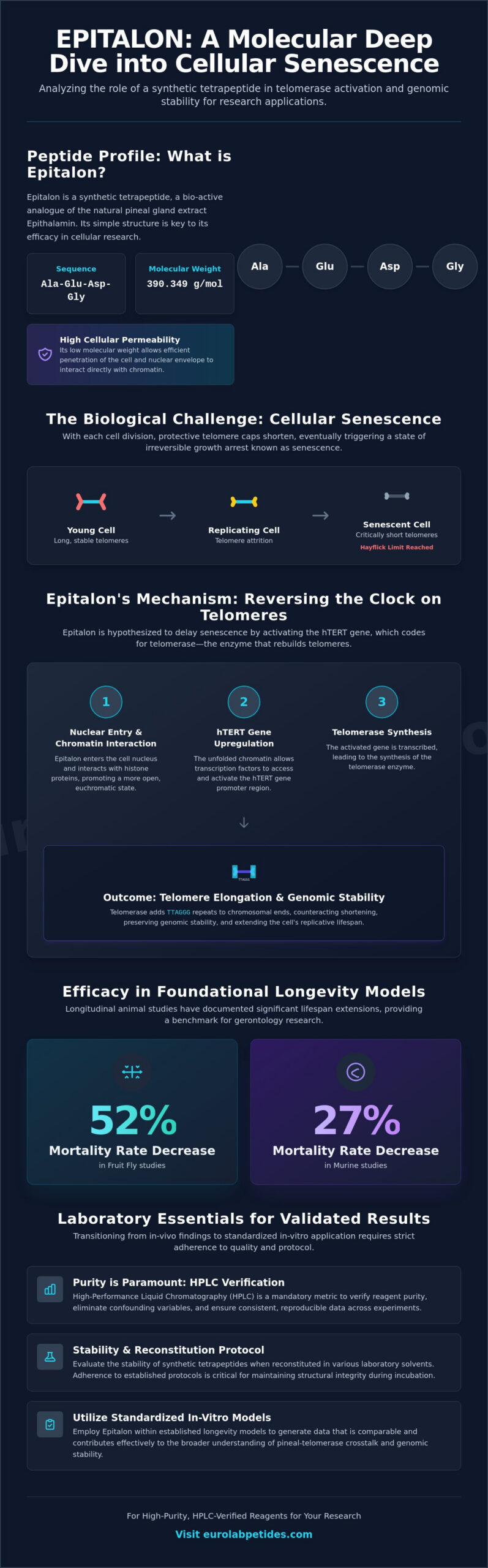
Research involving the synthetic tetrapeptide Epitalon (C14H22N4O9) has documented mortality rate decreases of up to 52% in fruit flies and 27% in mice, yet the transition to standardized in-vitro application remains technically demanding. The professional research community frequently encounters the persistent challenges of inconsistent peptide purity and the lack of granular molecular data regarding the Senescence-Associated Secretory Phenotype (SASP) in existing literature. This technical review investigates the efficacy of epitalon for cellular senescence research by analyzing its role in telomerase regulation and the specific activation of the TERT gene.
It’s essential to evaluate these developments through the lens of the April 15, 2026, FDA removal of Epitalon from the Category 2 list and the implementation of the June 2026 EMA guidelines for synthetic peptide manufacturing. The following analysis details established reconstitution protocols for longevity models and the verifiable metrics required to secure high-purity reagents for advanced laboratory development. We’ll conclude by examining the framework for utilizing Epitalon as a precise tool in genomic stability and pineal-telomerase crosstalk studies, ensuring that all laboratory procedures align with the latest regulatory standards for synthetic compounds.
Key Takeaways
- Examine the biochemical pathway of hTERT gene upregulation and the enzymatic addition of TTAGGG repeats to chromosomal ends.
- Identify standardized protocols for utilizing epitalon for cellular senescence research within established in-vitro longevity models.
- Evaluate the stability of synthetic tetrapeptides when reconstituted in various laboratory solvents to ensure consistent experimental results.
- Analyze foundational data from longitudinal animal studies to establish benchmarks for current gerontology research.
- Utilize High-Performance Liquid Chromatography (HPLC) verification as a mandatory metric for assessing the purity of research reagents.
Defining Epitalon within the Framework of Cellular Senescence
Epitalon is a synthetic tetrapeptide consisting of the amino acid sequence Alanine, Glutamic acid, Aspartic acid, and Glycine (Ala-Glu-Asp-Gly). It was originally identified as the bioactive component of epithalamin, a natural extract derived from the pineal gland. Within the scope of longevity and vitality research, this peptide is utilized as a precision tool for investigating the molecular drivers of biological decay. Cellular senescence is characterized by a stable cell cycle arrest where cells remain metabolically active but lose the capacity for replication. This state is recognized as a primary hallmark of aging and a precursor to systemic physiological decline.
The proliferative capacity of somatic cells is governed by the Hayflick limit, a biological threshold dictated by the progressive shortening of telomeres during each mitotic event. Once telomeres reach a critical minimum length, the cell enters a state of irreversible arrest to prevent genomic instability. This transition isn’t merely a cessation of growth; it involves complex epigenetic shifts and the development of the Senescence-Associated Secretory Phenotype (SASP). Utilizing Epitalon for cellular senescence research allows investigators to observe how short-chain peptides interact with these regulatory pathways at the chromatin level. The peptide’s unique position stems from its ability to act as an epigenetic modulator, potentially influencing gene expression without altering the underlying DNA sequence.
The Molecular Structure of the Ala-Glu-Asp-Gly Sequence
The Ala-Glu-Asp-Gly sequence is characterized by an exceptionally low molecular weight of 390.349 g/mol. This structural simplicity facilitates high cellular permeability and permits the peptide to penetrate the nuclear envelope more efficiently than larger protein complexes. While natural epithalamin is a complex mixture of pineal proteins, the synthetic analogue provides a standardized metric for laboratory development. The tetrapeptide’s stability in aqueous solutions is a critical technical specification, ensuring that the reagent maintains its structural integrity during prolonged in-vitro incubation periods.
Telomere Attrition and the Senescence Trigger
Critical telomere shortening serves as the primary trigger for the DNA damage response (DDR), which activates the p53/p21 and p16INK4a pathways. These signals transition a healthy cell into a senescent state, characterized by altered gene expression and morphological changes. In laboratory settings, epitalon for cellular senescence research is hypothesized to delay this transition by modulating the expression of the hTERT gene. By influencing telomerase activity, the peptide may extend the replicative lifespan of cells, providing a framework for studying the inhibition of established senescence markers and the maintenance of genomic stability over extended cell cycles.
Molecular Mechanisms: Telomerase Induction and Genomic Stability
The primary mechanism by which Epitalon influences cellular longevity is through the upregulation of the Human Telomerase Reverse Transcriptase (hTERT) gene. This gene encodes the catalytic subunit of telomerase, an enzyme responsible for the enzymatic synthesis of TTAGGG repeats at the 3′ ends of chromosomes. In somatic cells, telomerase activity is typically suppressed, leading to progressive telomere shortening. The introduction of this bioactive pineal tetrapeptide facilitates the unfolding of condensed chromatin, specifically within the promoter regions of the hTERT gene. This structural shift allows transcription factors to access the DNA, effectively reinitiating the telomere maintenance process.
Genomic stability is further preserved through the peptide’s impact on chromatin architecture. By interacting with histone proteins, Epitalon promotes a more euchromatic state, which is conducive to efficient DNA repair and transcriptional regulation. Using epitalon for cellular senescence research provides a controlled environment to observe these epigenetic shifts. Research protocols focused on Longevity & Vitality Research often prioritize the quantification of these chromatin modifications to validate the peptide’s efficacy in maintaining the structural integrity of the nucleus during extended cell cycles.
Activation of the hTERT Gene Pathway
Peptide signaling mimics the endogenous regulatory functions of the pineal gland, which naturally modulates telomerase activity through rhythmic secretion patterns. Quantitative measurements in longitudinal research models have shown that Epitalon administration leads to measurable increases in telomere length. These results are achieved by enhancing the expression of telomerase, which counteracts the natural attrition that occurs during mitosis. This pathway is a critical focal point for investigators seeking to bypass the Hayflick limit in specialized cell lines.
Modulating the Senescence-Associated Secretory Phenotype (SASP)
Senescent cells are not merely inert; they develop a pro-inflammatory profile known as the Senescence-Associated Secretory Phenotype (SASP). This phenotype is characterized by the secretion of interleukins, such as IL-6 and IL-8, and matrix metalloproteinases (MMPs) that degrade the extracellular matrix. These secretions can induce senescence in neighboring healthy cells, creating a paracrine effect of biological aging. Epitalon for cellular senescence research has demonstrated the capacity to interfere with these secretory pathways. By modulating the DNA damage response (DDR) signals, the peptide may reduce the production of these inflammatory mediators, thereby mitigating the systemic implications of localized senescence in complex tissue models.
Analyzing Epitalon in Murine and In-Vitro Longevity Models
The historical data regarding Epitalon originates from the St. Petersburg Institute of Bioregulation and Gerontology. Vladimir Khavinson’s foundational research established this tetrapeptide as a pivotal agent in experimental gerontology. In murine models, the administration of the peptide resulted in a 27% decrease in mortality rates. Even more pronounced effects were documented in Drosophila studies, where lifespan extension reached up to 52%. These metrics provide a quantifiable baseline for modern investigators utilizing epitalon for cellular senescence research to determine the limits of biological plasticity in-vitro.
One critical observation in these longitudinal models is the systematic reduction in spontaneous tumor incidence. By maintaining genomic stability through the pathways discussed in previous sections, the peptide reduces the frequency of oncogenic transformations. Additionally, the peptide enhances the activity of antioxidant enzymes, specifically Superoxide Dismutase (SOD). This upregulation provides a robust defense against reactive oxygen species (ROS) that exacerbate telomere attrition. Detailed molecular observations regarding these interactions are documented in the Epitalon and Telomerase Upregulation Study, which correlates enzymatic activation with increased replicative capacity.
The Khavinson Legacy: Foundational Longevity Studies
The 30-year research history at the St. Petersburg Institute offers a comprehensive dataset on peptide-mediated longevity. Statistical analysis of treated cohorts consistently demonstrates improved physiological markers across diverse species. Beyond mortality rate reductions, the research highlights the restoration of immune function and the stabilization of metabolic parameters. These foundational findings justify the continued application of epitalon for cellular senescence research in contemporary laboratory settings, particularly when evaluating the interaction between peptide signaling and chromatin accessibility.
Antioxidant Defense and Melatonin Synergy
Epitalon’s influence extends to the regulation of circadian rhythms by stimulating endogenous melatonin production within the pineal gland. This stimulation creates a synergistic effect that further mitigates oxidative stress markers. Melatonin acts as a potent scavenger of free radicals, and its synthesis is often diminished in senescent models. By restoring pineal health, the peptide facilitates a more efficient cellular repair environment during nocturnal cycles. This relationship between pineal-telomerase crosstalk and antioxidant defense is a primary area of interest for those developing protocols in Longevity & Vitality Research.
Laboratory Specifications: Reconstitution and Stability for In-Vitro Use
Precision in the reconstitution of lyophilized Epitalon is a prerequisite for experimental reproducibility. Because epitalon for cellular senescence research is typically supplied as a trifluoroacetate salt in a freeze-dried state, the choice of solvent directly impacts the peptide’s stability and bioavailability in culture media. Sterile saline (0.9% NaCl) is often preferred for immediate in-vitro application due to its isotonic properties, which minimize osmotic stress on primary cell lines. Conversely, bacteriostatic water containing 0.9% benzyl alcohol is utilized when multi-dose vials require extended shelf-life, though the potential for preservative-induced cytotoxicity must be evaluated against the specific sensitivity of the cellular model.
Calculating accurate molar concentrations is essential for defining dose-response curves in senescence studies. Given the molecular mass of 390.349 g/mol, researchers must account for the peptide content and purity reported in the Certificate of Analysis (CoA) to ensure the final micromolar concentrations are precise. High-stakes precision in these calculations prevents the data skewing that often occurs with generic volumetric measurements. For those establishing new laboratory benchmarks, sourcing reagents through Longevity & Vitality Research supply chains ensures access to the necessary technical documentation for these calculations.
Step-by-Step Reconstitution Protocol
Aseptic handling within a laminar flow hood is mandatory to prevent microbial contamination of the lyophilized cake. The solvent should be introduced by aiming the needle at the side of the glass vial, allowing the liquid to flow down the wall rather than directly onto the powder. This technique prevents the formation of bubbles and protects the peptide from mechanical stress. Gentle rotation of the vial is recommended; aggressive agitation or vortexing must be avoided to prevent peptide shearing and denaturation of the Ala-Glu-Asp-Gly sequence. Visual verification should confirm a clear, colorless solution before the reagent is aliquoted for experimental use.
Storage and Temperature Sensitivity
Lyophilized peptides exhibit maximum stability when stored at -20°C or -80°C, protected from light and moisture. Once reconstituted, the peptide becomes significantly more susceptible to degradation. Repeated freeze-thaw cycles must be avoided as they compromise the integrity of the peptide bonds, leading to a loss of biological activity. It’s best to aliquot the solution into single-use volumes immediately after reconstitution. For detailed technical specifications on maintaining reagent viability, refer to our comprehensive guide on storing lyophilized peptides for maximum stability. Research-grade Epitalon typically maintains its verified purity for up to 24 months in a lyophilized state when stored under optimal cryogenic conditions.
Sourcing Research-Grade Epitalon: The EuroLab Quality Standard
The validity of experimental data in gerontology depends entirely on the chemical purity of the reagents utilized. When procurement occurs for epitalon for cellular senescence research, the presence of residual trifluoroacetate, synthesis byproducts, or truncated peptide sequences can introduce significant artifacts into in-vitro models. EuroLab addresses these risks through a standardized multi-level quality control protocol that treats quality as a verifiable metric rather than a marketing claim. Every batch undergoes rigorous internal validation before being subjected to independent third-party analysis, establishing a non-negotiable benchmark for research accuracy in the specialized peptide space.
Rigorous testing ensures that the biochemical interactions observed in the lab are not influenced by contaminants that could trigger a false DNA damage response. By maintaining a detached and objective approach to manufacturing, the focus remains on providing a reagent that meets the exact specifications required for high-stakes precision. This commitment to radical honesty ensures that researchers can trust the empirical results of their studies without the interference of unverified variables.
Analytical Validation: HPLC and MS Analysis
High-Performance Liquid Chromatography (HPLC) is the primary analytical method for determining the percentage of the target peptide relative to impurities. A purity level of 99% or higher is the laboratory standard for development to ensure that cellular responses are attributable solely to the Ala-Glu-Asp-Gly sequence. Mass Spectrometry (MS) complements this by confirming the exact molecular weight of the compound, ensuring that the synthesized tetrapeptide matches the theoretical mass of 390.349 g/mol. Researchers are provided with verifiable certificates of analysis for every lot, ensuring transparency and allowing for the precise calculation of molar concentrations as detailed in previous sections.
The Role of EuroLab in European Longevity Research
EuroLab serves the professional research community by providing consistent batch-to-batch reliability, which is essential for longitudinal studies where variance must be minimized. Our commitment to scientific rigor is reflected in our localized European logistics, which ensure rapid delivery and strict temperature control during transit to maintain peptide stability. Professional users can learn more about our multi-level quality protocol to understand the empirical standards applied to our synthesis processes.
By prioritizing regional regulatory compliance and objective data over anecdotal evidence, EuroLab positions itself as a reliable partner for serious professional inquiry. This methodical approach ensures that your laboratory has access to elite tools for investigating telomerase activation and SASP modulation. Secure research-grade Epitalon for your laboratory today to ensure your experimental outcomes are supported by the highest available analytical standards.
Advancing Genomic Stability Through Standardized Peptide Analysis
The integration of epitalon for cellular senescence research into standardized in-vitro protocols provides a robust framework for investigating the delay of biological decay. By targeting the hTERT gene and modulating the pro-inflammatory SASP profile, this tetrapeptide serves as a precise tool for researchers seeking to maintain genomic stability across extended cell cycles. Experimental success relies on the strict application of the analytical benchmarks and reconstitution guidelines established throughout this review. Every variable, from molar concentration to storage temperature, must be controlled to ensure data reproducibility.
EuroLab supports the professional community by providing reagents that meet the highest technical specifications. Our products are third-party laboratory tested to ensure 99%+ purity, with full HPLC and MS validation reports available for every lot. Specialized European logistics for research chemicals ensure that temperature-sensitive compounds arrive with their structural integrity intact. Purchase Research-Grade Epitalon from EuroLab Peptides to secure high-purity reagents for your laboratory development. We look forward to supporting your ongoing contributions to the field of longevity and vitality research.
Frequently Asked Questions
What is the primary mechanism of Epitalon in cellular senescence research?
The primary mechanism involves the upregulation of the human telomerase reverse transcriptase (hTERT) gene. By facilitating chromatin remodeling, the peptide allows for the enzymatic addition of TTAGGG repeats to chromosomal ends. This process effectively counteracts telomere attrition, which is a fundamental driver of cellular arrest. Utilizing epitalon for cellular senescence research provides a controlled method to investigate the bypass of the Hayflick limit in diverse cell lines.
Is Epitalon the same as Epithalamin in a laboratory setting?
Epitalon is a synthetic tetrapeptide (Ala-Glu-Asp-Gly), whereas Epithalamin is a complex natural extract derived from bovine pineal glands. While Epitalon is the isolated bioactive component responsible for telomerase activation, researchers prefer the synthetic version for its standardized purity and predictable molecular weight of 390.349 g/mol. This distinction is critical for maintaining batch-to-batch consistency in quantitative in-vitro studies.
How should Epitalon be reconstituted for in-vitro cell culture studies?
Reconstitution should be performed using sterile saline or bacteriostatic water depending on the intended duration of the study. The solvent must be introduced slowly against the vial wall to prevent peptide shearing. Gentle rotation is required until the lyophilized cake is fully dissolved. Vortexing is strictly discouraged as it can compromise the structural integrity of the Ala-Glu-Asp-Gly bond.
What purity level is required for Epitalon in longevity research?
A purity level of 99% or higher is the established benchmark for high-stakes laboratory development. Verification through High-Performance Liquid Chromatography (HPLC) and Mass Spectrometry (MS) is mandatory to ensure the reagent is free from synthesis byproducts. Using high-purity epitalon for cellular senescence research prevents the introduction of contaminants that could trigger unintended DNA damage responses or metabolic artifacts.
Can Epitalon be combined with other peptides in a longevity research stack?
Epitalon is frequently included in a Longevity Research Stack to observe synergistic effects on cellular repair mechanisms. It’s often paired with compounds that target complementary pathways, such as tissue repair or metabolic regulation. Researchers must calculate the molarity of each component carefully to ensure the stability of the combined solution within the culture medium.
What are the storage requirements for lyophilized Epitalon to ensure stability?
Lyophilized powder must be stored at temperatures of -20°C or -80°C to maintain long-term stability. The vials should be kept in a desiccated environment and protected from direct light exposure to prevent degradation. Once reconstituted, the solution is significantly more labile and should be aliquoted for single-use to avoid the detrimental effects of repeated freeze-thaw cycles.
How does Epitalon influence the TERT gene expression?
The peptide influences expression by promoting a more euchromatic state within the promoter region of the hTERT gene. This epigenetic modulation increases the accessibility of transcription factors to the DNA sequence, leading to enhanced telomerase production. This specific interaction with the chromatin structure is what distinguishes the peptide as a potent tool for studying genomic stability and cellular lifespan extension.
What is the typical concentration of Epitalon used in murine models?
Concentrations in murine models are typically calculated based on the specific objectives of the longitudinal study and the age of the cohort. While research often utilizes microgram-scale dosing per kilogram of body weight, in-vitro models require precise micromolar calculations based on the peptide’s molecular mass. Investigators should refer to the established Khavinson protocols to determine the appropriate concentration for their specific experimental design.
