

Executing a precise peptide reconstitution protocol for research is the first critical step in ensuring the chemical integrity of an in-vitro study, yet it’s often where failure occurs. With the 2026 industry standard for research-grade peptides now exceeding 99% purity as verified by HPLC and Mass Spectrometry, the margin for error in laboratory preparation has narrowed. It’s understood that the risk of degrading high-value samples or producing inaccurate molar concentrations remains a primary concern for investigators seeking reproducible data.
This technical guide details the specific chemical procedures required to restore lyophilized compounds to their active state. By following these protocols, you’ll master the selection of appropriate solvents for hydrophobic sequences and eliminate the variables that lead to sample aggregation. We’ll examine the methodology for precise concentration calculations, standardized handling techniques to minimize sample loss, and the storage parameters necessary to ensure consistent experimental results across multiple trials.
Key Takeaways
- Understand the role of lyophilization in preserving the secondary structure of research compounds during storage and shipping.
- Determine optimal solvent selection by analyzing peptide polarity and net charge to ensure complete solubility.
- Implement a standardized peptide reconstitution protocol for research to maintain aseptic conditions and prevent sample degradation.
- Mitigate the risks of photodegradation and aggregation through precise temperature control and light-sensitive handling techniques.
- Recognize how utilizing high-purity (99%+) lyophilized powders ensures predictable chemical behavior during the reconstitution process.
The Fundamentals of Peptide Reconstitution for Research
Reconstitution is the technical process of dissolving a lyophilized peptide powder into a liquid solvent specifically for laboratory investigation. This step is a critical variable in the scientific method for in-vitro studies. If the preparation is flawed, the biological activity and concentration accuracy of the sample are compromised. Experimental reproducibility hinges on the consistency of the starting material. Using high-purity peptides, such as those provided by EuroLab which undergo third-party verification to ensure 99%+ purity, is only half of the equation. The other half is the precise execution of a peptide reconstitution protocol for research.
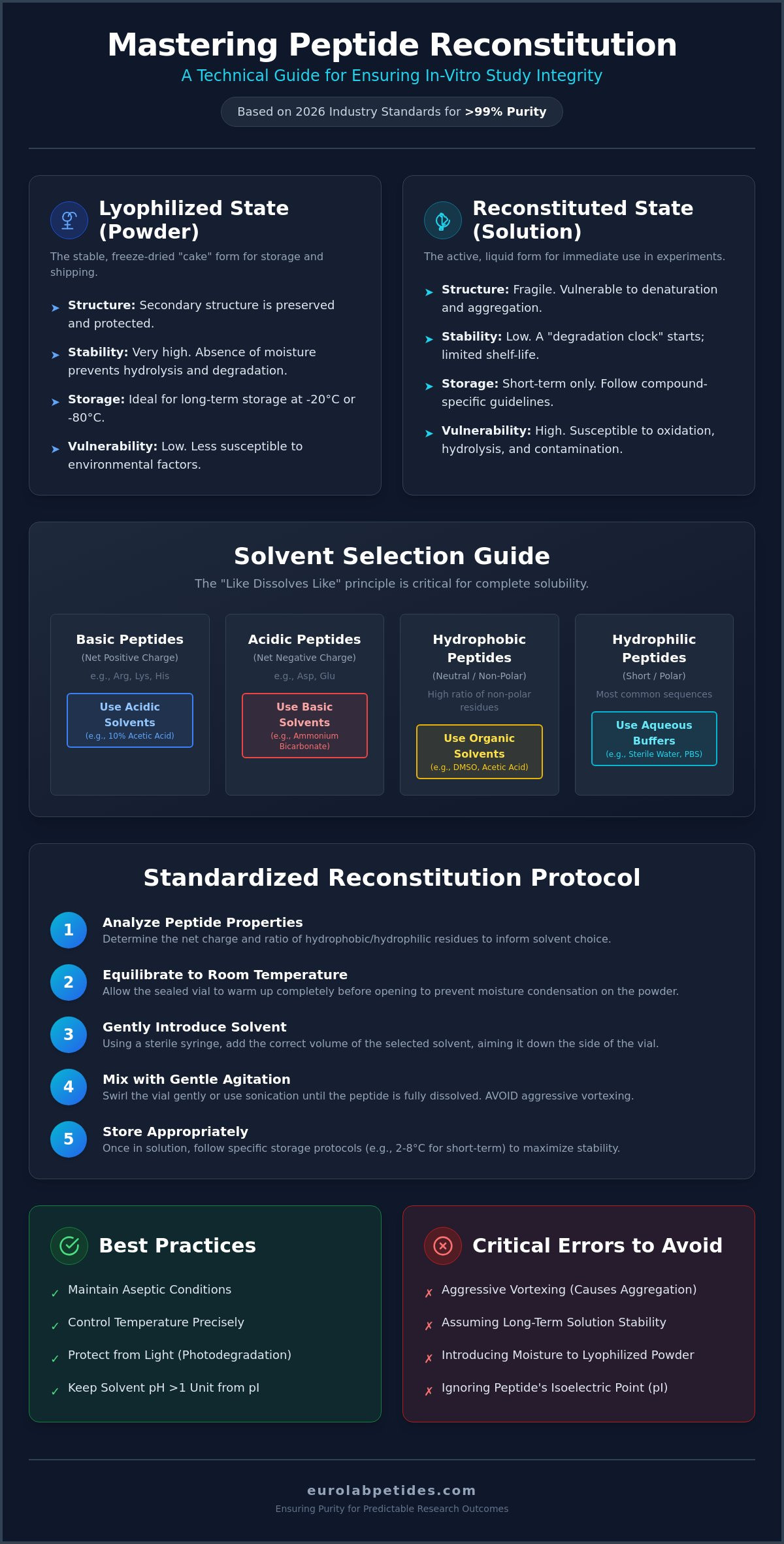
Lyophilization, or freeze-drying, is employed to preserve the peptide structure by removing water through sublimation under vacuum. This process creates a stable “cake” that maintains the secondary structure of the compound. While the powdered form remains stable for extended periods when stored at -20°C or -80°C, a reconstituted peptide is significantly more fragile. Researchers must treat the solution state as a temporary medium with a limited shelf life. The introduction of a liquid medium initiates the degradation clock, making the sample vulnerable to environmental factors that don’t affect the solid state.
Lyophilized State vs. Solution State
The chemical stability of the lyophilized cake is superior due to the absence of moisture, which prevents hydrolysis. Once a solvent is introduced, the rate of peptide oxidation and hydrolysis increases exponentially. The density of the cake and its surface area directly influence initial solubility. A loose, porous cake typically dissolves more rapidly than a dense, compressed one. A standard peptide reconstitution protocol for research must account for these physical characteristics to prevent mechanical stress during the mixing process. It’s vital to avoid aggressive vortexing, as the resulting shear forces can lead to peptide denaturation or the formation of insoluble aggregates.
Common Research Solvents: An Overview
Solvent selection depends on the specific chemical properties of the sequence. Sterile Water for Injection (SWFI) is frequently used for short-term studies. Bacteriostatic Water (BW), containing 0.9% benzyl alcohol, is utilized to inhibit bacterial growth in multi-use vials. For experiments requiring a physiological pH, Phosphate-Buffered Saline (PBS) is the preferred medium. Hydrophobic peptides, which lack polar side chains, often require organic solvents such as Dimethyl Sulfoxide (DMSO) or dilute Acetic Acid to achieve complete dissolution. However, researchers must account for the potential cytotoxicity of DMSO in cell-based assays, often requiring subsequent dilution into an aqueous buffer once the peptide is fully solubilized.
Solvent Selection Strategies Based on Peptide Polarity
Successful laboratory preparation depends on the “Like Dissolves Like” principle, where the chemical nature of the solvent must match the polarity of the peptide sequence. A standardized peptide reconstitution protocol for research requires a rigorous assessment of the net charge and the ratio of hydrophobic to hydrophilic residues before any liquid is introduced. High-purity compounds, such as the 99%+ pure lyophilized powders sourced from EuroLab Peptides, exhibit more predictable solubility profiles because they lack the salt contaminants that often interfere with pH-dependent dissolution. When dealing with complex sequences, researchers must determine the total number of charged residues to predict whether the compound will require acidic, basic, or neutral media.
The isoelectric point (pI) represents a critical threshold in biochemical preparation. It’s the specific pH value where a peptide carries no net electrical charge, leading to minimal electrostatic repulsion between molecules and subsequent precipitation. To ensure a stable solution, the solvent pH must be adjusted at least one full unit away from the pI. Technical procedures for managing these transitions are often documented in specialized literature, such as the NIH Peptide Reconstitution Protocol, which provides a framework for solvent exchange in analytical applications. Precise control over these variables prevents the formation of irreversible aggregates that can skew in-vitro data.
Handling Basic and Acidic Peptides
Peptides characterized by basic residues like Arginine (Arg), Lysine (Lys), and Histidine (His) require an acidic solvent environment for optimal dissolution. Researchers typically utilize a 10% Acetic Acid solution to initiate the process before diluting with sterile water. For acidic sequences containing Aspartic Acid (Asp) or Glutamic Acid (Glu), a 10% Ammonium Hydroxide solution provides the necessary basicity to achieve a clear solution. The isoelectric point is the pH at which a peptide has a net charge of zero, causing a total loss of solubility and immediate precipitation of the compound.
Hydrophobic vs. Hydrophilic Sequences
Hydrophobicity is determined by the density of non-polar residues such as Valine (Val), Leucine (Leu), Isoleucine (Ile), and Phenylalanine (Phe). If these residues exceed 50% of the total sequence, the compound will likely resist aqueous dissolution. The sequential addition method is the standard approach here; the powder is first dissolved in a minimal volume of a strong organic solvent before the primary buffer is added. Dimethyl Sulfoxide (DMSO) is frequently employed for highly insoluble research compounds, though its final concentration must remain below 1% to avoid inducing cellular toxicity or membrane disruption in experimental models. This careful titration ensures the peptide remains in the solution state without compromising the biological integrity of the assay.
Step-by-Step Laboratory Protocol for Peptide Reconstitution
The transition of a lyophilized compound from long-term storage to a functional solution requires a methodical approach to maintain chemical stability. Most high-purity peptides are archived at -20°C or -80°C to inhibit degradation. Before initiating the peptide reconstitution protocol for research, the vial must reach room temperature. This equilibration process typically takes 30 to 60 minutes. Opening a cold vial introduces atmospheric moisture, causing immediate condensation and potential hydrolysis of the delicate peptide bonds. Aseptic technique is non-negotiable. All preparation should occur within a laminar flow hood or a sanitized workspace using 70% isopropyl alcohol to prevent microbial contamination of the research sample. It’s essential to maintain a sterile environment to avoid compromising the analytical validity of the in-vitro model.
Pressure Equalization and Solvent Addition
Lyophilized vials are often sealed under a partial vacuum. If a solvent is injected without managing this pressure, the liquid can spray forcefully into the powder, causing mechanical stress or denaturation. To prevent this, a sterile needle should be inserted through the septum to equalize the internal pressure with the ambient environment. When introducing the solvent, use the “side-wall” technique. Aim the needle toward the glass wall of the vial rather than the lyophilized cake. Allowing the liquid to trickle down the side ensures a controlled interaction between the solvent and the powder, which is essential for preserving the integrity of complex sequences. This careful handling prevents the formation of bubbles, which can lead to air-liquid interface denaturation.
Achieving Complete Dissolution
Mechanical shear stress is a primary cause of peptide degradation, especially for long-chain sequences. While a “gentle swirl” is the standard recommendation, vortexing should be avoided as it can lead to irreversible denaturation or the formation of aggregates. The solution must be visually inspected against a dark background to identify any particulate matter or cloudiness. If the solution remains opaque, it indicates incomplete dissolution or precipitation. Sonication may be used as a last resort for stubborn samples, provided the water bath is kept cold to prevent thermal degradation. Final documentation is the cornerstone of experimental reproducibility. Researchers should record the following data points:
- The exact volume and type of solvent used.
- The calculated final concentration in mg/mL or molarity.
- The date of reconstitution and the batch number of the starting material.
This rigorous logging ensures that data collected across different trials can be accurately compared and validated.
Stability and Handling: Preventing Aggregation and Degradation
The thermodynamic stability of a peptide in solution is significantly lower than its lyophilized counterpart. Once the solution state is achieved, the half-life of the compound is governed by its primary sequence and the thermal energy of the environment. High temperatures accelerate chemical reactions such as deamidation and oxidation, which can render a research sample biologically inactive. Adhering to a stringent peptide reconstitution protocol for research requires immediate transition to controlled storage environments to mitigate these risks. It’s a standard requirement to treat reconstituted solutions as volatile materials with a finite window of utility.
Photodegradation represents another vector for chemical alteration. Sequences containing aromatic amino acids, such as tryptophan or tyrosine, are highly susceptible to UV-induced oxidation. For these compounds, the use of amber vials or storage in complete darkness is a non-negotiable laboratory standard. Physical stability is also compromised by repeated freeze-thaw cycles. The formation of ice crystals during the freezing process exerts mechanical shear forces that can physically break peptide bonds or lead to irreversible denaturation. To preserve the integrity of the sample, aliquoting is the professional standard. By dividing the master solution into single-use volumes, the bulk of the material remains undisturbed until required for a specific trial.
Storage Best Practices for Reconstituted Peptides
The optimal temperature for short-term solution storage is 4°C, which is suitable for samples intended for use within 24 to 72 hours. For investigations spanning longer durations, aliquots must be stored at -20°C. Even under these conditions, most peptides in solution exhibit a shelf life of only 7 to 14 days before significant degradation occurs. If multi-use vials are necessary, bacteriostatic water containing 0.9% benzyl alcohol is utilized to inhibit microbial proliferation. However, it’s essential to verify that the preservative doesn’t interfere with the specific analytical requirements of the in-vitro model.
Preventing Peptide Aggregation
Aggregation occurs when peptide molecules associate to form insoluble fibrils or clumps, often triggered by high concentrations or changes in pH. This process is frequently irreversible and results in a loss of available molarity. In specific research protocols, low concentrations of non-ionic surfactants, such as 0.01% Tween-20, are added to maintain solubility and prevent the peptide from adhering to the plastic walls of the microcentrifuge tubes. Utilizing a peptide reconstitution calculator ensures that the final solution does not reach over-saturation levels that trigger precipitation. To maintain the highest levels of experimental accuracy, researchers should source high-purity research peptides that exhibit predictable solubility profiles under standardized laboratory conditions.
EuroLab Peptides: Ensuring Purity for Predictable Research
The efficacy of any peptide reconstitution protocol for research is fundamentally limited by the purity of the lyophilized starting material. Impurities in the powder, such as residual solvents or truncated sequences, introduce uncontrolled variables that compromise the solubility profile and chemical stability of the final solution. At EuroLab, every batch is synthesized to exceed the 2026 industry standard of 99% purity. This high threshold ensures that the chemical behavior remains predictable during the transition to the solution state, allowing investigators to focus on experimental outcomes rather than troubleshooting preparation failures. Standardized manufacturing processes are employed to minimize the presence of counter ions and salts, which are known to interfere with the isoelectric point and subsequent dissolution of complex sequences.
Rigorous quality control is the cornerstone of reproducible science. When the starting material is of verifiable excellence, the risks of aggregation or inaccurate molarity calculations are significantly reduced. EuroLab functions as a meticulous partner in the chemical synthesis space, providing the high-stakes precision required by the specialized research community. By prioritizing objective data over marketing claims, we ensure that the chemicals used in your laboratory preparation meet the strict demands of modern in-vitro investigation.
The EuroLab Quality Protocol
Verification of chemical identity and purity is achieved through a multi-stage analytical process. High-Performance Liquid Chromatography (HPLC) is utilized to determine the purity levels, while Mass Spectrometry (MS) confirms the exact molecular weight of the peptide sequence. These empirical results provide a verifiable metric of quality that replaces the need for anecdotal trust. A critical aspect of our synthesis is the management of Trifluoroacetic acid (TFA) residues. TFA is a common byproduct of peptide synthesis that can exhibit cytotoxicity in sensitive in-vitro models; therefore, our protocols prioritize the reduction or removal of these residues to ensure the integrity of your research. You can learn more about our multi-level quality protocol to understand the technical benchmarks we maintain.
Sourcing Peptides for In-Vitro Investigation
Reliability in the laboratory requires a supplier that operates within the rigorous demands of the modern scientific environment. With the implementation of the EMA Guideline on the Development and Manufacture of Synthetic Peptides on June 1, 2026, the European regulatory landscape has shifted toward stricter analytical control. It’s essential for researchers to source materials from partners who understand how to navigate the European research landscape while providing localized logistics and transparent data. EuroLab supports a broad spectrum of scientific inquiry, including Longevity & Vitality Research, Weight Management Research, and Cognitive Function Research. Whether your study involves the Advanced Metabolic Stack or specific compounds like SLU-PP-332, we provide the technical documentation necessary for rigorous investigation. You may browse our full catalog of research peptides to select the high-purity tools required for your next trial.
Advancing Experimental Reproducibility Through Precise Preparation
Precision in the laboratory is the objective foundation of reliable data. Implementing a standardized peptide reconstitution protocol for research ensures that chemical integrity is maintained from the lyophilized state to the solution state. By prioritizing correct solvent selection and managing environmental variables such as temperature and light, researchers effectively mitigate the risks of aggregation and degradation. The use of high-purity compounds further stabilizes these protocols, providing a consistent baseline for complex in-vitro investigations.
To support the rigorous demands of your study, EuroLab provides materials with a 99%+ purity guarantee and third-party Certificates of Analysis (COA) for every batch. With fast shipping across Europe, your laboratory can maintain a steady supply of elite research tools. Order Research-Grade Peptides with Certified Purity and ensure your trials are built on a foundation of verifiable excellence. Adherence to these technical benchmarks ensures the absolute security of experimental results in every trial.
Frequently Asked Questions
How much bacteriostatic water should I add to my peptide vial?
The volume of bacteriostatic water added depends entirely on the required concentration for your specific in-vitro model. A standard preparation often involves adding 1.0 mL or 2.0 mL of solvent to a 5 mg or 10 mg vial to achieve final concentrations of 5 mg/mL or 10 mg/mL, respectively. Precise molarity should be calculated using the molecular weight provided on the Certificate of Analysis for that specific batch.
What happens if my peptide does not dissolve completely and remains cloudy?
Cloudiness or visible particulate matter signifies that the peptide hasn’t reached a full solution state or has precipitated due to an incorrect solvent pH. If a standard peptide reconstitution protocol for research fails to produce a clear solution, the sample’s biological activity is compromised. Researchers should reassess the peptide’s net charge and consider adjusting the pH or utilizing a small percentage of organic solvent like DMSO.
Can I use a vortex mixer to speed up the peptide reconstitution process?
Vortex mixers shouldn’t be used because the resulting mechanical shear stress can denature the peptide’s secondary structure. Aggressive agitation often leads to irreversible aggregation, particularly in long-chain sequences. Gentle swirling or slow inversion is the only acceptable method for achieving dissolution while maintaining the chemical integrity of the compound and ensuring experimental accuracy.
Why is it necessary to let the vial reach room temperature before adding solvent?
Equilibration to room temperature is required to prevent atmospheric moisture from condensing inside the vial upon opening. If a cold vial is exposed to humid air, the resulting condensation can initiate immediate hydrolysis of the peptide bonds. This 30 to 60-minute wait period is a fundamental step in any professional peptide reconstitution protocol for research to ensure sample stability.
Is it better to use sterile water or bacteriostatic water for research peptides?
Solvent choice is dictated by the duration of the study and the need for microbial inhibition. Sterile Water for Injection (SWFI) is appropriate for single-use applications where preservatives might interfere with analytical results. Bacteriostatic water, which contains 0.9% benzyl alcohol, is the professional standard for multi-use vials intended for storage over 7 to 14 days, as it inhibits bacterial proliferation.
How long can a reconstituted peptide remain stable at room temperature?
Reconstituted peptides are highly volatile and shouldn’t remain at room temperature for more than a few hours. The transition to a solution state increases the rate of oxidation and hydrolysis exponentially compared to the lyophilized powder. Immediate refrigeration at 4°C or aliquoting for storage at -20°C is necessary to preserve the compound’s half-life and maintain the validity of the research data.
Can I mix two different peptides in the same vial for my research study?
Mixing two different peptides in a single vial isn’t recommended because it introduces the risk of unpredictable cross-reactions or the formation of complex aggregates. Such interactions can alter the biological activity of both compounds and invalidate experimental data. Each peptide should be reconstituted and stored in its own dedicated, sterile vial to ensure the purity of the research environment.
What is the best way to aliquot peptides to avoid repeated freeze-thaw cycles?
Aliquoting should be performed immediately after the initial reconstitution by dividing the master solution into single-use volumes. These individual aliquots are then stored at -20°C or -80°C to prevent the bond-shearing effects of repeated freeze-thaw cycles. This technique ensures that only the required amount of material is thawed for a specific trial, leaving the remainder of the stock undisturbed and stable.
