

What makes a cross-border research order dependable: a high purity claim, or evidence that quality controls and delivery requirements have been considered together? For researchers finding peptide suppliers that ship to North America, the distinction matters. A product claim alone does not establish identity, and general shipping information may not address the requirements of a specific destination.
It is reasonable to expect clear analytical evidence and fewer avoidable surprises in transit. This guide explains how to assess supplier quality controls and documentation, including the role of in-house and independent third-party testing. It also outlines destination-specific shipping, customs, and import details to review before placing a research order, without assuming that one set of terms applies across North America. EuroLab Peptides is a Europe-based chemical supplier for in-vitro research and laboratory development. Its stated multi-level quality approach includes in-house and independent third-party testing. The sections ahead offer a practical framework for evaluating whether a supplier’s evidence and processes fit your laboratory’s requirements. Products are for research use only, not for human consumption or clinical use.
Key Takeaways
- When finding peptide suppliers that ship to North America, assess the United States and Canada as separate destinations rather than assuming one set of requirements applies to both.
- Compare identity, purity, lot traceability, analytical methods, and report availability to judge whether testing evidence is relevant to your laboratory’s needs.
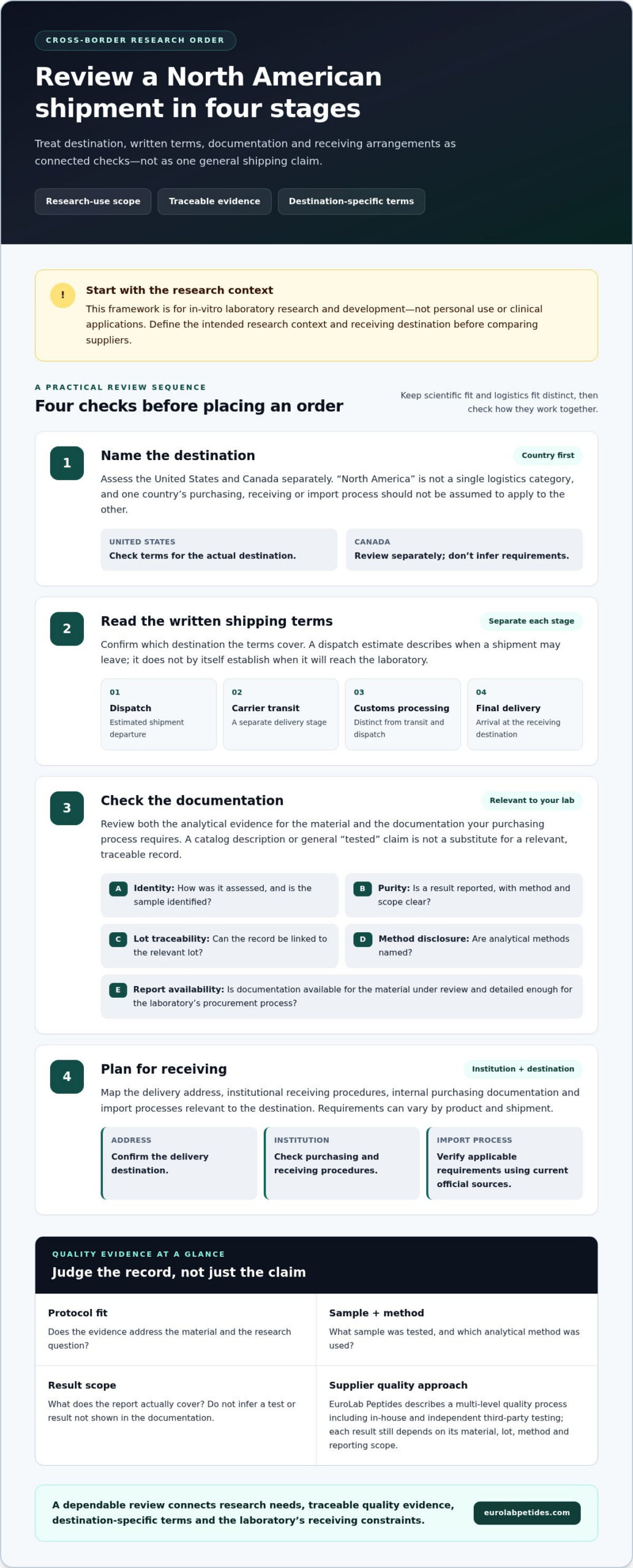
- Review shipping in four stages: destination, written terms, required documentation, and receiving arrangements. Keep dispatch estimates distinct from transit, customs processing, and final delivery.
- Use a weighted scorecard to compare research-use scope, testing evidence, documentation, and destination-specific terms against your protocol and receiving constraints.
- EuroLab Peptides is a Europe-based supplier for in-vitro research and laboratory development, with a stated multi-level quality process that includes in-house and independent third-party testing.
Finding peptide suppliers for North America starts with destination and research needs
This guide covers peptide sourcing for in-vitro laboratory research and development, not personal use or clinical applications. Before comparing suppliers, define the destination country, receiving institution, and intended research context. A laboratory in the United States and one in Canada may have different purchasing, receiving, import, and documentation processes. Requirements can also vary by product and shipment, so “North America” is not a single logistics category.
A research-use supplier is one whose stated application is laboratory research and whose quality claims are supported by relevant, traceable evidence. Keep two questions in view: whether the material fits the scientific protocol, and whether the order can be documented and received under the destination’s applicable processes.
What North American researchers need to establish first
Write down the experimental requirements before reviewing catalogs. Specify the material’s intended in-vitro role, the identity and purity evidence your protocol requires, and any lot-level records needed for reproducibility. Then map the operational details separately: the delivery address, institutional receiving procedures, documentation needed for internal purchasing, and import processes relevant to the destination.
- Scientific fit: Does the available evidence address the material and the research question?
- Purchasing and receiving fit: Can your institution process the order and receive the shipment under its procedures?
- Destination fit: Are the written shipping and documentation terms specific to the country receiving the shipment?
Keep these checks distinct. A research protocol may require a particular level of identity confirmation, while a receiving department may have its own procedures for chemical shipments. Do not infer either from a catalog description. Verify applicable requirements using current official sources rather than relying on a supplier’s general statement or assuming one country’s process applies in the other.
Why a catalog listing is not enough
A product appearing in a catalog confirms that it is presented for ordering. It does not, by itself, establish molecular identity, measured purity, or consistency between lots. Evaluate the supporting evidence in context: what sample was tested, which analytical method was used, and what the report actually covers. Background on peptide synthesis methods can help explain why production processes matter, but process descriptions do not replace product- or lot-specific evidence.
Read delivery language just as closely. A dispatch estimate describes when a shipment may leave, not necessarily when it will reach the laboratory. Carrier transit, customs processing, and final delivery are separate stages, and terms should identify the destination they cover. Do not treat a domestic shipping claim or a broad “North America” statement as confirmation of cross-border delivery conditions.
For scientific context on peptide structure and terminology, the existing guide What Are Peptides? A Comprehensive Guide for Researchers can help establish foundational concepts before supplier comparisons begin. With destination, protocol, evidence needs, and receiving constraints defined, finding peptide suppliers that ship to North America becomes a structured evaluation rather than a catalog search.
Assess peptide supplier quality through testing evidence and documentation
Quality claims become useful when they are connected to relevant, interpretable evidence. A purity statement or “tested” label is a starting point, not a complete assessment. Researchers need to understand what was examined, how the sample was identified, and what the reported result can support.
Use this comparison framework to assess documentation for a product or lot:
Identity: Does the report describe how the material’s identity was assessed, and does it identify the sample?
Purity: Is a purity result reported, with the method and scope clear enough to interpret?
Lot traceability: Can the report be connected to the relevant product lot, rather than only to a general product name?
Method disclosure: Are analytical methods named so the result can be understood in context?
Report availability: Is relevant documentation available for the material under review, and does it provide enough detail for the laboratory’s procurement process?
This framework helps distinguish a specific analytical record from a broad catalog claim. EuroLab Peptides describes a multi-level quality-control process that includes in-house and independent third-party laboratory testing. That approach is relevant context when assessing supplier quality, but the value of any result still depends on its connection to the material, lot, method, and reporting scope. Do not infer a particular test or result unless it appears in the documentation being evaluated.
How to read a Certificate of Analysis for research procurement
Start with the report’s sample identification. Check whether it names the tested material and provides a lot reference that can be matched to the relevant order or container. Then review which analytes or characteristics were assessed, which analytical methods are stated, and whether the results have enough context to interpret. A report supports only the properties within its stated scope. It does not establish unreported characteristics, clinical suitability, or human safety.
What independent testing can and cannot establish
Independent laboratory testing can add an external analytical check, but “third-party tested” is not self-explanatory. The test’s scope determines what its findings support, and a result for one characteristic should not be treated as evidence for another. Distinguish a report with identifiable sample details and a stated method from a promotional phrase that provides no comparable context. For broader scientific background, independent peptide research and analysis can help readers consider claims alongside research literature, while supplier documentation addresses the tested material itself.
For a more detailed procurement framework, the existing article How to Buy Research Peptides: A 2026 Guide to Purity, Sourcing, and Laboratory Standards complements this evidence-focused review. Researchers finding peptide suppliers that ship to North America can use both the analytical record and destination-specific terms to evaluate fit. To learn about EuroLab’s materials for in-vitro research and laboratory development, explore EuroLab Peptides’ research materials.
Compare North American shipping terms without assuming customs outcomes
Cross-border delivery involves several distinct stages, and a supplier’s shipping statement may describe only one of them. A dispatch estimate indicates when an order may leave the supplier; it is not a promise of total delivery time. Carrier transit, customs processing, and final delivery can each affect when a laboratory receives a shipment. Treat each stage separately when planning research timelines.
Use this four-step review before ordering:
- Identify the destination. Confirm the country and complete institutional receiving address. Assess a United States destination and a Canadian destination independently.
- Review written terms. Determine what the supplier means by processing or dispatch, which destination the terms cover, and how tracking and delivery updates are provided.
- Check documentation. Identify the order records, product identifiers, and available analytical documents that may be needed for purchasing, shipment review, or receipt.
- Plan receiving. Account for institutional receiving hours, delivery procedures, and who is responsible for accepting and routing the package.
This sequence keeps supplier statements distinct from carrier estimates and destination processes. It also exposes planning gaps before a shipment is scheduled around an assumed arrival date.
United States and Canada require destination-specific checks
Neither country should be treated as having one universal process for every research material or shipment. Import and documentation considerations can depend on the product and destination, so verify applicable requirements against current official sources. For United States shipments, consult relevant federal agency guidance for the material and shipment in question. For Canada, review current federal guidance, including relevant information from Health Canada and the Canada Border Services Agency. These references are starting points, not a substitute for determining what applies to a specific order.
Institutional buyers should also review their own procurement and receiving procedures. A university or laboratory may require specific order records, internal approvals, or advance notice for incoming materials. Keep those institutional steps separate from customs checks, and do not treat supplier shipping language as confirmation that either process is complete.
Build delivery planning around documentation and receiving
Prepare a shipment file with the order confirmation, product name or identifier, lot reference where available, and relevant analytical documents. These records help the receiving team reconcile the package with the purchase and direct it to the appropriate laboratory contact. They also make it easier to identify which documents are available without assuming that every document serves the same purpose.
Receiving logistics matter. Check whether the institution accepts deliveries at a central dock, requires a named recipient, or follows specific procedures for chemical materials. A delivery arriving outside staffed hours may need different coordination from one sent to a dedicated receiving area. Build the schedule around written terms and the institution’s own process, not a generic transit estimate.
For researchers finding peptide suppliers that ship to North America, this documented review provides a more defensible basis for planning. It will not determine customs outcomes or eliminate delays, but it helps distinguish what the supplier states from what the carrier, destination process, and receiving institution control.
Use a supplier comparison checklist to make a defensible research purchase
A consistent scorecard turns supplier review into a documented procurement decision rather than an impression based on catalog breadth or polished claims. Compare evidence and process transparency, not price. Set the laboratory’s minimum protocol and receiving requirements first, then apply the same criteria to each supplier under consideration.
A practical supplier scorecard for laboratory buyers
For each criterion, record documented, unclear, or not applicable. Add a brief evidence note beside every rating, such as the relevant report, written term, or institutional procedure. “Not applicable” should reflect the project’s actual requirements, not a missing answer.
- Research-use scope: Is the stated application limited to in-vitro research and laboratory development, and is it compatible with the planned work?
- Testing: Are identity and purity claims supported by analytical evidence with an interpretable scope?
- Documentation: Can available records be connected to the material or lot being evaluated?
- Destination terms: Are shipping and documentation terms written for the intended country, rather than generalized across North America?
- Receiving fit: Can the institution process the order and receive the shipment under its procedures?
Weight criteria according to the project. A protocol-specific identity requirement or an institutional receiving condition may be mandatory, while a preferred shipping option may be secondary. Treat mandatory criteria as pass-or-pause gates. Do not let a strong rating in one area offset a failure in another. This makes the comparison reproducible and easier to explain during internal review.
When to pause a purchase decision
Pause when the supplier’s intended-use restrictions conflict with the planned laboratory application. Also flag unclear identity information, testing scope, lot documentation, or destination-specific terms for procurement or institutional review. These are evidence gaps to resolve, not proof of misconduct. Keep the decision within laboratory sourcing. Procurement criteria do not establish suitability for personal use, clinical use, or medical decisions.
Missing information calls for a different response from a documented mismatch. If a report does not identify the tested sample, record the gap rather than assuming the material failed testing. If shipping terms do not explain which destination they cover, mark them unclear instead of treating a general delivery statement as a country-specific commitment. Apply the same standard to each supplier so the comparison remains evidence-led.
For researchers finding peptide suppliers that ship to North America, a completed scorecard creates an auditable record of why a supplier fits, or does not yet fit, the laboratory’s requirements. EuroLab Peptides’ stated quality approach includes in-house and independent third-party testing, and its products are intended for in-vitro research and laboratory development. Explore EuroLab’s research materials as part of your documented supplier review.
Evaluate EuroLab Peptides as a research supplier
EuroLab Peptides is a Europe-based chemical supplier for in-vitro research and laboratory development. Its stated quality approach uses a multi-level process that includes in-house and independent third-party laboratory testing. These details provide a concrete starting point for supplier evaluation. Product-specific documentation and current destination terms are also part of a North American laboratory’s review.
The distinction matters: a description of a quality-control process tells buyers what kinds of oversight the supplier says it uses, but it is not a substitute for examining relevant evidence. Researchers can assess the stated process alongside their protocol, documentation needs, procurement workflow, and receiving constraints. This keeps the evaluation factual without assuming particular analytical methods, test results, certifications, or shipping arrangements.
How EuroLab’s stated quality process fits the evaluation framework
In-house testing represents one layer of the stated process; independent third-party laboratory testing adds an external testing layer. Both are relevant criteria for a laboratory’s comparison. The next step is to consider evidence applicable to the research material and lot under review, including what it identifies and what its scope supports. Do not infer a specific test method or result from the general description alone.
Apply the same distinction to documentation. A supplier’s description of its quality process offers context, while a report or other analytical record can provide evidence about a particular sample or lot. Researchers should evaluate those records against their experimental requirements and internal procurement standards. The article The Importance of Third-Party Tested Peptides provides further context on why external testing can be a meaningful part of supplier assessment, while the scope of any individual test still determines what its result can establish.
Next steps for North American laboratory buyers
Before making a research purchase, review three items together: the in-vitro research-use scope, product documentation relevant to your laboratory’s needs, and current written terms for the intended destination. North American buyers should assess United States and Canadian destinations separately and verify applicable import and receiving requirements through current official sources and institutional procedures.
Keep the intended application within laboratory research and development. EuroLab’s products are not intended for human consumption or clinical use, and supplier information should not be treated as medical guidance. This boundary is fundamental to interpreting the catalog and planning procurement.
For researchers finding peptide suppliers that ship to North America, the defensible approach is to compare stated quality controls with relevant documentation and destination-specific terms, without filling evidence gaps with assumptions. Review EuroLab’s research-use scope and product information as part of that assessment: Review EuroLab Peptides research products and quality information.
Make your next research order evidence-led
Use your supplier review as part of the research record. A clear rationale for material selection, documentation, and procurement helps preserve consistency when projects change hands or experimental work is repeated. It also gives your laboratory a practical basis for revisiting supplier fit as protocols and receiving needs evolve.
For researchers finding peptide suppliers that ship to North America, the next step is to apply these criteria to the research material and destination under consideration. EuroLab Peptides describes a multi-level quality-control process that includes in-house and independent third-party laboratory testing. Its products are designated for in-vitro research and laboratory development only, not for human consumption or clinical use.
Review the available research information alongside your laboratory’s requirements, then include current destination-specific terms in your procurement process. Review EuroLab Peptides research products and quality information to continue your evaluation. A careful, documented decision gives your research program a stronger starting point.
Frequently Asked Questions
How can I evaluate a peptide supplier that serves North America?
Evaluate the supplier against your research application, quality evidence, documentation needs, and written terms for the exact destination. For example, if your laboratory’s procurement process requires lot-linked records, general product information may not meet that need. Apply the same criteria to each supplier and record unresolved gaps. When finding peptide suppliers that ship to North America, do not treat a broad “international shipping” statement as proof of destination-specific suitability.
Can research peptides be shipped from Europe to the United States or Canada?
It depends on the material, destination, and current shipping and import requirements. A European supplier’s catalog listing does not by itself establish that a shipment to a U.S. or Canadian address can be accepted or delivered. Identify the destination and product, review written shipping terms, and consult current official import guidance and institutional procurement staff before ordering. Requirements and outcomes should not be assumed to be identical between the two countries.
What should a Certificate of Analysis show?
A useful Certificate of Analysis should let a researcher understand what material was tested and how to interpret the stated results. Look for sample or lot identification, the report date, analytical methods, and the characteristics measured. Note whether values are reported as measured results or compared with a stated specification, and check units and any limitations. A certificate’s title alone does not establish that its contents cover the characteristics your protocol requires.
How much time should I allow for an international research peptide order?
There is no single reliable time allowance for every international research order. Separate the supplier’s order-processing and dispatch estimate from carrier transit, any customs processing, and delivery to the receiving laboratory. Use current written terms for the specific destination, then coordinate the expected arrival window with your institution’s receiving schedule. Avoid fixing an experiment start date to a dispatch estimate. Preserve scheduling flexibility for stages outside the laboratory’s control.
What happens if a research peptide shipment is delayed at customs?
A delay does not by itself reveal why a shipment is being held or what its eventual outcome will be. Check the carrier’s tracking information and retain the order record, product identifiers, and relevant shipment documents. Follow instructions from the responsible carrier or customs authority, and involve your institution’s procurement or receiving staff as appropriate. Do not assume that a delay means a shipment has cleared, been refused, or will arrive by a particular date.
Are research-grade peptides intended for human consumption?
No. EuroLab Peptides’ products are designated for in-vitro research and laboratory development only; they are not intended for human consumption or clinical use. A research-use label describes the stated application, not authorization for personal use or treatment. Keep procurement, handling, and use within the laboratory’s approved research procedures. Product information should not be interpreted as medical advice or evidence of safety or suitability for human use.
Does third-party testing guarantee that a peptide is suitable for every study?
No. Independent testing can provide evidence about the characteristics included in a particular analysis, but it cannot establish suitability for every experimental design. A result may not address all variables relevant to a protocol, such as the laboratory’s required acceptance criteria or intended analytical application. Researchers must interpret available records against their study methods and institutional standards. Testing evidence is one part of an assessment, not a universal endorsement of a material.
