

What can a reproductive signal suggest without proving a clinical effect? Kisspeptin-10 for reproductive research is best understood through that distinction. It is a short, active kisspeptin fragment used to investigate signaling in the reproductive axis, not a shortcut from laboratory findings to treatment claims.
The central model is that kisspeptin binds the KISS1 receptor (KISS1R), influencing gonadotropin-releasing hormone (GnRH) signaling and, downstream, pituitary hormones such as luteinizing hormone and follicle-stimulating hormone. To assess a finding, separate evidence specific to Kisspeptin-10 from research on longer kisspeptin forms or the wider peptide family. Then match the claim to the model and endpoint actually studied.
This article outlines the proposed signaling relationship, explains how to assess preclinical and clinical evidence without overstating its implications, and identifies study-design considerations for interpreting reproductive endpoints. It also explains why analytical information matters when evaluating research materials. EuroLab Peptides describes a multi-level quality-control process that includes in-house and independent third-party laboratory testing. This supplier information supports material assessment, but does not establish biological outcomes.
Key Takeaways
- Separate findings on Kisspeptin-10 from results involving other kisspeptin fragments or the broader signaling system.
- Assess Kisspeptin-10 for reproductive research by matching each claim to its model, measured endpoint, and evidence type.
- Compare mechanistic, animal, and human studies without treating one category as proof of outcomes in another.
- Build a research question around a defined biological model and endpoint, then state its evidence limits clearly.
- Assess research-material documentation and analytical quality information as part of efforts to support reproducible laboratory work.
What Is Kisspeptin-10 in Reproductive Research?
Kisspeptin-10 is a short, biologically active peptide fragment studied for its role in signaling pathways involved in reproductive hormone release. A citation-ready definition is: “Kisspeptin-10 is the C-terminal decapeptide sequence shared by kisspeptin peptides and can activate the KISS1 receptor, linking kisspeptin signaling to reproductive neuroendocrine regulation” (Pinilla et al., “Kisspeptins and Reproduction: Physiological Roles and Regulatory Mechanisms,” Physiological Reviews, 2012). This places the peptide within a defined biological system without implying that experimental activity establishes treatment efficacy.
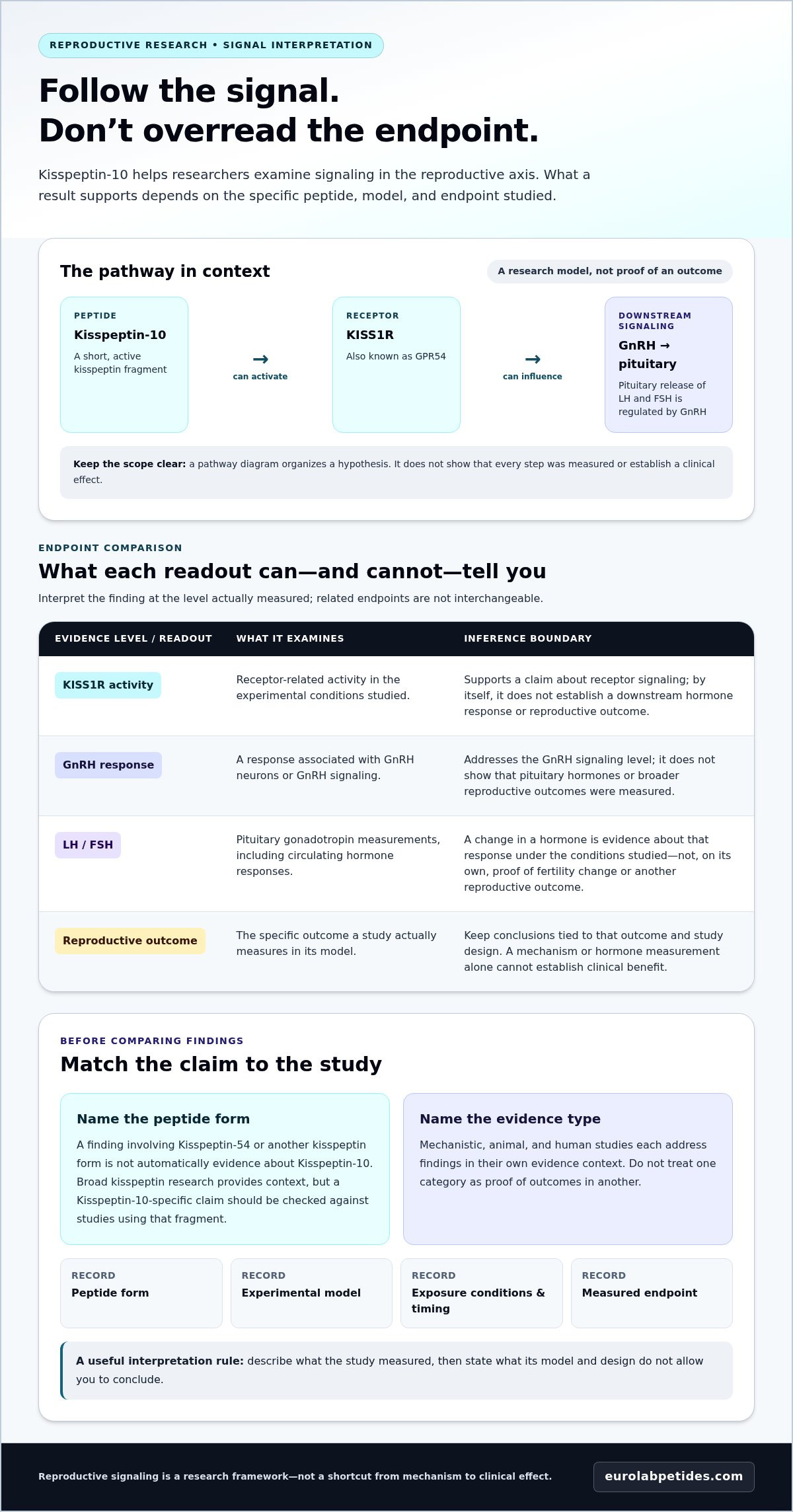
In Kisspeptin-10 for reproductive research, distinguish research on one peptide fragment from research on the wider kisspeptin system. That system includes peptide products derived from the KISS1 gene, their interactions with a receptor, and the neural and hormonal pathways that respond to those signals. Findings involving a longer kisspeptin form, such as Kisspeptin-54, are not automatically evidence about Kisspeptin-10. When comparing studies, record the peptide form, experimental model, exposure conditions, and measured endpoint.
How Kisspeptin-10 Fits Within the Kisspeptin System
Kisspeptins are signaling peptides relevant to reproductive neuroendocrinology. Their receptor, KISS1R, is also known as GPR54. Receptor activation is associated with signaling that can influence gonadotropin-releasing hormone (GnRH) neurons. The Kisspeptin signaling overview provides foundational context on the peptide family, the KISS1 gene, and GPR54. In research summaries, however, “kisspeptin” should not stand in for a specific experimental material. Identify studies of a particular fragment as such, especially when comparing receptor responses or hormone measurements across papers.
A shared signaling system does not make every peptide form interchangeable. Peptide length and experimental conditions may affect which signal a study examines. A review of kisspeptin broadly can establish biological context, but a claim specifically about Kisspeptin-10 should be checked against studies that used that fragment.
Why Researchers Study Reproductive Hormone Release
The hypothalamic-pituitary-gonadal (HPG) axis provides a framework for studying how brain signals relate to reproductive hormones. In simplified terms, hypothalamic GnRH signaling prompts the pituitary gland to release the gonadotropins luteinizing hormone (LH) and follicle-stimulating hormone (FSH). These hormones act on the gonads, while feedback signals can influence activity across the axis. Kisspeptin is studied in this context as a way to examine signaling upstream of GnRH and downstream hormone responses.
Researchers may measure different points in this pathway, including receptor-related activity, GnRH-associated responses, or circulating gonadotropins. These endpoints address different questions. A change in one is not, by itself, proof of a broader reproductive outcome. Interpret laboratory findings and human-study results in context, considering the model, peptide form, and study design. The aim is to clarify biological relationships, not to infer clinical benefit from a mechanism alone.
How Kisspeptin-10 Signaling Relates to the Reproductive Axis
The pathway is useful as a research model, but each step represents a distinct biological question. Kisspeptin-10 can activate KISS1R, the receptor associated with kisspeptin signaling. In relevant neural circuits, that signaling can influence gonadotropin-releasing hormone (GnRH) neurons. GnRH then acts on the anterior pituitary, where it regulates release of luteinizing hormone (LH) and follicle-stimulating hormone (FSH). Pinilla et al. describe this kisspeptin-GnRH relationship in their review of reproductive physiology (Physiological Reviews, 2012).
This pathway summary is not evidence that a particular intervention produces a clinical outcome. A measured change in LH, for example, is evidence about a hormone response under the conditions studied. It does not, by itself, establish a change in fertility or another reproductive outcome. The scope of each inference depends on the experimental model, peptide form, timing, and endpoint.
KISS1R, GnRH, and Downstream Hormone Measurements
In research, KISS1R activation and downstream hormone measurements represent different levels of the signaling chain. GnRH is released in pulses, and pituitary LH and FSH responses reflect both hypothalamic input and pituitary responsiveness. A hormone measurement is most informative when interpreted alongside the sampling schedule and study context. A pathway diagram can organize a hypothesis, but it cannot show that every step was measured or establish a clinical effect.
Choose endpoints to match the research question. A study investigating receptor signaling needs evidence relevant to receptor activity. One examining downstream endocrine response may measure circulating gonadotropins. These outcomes are related, but not interchangeable. Similarly, a result observed after exposure to Kisspeptin-54 or another kisspeptin form should not be presented as a Kisspeptin-10-specific finding unless the study supports that interpretation directly.
KNDy Neurons and Reproductive Signaling Context
KNDy neurons are named for their association with kisspeptin, neurokinin B, and dynorphin. Populations in the arcuate nucleus are implicated in the neural regulation of GnRH pulses, making them relevant to research on reproductive signaling rhythms. Lehman, Coolen, and Goodman describe KNDy cells as a central node in the control of GnRH secretion (Endocrinology, 2010). This system-level model does not establish that every KNDy effect is caused by Kisspeptin-10 specifically.
Interpretation also depends on the study population or model. Sex, developmental or reproductive state, species, and experimental conditions can shape signaling and hormone responses. An animal study may help define a mechanism, while a human study addresses a different evidentiary question. Even within one model, a single endpoint captures only part of the system.
- Model: Identify whether evidence comes from cells, animals, or human participants.
- Biological context: Record sex and reproductive state where reported.
- Endpoint: Distinguish receptor or neural measures from GnRH-related and pituitary hormone outcomes.
For Kisspeptin-10 for reproductive research, these distinctions keep a plausible signaling mechanism separate from a demonstrated effect. The most defensible interpretation stays close to the peptide, model, and endpoint actually studied.
What the Evidence Says About Kisspeptin-10, and What It Cannot Show
Evidence on reproductive signaling spans laboratory systems, animal models, and human studies. These categories answer different questions. A mechanistic result can support a proposed interaction; an animal study can examine a response in an intact organism; a human study can describe outcomes in its participants and conditions. None is interchangeable with the others, and evidence about kisspeptin generally does not automatically establish an effect specific to Kisspeptin-10.
The table provides a framework for appraising evidence, not a claim that every study in each category reports the same result. For an individual paper, check the full text for the peptide form, methods, population or model, endpoint, and limitations before summarizing its findings.
| Model | Research question | Endpoint | Reported finding | Limitation |
|---|---|---|---|---|
| Cell or mechanistic system | Does kisspeptin signaling engage a receptor or cellular pathway? | Receptor activity or cellular response | May support a molecular interaction under the tested conditions. | Doesn’t establish whole-organism hormone responses or clinical outcomes. |
| Animal model | How does a signal relate to reproductive-axis activity in an organism? | Hormonal, neural, or reproductive measures | May characterize responses in the species and conditions studied. | Species, sex, reproductive state, and design constrain generalization. |
| Human study | What response is observed in a defined participant group? | Hormone measures or other prespecified outcomes | Can describe the observed response in that study population. | Sample, protocol, peptide form, and endpoint limit broader conclusions. |
How to Read Findings Across Different Research Models
Start with the model, then interpret the endpoint in relation to the research question. Cell studies can isolate components of signaling, but they do not reproduce the complete hypothalamic-pituitary-gonadal axis. Animal studies add biological context, yet findings in one species or reproductive state may not translate directly to people. Human studies provide direct observations in participants, but conclusions remain bounded by the study design and sample. A measured hormone response is not equivalent to evidence of improved fertility.
When assessing a specific human paper, including the often-cited 2011 work, verify the full-text methods and results before reporting its participant group, peptide administered, hormone outcomes, or sex-related differences. A title or abstract alone is not enough to support a detailed summary.
Where the Evidence Remains Limited
Reviews organize and interpret studies; they do not independently prove a biological or clinical outcome. Their conclusions depend on the literature they include, which may differ in peptide form, model, methods, and endpoints. Publication date matters as well: a review cannot account for evidence published after its search period.
For Kisspeptin-10 for reproductive research, keep mechanistic plausibility separate from demonstrated clinical effectiveness. Therapeutic hypotheses may motivate further investigation, but research findings do not establish a therapy or clinical recommendation. State what the study measured, what it observed, and what remains unresolved.
How to Frame a Kisspeptin-10 Reproductive Research Question
A useful research question begins with a defined biological uncertainty, not a broad claim about reproductive function. For Kisspeptin-10, specify whether the study concerns receptor-related signaling, GnRH-associated activity, downstream hormone release, or another clearly bounded endpoint. Then choose a model capable of addressing that question. This alignment helps distinguish what the study measures from what the results may suggest.
Use this sequence to frame the question without turning it into an experimental protocol:
- Define the model. State whether the evidence concerns a cellular system, an animal model, or human participants, and describe the relevant biological context.
- State the research question. Identify the relationship or response being investigated, distinguishing Kisspeptin-10 from other kisspeptin forms.
- Specify the endpoint. Name the outcome that will address the question, such as a receptor-related measure or hormone measurement.
- Set the inference boundary. Identify what the design can support and which downstream conclusions remain outside its scope.
This structure prevents a common interpretive leap: treating evidence of a biological response as proof of a broader reproductive outcome. Let the model and endpoint determine the strength and scope of the conclusion.
Choose the Model and Endpoint Before Interpreting Results
First decide whether the question concerns receptor signaling, hormone release, or another defined process. A cellular model can isolate a signaling component, while an intact-organism model captures additional biological interactions. Neither automatically answers the same question as a human study. Record relevant features of the model, including species or participant group, sex, and reproductive state where reported.
Interpret endpoints narrowly. If the outcome is a measured hormone concentration, report that measurement and its study context rather than implying a change in fertility. Note the assay and sampling context, relevant controls, and limitations that affect interpretation. Transparent reporting helps readers assess whether an apparent response is specific to the research question or may reflect other features of the model or measurement.
Build an Evidence-Aware Literature Review
Search primary studies alongside reviews, and record the publication date and peptide form for each paper. Reviews help map concepts and identify references, but primary reports are needed to verify methods, endpoints, and findings. Compare studies only after checking whether their models, biological contexts, and outcomes are sufficiently aligned.
A practical evidence table can include the citation, model, peptide form, research question, endpoint, controls, key result, and stated limitation. This makes differences visible before they are flattened into a general summary. It also helps distinguish direct Kisspeptin-10 evidence from broader findings about the kisspeptin system.
For basic terminology, use a guide to peptides for researchers alongside primary literature, and check that definitions match the specific material and research context. EuroLab Peptides supplies research materials for in-vitro research and laboratory development, not clinical use. To review research-material information relevant to laboratory planning, explore EuroLab Peptides research materials.
Research-Material Quality and EuroLab Peptides
Reproducible research depends on both a well-defined experimental design and a clearly characterized research material. Purity and consistency are relevant quality attributes because differences in material composition can complicate comparisons across experiments. They do not guarantee a particular biological response or establish that a material is suitable for every assay. Quality information supports interpretation; it cannot replace controls, validated measurement, or appropriate study design.
For Kisspeptin-10 for reproductive research, consider the material’s identity and associated analytical information alongside the study’s model, endpoint, and reported methods. When records identify the material used, researchers can connect it with the experiment and its documentation. That traceability can help distinguish material-related variation from biological variation, but analytical results alone cannot support conclusions about biological effects.
What Quality-Control Information Supports Research Confidence?
Useful analytical documentation should make clear what material was assessed and what the reported quality information represents. Researchers can examine whether records correspond to the material used, whether the stated assessment addresses purity or consistency, and whether the information is adequate for the intended laboratory context. Do not infer an assay method, result, or specification that the documentation does not state.
EuroLab Peptides describes a multi-level quality-control process that uses both in-house and independent third-party laboratory testing to assess purity and consistency. These practices provide supplier context for evaluating research materials; they do not establish experimental performance or guarantee reproducibility. The company’s overview of third-party-tested peptides can complement a careful review of study-specific material documentation.
EuroLab Peptides’ Research-Only Scope
EuroLab Peptides supplies research-grade peptides designated for in-vitro research and laboratory development. These materials are not for human consumption or clinical use. This scope matters when interpreting reproductive-axis literature: laboratory findings are scientific evidence about the models and endpoints studied, not treatment guidance or proof of clinical benefit.
Keep quality assessment proportional to the evidence. Analytical testing can inform material characterization, while the research question, controls, assay context, and limitations determine how results should be interpreted. Neither a supplier’s quality process nor a peptide’s analytical profile establishes a therapeutic effect.
For laboratory research professionals assessing research materials, EuroLab Peptides’ in-house and independent third-party testing provides relevant supplier-quality context. Explore the EuroLab Peptides catalogue for research materials designated for in-vitro research and laboratory development.
Carry the Research Forward With Clear Evidence Boundaries
Turn a defined question into a transparent research record. For Kisspeptin-10 for reproductive research, document the peptide form, model, endpoint, controls, and analytical context so readers can assess what the findings support and where interpretation must stop. Reproducibility depends on that alignment, not on extending a mechanistic result beyond its evidence.
Material characterization is part of the same discipline. EuroLab Peptides describes a multi-level quality-control process that includes in-house and independent third-party laboratory testing to assess purity and consistency. Its products are designated for in-vitro research and laboratory development, not human consumption or clinical use. These quality practices provide relevant supplier context, while experimental design and results remain the basis for scientific conclusions.
Research professionals developing laboratory work can explore EuroLab Peptides’ research-grade peptide catalogue and review the material information relevant to their research needs. Start with a clearly bounded question, transparent documentation, and conclusions anchored to the evidence.
Frequently Asked Questions
What is Kisspeptin-10?
Kisspeptin-10 is a ten-amino-acid peptide fragment studied in reproductive neuroendocrinology. Researchers use it to investigate questions such as how a defined kisspeptin signal relates to receptor activity or hormone responses. In Kisspeptin-10 for reproductive research, identify the exact peptide form used in each study rather than relying on a general reference to “kisspeptin,” which may describe other fragments or the wider signaling system.
How is Kisspeptin-10 related to GnRH?
Kisspeptin-10 can activate KISS1R, a receptor associated with signaling to GnRH neurons. GnRH, in turn, regulates pituitary release of luteinizing hormone (LH) and follicle-stimulating hormone (FSH). For example, a study measuring LH examines a downstream response, not necessarily GnRH activity directly. Interpret each result according to what the study assessed, and do not treat pathway relationships as proof of a clinical outcome.
What is the difference between Kisspeptin-10 and kisspeptin?
Kisspeptin refers to a signaling system and its family of peptide forms, while Kisspeptin-10 names one specific short peptide fragment. The distinction matters in literature searches and evidence summaries: a paper discussing kisspeptin broadly may include other fragments, receptor biology, or neural pathways without testing Kisspeptin-10 itself. Check the methods for the exact peptide studied before applying a finding to this particular form.
What reproductive hormones are studied alongside Kisspeptin-10?
LH and FSH are common downstream hormones of interest because the pituitary releases them under GnRH regulation. Some research may also examine GnRH-related activity or other reproductive measures, depending on the model and question. Check whether the paper reports a direct hormone assay, when measurements were taken, and the participant or animal context. These details help distinguish an observed hormone response from a broader interpretation of reproductive function.
Do Kisspeptin-10 research findings prove it treats infertility?
No. Research findings do not establish Kisspeptin-10 as an infertility treatment or support a clinical recommendation. A mechanistic result or hormone change addresses the conditions and endpoints of that study; it does not, by itself, demonstrate improved fertility or safety and effectiveness in clinical care. Keep experimental evidence separate from treatment claims, and do not use research materials for human consumption or clinical use.
Why can Kisspeptin-10 findings differ between studies?
Studies can differ because they use different species or participant groups, reproductive states, peptide forms, methods, and endpoints. For instance, a receptor-related measure in a laboratory model is not directly comparable to a circulating hormone measurement in people. Study design and sampling can also affect what is observed. Compare methods and outcomes before interpreting apparently conflicting results, and report variation rather than forcing a single conclusion.
What should researchers consider when evaluating Kisspeptin-10 materials?
Assess the material’s identity and the scope of its analytical information, including whether documentation relates to the material used in the study. Purity and consistency information can support material evaluation but cannot guarantee experimental outcomes. EuroLab Peptides describes in-house and independent third-party testing as part of its quality-control process. Its products are designated for in-vitro research and laboratory development, not human consumption or clinical use.
