

Reagent purity can determine whether an experimental result reflects the intended chemistry or interference from contaminants. The impact of reagent quality on scientific validity may appear as altered reaction pathways, distorted assay signals, or inconsistent results between batches. Reliable results depend not only on the protocol but also on the identity, composition, and condition of the materials used.
Even small variations can affect reproducibility. Reagent differences may make it harder to distinguish a true experimental effect from background interference. This article explains how purity, contamination, stability, and batch variation affect research findings, and why batch-specific documentation matters when interpreting results. It also connects reagent quality to assay accuracy, reaction pathways, and confidence in conclusions, helping you assess research materials more precisely.
Key Takeaways
- Match reagent grade and purity to the sensitivity and demands of the analytical, biological, or synthesis workflow.
- Use batch-specific documentation to trace material characteristics and interpret differences when reagent lots change.
- Consider how contaminants can influence reaction behavior and lead to conclusions that don’t reflect the intended experimental conditions.
- Understand the distinct roles of solvents, buffers, standards, and other research reagents to assess where material quality matters most.
Why are high-purity reagents important?
High-purity reagents can reduce interference from unwanted substances in analytical, biological, and synthesis workflows. Their composition can affect signal quality, reaction outcomes, and confidence in experimental conclusions.
Purity Across Laboratory Workflows
Purity describes the proportion of a reagent that is the intended substance rather than impurities. In analytical applications, unwanted compounds can interfere with detection; in biological assays, they may affect sample responses; and in synthesis, they can take part in unintended reactions. For example, a chromatography solvent must meet the method’s sensitivity requirements. Matching purity to the workflow helps control these sources of variation.
Purity, Accuracy, and Reproducibility
Accuracy is how closely a result aligns with the true value; reproducibility is the consistency of results across repeated experiments. The impact of reagent quality on scientific validity becomes clear when impurities shift measurements or biological responses. A buffer with variable composition, for example, may change assay conditions between runs. Degraded reagents, impurities that distort signals, and batch composition differences can all contribute to irreproducible findings.
Impurities and Reagent Composition
Purity is only one aspect of reagent quality. Identity, composition, concentration, and stability also shape how a material behaves. An impurity may react with a target compound, absorb at a measurement wavelength, or alter the sample’s chemical environment. Concentration errors can change reaction conditions even when the substance is chemically pure. To assess the impact of reagent quality on scientific validity, distinguish these variables using appropriate testing and preparation records.
Grades, Applications, and Documentation
Reagent grades, including analytical reagent (AR), laboratory reagent (LR), and chemically pure (CP), describe categories of laboratory materials. The suitable grade depends on the method and its sensitivity; a label alone does not establish suitability for every application. Documentation of composition, purity, and batch supports traceability and comparison with protocol requirements. Higher-grade reagents may cost more than standard-grade materials, while repeat experiments caused by reagent issues can also consume materials and labour.
Certificates of Analysis and batch-specific documentation
A Certificate of Analysis (CoA) records test results for a specific reagent batch. Batch-level evidence helps laboratories interpret analytical performance and distinguish material variation from experimental variation.
Reagent Quality and Analytical Sensitivity
Analytical sensitivity describes a method’s ability to detect a target reliably at low levels. Impurities or inconsistent composition can increase background signals or weaken detection, affecting accuracy near the method’s detection limit. For example, chromatography may reveal contaminants that interfere with a target compound’s signal. Appropriate testing helps establish whether a reagent suits the analysis and its sensitivity requirements.
Mass spectrometry, chromatography, and spectroscopy can assess reagent identity, purity, and potency. Each method provides different evidence: chromatography separates components, while mass spectrometry supports identification by mass. Interpret results in relation to the intended reaction and application rather than treating these methods as interchangeable measures of quality.
Certification and Supplier Quality Systems
A CoA documents measured properties for an individual batch, while a supplier quality system describes broader controls across manufacturing and testing. The document connects an analysis to a specific lot; the system addresses how materials are produced and assessed. Neither replaces the other: batch evidence supports traceability, and consistent quality practices support repeatable production.
CLSI released guidance for user evaluation of reagent lot-to-lot variation in late 2013. On receipt, match the reagent identity and lot number to its CoA, record the shipment, inspect packaging, and store it under the stated conditions. When changing lots or receiving a new shipment of the same lot, assess performance before relying on results. QC shifts exceeding one standard deviation warrant troubleshooting in the described QC-based validation approach.
For research involving immune response, immune system research is a relevant area where batch traceability can support interpretation of experimental results.
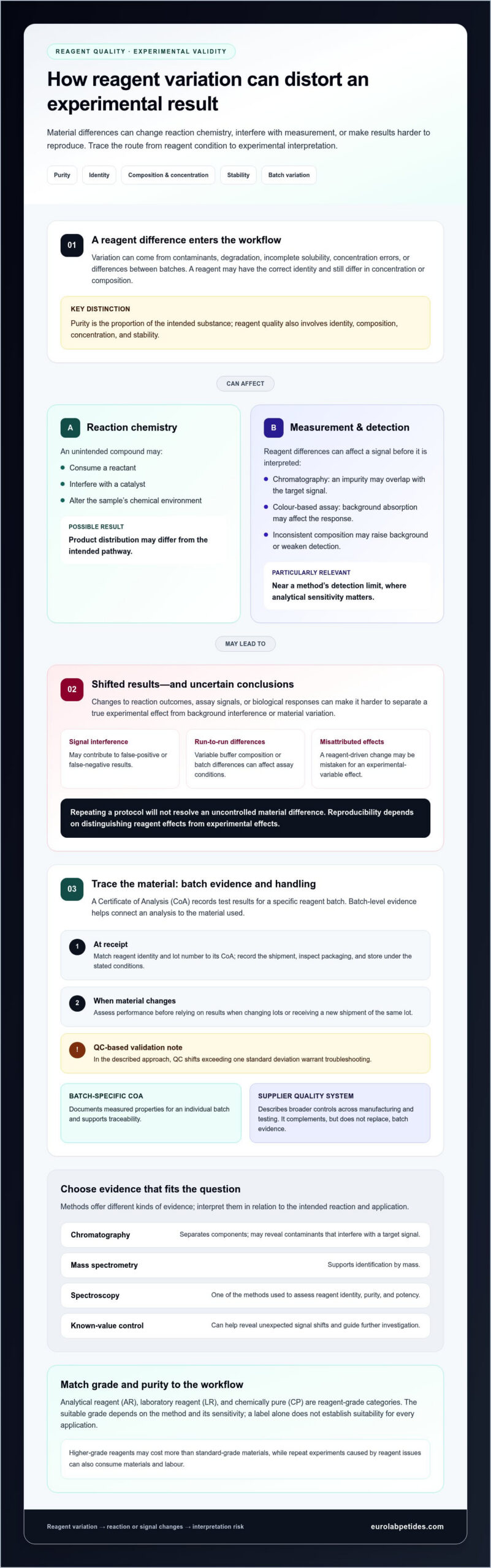
Contamination and altered reaction pathways
A contaminant can change a reaction, not just add noise to its measurement. An unintended compound may consume a reactant, interfere with a catalyst, or alter the sample’s chemical environment. The resulting product distribution may differ from the intended pathway. The impact of reagent quality on scientific validity is especially important when researchers attribute that change to an experimental variable without accounting for reagent composition.
Contamination can affect measurement before a reaction is interpreted. In chromatography, an impurity that overlaps with a target signal can complicate identification. In a colour-based assay, background absorption can affect the measured response. This interference may reduce detection sensitivity or contribute to false-positive or false-negative results. A control sample with a known value can help reveal unexpected signal shifts and guide further investigation.
Reagent-related variability can result from contaminants, degradation, incomplete solubility, concentration errors, or batch differences. These causes may act separately or together. For example, a concentration error can change reaction conditions even when the reagent’s identity is correct. Repeating a protocol will not resolve an uncontrolled material difference, so reproducibility depends on distinguishing reagent effects from procedural variation.
Compare affected reactions with appropriate controls, review batch records, and assess whether experimental conditions remained consistent. Chromatography, mass spectrometry, or spectroscopy can help detect impurities or confirm identity. The impact of reagent quality on scientific validity also depends on interpreting analytical evidence in context. The European Union’s CLP Regulation covers the classification, labelling, and packaging of chemical substances and mixtures; it does not establish suitability for a particular experimental application.
When results change after a reagent replacement, distinguish material effects from protocol effects before drawing conclusions. A shift in controls, altered reaction products, or inconsistent measurements across runs can indicate a quality-related source of error. Recording the reagent lot and observed response preserves traceability and helps researchers assess whether findings reflect the intended experimental mechanism.
Definition and roles of research reagents
Chemical reagents are substances used to cause, support, detect, or measure chemical and biological reactions. A reagent’s role determines which quality attributes, such as purity or concentration, are critical to the experimental result.
A buffer maintains an assay’s chemical environment, while a solvent dissolves or separates sample components. Reference materials provide known compositions for comparison and calibration; standards support analytical measurement. Building blocks, inhibitors, and labelled compounds serve different purposes in synthesis and biological experiments. Identifying a reagent’s function helps researchers assess whether its properties fit the protocol.
Quality control assesses whether a reagent’s identity, composition, concentration, and purity meet specified criteria. These attributes affect different steps: concentration determines how much material enters a reaction, while purity can influence background signals or unintended interactions. For example, a reference standard with a known concentration can help calibrate an analytical measurement. Recording the reagent identity and lot links those measurements to the material used.
Research reliability depends on more than a reagent label. Researchers interpret results alongside protocol conditions, controls, and the analytical method. A solvent suitable for a separation may not suit a sensitive biological assay, where trace impurities could affect the measured response. Recording preparation and storage conditions also helps distinguish reagent-related changes from differences in technique.
Research Use Only (RUO) identifies materials intended for research applications. Clear quality documentation can help researchers assess how a reagent may affect experimental results. The designation alone does not establish purity, concentration, or suitability for a specific method. For clinical testing, research materials should not be treated as equivalent to reagents validated for clinical laboratory use.
For research planning, explore research applications and match material selection to the study’s experimental purpose.
EuroLab Peptides: Longevity & Vitality Research
EuroLab Peptides supports research in longevity and vitality with research-grade peptides subject to in-house and independent third-party laboratory testing. This is relevant to studies involving longevity, weight management, tissue repair and recovery, or cognitive function, where material quality and consistency matter. Its multi-level quality control gives researchers a basis for evaluating materials alongside the experimental protocol and batch documentation. Consider these offerings when selecting materials for research in those areas, and interpret findings within the limits of the methods and controls. Contact EuroLab Peptides to discuss your research needs.
Set a Stronger Standard for Your Next Study
Build reagent quality into experimental planning rather than treating it as a procurement detail. Define which material attributes are critical to your study, how they relate to the planned methods, and how you will interpret results if conditions change. The impact of reagent quality on scientific validity is easier to assess when material selection and experimental decisions align from the outset. This approach helps teams evaluate findings and refine future study design.
For research focused on longevity and vitality, weight management, or tissue repair and recovery, EuroLab Peptides offers research-grade peptides. Match the research focus to your experimental objectives and use the relevant offering as a starting point for planning.
Contact EuroLab Peptides to discuss your research needs. A more deliberate approach to reagent selection can strengthen the work ahead.
Frequently Asked Questions
How can labs improve accuracy when selecting reagents?
Labs can improve accuracy by matching reagent specifications to the method’s analytical demands. Define the required identity, concentration, grade, and limits on interfering substances before purchase. For example, choose a calibration solution with a stated composition suited to the measurement. Record the selection criteria in the protocol so future researchers can reproduce the decision instead of relying on an informal product preference.
How does reagent quality affect scientific validity and reproducibility?
Reagent quality affects whether an observed difference can be attributed to the experimental variable rather than the material itself. If results shift after a reagent change, compare the control response and experimental data before interpreting the biological effect. Consistency across runs strengthens confidence that the procedure measures the intended phenomenon. Reagent quality is one factor among protocol execution, equipment, sample handling, and analysis.
What reagent purity and grade standards are used in scientific research?
Laboratory reagents may be labelled analytical reagent (AR), laboratory reagent (LR), or chemically pure (CP). These grade terms describe intended material quality, but researchers still need to relate the grade to the method’s requirements. Analytical work may require high-purity substances, while another application may prioritise a different specification. Review the stated composition and test results alongside the grade, rather than treating the label as a universal threshold.
How can researchers verify reagent identity, purity, and lot-to-lot consistency?
Researchers can use mass spectrometry, chromatography, or spectroscopy to evaluate identity, purity, and potency, choosing the method that answers the specific analytical question. To assess a new lot, compare its performance with the previous lot using the same protocol and suitable controls. Record observed differences and investigate shifts before combining data across lots. A Certificate of Analysis can link those results to the batch being evaluated.
How do contaminated or degraded reagents affect experimental results?
Contaminated or degraded reagents can cause signal interference, reduce detection sensitivity, or change a sample’s response. For example, an aged solution may no longer perform like freshly prepared material, creating differences between experimental runs. A blank or known-value control can help reveal unexpected background or response changes. Interpret affected results cautiously and determine whether reagent condition, handling, or another experimental factor explains the discrepancy.
How should reagent quality be documented in methods and publications?
Methods should identify each critical reagent clearly enough for another laboratory to reproduce the work. Report the reagent name, grade or relevant specification, manufacturer, catalogue identifier when available, lot number, concentration, and preparation details. Include storage and handling conditions when they affect use, and describe any quality assessment or control comparison performed. In a publication, distinguish measured reagent properties from assumed characteristics so readers can assess the evidence behind the method.
