

A 10 mg vial of lyophilized Kisspeptin-10 is a listed laboratory format, and reported purity results vary by product and batch. For teams looking to buy kisspeptin for research, the stated purity is a starting point, while batch-specific analytical documentation helps characterize the material. The product is designated for laboratory experimentation, not human or animal consumption.
Choosing a research peptide involves more than comparing a purity percentage. Consider the product format, package size, and what the accompanying test data can tell you about the specific lot.
This guide explains how to assess Kisspeptin-10 purity claims, compare formats and package sizes, and interpret pricing in relation to what’s supplied. It also outlines the quality-control details that matter when selecting research-grade material, so you can make a more informed decision for your laboratory work.
Key Takeaways
- Compare purity claims with batch-specific HPLC results to understand what the analytical data says about a lot.
- Assess the supplied format and peptide quantity against your laboratory’s research requirements.
- Interpret package pricing alongside vial strength and product documentation, rather than treating price as a measure of quality.
- Use identity details such as the sequence and CAS number to distinguish Kisspeptin-10 from related peptide forms.
Kisspeptin-10 peptide purity
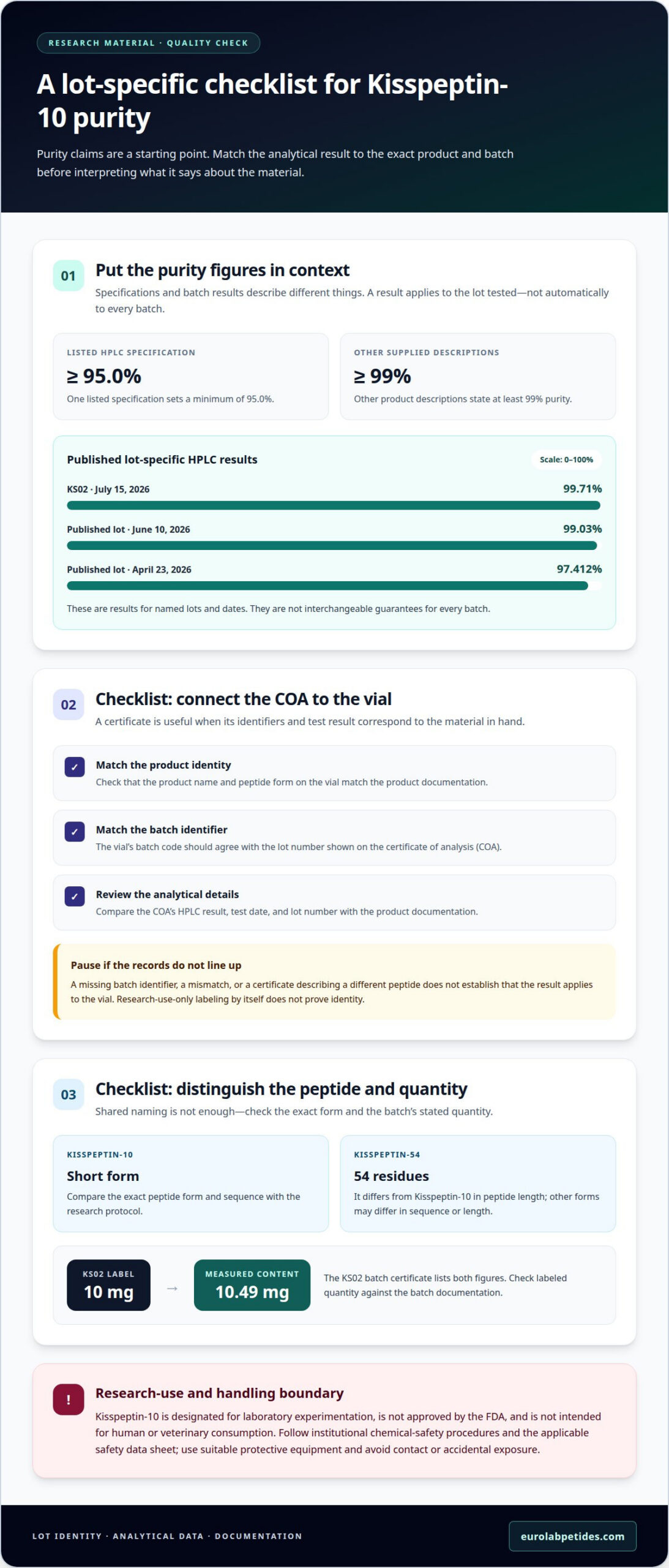
Kisspeptin-10 and kisspeptin-54 differ in peptide length: Kisspeptin-10 is a short form, while kisspeptin-54 contains 54 residues. Other forms can differ in sequence or length, so compare the exact peptide identity rather than relying on the shared “kisspeptin” name. A team planning to buy kisspeptin for research should match the form to its protocol.
Purity figures need context. One listed HPLC specification sets a minimum of 95.0%, while other supplied descriptions state at least 99% purity. Batch results also vary: KS02 recorded 99.71% on July 15, 2026; other published lots reported 99.03% on June 10, 2026, and 97.412% on April 23, 2026. These results are lot-specific, not interchangeable guarantees for every batch.
To assess product identity and purity, match the product name and batch identifier on the vial to the certificate of analysis (COA). Then compare the COA’s HPLC result, test date, and lot number with the product documentation. A clear, consistent match shows which test result applies to the material in hand; a generic certificate without a matching lot does not establish that connection.
For laboratory handling, follow institutional chemical-safety procedures and the applicable safety data sheet. Use suitable protective equipment, avoid contact or accidental exposure, and keep research material away from human and veterinary use. Kisspeptin-10 is not approved by the FDA and is not intended for human or veterinary consumption.
Research-use-only labeling does not prove a product’s identity. Compare the label, peptide form, batch code, and COA, and check whether the analytical result corresponds to the stated lot. A mismatch, missing batch identification, or certificate describing a different peptide is a reason to pause evaluation, not treat the label as verification.
The KS02 batch certificate lists a labeled quantity of 10mg and measured peptide content of 10.49mg, a distinction worth checking against the batch documentation.
Kisspeptin-10 product formats
A listed format for Kisspeptin-10 is a 10 mg vial of lyophilized powder. Lyophilization removes water from the peptide during preparation, leaving a dried material rather than a ready-made solution. The vial strength describes its labeled peptide quantity; it doesn’t identify the amount of solvent needed for a laboratory protocol. Read the product label alongside the batch documentation so the material’s identity and stated quantity are clear before planning an experiment.
Solubility affects how a format can fit a research workflow. Kisspeptin-10 is described as soluble in water, bacteriostatic water, and DMSO, with water solubility listed up to 1 mg/mL. These details are not interchangeable instructions for every assay. The appropriate solvent and concentration depend on the experimental method, compatibility requirements, and the laboratory’s established protocol. Record the selected solvent and preparation conditions as part of the experiment.
Storage differs between the lyophilized powder and reconstituted material. The listed guidance says to store lyophilized Kisspeptin-10 at −20°C, protected from light and moisture. After reconstitution, the guidance specifies 2-8°C and prompt use. This distinction matters when organizing sample handling: preserve the dry vial under its stated conditions, then manage any prepared solution according to the separate storage guidance.
Before selecting a format, map the vial strength to the study’s planned use and handling sequence. Confirm that the label identifies Kisspeptin-10 and gives a 10 mg quantity, then review solvent compatibility and storage needs against the laboratory protocol. A lyophilized vial may suit workflows that require preparing material for a particular experiment, while a supplied solution would have different handling implications. The listed format here is the lyophilized 10 mg vial, not a pre-mixed solution. For reproducible records, document the lot, preparation date, solvent, and storage conditions alongside the experiment’s sample identifiers.
Peptide package sizes and prices
The listed Kisspeptin-10 vial strength is 10 mg, providing a clear unit for comparing offers. The market range for a 10 mg vial is $22 to $62, with a median of about $39. This range reflects seven price samples from five sources, collected November 2, 2026, and valid until December 2, 2026. It describes the market, not an individual seller’s price.
Price comparisons are most useful when the package contents match. Confirm that each figure refers to a 10 mg vial, rather than a different strength or package quantity. A displayed price without its unit can make unlike offers appear comparable. Record the vial strength, number of vials, and total amount supplied before evaluating the quoted cost.
For a laboratory budget, calculate the required quantity from the study plan, then compare the total package cost for equivalent amounts. Keep the unit consistent: a 10 mg vial should be compared with another 10 mg vial, not with a larger package’s headline price. If multiple vials are considered, multiply the per-vial price by the number needed. This separates the unit price from the full order amount.
Price alone doesn’t establish how a lot was characterized. Pair the cost comparison with the product’s stated strength and the lot documentation relevant to the material. For example, two offers at different points within the $22-$62 market range may differ in package quantity or documentation. Those details affect whether the comparison is like-for-like; the numerical range itself doesn’t describe the analytical quality of any particular vial.
Use a simple purchasing record with the date, stated vial strength, quantity, unit price, and total. Include the lot identifier when available, so the order can be connected with its accompanying records. The market figures collected November 2, 2026, provide a time-bounded reference, not a permanent benchmark. Revisit the comparison when the collection period expires on December 2, 2026, or when the package size changes.
Research-grade Kisspeptin-10 peptide
Research-grade evaluation starts with peptide identity, intended use, and handling requirements. These specifications help researchers match the material to laboratory protocols.
The listed sequence is YNWNSFGLRF-NH₂, a 10-residue peptide. Its CAS number is 374675-21-5, and its monoisotopic mass is 1301.6305 Da. Use these identifiers alongside the product name when recording material details. A matching sequence and CAS number help distinguish Kisspeptin-10 from other peptide forms, but they do not replace lot-specific analytical documentation.
For U.S. purchasing, distinguish a research-use designation from authorization for consumption. The product is designated for laboratory experimentation and in-vitro testing, not human or animal consumption. These facts describe intended use, not a specific U.S. law or regulatory approval.
Research-Grade Supplier Options
U.S. suppliers offering research-grade Kisspeptin-10 can be assessed through the product identity and documentation they provide. Compare the stated sequence, CAS number, vial label, and lot-specific certificate of analysis. The certificate should correspond to the material’s batch, allowing the reported analytical result to be matched with the item received. Avoid treating a research-use label alone as proof of peptide identity.
Storage and Handling Conditions
For lyophilized Kisspeptin-10, the listed storage condition is −20°C, protected from light and moisture. After reconstitution, the stated range is 2-8°C, with prompt use advised. Keep these stages distinct in laboratory records. Document the material’s lot, preparation details, and storage conditions so sample handling can be interpreted alongside experimental results.
For research focused on longevity, vitality, or related areas, explore research-focused offerings as a next step when you want to buy kisspeptin for research.
The fragment description provides another way to characterize the material alongside its sequence and CAS number. Kisspeptin-10 is described as a peptide fragment containing amino-acid positions 45-54 of Kisspeptin-54. The listed Kisspeptin-10 molecular formula is C₆₃H₈₃N₁₇O₁₄.
Recording the fragment designation and formula alongside the product identity can make research documentation more complete. These are additional descriptors, not substitutes for matching the vial label and lot-specific analytical documentation to the batch received. Researchers can keep these details with preparation and storage records to support consistent interpretation of laboratory work.
EuroLab Peptides: Longevity & Vitality Research
EuroLab Peptides offers Longevity & Vitality Research for laboratory work focused on longevity. Its research-grade peptide range is supported by multi-level quality control, including in-house and independent third-party laboratory testing. This approach is relevant when documented product consistency matters to a research workflow.
Related research areas include Weight Management Research, Tissue Repair & Recovery Research, and Cognitive Function Research. These offerings may be a relevant next step when your work aligns with those fields and you are assessing peptide sourcing.
For research use only, consider EuroLab Peptides when its research areas align with your laboratory’s focus. Contact EuroLab Peptides or visit eurolabpetides.com.
Plan the Next Research Step
Turn your sourcing criteria into a documented decision process. Align peptide identity and analytical records with your protocol, then define how incoming material will be reviewed and recorded. This connects procurement to experimental requirements rather than treating it as a separate task. For teams planning to buy kisspeptin for research, that approach can make the next sourcing decision more deliberate.
EuroLab Peptides’ research areas include Longevity & Vitality Research, Weight Management Research, and Tissue Repair & Recovery Research. These may be relevant when your laboratory’s broader work overlaps with them. Consider how your research focus aligns with these offerings and the peptide specifications your workflow requires.
For a discussion related to research sourcing, contact EuroLab Peptides about research sourcing. A clear account of your research focus can help frame the conversation. Proceed with a sourcing approach that keeps documentation, intended use, and experimental needs aligned.
Frequently Asked Questions
What is kisspeptin and what forms are sold for research?
Kisspeptin is a peptide that interacts with the KISS1 receptor, and research materials include forms such as Kisspeptin-10 and kisspeptin-54. These forms differ in peptide length and should not be treated as interchangeable in an experiment. For example, match the form named in the study protocol to the product identity and analytical records, then record that form consistently in sample logs and reports.
What are typical prices and shipping costs for research-grade kisspeptin in the United States?
Market observations place a 10 mg vial between $22 and $62, with a median of about $39, based on samples collected November 2, 2026, valid through December 2, 2026. Shipping charges depend on the seller’s delivery options, destination, and order conditions. Compare the vial strength and order quantity alongside delivery charges, so the total procurement cost reflects equivalent packages.
Can individuals buy kisspeptin for research, or is institutional documentation required?
Whether an individual can buy kisspeptin for research depends on the seller’s purchasing requirements; research-use labeling alone does not establish that institutional credentials are required. Before ordering, distinguish seller account requirements from your laboratory’s procurement and recordkeeping procedures. Keep the order documentation, product identity, and intended in-vitro research use together in your records, especially when purchases are managed outside a formal institutional purchasing system.
