

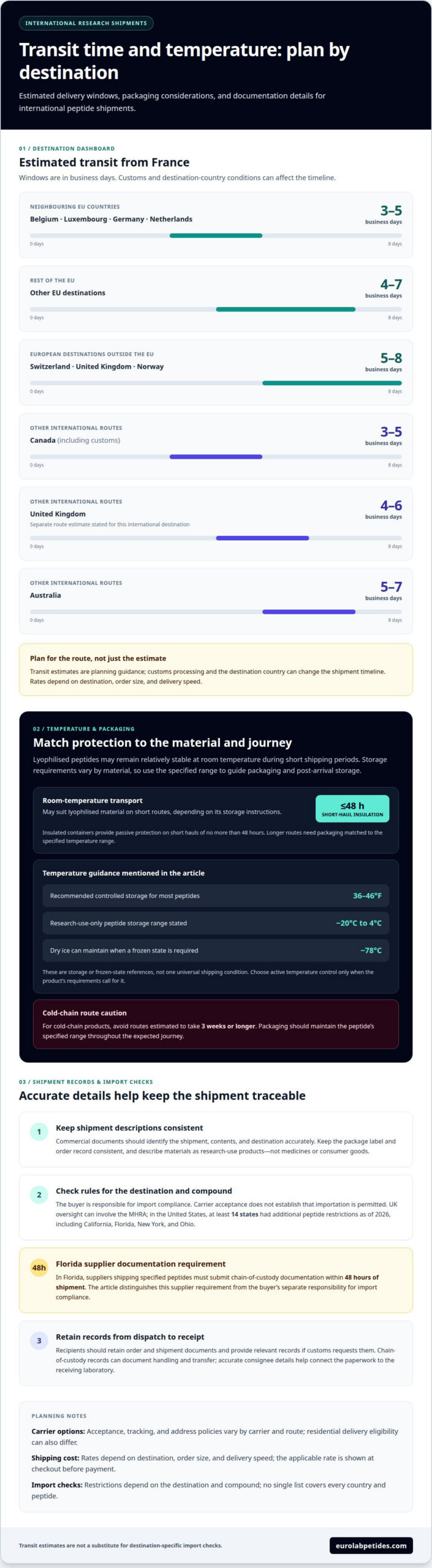
Lyophilised peptides can remain relatively stable at room temperature during short shipping periods, so delivery does not always require a cold chain. For parcels sent from France, estimated transit is 3 to 5 business days to neighbouring EU countries, 4 to 7 business days to the rest of the EU, and 5 to 8 business days to European destinations outside the EU.
Temperature control is not a minor detail: storage requirements and expected transit time determine suitable packaging. Knowing how to ship peptides internationally for research also means accounting for destination-specific import rules and preparing accurate shipping documents.
This guide covers how transit estimates vary by destination, when cold-chain packaging may be appropriate, and what labeling and chain-of-custody records can involve. It also explains relevant federal requirements for research-use peptides, helping you assess regulatory considerations alongside practical steps for international shipping.
Key Takeaways
- Compare destination-specific transit estimates when planning a shipment, and account for customs processing in your timeline.
- Prepare accurate shipment labels and chain-of-custody documentation, while recognizing that import compliance is the buyer’s responsibility.
- Choose packaging according to the peptide’s storage requirements and expected transit conditions; lyophilised material may not need the same handling as temperature-sensitive products.
- Understand how federal requirements affect research-use peptides and which records support a documented, compliant research process.
International shipping destinations and estimated transit times
International delivery estimates depend on destination and route. Parcels shipped from France take 3 to 5 business days to neighbouring EU countries, including Belgium, Luxembourg, Germany, and the Netherlands. Delivery to the rest of the EU takes 4 to 7 business days. European destinations outside the EU, such as Switzerland, the United Kingdom, and Norway, have estimates of 5 to 8 business days.
For other international destinations, estimated delivery is 3-5 business days to Canada, including customs, 4-6 business days to the United Kingdom, and 5-7 business days to Australia. These estimates help compare routes, but customs and the destination country affect the shipment timeline. A practical first step in how to ship peptides internationally for research is to match the destination estimate to the project schedule before placing an order.
Which couriers ship research peptides internationally, and what are their policies? The options depend on the route and destination; acceptance, tracking, and address policies vary by carrier. Residential delivery eligibility can also differ by service, so confirm that the selected option supports the delivery address and the shipment’s handling needs.
How much does international peptide shipping cost, and how long does delivery take? Rates depend on destination, order size, and delivery speed, while transit estimates vary by country. The applicable rate is shown at checkout before payment. These are key considerations when planning how to ship peptides internationally for research.
Temperature-sensitive products need packaging suited to their required conditions. Ice packs or dry ice may be used; dry ice can maintain −78 °C when a frozen state is required. For cold-chain products, avoid routes estimated to take 3 weeks or longer. Select an active temperature-control option only when the product’s requirements call for it, and factor expected transit time into the packaging decision.
Shipment labeling and chain-of-custody documentation
Import rules vary by destination, so documentation and peptide eligibility must be considered together. In the United Kingdom, certain compounds are subject to MHRA oversight; in the United States, at least 14 states had additional peptide restrictions as of 2026, including California, Florida, New York, and Ohio.
Customs and Commercial Documents
International customs documents identify the shipment, its contents, and its destination. Commercial documents should accurately and consistently describe research-use materials, including the package label and order record. Avoid descriptions that suggest human consumption: research products must not be presented as medicines or consumer goods. Clear, matching details help customs assess the parcel and reduce confusion if it is inspected.
The buyer is responsible for import compliance. Before placing an order, assess the destination’s import rules for the specific compound and intended research use. Carrier acceptance does not mean importation is permitted. For shipments to the United States, state-level restrictions may apply in addition to federal requirements, so consider the state as well as the country.
Inspection and Recipient Documentation
Customs authorities may inspect a parcel and request information from its recipient. The recipient should retain the order record and shipment documentation, then provide relevant records if an inspection requires them. Accurate consignee details help connect the documentation to the receiving laboratory. In Florida, suppliers shipping specified peptides must submit chain-of-custody documentation within 48 hours of shipment.
Chain-of-custody records document a shipment’s handling and transfer. For a laboratory receiving research materials, preserve shipment records with the related order details and note any inspection or transfer events. This creates a traceable record from dispatch to receipt. Florida’s 48-hour submission requirement applies to suppliers shipping specified peptides; it does not remove the buyer’s separate responsibility for import compliance.
No single list covers every country that prohibits every research peptide. Restrictions depend on the destination and compound; UK MHRA oversight and state-specific rules in the United States illustrate why screening must be specific to each shipment. Inspections or incomplete documentation can cause customs delays, so identify the destination, compound, and recipient accurately before dispatch.
Do lyophilised peptides need a cold chain for delivery?
Lyophilised peptides may tolerate room-temperature conditions during short transit, but requirements vary by material. Match packaging and post-arrival storage to the specified temperature range.
Cold-Chain Temperature Ranges
For most peptides, temperature-controlled storage is recommended at 36-46°F. Research-use-only peptides may retain full activity when stored between −20 °C and 4 °C. These ranges describe storage guidance, not a single shipping condition for every compound. Use the peptide’s specified range to determine the required protection during transit and expected business days in transit.
Room-Temperature Transport
Lyophilised powder is relatively stable at room temperature during short shipping periods. That makes a cold chain less critical for some short-haul shipments, but it doesn’t remove the need to account for transit duration and the material’s storage instructions. Insulated containers provide passive protection on short hauls of no more than 48 hours. Longer routes require packaging matched to the specified temperature range.
Temperature Stability and Storage
Packaging should maintain the peptide’s specified range throughout the expected journey. For many shipments, insulation is selected to maintain 2-8 °C; active refrigerated units can hold an interior temperature within a ±2 °C band. After arrival, store vials intended for near-term use at 2-8 °C. Place vials intended for long-term storage in a freezer, following the material’s storage requirements.
Temperature-Breach Contingencies
Temperature monitoring helps identify excursions during shipment. Configure alerts for a shipment exceeding 4 °C or falling below −20 °C when those limits apply to the material. For refrigerated carriers, pre-cool the unit for at least two hours, then confirm the logger records stable temperature for the first 30 minutes before dispatch. Keep logger records with shipment documentation.
If a logger records a temperature breach, preserve the readings and shipment details, then assess the exposure against the peptide’s specified range. An alert alone does not prove loss of activity. Record the excursion’s duration and maximum or minimum temperature, and keep the affected vial under its required storage conditions while the exposure is assessed and documented.
Federal requirements for research-use peptides
Federal requirements depend on a peptide’s classification and intended use. Research-use labeling, purity data, and packaging do not independently authorize import.
Rules by Peptide Material Type
Peptide standards, non-clinical research materials, and medicines are distinct regulatory categories. Classification and intended use shape the applicable requirements. A research-use-only label describes intended use, but it does not turn a medicine into a research material or guarantee that import is permitted. Before dispatch, review the material’s classification, destination-specific restrictions, and accompanying documentation.
International Import and Export Restrictions
No blanket rule makes every research peptide legal to import or export internationally. Permission depends on the specific peptide, its classification, and the laws at origin and destination. The buyer remains responsible for import compliance, including restrictions on individual compounds. Carrier acceptance or domestic dispatch does not establish that international import is lawful.
The FDA issued final guidance on research-grade peptides in March 2025, with enforcement beginning in January 2026. The FDA placed 19 peptides in Category 2 in 2023. Certain peptides were expected to come off Category 2 restrictions as of April 23, 2026. These classifications can affect whether a material is suitable for a research shipment; they are not a universal clearance for import.
Enforcement activity also provides regulatory context. The FDA issued 14 warning letters related to research peptides between January and December 2024, then 41 warning letters between January 2026 and March 2026. Those figures do not determine an individual shipment’s legal status. Keep research-use verification records and supporting documentation.
Before dispatch, assess the peptide’s category, intended use, origin, and destination. A certificate of analysis or purity result can document product characteristics, but neither replaces import authorization or applicable regulations. Distinguish research materials from medicines in the shipment record, and retain records connecting the material to its stated non-clinical purpose.
EuroLab Peptides
EuroLab Peptides supplies research-grade peptides for scientific studies. Its multi-level quality control includes in-house and independent third-party laboratory testing. For research groups planning international shipments, product selection and documented quality matter alongside destination rules, packaging, and transit conditions.
Research areas include Longevity & Vitality Research, Weight Management Research, Tissue Repair & Recovery Research, and Cognitive Function Research. These offerings support distinct areas of inquiry and are intended for research, not human consumption or medical treatment.
Contact EuroLab Peptides to discuss research-grade peptide requirements for your study.
Plan the shipment around the study
Make shipment planning part of study preparation, not a last-minute purchasing detail. Before ordering, align the material’s intended research use with the receiving laboratory’s handling procedures and the destination’s import requirements. This gives you a clear basis for coordinating documentation, receipt, and storage.
A practical approach to how to ship peptides internationally for research connects product selection, destination, transit conditions, and records to the study’s requirements. Keep these decisions together in the project plan so you can assess the shipment in relation to its intended use and laboratory workflow.
For research teams evaluating peptide requirements, EuroLab Peptides can be a relevant supplier for research-grade materials. Contact EuroLab Peptides about shipping and discuss how your research needs fit the next step in planning.
Clear preparation makes the transition from sourcing to laboratory work more coherent.
Frequently Asked Questions
Do you ship internationally?
Yes. EuroLab Peptides ships research-grade peptide orders worldwide. The destination still matters: import eligibility, customs procedures, and carrier acceptance can vary by country and material. Products are supplied for in-vitro research and laboratory development, not clinical use or human consumption. When arranging an order, provide the receiving institution’s complete address and an authorized recipient.
Is the parcel discreet?
Shipment descriptions should be accurate; “discreet” packaging must not conceal or misdescribe research materials. For delivery to a laboratory, use its authorized receiving address and provide the recipient’s correct name and department. This helps the institution route the parcel appropriately. If internal receiving procedures require an attention line or department identifier, include it in the delivery details.
Questions About Your Shipment?
For a shipment enquiry, contact EuroLab Peptides with your order reference, destination country, and recipient laboratory. Clearly describe the issue, such as a tracking update, delivery-address correction, or parcel held for customs review. These details help identify the order and its logistics stage. Avoid sharing sensitive laboratory information that is not needed to resolve the enquiry.
What permits, licenses, or customs declarations are required to ship peptides for research?
Requirements depend on the peptide, its classification, and the destination. No single permit or declaration applies to every international research shipment. The importer is responsible for determining applicable import requirements and providing requested recipient documentation. Before dispatch, identify the compound and intended research use, then establish which destination-specific declarations or permissions apply.
How should research peptides be classified and described on international shipping documents?
Describe the material truthfully, using its correct identity and research purpose. Do not label research material as a medicine, consumer product, or unrelated commodity to simplify customs handling. A certificate of analysis can document analytical characteristics, such as purity, but does not by itself establish legal classification or grant import permission. Keep descriptions consistent across all shipment documents.
What packaging and temperature controls are needed to ship peptides internationally?
Choose packaging based on the material’s stated storage conditions and expected transit time. Lyophilised powder may tolerate short room-temperature transit, while temperature-sensitive material needs suitable insulated or refrigerated protection. Distinguish lyophilised from reconstituted material when planning handling. On receipt, retain any temperature-monitoring record and place the material in its specified storage conditions without unnecessary delay.
