

A peptide standard is only useful when it fits the method. Peptides for use as analytical standards are characterized reference materials with known sequences and concentrations. They help calibrate instruments, validate methods, and identify or quantify peptides in samples. Their value depends not only on purity, but also on sequence identity, stability, and compatibility with the analytical workflow.
That distinction matters in peptide analysis: a reference material must support the measurement the method is designed to make. Choosing a standard means considering its characterization and handling requirements alongside the instrument and application.
This article explains what peptide standards are and how they support calibration, method validation, and impurity testing. It outlines how purity, sequence verification, storage conditions, stability, and instrument compatibility affect selection, helping you identify which characteristics matter for your analytical purpose.
Key Takeaways
- Understand how characterized peptide reference materials support instrument calibration, method validation, and peptide identification or quantification.
- Assess purity, sequence verification, stability, storage conditions, and instrument compatibility against the analytical method’s purpose.
- Learn how analytical role and specification requirements inform the choice of synthetic peptide standard and its cost.
- See where EuroLab Peptides’ research offerings in longevity, weight management, tissue repair, and cognitive function may fit your research focus.
Instrument calibration and analytical method validation
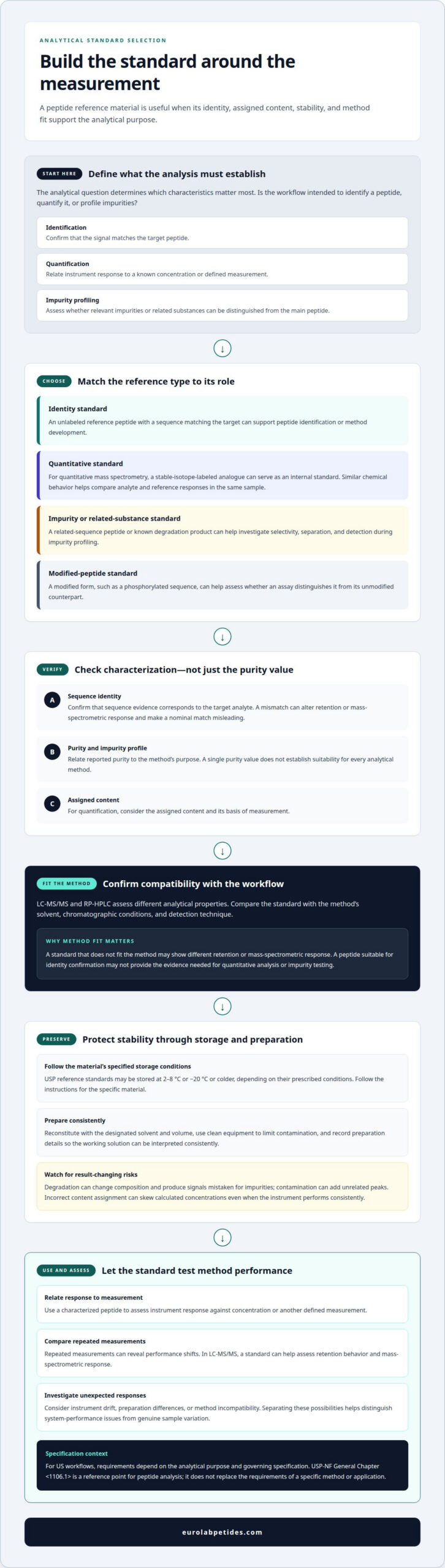
Peptides for use as analytical standards link an instrument’s response to an identified analyte and known concentration. In mass spectrometry-based proteomics, they support peptide identification, quantitative analysis, and performance monitoring. A standard can help determine whether a signal matches the target peptide and whether measured amounts align with expected values. This makes it useful for calibration and for assessing whether an analytical method performs as intended.
Calibration uses a reference material to relate instrument response to concentration or another defined measurement. During method validation, researchers assess whether a procedure can reliably identify or quantify peptides under specified conditions. For example, peptides for use as analytical standards analyzed by LC-MS/MS can help assess retention behavior and mass-spectrometric response. Repeated measurements can also reveal changes in system performance before they affect sample data.
For US workflows, requirements depend on the analytical purpose and the method’s governing specification. USP-NF General Chapter <1106.1> is a reference point for peptide analysis; it does not replace the requirements of a specific method or application.
Storage and handling affect whether a standard remains suitable for measurement. USP reference standards may be stored at 2-8 °C or −20 °C or colder, depending on their prescribed conditions. Follow the material’s specified storage instructions. Reconstitute it with the designated solvent and volume, using clean equipment to limit contamination. Record preparation details so the working solution can be interpreted consistently.
A validated workflow uses the standard to assess method performance, not merely to produce a calibration curve. The analyst evaluates whether identification and measurement remain consistent across the method’s operating range and sample matrix. If peptides for use as analytical standards produce an unexpected response, possible causes include instrument drift, differences in preparation, or incompatibility with the method. Separating these possibilities helps distinguish system performance issues from genuine sample variation.
- Use a characterized peptide to assess instrument response.
- Compare repeated measurements to identify performance shifts.
- Apply the method’s stated storage and preparation conditions.
Selecting standards by purity, sequence, stability, and compatibility
Start with the analytical question: identification, quantification, or impurity profiling. The answer determines which characteristics matter most. A standard used to confirm a target peptide’s identity needs sequence evidence that matches the analyte. For quantification, the assigned content and basis of measurement matter too. Purity data describes the material, but a single purity value cannot establish suitability for every method.
Sequence verification links the reference material to the peptide under study. A sequence mismatch, for example, can alter retention or mass-spectrometric response, making a nominal match misleading. Review characterization data for identity and purity, then consider whether the analytical method can distinguish relevant impurities from the main peptide. LC-MS/MS and RP-HPLC assess different analytical properties, so method fit matters.
Stability depends on the peptide and its handling conditions. Degradation can change the material’s composition and produce signals mistaken for impurities; contamination can add unrelated peaks. Incorrect content assignment can also skew calculated concentrations, even when the instrument performs consistently. These risks affect how results are interpreted, not just the standard’s appearance.
- Purity: Relate the reported value to the method’s purpose and impurity profile.
- Sequence: Confirm the stated sequence corresponds to the target analyte.
- Stability: Use the material within its defined storage and handling conditions.
- Compatibility: Consider solvent, chromatographic conditions, and detection technique.
Compare those criteria with the intended workflow before selecting a material. A peptide suitable for identity confirmation may not provide the evidence needed for quantitative analysis or impurity testing. For research workflows, explore research-grade peptide options relevant to the analytical purpose.
Which types of synthetic peptide standards are available for analytical testing?
Choose synthetic peptide standards for their analytical role, not simply their sequence. An unlabeled reference peptide can support identity checks or method development when its sequence matches the target. For quantitative mass spectrometry, a stable-isotope-labeled analogue can serve as an internal standard. Its similar chemical behavior helps compare analyte and reference responses in the same sample.
Other standards represent specific forms of an analyte. A modified peptide, such as a phosphorylated sequence, can help assess whether an assay distinguishes that form from its unmodified counterpart. A related-sequence peptide can help investigate selectivity, while a known degradation product can support impurity profiling. The analytical question determines which reference is relevant.
- Identity standards: Match the target sequence to support peptide identification.
- Quantitative standards: Use a labeled analogue to normalize mass-spectrometric measurements.
- Impurity standards: Represent related substances or degradation products for separation and detection.
- Modified-peptide standards: Help distinguish a specific chemical form from the unmodified peptide.
Reference materials can also differ in how their amount is assigned and reported. For example, a desmopressin acetate reference material was assigned an assay value of 1.75 mg per vial on an as-is basis. That value illustrates why the certificate’s stated basis matters: analytical calculations must correspond to the form and quantity being used.
Choose a standard according to the method’s purpose. A sequence-confirmation assay may need an identity reference, while quantitative LC-MS/MS may benefit from a labeled internal standard. Impurity testing calls for references representing the substances the method must resolve. Leuprolide acetate, for example, has been characterized using mass spectrometry and chromatography, illustrating how different analytical approaches can examine the same peptide.
For each standard type, match the sequence and chemical form to the target, then consider the method’s detection mode. A standard designed for one purpose does not automatically work as a quantitative calibrator or impurity reference.
How much do peptide analytical standards cost, and what affects pricing?
There is no single price for every peptide analytical standard. Cost depends on the material’s specification and production requirements, including sequence, chemical modifications, purity target, quantity, and characterization. A short, unmodified peptide and a complex modified sequence require different synthesis and analytical work, so their prices are not directly comparable.
Sequence complexity is one cost driver. A longer sequence or a peptide with modifications may require more demanding synthesis and purification. A stable-isotope-labeled analogue uses specialized components and may need additional characterization. Let the method’s purpose guide these choices: quantitative LC-MS/MS may call for a labeled internal standard, while identity testing may need a matching unlabeled sequence.
Purity and characterization requirements also affect the final specification. Purification separates the target peptide from related material, while identity testing and analytical characterization establish what the standard contains. More extensive evidence can require work beyond synthesis alone. Compare not only the amount of peptide, but also the scope of the documented analytical work.
- Sequence and structure: Length and chemical modifications affect synthesis complexity.
- Purity specification: The required separation and purification influence production work.
- Characterization: Identity, assay, and impurity data involve different analytical requirements.
- Quantity and format: The amount and intended use shape the requested material specification.
Compare quotations by matching these variables rather than comparing unlike products. For example, a standard with a defined assay value and supporting identity data is not equivalent to material specified only by sequence. Confirm that the requested amount, characterization, and intended application align before evaluating alternatives.
For research planning, explore research peptide options relevant to your study area. A defined analytical specification helps clarify what the material must support, while the analytical method determines which evidence is useful. That distinction keeps purchasing decisions tied to experimental requirements rather than an isolated price.
EuroLab Peptides
EuroLab Peptides supplies research-grade peptides for scientific studies, including research into longevity, weight management, tissue repair, and cognitive function. Its multi-level quality control includes in-house and independent third-party laboratory testing to assess product purity and consistency. These offerings can support research programs in those fields. Analytical standards still need to match the method’s purpose, required characterization, and compatibility; research-grade material should not automatically be treated as a certified reference standard.
For research teams assessing peptide materials in these fields, EuroLab Peptides offers research-grade peptides. Contact EuroLab Peptides to discuss your research needs.
Make Your Next Analytical Decision Deliberate
Before specifying peptides for use as analytical standards, define the measurement your workflow must support. This helps align material selection with the study’s analytical purpose, rather than treating general research relevance as proof of suitability for every assay. A clear specification also focuses discussions about identity, purity, and characterization.
EuroLab Peptides supports Longevity & Vitality Research, Weight Management Research, and Tissue Repair & Recovery Research. These areas provide context for research programs, while analytical standards must be selected against the method’s specific requirements. Keep that distinction in mind as your study moves from planning to material selection.
When you’re ready to explore research options connected to your work, contact EuroLab Peptides. A well-defined analytical question is a strong starting point for the next stage of your research.
Frequently Asked Questions
What Are Peptide Standards?
Peptide standards are characterized reference materials used to compare analytical measurements with a defined peptide. Their sequence and assigned concentration provide a basis for evaluating a sample signal. For example, a laboratory may analyze a reference peptide alongside an unknown sample to support identification or measurement. The standard’s usefulness depends on its intended role and the analytical method.
What are peptide analytical standards, and what are they used for?
Peptide analytical standards are reference peptides used to assess peptide measurements in laboratory workflows. They can support instrument calibration, method evaluation, quantitative analysis, and impurity testing. In a biomarker study, a reference peptide can help distinguish a change in measured abundance from a change in instrument response. Define its role before analysis, since identity testing and quantification require different comparisons.
How do I choose a peptide standard for LC-MS, HPLC, or other analytical methods?
Choose a standard that matches the method’s analyte and intended measurement. For LC-MS, consider whether its sequence and mass-spectrometric response suit identification or quantification. For HPLC, assess whether the peptide’s chromatographic behavior supports the separation being evaluated. Consider the sample matrix and solvent compatibility too. A standard suited to one detection method may not provide the right evidence for another.
What purity, identity, and characterization data should a peptide reference standard include?
Useful documentation identifies the peptide sequence and explains the analytical basis for identity and purity. For quantitative work, the assigned assay or content value and its basis matter because calculations depend on what that value represents. Characterization relevant to the intended method helps with interpretation. For example, a purity result alone does not establish the amount of peptide available for a concentration calculation.
How do I prepare peptide standards and calibration curves for analytical assays?
Use the material’s assigned content and specified preparation conditions to calculate the starting concentration. Dissolve the peptide in a solvent compatible with the method, then prepare a series of concentrations spanning the assay’s intended working range. Analyze them under the same conditions as the samples. Plot measured response against concentration and assess whether the curve fits the method’s intended model before using it to calculate sample results.
