

A peptide hit is only as credible as the assay and quality controls behind it. Screening peptides for biological activity combines binding or affinity assays with functional testing to determine whether a candidate interacts with a target and produces the intended biological response.
Binding alone does not establish activity. Results can be affected by the screening format, library design, peptide integrity, and assay artifacts. Interpret each signal in context and support it with appropriate validation.
This guide explains how binding assays and library-screening approaches, including phage display and mRNA display, help identify candidate peptides. It also covers how functional assays assess biological activity, and how workflow controls such as compound-integrity checks, sample tracking, and statistical hit calling help distinguish meaningful results from false positives or negatives. Together, these methods provide a structured basis for deciding which hits warrant further investigation and where additional validation is needed.
Key Takeaways
- Choose an assay format that preserves the binding interaction you need to measure, especially when screening cyclic peptides.
- Match the library method to the peptide designs you want to explore, including whether unnatural amino acids are important.
- Use functional evidence to distinguish target binding from a biological effect, and consider how unintended interactions may be assessed.
- Build quality controls into the workflow so peptide integrity, sample identity, and screening signals can be interpreted reliably.
Binding and affinity assays
In screening peptides for biological activity, binding assays establish whether a peptide associates with a defined molecular target. Affinity assays estimate interaction strength under specified conditions. These readouts answer different questions: detection identifies association, while affinity helps rank candidates. Neither result alone shows that binding changes biological function. For example, a peptide may bind a receptor without activating its signaling pathway. Treat target engagement as an initial selection criterion, followed by functional testing. Match assay design to the target, peptide format, and experimental decision.
For cyclic peptides, homogeneous assay formats are often preferred because they avoid wash steps. Washing can disturb equilibrium binding and change the measured signal after complexes form. A homogeneous format keeps the target and peptide together during measurement, helping preserve the interaction. Choose a readout that distinguishes target-specific binding from background. Target-free or irrelevant-target controls can reveal nonspecific signals. A single-concentration measurement may flag binding, but concentration-dependent responses provide more information for comparing candidates.
Display-based affinity selections also require attention to peptide presentation. In mRNA display, puromycin links a peptide to its mRNA template during translation. The attached nucleic acid may be vulnerable to nucleases or may sterically hinder binding. Either issue can affect recovery during selection. Consider whether the display tag could limit access to the target, then validate promising sequences with an assay that measures the peptide outside its display context.
Assay throughput shapes the practical screening format. Cyclic peptide high-throughput screening commonly uses 384-well or 1536-well microplates. Acoustic droplet ejection can dispense compounds in nanoliter-range volumes, supporting miniaturized assays. Reaction volumes below one microliter can enable cost-effective screening of million-compound libraries. These formats increase capacity, but they don’t replace controls for signal quality or binding specificity. A reliable approach to screening peptides for biological activity aligns plate density and dispensing conditions with the assay’s signal window, target stability, and peptide solubility. That alignment makes affinity results more interpretable before candidates advance to activity evaluation.
Two methods for peptide library screening
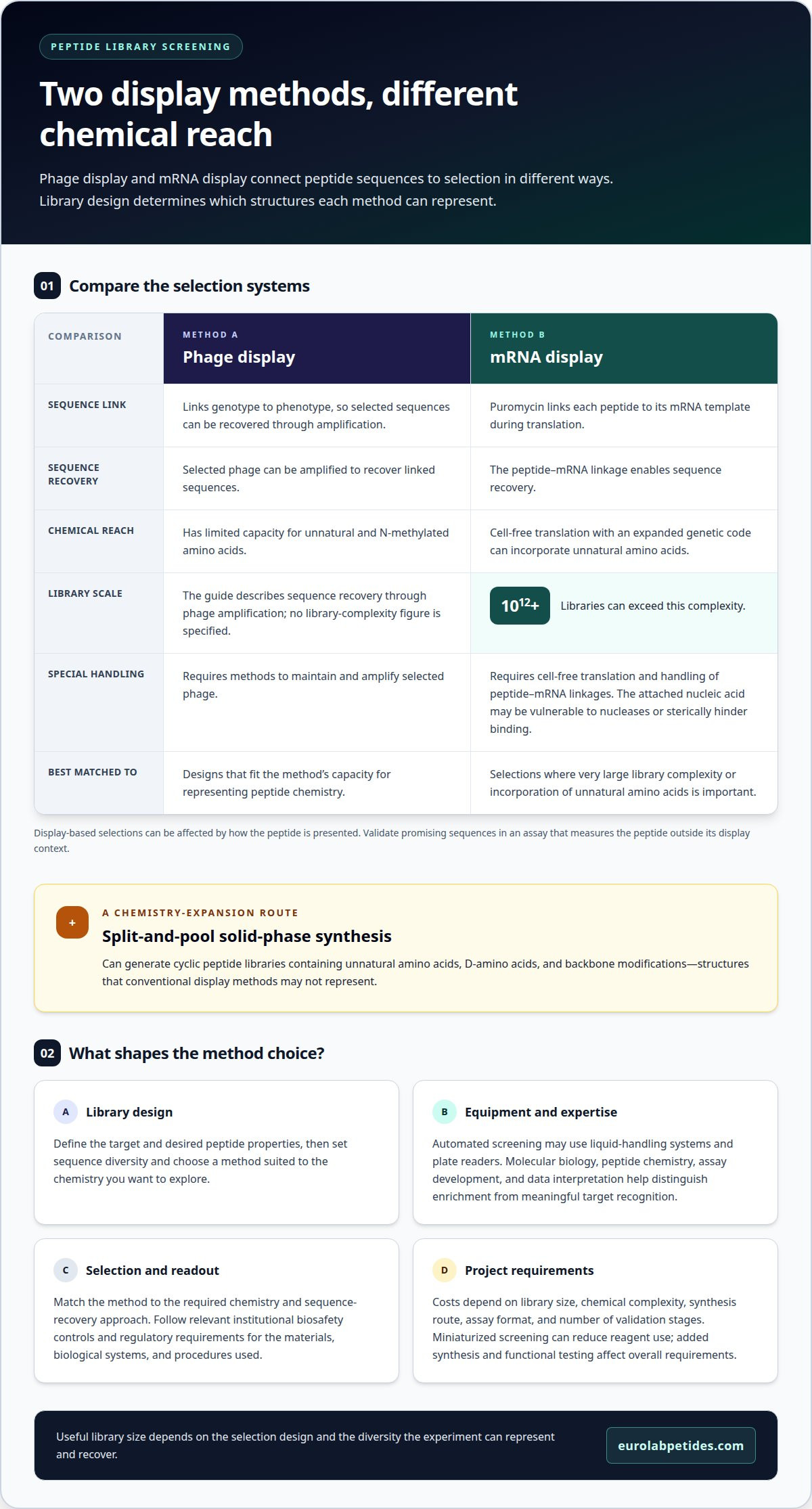
Phage display and mRNA display both link peptide sequences to selection, but use different molecular linkages. Library design determines which peptide structures each method can represent.
Peptide Library Design
A peptide screening library is a designed set of sequence variants used to identify candidates that interact with a chosen target. Start by defining the target and desired peptide properties, then choose sequence diversity and a screening method suited to them. For example, phage display links genotype to phenotype, allowing selected sequences to be recovered through amplification. However, it has limited capacity for unnatural and N-methylated amino acids, which can support properties such as permeability and metabolic stability.
For broader chemical diversity, split-and-pool solid-phase peptide synthesis can generate cyclic peptide libraries with unnatural amino acids, D-amino acids, and backbone modifications. This lets researchers test structures that conventional display methods may not represent. mRNA display can screen libraries with complexities exceeding 1012 members. The useful library size depends on the selection design and the diversity the experiment can represent and recover.
Screening Equipment and Expertise
Peptide screening requires equipment suited to library construction, target selection, and readout. Phage display needs methods to maintain and amplify selected phage; mRNA display requires cell-free translation and handling of peptide-mRNA linkages. Automated screening may use liquid-handling systems and plate readers. In the United States, safety and regulatory requirements depend on the materials, biological systems, and procedures used. Apply the relevant institutional biosafety controls and regulatory requirements to the specific work.
Expertise in molecular biology, peptide chemistry, assay development, and data interpretation helps distinguish sequence enrichment from meaningful target recognition.
Synthesis and Screening Costs
In the United States, peptide synthesis and biological activity screening costs depend on library size, chemical complexity, synthesis route, assay format, and the number of validation stages. A focused library of conventional sequences differs substantially from a cyclic library containing modified amino acids. Miniaturized screening can reduce reagent use, while added synthesis and functional testing affect overall project requirements. Define the target, desired diversity, and readout first; those choices determine the work the study requires.
After selection, phage-displayed candidates can be recovered by amplifying their linked sequences. In mRNA display, puromycin links each peptide to its mRNA template during translation, enabling sequence recovery. Cell-free translation with an expanded genetic code can incorporate unnatural amino acids. These features support different library designs, so choose a method based on the required chemistry and sequence-recovery approach.
Evaluating biological activity
Binding signals identify molecular interactions, but functional assays test whether a peptide changes a biological process. Screening peptides for biological activity therefore requires readouts matched to the intended effect, followed by analysis and confirmation.
Biological Activity Screening Methods
Biological activity screening measures whether a peptide produces a defined functional effect. The assay should reflect the target’s expected role. For example, a receptor-targeting candidate might be assessed for a downstream signaling response. Functional testing matters because binding measurements alone cannot establish a biological effect. For biologics, evaluation may also include protein folding and glycosylation, properties that can affect activity.
High-throughput screening can assess candidates across functional readouts, while bioinformatics tools can help predict unintended interactions. Together, these approaches help identify effects beyond the intended target response and support more informed candidate selection.
Analyzing and Ranking Results
Analyze results by comparing each peptide’s functional response with assay controls and the study’s activity criteria. Rank candidates by the strength and consistency of measured effects, then assess whether each signal fits the proposed biological mechanism. Bioinformatics and high-throughput screening can help identify possible unintended interactions during preclinical evaluation.
Investigate potential off-target effects with functional assays, advanced imaging, proteomics, and genomics analyses. Each method provides different evidence: imaging can reveal cellular changes, while proteomics and genomics can expose broader molecular responses. Interpret these findings alongside the primary readout, not as a substitute for it.
Confirming Peptide Hits
Hit confirmation tests whether activity changes consistently across a concentration series and an independent assay. A dose-response experiment helps distinguish a graded functional effect from an isolated screening signal. Compare the pattern with assay controls and assess whether it aligns with the intended target activity. This adds context when screening peptides for biological activity before prioritizing candidates.
Orthogonal assays examine the same biological question through different readouts or principles. For example, pair a biochemical functional readout with imaging of cellular effects. Agreement between methods strengthens interpretation; disagreement can reveal assay interference, context dependence, or an unintended effect. This confirmation helps prioritize peptides for further investigation without equating target binding with biological activity.
Screening workflow quality control
Workflow controls help determine whether a peptide signal reflects the sample or an assay artifact. Common false positives include nonspecific aggregators, fluorescent contaminants, and apparent affinity increased by avidity on beads.
Automated cyclic peptide high-throughput screening platforms typically report a coefficient of variation below 5% in 384-well or 1536-well microplates. This measure describes variation across replicate results. Plate-level consistency supports reliable comparisons, but it doesn’t establish that a hit is specific. Statistical hit calling can filter signals associated with nonspecific aggregators and fluorescent contaminants before candidate ranking.
One-bead-one-compound libraries require careful interpretation. Incomplete cyclization can produce heterogeneous mixtures on a bead, complicating the link between a detected signal and a defined peptide structure. Multiple copies of a peptide on one bead can also increase apparent affinity through avidity. Treat such signals as candidates for further validation, not as direct evidence of strong solution-phase binding.
Check sample integrity before the assay begins. Mass spectrometry can assess source-plate compounds for degradation or precipitation before screening. Degraded or precipitated material can reduce the available peptide and contribute to false negatives. A pre-screen integrity check helps distinguish a weak assay response from problems with the test compound itself.
Traceability supports interpretation throughout the workflow. Automated plate barcode collection and sample-position tracking can feed screening data systems, connecting each result to its plate and well. If a signal appears unexpectedly, this record helps identify the associated sample and review its processing history. Statistical hit calling can then flag patterns consistent with nonspecific aggregation or fluorescent interference.
The practical takeaway is to combine replicate consistency, compound-integrity assessment, sample tracking, and artifact-aware hit calling. No single control addresses every failure mode. Together, these measures make screening results easier to interpret and help prioritize peptides whose signals remain credible after workflow review.
EuroLab Peptides
EuroLab Peptides supplies research-grade peptides for scientific work across several research areas, including Longevity & Vitality Research, Weight Management Research, Tissue Repair & Recovery Research, and Cognitive Function Research.
For researchers planning peptide studies, product purity and consistency matter when interpreting experimental results. EuroLab Peptides uses in-house and independent third-party laboratory testing as part of a multi-level quality control process. Its research-grade peptides support work across these areas alongside assay design and workflow controls suited to the study.
Contact EuroLab Peptides to discuss research-grade peptides for your research area.
Shape the Next Research Decision
A productive next step is to define what evidence would make a peptide relevant to your research question. Set the intended biological context, the decision the study must support, and the criteria for advancing a candidate. This framing keeps screening peptides for biological activity connected to a clear research objective, rather than treating a hit as an endpoint.
As plans develop, align peptide selection with the intended research area and the requirements of the experimental design. A well-defined scope helps clarify which research materials fit the work and what information matters for interpreting results. Keep the distinction between research use and conclusions about human health explicit throughout the project.
For research peptide options relevant to your area of study, contact EuroLab Peptides. A carefully framed research question is a strong foundation for the next stage of investigation.
Frequently Asked Questions
How do cell-based and biochemical peptide activity assays compare?
Biochemical assays isolate a defined molecular interaction, while cell-based assays measure a response in a cellular context. For example, a biochemical assay can test enzyme inhibition directly; a cell-based assay can reveal whether a peptide produces a downstream response in cells. The second format includes factors such as cellular uptake, which can complicate interpretation. Use the format that matches the decision the experiment must support.
What controls and replicates are needed for peptide activity screening?
Include controls that identify background, vehicle effects, and the expected assay response. A no-peptide control measures baseline signal; a vehicle control helps separate solvent effects from peptide activity; and a positive reference shows whether the assay can detect a known response. Technical replicates reveal variation within the same run, while independent biological replicates help assess reproducibility across experiments. Review control behavior and plate patterns before interpreting candidate signals.
