

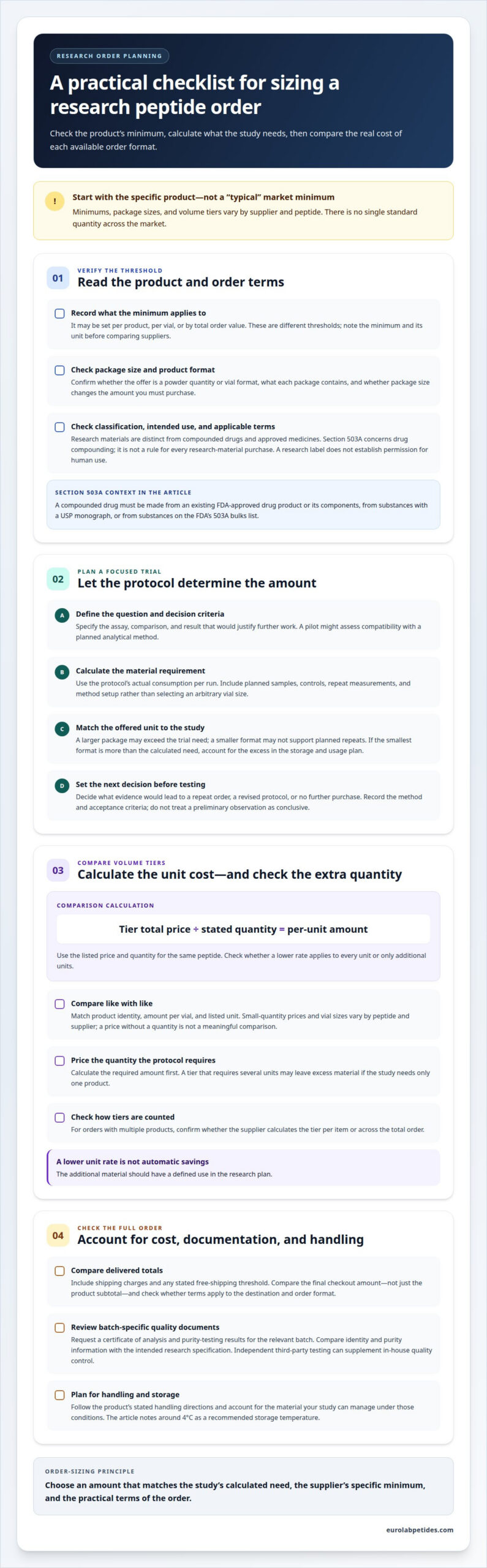
A small trial order isn’t necessarily the smallest order a supplier accepts. The minimum order quantity for research peptides varies by supplier and product, so there is no single standard quantity across the market. Start by checking the listed minimum, then assess whether it matches the amount your research requires.
It makes sense to prefer a smaller initial order when evaluating a material or planning a study. However, minimums, package sizes, and volume price tiers can affect whether that quantity is available and how the per-unit price changes as the order grows.
This guide explains how to interpret supplier minimums, assess small trial orders, and compare volume tiers without buying more than your work requires. It also covers the order details to consider alongside quantity, helping you choose an amount that fits your research plan and purchasing constraints.
Key Takeaways
- Determine the supplier’s minimum for the specific peptide and order format; there isn’t one standard quantity across suppliers.
- Assess whether a small initial order is sufficient for your research plan before choosing an order size.
- Compare volume tiers by their effect on per-unit pricing, but don’t let a discount alone drive the quantity.
- In the United States, focus on the supplier’s stated minimum and the research requirements; a single typical minimum doesn’t apply across the market.
Minimum order quantity and supplier minimums
Check the supplier’s stated minimum for the specific product and order format. Distinguish research materials from compounded drugs, as different rules and purchasing terms may apply.
-
Check Applicable Purchasing Rules
Identify the product’s intended use and legal category before placing an order. For compounded drugs, Section 503A sets specific conditions. According to United States Code, under Section 503A, a compounded drug must be made from an existing FDA-approved drug product or its components, from substances with a USP monograph, or from substances on the FDA’s 503A bulks list. That rule concerns drug compounding, not every research-material purchase. Don’t treat a research-only product as an approved medicine.
-
Compare Supplier Minimums
Read the product page and order terms to see how the supplier defines its minimum. It may apply per product, per vial, or to the total order value; these are different thresholds. A per-vial minimum, for instance, may require a set quantity of one item, while an order-value minimum may let several products count toward the total. Check whether package size changes the amount you must purchase. Record the threshold and its unit before comparing options.
- Determine whether individual purchase is permitted by reviewing the product classification, intended use, seller terms, and applicable federal and state rules. Research-only products are distinct from approved medicines in their evidence, quality controls, and instructions. A research label does not establish permission for human use.
- Calculate the delivered total for a small order, including shipping charges and any stated free-shipping threshold. These terms vary by seller and can change the relative cost of ordering one vial versus combining products. Compare the final checkout amount, not just the product subtotal. Don’t assume a threshold applies to every destination or order format.
- Request quality documentation for the relevant product batch, such as a certificate of analysis and purity-testing results. Compare the identity and purity information with the intended research specification. Independent third-party testing can supplement in-house quality control. A general product description is not the same as batch-specific analytical documentation.
- Review handling instructions before selecting an order quantity. Peptides may require controlled storage; around 4°C is recommended for storage. Use the product’s stated handling directions, maintain appropriate temperature during storage, and avoid exposure to unsuitable conditions. Quantity planning should account for the material your study can handle under those requirements.
Small trial orders
A trial order can help determine whether a research material fits a defined study. Set the study’s decision criteria before choosing how much material to order.
- Define the question the trial must answer. Specify the assay, comparison, and result that would justify further work. For example, a pilot can assess whether a candidate peptide is compatible with the planned analytical method. Keep the trial focused so the order supports a clear decision rather than leaving unused material.
- Translate the protocol into a material requirement. Calculate the quantity needed for planned samples, controls, repeat measurements, and method setup. Use the protocol’s actual consumption per run rather than choosing an arbitrary vial size. This makes the requested amount traceable to the experimental needs.
- Match the order format to the trial design. Check whether the supplier offers a powder quantity or vial format suited to the planned work. A larger package may exceed the trial requirement, while a smaller format may not support planned repeats. Compare the offered unit with the study’s calculated requirement.
- Distinguish product evaluation from study results. A trial may assess handling in an assay, analytical compatibility, or reproducibility under the specified protocol. Record the method and acceptance criteria before testing. Don’t treat a preliminary observation as conclusive evidence or extrapolate beyond the conditions evaluated.
- Plan the next decision before ordering. Define what evidence would lead to a repeat order, a revised protocol, or no further purchase. Include the supplier’s product identity and batch documentation in the evaluation record. If the smallest available format exceeds the calculated need, weigh the excess against the study’s storage and usage plan.
Volume-based price tiers
Compare each listed tier with the quantity your research plan requires. A lower per-unit price matters only when the additional material has a defined use.
-
Compare Volume-Based Price Tiers
Record the quantity and displayed price at each tier for the same peptide. Calculate the per-unit amount by dividing the tier’s total price by its stated quantity. Then compare the tiers, including whether the lower rate applies to every unit or only additional units. For example, a tier may require more than the study plans to use. Don’t mistake a lower unit rate for automatic savings.
-
Review Small-Quantity Prices and Vial Sizes
Check the product listing for its smallest offered vial or package, stated contents, and price. Small-quantity prices and vial sizes vary by peptide and supplier, so there is no typical price or format for all research peptides. Compare like with like: the product identity, amount per vial, and listed unit must match. A price without a quantity does not support a meaningful comparison.
- Calculate the total for the amount your protocol requires instead of choosing a tier first. Include the number of units in the package and any order conditions shown at checkout. If a study needs one product, a tier requiring several units may leave excess material. If it needs multiple products, check whether the supplier calculates tiers per item or across the order.
- Keep price comparisons separate from analytical suitability. Two listings may have different unit prices because their product formats or documented specifications differ. Compare product identity and available batch documentation alongside quantity and tier. For instance, don’t compare vials with different stated quantities as though they contained equivalent amounts.
- Use a simple comparison record before deciding: peptide name, vial contents, order quantity, tier price, and calculated per-unit amount. Note the study’s required quantity alongside these details. This makes the trade-off clear: a tier may reduce unit cost, but the relevant measure is the cost of the usable amount required for the planned work.
What is the typical minimum order quantity for research peptides in the United States?
There is no single U.S. minimum that applies across research peptide suppliers. Find the applicable quantity in the specific product listing and ordering terms.
- Start with the supplier’s product page. Record the listed peptide, package format, and minimum purchase unit. The minimum may be stated as a vial, a quantity per product, or a total-order threshold. These describe different purchasing requirements, so don’t treat them as interchangeable. A stated minimum is useful only when its unit is clear.
- Separate the supplier’s order minimum from the amount your study needs. For example, a protocol may require less material than the smallest package available. In that case, compare the package quantity with planned assay runs, controls, and repeat measurements. The package minimum reflects the seller’s terms, not a universal research standard.
- Check whether the threshold applies to each peptide or the whole cart. A per-product minimum may require separate quantities for different materials. A total-order minimum may let multiple products count toward the threshold. Read the conditions alongside the listed unit, then calculate the order before checkout.
- Use a consistent comparison record for U.S. listings: product identity, quantity per package, minimum units, and order threshold. This helps prevent confusion between vial count and total peptide content. If one listing gives a package size and another gives a required unit count, compare the resulting total quantity, not the labels alone.
- Choose an order that meets both the seller’s terms and the study plan. Don’t assume every peptide or supplier offers a small trial order. Base your decision on the listed format and the research quantity calculated from the protocol. This gives you a defensible order size without relying on an industry-wide figure.
EuroLab Peptides
EuroLab Peptides supplies research-grade peptides for studies in longevity, weight management, tissue repair, and cognitive function. To assess order quantity, match the product and package to your research plan, then review the product information and quality documentation.
Product quality is assessed through in-house and independent third-party laboratory testing to support evaluation of purity and consistency. Consider this evidence alongside the supplier’s stated minimums and package formats when making a purchasing decision.
For research focused on these areas, EuroLab Peptides offers relevant research categories, including Longevity & Vitality Research, Weight Management Research, Tissue Repair & Recovery Research, and Cognitive Function Research. Contact EuroLab Peptides to discuss your research requirements.
Set your next order around the study
Make the next purchase decision part of your research design. Define what the material must support, how its performance will be assessed, and what findings would justify further work. This gives the order a clear purpose beyond meeting a supplier’s minimum. The minimum order quantity for research peptides should serve the study plan, not replace it.
EuroLab Peptides offers Longevity & Vitality Research, Weight Management Research, and Tissue Repair & Recovery Research. These categories help researchers identify materials aligned with their area of inquiry. Keep the intended research application and product information central as you prepare your requirements.
For questions about research requirements or product categories, contact EuroLab Peptides. A considered order is a practical starting point for focused, well-planned research.
Frequently Asked Questions
Can you start with a small trial order?
A small trial order is possible when the supplier’s package and purchase terms allow it. First define the assay question the trial should address, then choose a format suited to planned controls and repeat measurements. For example, an analytical compatibility check may require a different quantity from a multi-condition study. Tie the order to its research purpose and record the batch identity.
What is a minimum order for wholesale peptides, and how do volume tiers work?
A wholesale minimum is a supplier’s threshold for a qualifying purchase, not a standard quantity across the market. Volume tiers set different unit prices at order thresholds. Check how each tier is calculated: separate peptide line items may need to qualify individually, or combined purchases may count. Review the order summary before purchase to see which quantity qualifies and which tier applies.
Do bulk discounts or wholesale minimums apply to research peptides?
Bulk discounts and wholesale minimums are not universal; each supplier sets its own terms. Distinguish tiered pricing from a stated bulk discount, then identify the qualifying quantity and the items it covers. EuroLab Peptides’ products are sold strictly for in-vitro research and laboratory development, not for human consumption or clinical use. Don’t infer a wholesale threshold or discount from a product category alone.
