

A bulk peptide quote is only useful for comparison when the requested quantity and pack format are clear. There is no single minimum order quantity for every peptide or supplier, so getting a quote for bulk peptide orders starts with identifying the material and amount you need.
That distinction matters: vial count, fill weight, and the number of different peptides can all affect a quote. A concise request should identify your institution or business, research affiliation, peptide name, CAS number, required quantity or fill weight, purchase order reference, and any timeline constraints.
This guide explains what to include in a quote request, how volume tiers and multi-vial discounts may be structured, and which bulk packaging details to ask about. It also covers how to assess quote documentation, including batch records and testing, so you can compare the terms with your research requirements.
Key Takeaways
- State the peptide, CAS number, quantity or fill weight, and pack format clearly so a quote can be assessed against your research requirements.
- Volume pricing may depend on the quantity of each individual peptide, so clarify whether different materials can be combined toward a tier.
- For repeat quantities of the same product and pack size, ask how the supplier’s volume tiers affect the per-kit price.
- Specify the bulk packaging format you need and consider how batch documentation and testing information support your procurement review.
How do volume tiers work?
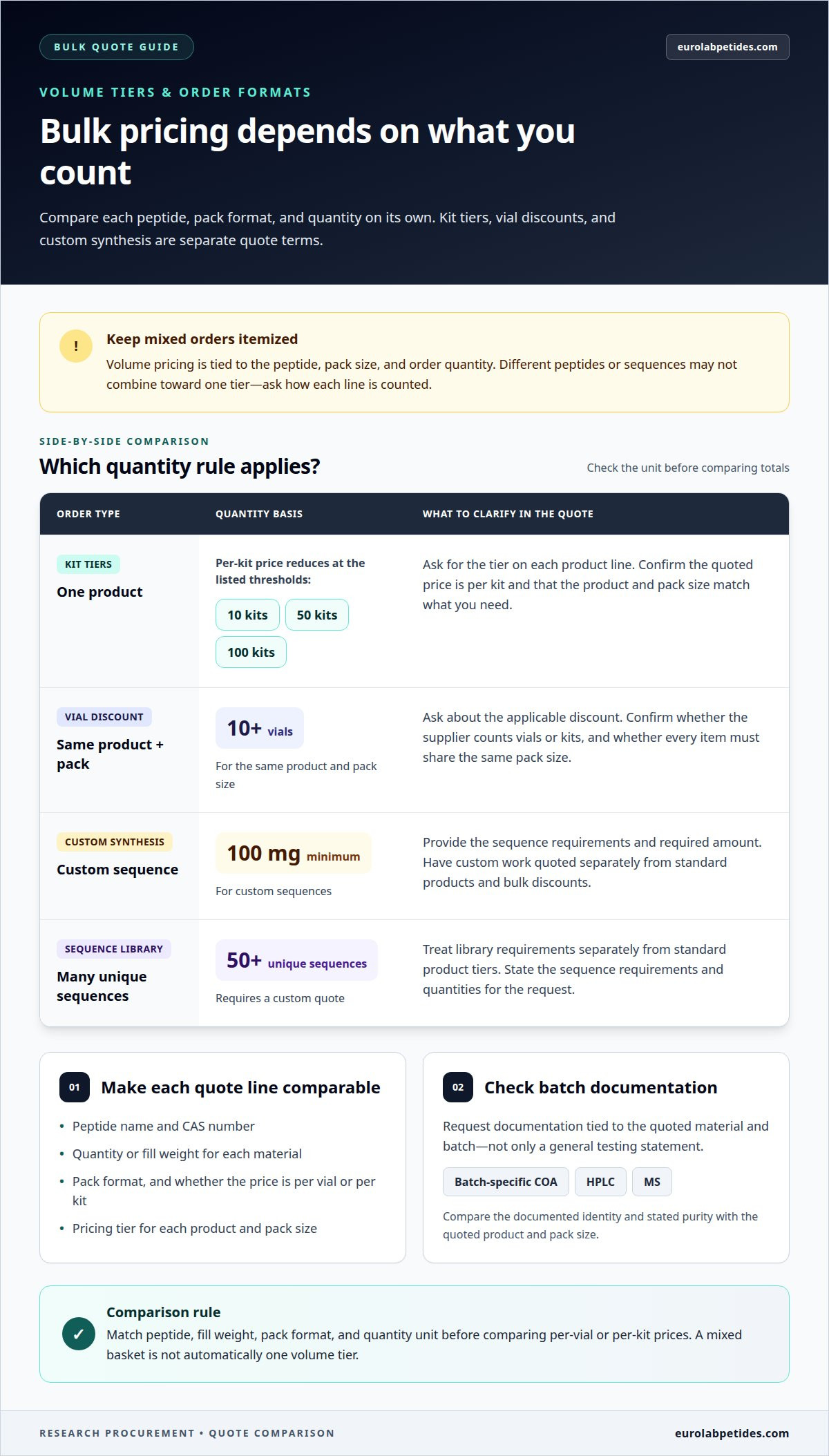
Volume pricing depends on the peptide, pack size, and order quantity. Compare the pricing tier for each peptide separately before treating a mixed order as one volume.
Per-Peptide Pricing and Mix-and-Match Eligibility
Per-peptide pricing ties each material to its own quantity and pack format. A mixed order may not qualify for a single combined tier. Ask how each peptide is counted, and whether different sequences or products can be combined. Custom sequences have a 100 mg minimum, while libraries containing 50 or more unique sequences require a custom quote. Those terms distinguish standard bulk orders from custom synthesis.
Factory-Direct Bulk Pricing
A factory-direct quote should distinguish peptide pricing from the requested pack format. It should identify each material, its quantity, and whether the price is per vial or per kit. This lets you compare the same research-use-only material across order sizes. For a custom request, include the sequence requirements and quantity so the work can be quoted separately from standard products.
Volume-Based Pricing Tiers
Tiered bulk pricing commonly applies to defined quantities of one product, rather than a mixed basket. The described kit tiers reduce the per-kit price at 10, 50, and 100 kits of a product. Customers ordering 10 or more vials of the same product and pack size are directed to inquire about a discount. Ask whether the threshold counts kits or vials, and whether every item must share the same pack size. This step clarifies eligibility before comparing totals.
Custom synthesis and bulk discounts are separate quote terms. Custom sequences have a 100 mg minimum, and libraries of 50 or more unique sequences need a custom quote; kit tiers are tied to individual products.
U.S. requirements can differ for ordering, importing, and selling research peptides. Product classification and intended use affect which requirements apply, so a bulk quote alone does not establish whether a transaction is permitted.
There is no single useful U.S. price range for all peptides. Compare itemized pricing by peptide, quantity, fill weight, pack size, and whether custom synthesis is involved.
What suppliers need to prepare a bulk peptide quote
Getting a quote for bulk peptide orders starts with an identifiable research organization and a clearly defined material request. Include details that distinguish the peptide, quantity, pack format, and procurement timeline. A laboratory should state its research affiliation and any purchase order reference. These details help route the request for commercial and technical review.
Include these request details:
- Institution or business name and research affiliation
- Peptide name and CAS number
- Required quantity or fill weight for each material
- Purchase order, if applicable
- Timeline constraints and requested pack format
- Labeling requirements for the facility’s receiving process
For 10 or more vials of the same product and pack size, request the applicable discount. Keep each peptide and pack size itemized. This lets the supplier assess each line separately, rather than treating unrelated materials as one combined order. State whether the requested amount means vial count or fill weight.
A wholesale quote review should consider material identity, quantity, packaging, and timing. Clear identifiers reduce confusion between similar peptide names, while a purchase order supports the buyer’s procurement process. For custom synthesis, specify the sequence and required amount separately to distinguish custom requirements from standard products in the quote.
To streamline getting a quote for bulk peptide orders, state your documentation needs in the initial request. For example, specify whether you require batch-specific certificate-of-analysis documentation and identify the relevant testing information. Third-party batch testing includes HPLC and MS. State any labeling needs too, so the quote reflects your requested format.
Multi-vial discounts for the same product and pack size
Discount eligibility depends on matching both the product and its pack size. The listed per-kit price drops at 10, 50, and 100 kits of one product. Customers ordering 10 or more vials of the same product and pack size are asked to inquire about the discount. These thresholds are separate from a mixed order containing several peptides.
Compare offers item by item. Match the peptide name, fill weight, and pack format before assessing the price per vial or kit. For example, two quotes for the same peptide may not be comparable if one lists vials and the other lists kits. Ask the supplier to identify the pricing tier for each line and clarify whether the quantity refers to kits or vials.
Product specifications matter alongside discount terms. A catalog purity statement, such as “99%,” should be read with its analytical context, not treated as a complete quality assessment. Look for batch-specific documentation and identify the analytical methods used. Third-party testing for each batch includes HPLC and MS. These methods provide analytical information, but the quote should still connect documentation to the specific product and batch.
A certificate of analysis should identify the batch and report relevant test results. Compare the peptide identity and stated purity in the document with the quoted catalog item and pack size. A general statement about testing is less informative than documentation tied to the quoted material. Clarify whether the specification applies to each batch or describes a general product standard.
What risks should buyers check for when evaluating bulk peptide suppliers? Key risks include unclear product identity, unsupported purity claims, and a certificate of analysis that cannot be linked to the quoted batch. Check that the quote identifies the exact product, pack size, testing information, and discount tier.
Finally, review the quote-validity statement and the period it specifies in business days. This helps procurement teams compare offers on equivalent terms without assuming that all suppliers use the same validity window.
Bulk packaging options
Packaging affects how a bulk order is received, identified, and tracked. A kit contains 10 vials, so state whether your requested quantity refers to kits or individual vials. Also specify the fill weight and preferred packaging format for each peptide. This gives the supplier a defined basis for preparing the quotation.
Ask how each unit will be identified and documented. The product name, batch identification, fill weight, and research-use-only labeling help distinguish materials during laboratory receiving and storage. If your facility has specific labeling requirements, describe them in the quote request. Do not assume a label for human or veterinary use is interchangeable with research-use-only documentation.
Private-label packaging is a separate arrangement from standard bulk orders. The stated minimum for a supplier’s private-label program is 100 vials per peptide. Its payment terms require a 50% deposit, with the remaining 50% due before shipment. Treat these as program-specific terms, not as general payment conditions for every bulk purchase.
Consider packaging and manufacture together. A custom label may affect the production workflow, documentation, and order schedule. Include the requested label content and packaging format when asking for a quote. This lets the supplier reflect your requirements in the commercial terms rather than pricing an assumed standard configuration.
Keep the use designation precise. Represent research-use-only materials as such, not as verified for human or veterinary use. A packaging request does not establish suitability for another purpose. Align the product description, labeling, and supporting batch documents with the intended research context.
Before accepting a quote, confirm that the listed vial count, kit count, fill weight, label format, and payment terms match the order. For example, a request for kits should state the kit quantity, since each kit contains 10 vials. This simple distinction helps prevent discrepancies between the quoted package and the receiving record.
EuroLab Peptides
EuroLab Peptides supplies research-grade peptides for scientific work, using in-house and independent third-party laboratory testing as part of its quality-control process. For research related to longevity, weight management, tissue repair, or cognitive function, specify the material, quantity, and packaging needs relevant to your project.
This is a practical next step once your procurement criteria are defined and you’re ready to discuss a bulk order. Quality-control information can support your technical review, while the quantities and formats you request clarify the scope of the quote. EuroLab Peptides’ offerings are for research only, not human consumption, medical advice, or pharmaceutical use.
Contact EuroLab Peptides to discuss your research requirements and bulk order request.
Move Your Research Procurement Forward
Use the quote process to align procurement with your research program. A well-defined request connects material selection, documentation, packaging, and internal purchasing review from the outset. When getting a quote for bulk peptide orders, clearly state your research scope and the procurement details that matter to your facility.
EuroLab Peptides offers Longevity & Vitality Research, Weight Management Research, and Tissue Repair & Recovery Research products for scientific research. These areas can help you frame a request around your research focus, while your institution remains responsible for its own evaluation.
Contact EuroLab Peptides for a quote and move your procurement request forward with clearly defined research requirements.
Frequently Asked Questions
What is the minimum order quantity?
Minimums depend on the product and order type. The listed minimum for each peptide in the popular-peptides table is 10 vials. Custom peptide sequences have a 100 mg minimum, while private-label orders have a 100-vial minimum per peptide. These are different order formats, so identify whether you need a catalog peptide, custom sequence, or private-label arrangement before assessing the minimum.
Can you start with a small trial order?
A small initial order may be possible when the selected product’s minimum allows it. For example, a listed minimum of 10 vials would set the entry point for that peptide, rather than allowing a single-vial trial. A research team can begin with one material and a defined quantity, then plan later procurement around study requirements and documented batch characteristics.
How do you compare prices across suppliers?
Compare equivalent specifications, not just the total quoted amount. A useful comparison matches peptide identity, quantity, fill weight, packaging, testing documentation, and shipping terms. For example, a quote for one kit should not be compared directly with a quote for a different vial count. Record each supplier’s terms in the same format, then identify differences that affect the order’s suitability.
Is a Certificate of Analysis included with every order?
Each order includes batch certificate-of-analysis documentation. Check whether the document identifies the supplied batch and corresponds to the material on the order. A general product sheet and a batch-specific certificate serve different purposes. Keep the relevant certificate with your procurement record so the research team can trace the documentation to the received lot.
What happens with very large orders?
Large quantities can reach different pricing tiers or require a custom quotation, depending on the order structure. The listed per-kit price drops at 10, 50, and 100 kits of a product. A library containing 50 or more unique sequences requires a custom quote. Separate standard products from custom sequence requirements so the supplier can assess each part clearly.
What is the lead time for custom orders or blends?
Lead time depends on the order requirements, including sequence customization, batch manufacture, testing, and packaging. A blend may have different specifications from a standard catalog item, so its preparation schedule can depend on the requested composition and documentation. Include your required delivery window and complete technical details in the request so timing can be considered as part of the quote.
