

A supplier’s claims are only as useful as the evidence behind them. Knowing how to vet a research chemical company starts with defining the review’s purpose and scope, then assessing documentation for each chemical. For every chemical under review, gather its safety data sheet (SDS) and any relevant safety-related standard operating procedure (SOP).
A sound safety review considers more than a product description. Its value depends on whether the information clearly identifies potential hazards and describes procedures relevant to the intended research use.
This article explains how to assess a company’s chemical review purpose and scope, what an SDS and SOP contribute, and how to submit these documents so they can inform the review. It also outlines the records and safety considerations that help make the process more transparent and useful.
Key Takeaways
- Assess whether a supplier’s business identity, address, and ownership records are consistent and traceable.
- Use a certificate of analysis to understand what was tested, which method was used, and whether the results match the chemical under review.
- Distinguish independent laboratory testing from supplier testing by examining the laboratory’s role and the analytical methods reported.
- Evaluate safety documentation against the purpose and scope of your review so the evidence supports a clear, research-specific assessment.
What credentials and business records should a research chemical supplier provide?
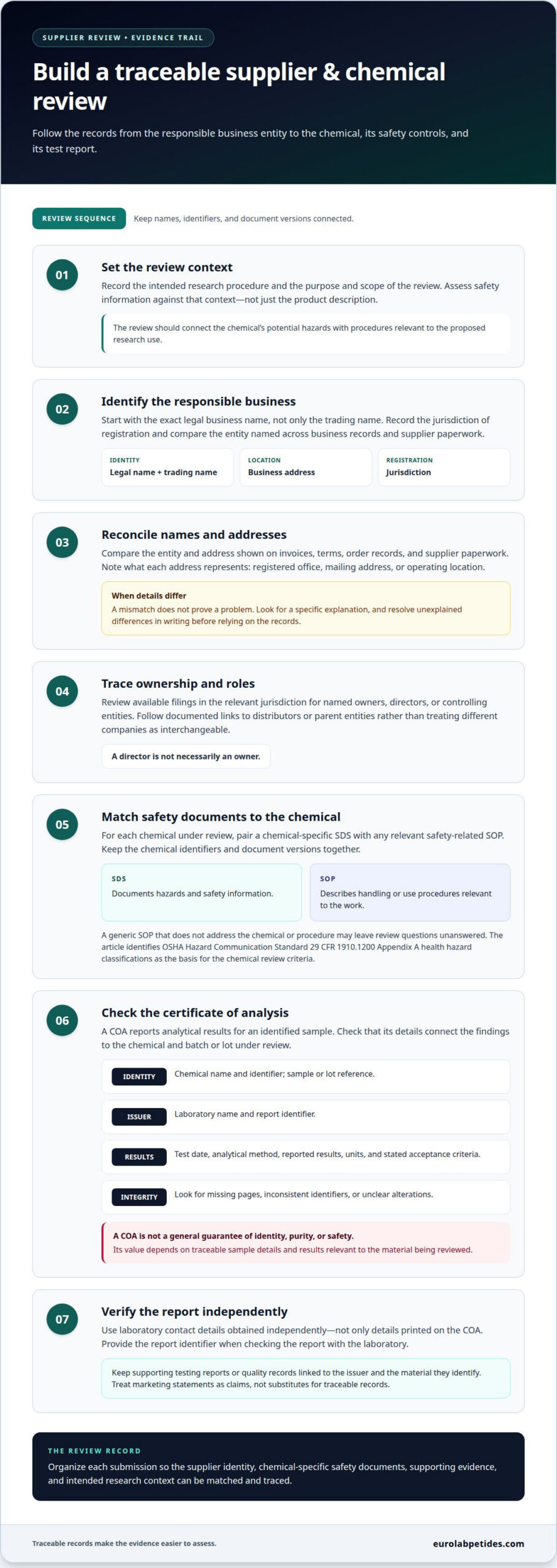
Separate business identity records from chemical safety documents. Record the supplier’s legal business name, operating address, and jurisdiction of registration. These details help identify the entity responsible for the transaction and its records. Compare the name across invoices, product documentation, and correspondence. If the names differ, the entities may be separate legal parties, so clarify their relationship before relying on the records.
Credentials should be relevant to the activity being represented. A supplier claiming independent testing, for example, should identify the laboratory and provide reports tied to the material. A quality certificate should identify its issuer and scope. Treat marketing statements as claims, not as substitutes for traceable records. The chemical review criteria are based on health hazard classifications in OSHA Hazard Communication Standard 29 CFR 1910.1200 Appendix A, according to the U.S. Occupational Safety and Health Administration.
For each chemical under review, use its safety data sheet (SDS) and any relevant safety-related standard operating procedure (SOP). The SDS documents hazards and safety information; the SOP describes relevant handling or use procedures. Together, they connect a chemical’s hazards with the controls proposed for the work. A generic SOP that does not address the chemical or procedure may leave important review questions unanswered.
Organize the submission so each record can be matched to the exact chemical and research context. Include:
- Supplier identity: legal name, business address, and registration jurisdiction.
- Chemical documentation: a chemical-specific SDS and related safety SOP.
- Supporting evidence: testing reports or quality records, with issuer and material identified.
- Review context: intended research procedure and the safety controls described in its SOP.
The Right to Know Law gives workers the right to know which chemicals they are exposed to at work. Clear records support that information flow and help reviewers assess hazards in relation to proposed procedures. Keep document versions and chemical identifiers together so each record can be traced to the material under consideration.
How can you verify a research chemical company’s identity, address, and ownership?
Start with the supplier’s exact legal name, rather than its trading name. Search that name in the business register for its stated jurisdiction, where a public register is available. Compare the registered entity with the names on invoices, terms, and order records. A trading name, for example, may differ from the legal entity responsible for a transaction. The supplier’s documents should make that relationship clear.
Next, compare the address across business records and supplier paperwork. Note whether each record gives a registered office, mailing address, or operating location, since these serve different purposes. A mismatch does not prove a problem, but it should have a specific explanation. For example, a registered office may belong to an administrative agent, while correspondence uses another address.
- Identity: Record the legal name, trading name, and jurisdiction shown in business documents.
- Address: Identify the type of address and compare it across records.
- Ownership: Review available filings for named owners, directors, or controlling entities.
Ownership records can help distinguish a supplier from a distributor or parent entity. Review available filings in the relevant jurisdiction to identify who owns or controls the entity and who holds director roles. A director is not necessarily an owner. If another company appears in the ownership chain, trace the documented relationship rather than treating the entities as interchangeable.
Create a simple consistency record listing each document, the entity name and address it uses, and the role it states. Compare this with the supplier’s order and safety paperwork. A name change, unexplained address mismatch, or different contracting entity can affect accountability for the transaction. Resolve discrepancies in writing before relying on the records. This creates a traceable picture of identity and ownership without assuming that one address or label tells the whole story.
What is a certificate of analysis, and how can you verify it independently?
A certificate of analysis (COA) records analytical results for an identified sample. It should link the findings to a chemical, batch or lot, and issuing laboratory. A COA is not a general guarantee of identity, purity, or safety. Its value depends on traceable sample details and results relevant to the material under review.
Read the COA as a set of connected fields. Check the chemical name and identifier, sample or lot reference, test date, laboratory name, analytical method, and reported result. Confirm that units and any acceptance criteria are clear. For example, a purity result without a named method or sample reference offers limited evidence about the material received.
- Sample identity: Match the chemical name and batch or lot reference to the material documentation.
- Laboratory identity: Record the issuing laboratory’s full name and report identifier.
- Analytical details: Note the method, test date, results, units, and stated criteria.
- Document integrity: Look for missing pages, inconsistent identifiers, or unclear alterations.
Verify the report with the laboratory using contact details obtained independently, rather than relying only on information printed on the COA. Give the report identifier and ask whether the laboratory issued it. Confirm that the chemical identity, sample reference, and results match its record. This checks the document’s provenance, not whether the tested sample represents every unit or later batch.
Then check the link to the sample. A COA applies to the sample described in that report; it does not automatically establish results for another lot. Compare the lot reference with the supplier’s product documentation and the material under review. If the identifiers differ, the report may concern another sample. Record the discrepancy and its explanation in the review file.
Finally, interpret the findings within their stated scope. An analytical result answers a specific test question; it does not replace hazard documentation or establish suitability for every research procedure. When assessing how to vet a research chemical company, treat the COA as one evidence record alongside chemical-specific safety documents and the intended research context.
How do third-party laboratory testing and analytical methods differ among suppliers
Testing varies by who performs it, what is measured, and how results are reported. In-house testing can support routine quality control within a supplier’s process. Independent third-party testing adds analysis by an external laboratory. Neither label alone shows what a report demonstrates. The sample identity, analytical method, and reported result define its evidential value.
Compare the test objective with the claim being assessed. A method designed to estimate purity does not necessarily identify every component in a sample. For example, high-performance liquid chromatography (HPLC) separates components for analysis. Liquid chromatography-mass spectrometry (LC-MS) combines separation with mass-related information. The appropriate method depends on the analyte and the question.
- Laboratory role: Identify whether testing was performed in-house or by an independent laboratory.
- Sample traceability: Match the tested material to its batch or lot record.
- Method: Note the method name and the analytical purpose it serves.
- Reported results: Review analytes, units, and any stated acceptance criteria.
Reports from different suppliers may use different methods or levels of detail. One may state a result without describing the analytical procedure; another may identify the laboratory, method, sample reference, and result. This affects how readily a reviewer can interpret and trace the evidence. A clear report connects these elements rather than relying on a broad testing claim.
Assess the laboratory’s role as well as its name. A supplier may arrange external analysis, but the report may still leave sample handling or batch linkage unclear. Record who performed the test, what sample was analyzed, and whether the method addresses the relevant question. These details help distinguish an independent result from an unsupported summary.
For research materials supported by layered quality control, explore research-grade peptide materials and their testing information as part of your supplier assessment.
An Integrated Testing Strategy weighs available evidence before considering further testing. This may include exposure, chemical properties, laboratory and computational data, toxicological and epidemiological data, and information about similar chemicals.
EuroLab Peptides
EuroLab Peptides supplies research-grade peptides for scientific research, with quality control that includes in-house and independent third-party laboratory testing. Its offerings may suit projects in areas such as Longevity & Vitality Research, Weight Management Research, Tissue Repair & Recovery Research, and Cognitive Function Research.
Use the review criteria described above to evaluate documentation in context: confirm the material’s identity, examine the analytical evidence, and consider whether the available records support your research requirements. EuroLab Peptides’ research offerings provide a relevant starting point for investigators assessing peptide materials for these fields. The products are for research use, not human consumption, and are not medical advice or medicines.
Contact EuroLab Peptides to discuss research materials relevant to your project.
Build a Consistent Review Standard
Make supplier assessment part of research planning, not a last-minute purchasing check. Define the evidence your team needs before evaluating a material, then apply the same criteria consistently across projects. A concise review record preserves the reasoning behind decisions and helps colleagues understand the evidence supporting a research choice.
The principles behind how to vet a research chemical company are most useful when they support repeatable decisions. Keep the intended research area central, and distinguish product documentation from conclusions about suitability for a particular protocol. EuroLab Peptides offers Longevity & Vitality Research, Weight Management Research, and Tissue Repair & Recovery Research materials for scientific research.
When those research areas align with your work, discuss your research needs with EuroLab Peptides. A clear scope and evidence-based approach can help your team move forward with greater consistency.
Frequently Asked Questions
What U.S. laws and regulations apply to research chemicals and their sale?
The article says chemical review criteria are based on health hazard classifications in OSHA Hazard Communication Standard 29 CFR 1910.1200 Appendix A. It also notes that the Right to Know Law gives workers the right to know which chemicals they are exposed to at work.
What are common scams and warning signs when buying research chemicals?
Warning signs include unexplained differences in the supplier’s legal name or address, unclear relationships between entities, and marketing claims without traceable records. A COA with missing sample details, unclear methods, inconsistent identifiers, or results that do not match the material also provides limited evidence.
What liability, payment, and data-security risks should buyers consider when vetting a chemical supplier?
An unexplained change in the contracting entity or an address mismatch can affect accountability for a transaction. Resolve discrepancies in writing before relying on the records. This review focuses on supplier identity and chemical documentation, not payment or data-security practices.
