

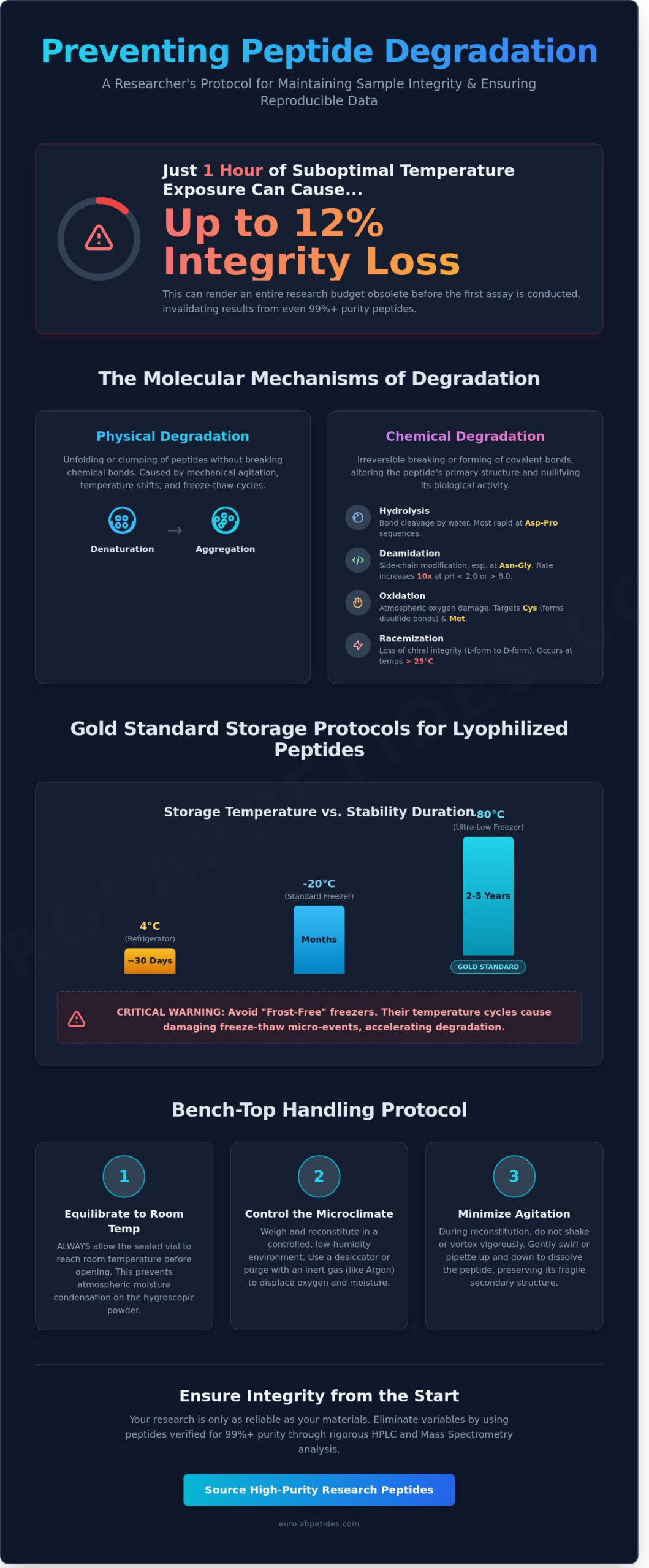
A single hour of exposure to suboptimal temperatures can reduce the secondary structure integrity of a synthetic peptide by up to 12%, rendering an entire research budget obsolete before the first assay is even conducted. You’ve likely observed that even a 99%+ purity rating cannot survive improper handling or the inadvertent introduction of atmospheric moisture during the weighing process. Mastering how to prevent peptide degradation is a fundamental requirement for any researcher seeking to eliminate the variables that lead to inconsistent experimental data and wasted resources.
This professional guide outlines the rigorous protocols required to maintain peptide structural integrity and ensure reproducible research results across every batch. We’ll provide a comprehensive analysis of chemical vulnerabilities such as oxidation and deamidation while establishing precise Standard Operating Procedures (SOPs) for long-term cryogenic storage and reconstitution. By implementing these stringent laboratory standards, you’ll maximize sample longevity and protect the integrity of your scientific inquiry through 2026 and beyond.
Key Takeaways
- Identify specific sequence vulnerabilities, such as Aspartic acid and Cysteine residues, to mitigate inherent biochemical instability from the outset.
- Master the technical requirements for long-term storage and learn how to prevent peptide degradation by maintaining stringent temperature controls between -20°C and -80°C.
- Optimize the laboratory microclimate by utilizing inert gas purging and avoiding the thermal fluctuations inherent in “frost-free” refrigeration systems.
- Standardize your reconstitution protocols to minimize mechanical agitation and preserve the critical secondary structural integrity of delicate peptide chains.
- Validate the reliability of your research data by ensuring all sequences are verified for 99%+ purity through rigorous HPLC and Mass Spectrometry analysis.
The Molecular Mechanisms of Peptide Degradation
Peptide degradation is the irreversible loss of primary and secondary structural integrity within a synthetic sequence. Understanding The Molecular Mechanisms of Peptide Degradation is essential for maintaining the 99%+ purity required in clinical research. When the primary structure is compromised through chemical cleavage or the secondary structure is lost via denaturation, the peptide’s biological activity is nullified. This degradation compromises research reproducibility. Even a 3% variance in purity leads to inconsistent data in high-stakes assays. Identifying these vulnerabilities is fundamental to mastering how to prevent peptide degradation in a professional setting.
The distinction between physical and chemical degradation is critical for laboratory protocols. Physical degradation involves denaturation, where the peptide unfolds or aggregates without breaking covalent bonds. Chemical degradation involves the modification of the peptide through the breaking or forming of new bonds. Both processes render a sample useless for precise quantification. Inherent stability is largely dictated by the amino acid sequence, with specific residues like Aspartic Acid (Asp), Cysteine (Cys), and Methionine (Met) serving as primary points of failure.
Common Chemical Pathways: Hydrolysis and Deamidation
Hydrolysis and deamidation represent the most frequent chemical transitions that compromise sample integrity. Acid-catalyzed hydrolysis occurs most rapidly at Asp-Pro sequences. In these sequences, the peptide bond is particularly labile. Deamidation of Asn-Gly sequences results in the formation of inactive iso-aspartate analogs, which can’t be easily detected without high-resolution HPLC. These processes are highly pH-dependent. At pH levels below 2.0 or above 8.0, the rate of deamidation increases by a factor of 10. This fundamentally alters the peptide’s mass spectrometry profile and biological efficacy.
Oxidation and Racemization
Cysteine and Methionine are the primary targets for oxidative stress. Cysteine oxidation often leads to the unintended formation of disulfide bonds. This disrupts native folding patterns and triggers rapid aggregation. While Methionine oxidation is sometimes reversible with specific reducing agents, it remains a primary cause of lost potency in aqueous solutions. Racemization involves the loss of chiral integrity at the alpha-carbon. This typically occurs during long-term storage at temperatures exceeding 25 degrees Celsius. The shift from L-form to D-form amino acids renders the peptide unrecognizable to target receptors, effectively ending the experiment’s viability. Researchers must implement stringent storage conditions to counteract these specific chemical shifts.
Storage Protocols for Lyophilized and Reconstituted Peptides
Lyophilization is the definitive industry standard for ensuring long-term peptide integrity. By removing moisture through the process of sublimation, the chemical structure is locked into a solid state. This physical transition minimizes the risk of hydrolysis and deamidation, which are the primary drivers of chemical instability. Understanding how to prevent peptide degradation starts with recognizing that even in a freeze-dried state, these molecules remain sensitive to their environment. While a lyophilized powder may remain stable at 4°C for approximately 30 days, any project requiring extended timelines necessitates a significant reduction in thermal energy.
Peptides are inherently hygroscopic, meaning they actively attract and hold water molecules from the surrounding atmosphere. This characteristic presents a significant risk during sample dispensing. If a cold vial is opened in a high-humidity environment, moisture will immediately condense on the powder. This introduces enough water to trigger degradation even if the vial is returned to the freezer. To maintain the 99%+ purity verified by HPLC analysis, researchers must allow vials to equilibrate to room temperature within a controlled environment before breaking the seal.
The Gold Standard: Long-Term Lyophilized Storage
Maintaining a constant temperature of -80°C is the most effective protocol for ensuring multi-year stability. At these ultra-low temperatures, molecular motion is virtually halted, preserving the primary sequence for 2 to 5 years. If -80°C is unavailable, a standard -20°C medical freezer is acceptable for shorter durations, provided it’s a non-frost-free model. Frost-free units utilize temperature cycles that can cause damaging freeze-thaw micro-events. Vials should be stored in a desiccator to provide an extra barrier against moisture. Since many sequences are vulnerable to photolysis, using amber glass or wrapping vials in foil is a mandatory stringent requirement to prevent light-induced cleavage.
Handling Solution-Phase Peptides
Once a peptide is transitioned into the liquid phase, its shelf-life drops from years to mere days or weeks. The chemical environment of the solvent dictates the rate of decay. Most sequences exhibit maximum stability within a narrow pH range of 3.0 to 6.0. While sterile saline is often used for immediate applications, bacteriostatic water containing 0.9% benzyl alcohol is preferred for multi-dose vials to inhibit microbial growth. However, researchers must verify that the specific peptide sequence isn’t sensitive to the oxidative potential of alcohols. High-quality 99%+ purity peptides should always be stored in borosilicate glass rather than plastic. Polypropylene containers can lead to the adsorption of hydrophobic peptides onto the vessel walls, which significantly reduces the effective concentration of the solution. If you’re working with these sensitive compounds, glass ensures the integrity of the concentration remains uncompromising.
Environmental Factors: Controlling the Laboratory Microclimate
Maintaining a controlled laboratory microclimate is the primary defense against sample loss. Researchers often overlook the hidden risks of standard storage equipment. For instance, “frost-free” freezers are unsuitable for long-term storage because they utilize internal heating elements to prevent ice buildup. These cycles cause temperature fluctuations of 5 to 10 degrees Celsius, which can trigger repeated micro-thawing at the molecular level. To understand how to prevent peptide degradation, one must prioritize high-stability, manual-defrost units that maintain a constant -20°C or -80°C environment.
Atmospheric exposure presents another significant threat. Oxygen reacts with specific residues, particularly methionine and cysteine, leading to sulfoxide formation and disulfide scrambling. Purging vial headspaces with high-purity inert gases like Nitrogen or Argon (99.999% purity) is a standard protocol for sensitive sequences. Argon is often preferred in European laboratories due to its higher density compared to air, which allows it to form a more effective protective blanket over the sample.
Photochemical degradation also requires stringent management. UV exposure, even from standard overhead laboratory lighting, triggers free radical formation that cleaves peptide bonds. Using amber borosilicate vials or opaque foil wrapping mitigates this risk. Finally, sample concentration influences stability. Dilute solutions, typically those under 1.0 mg/mL, degrade faster than concentrated aliquots because a higher percentage of the peptide is exposed to the vial surface and dissolved oxygen.
Freeze-Thaw Cycles and Structural Stress
The physical mechanics of freezing can be as damaging as heat. As water crystallizes into ice, the resulting expansion creates mechanical shearing forces that break delicate peptide chains. These crystals also exclude solutes, creating pockets of high salt concentration that alter the local pH and ionic strength. This environment promotes secondary structure denaturation and irreversible aggregation. To bypass these issues, researchers must implement precise aliquoting strategies. By dividing a bulk sample into single-use volumes, you eliminate the need for repeated thermal cycling. To ensure maximum stability, adopt a strict aliquot-once policy where each vial is thawed exactly one time for immediate experimental use.
pH and Buffer Selection
Chemical stability is heavily dependent on the hydrogen ion concentration of the solvent. Basic environments where the pH exceeds 8.0 accelerate base-catalyzed reactions, such as deamidation of asparagine or glutamine residues. When determining how to prevent peptide degradation during storage, the choice of buffer is critical. Non-volatile buffers like ammonium acetate or ammonium bicarbonate are essential for samples intended for future re-lyophilization, as they sublimate along with the water. Furthermore, salt concentration must be monitored. High ionic strength often reduces the solubility of hydrophobic peptides, leading to aggregation and loss of biological activity. Maintaining a slightly acidic pH (around 5.0 to 6.0) is generally the most stable configuration for the majority of synthetic sequences.
Bench-top Handling: A Step-by-Step Protocol for Researchers
The bench-top environment represents the highest risk phase for sample compromise. Understanding how to prevent peptide degradation requires a rigorous, standardized workflow that begins the moment a shipment arrives at the facility. Researchers must treat the transition from cold-chain transport to laboratory storage as a critical control point. Precision during these initial minutes determines the viability of the entire research project. If a protocol doesn’t prioritize immediate stabilization, the technical integrity of the sequence is at risk before the first aliquot is even drawn.
Receiving and Initial Inspection
Upon receipt, the integrity of the vacuum seal and the physical state of the lyophilized cake must be verified. A collapsed or discolored cake often indicates moisture ingress or thermal stress during transit. Each vial is transferred to deep-freeze storage at -20°C or -80°C immediately to maintain the 99%+ purity levels achieved during synthesis. Cross-referencing the Certificate of Analysis (CoA) is mandatory; this document contains sequence-specific warnings regarding hygroscopic properties or light sensitivity that dictate specific handling requirements. Any deviation from the expected appearance of the lyophilized material should be documented before the vial is opened to ensure lot-specific data remains accurate.
The Reconstitution Process
Reconstitution is a delicate procedure where excessive mechanical forces can disrupt the peptide’s secondary structure. Vortexing is generally discouraged because it introduces air bubbles and promotes surface-induced denaturation. Instead, gentle swirling or slow inversion is used to facilitate dissolution. To ensure precise molarity and avoid measurement errors, researchers should utilize the peptide reconstitution calculator before adding any solvent. Solvents must be degassed to remove dissolved oxygen, which prevents oxidative degradation of sensitive residues like Methionine or Cysteine. This step is a cornerstone of how to prevent peptide degradation during active experimentation.
Proteolysis often results from microbial introduction or contact with skin-surface enzymes. All handling occurs within a laminar flow hood using sterile, filtered pipette tips to maintain an aseptic environment. Documentation protocols must record the lot number, date of reconstitution, and the specific solvent used. This data is vital for tracking stability over time and ensuring that every experiment meets the uncompromising standards of European laboratory practice. By maintaining a meticulous log, researchers can correlate lot-specific stability with experimental outcomes and maintain a verifiable chain of custody for every milligram of material.
To ensure the integrity of your research, utilize only verified materials. Access our catalog of 99%+ purity peptides for your next study.
Ensuring Integrity with High-Purity Research Peptides
The foundation of long-term stability is established during the initial synthesis and purification phase. Impurities remaining after chemical synthesis often act as catalysts for unwanted chemical reactions, making the purification process the first critical step in how to prevent peptide degradation. At EuroLab Peptides, the synthesis of every sequence concludes with a rigorous purification protocol designed to meet European research standards. High-Performance Liquid Chromatography (HPLC) is utilized to isolate the target peptide from synthesis byproducts, while Mass Spectrometry confirms the exact molecular weight and structural identity. This multi-level quality control protocol ensures that 99%+ purity is a verifiable metric for every batch dispatched to the researcher.
A high-purity environment minimizes the presence of TFA (Trifluoroacetic acid) salts and moisture, both of which accelerate the breakdown of peptide bonds over time. By achieving a 99%+ purity threshold, the kinetic energy required for degradation is significantly increased, effectively extending the shelf life of the material before it even reaches your laboratory. Quality is not a marketing claim; it’s a structural requirement for experimental reproducibility.
Third-Party Verification as a Baseline
Internal metrics are insufficient for high-stakes scientific inquiry. Independent laboratory testing provides an objective audit of chemical integrity, identifying potential degradation products before they reach your bench. In 2026, sequence validation is mandatory for complex longevity research where even a single amino acid substitution or deletion can alter the entire experimental profile. These third-party reports verify that the peptide sequence remains intact and free from truncated sequences. Researchers should review the how to buy research peptides guide to understand the stringent criteria required for laboratory-grade procurement and verification.
Sourcing for Stability
To maximize chemical longevity, EuroLab provides peptides in their most stable lyophilized form. This advanced freeze-drying process removes aqueous solvents, which are the primary drivers of hydrolytic cleavage. By maintaining a moisture content typically below 2.5%, the molecular structure remains locked in a solid state, which is essential in how to prevent peptide degradation during transit and long-term storage. Customized storage recommendations are provided for every specific research stack, ensuring the transition from the warehouse to the laboratory freezer doesn’t compromise sample integrity. Explore our range of 99%+ purity research peptides to secure materials synthesized under the most uncompromising European standards.
Sustaining Analytical Integrity in Modern Research
Maintaining the structural integrity of your sequences requires rigorous adherence to established thermodynamic protocols. Understanding how to prevent peptide degradation involves more than simple refrigeration; it necessitates precise control over the laboratory microclimate and the total elimination of repeated freeze-thaw cycles. By implementing the 2026 standards for lyophilized storage and utilizing high-purity solvents during reconstitution, researchers ensure that chemical sequences remain stable for up to 24 months. Every analytical procedure depends on the initial quality of the compound. Lyophilization remains the industry gold standard for preserving secondary structures, providing maximum shelf-life stability across diverse environmental conditions.
When these protocols are paired with stringent European manufacturing standards, the risk of experimental variance is significantly reduced. It’s essential to verify every batch through third-party HPLC and Mass Spectrometry to maintain 99%+ purity benchmarks. These rigorous metrics provide the absolute security required for high-stakes scientific inquiry. Your next breakthrough relies on the uncompromising quality of your reagents. Secure your research with 99%+ purity peptides from EuroLab. Your commitment to precise methodology will yield the reliable data your research deserves.
Frequently Asked Questions
How long do lyophilized peptides stay stable at room temperature?
Lyophilized peptides remain stable at a room temperature of 25°C for a period of 2 to 4 weeks without significant loss of secondary structure. While this allows for standard international shipping durations, long-term storage requires temperatures of -20°C or -80°C to maintain 99%+ purity. Stability studies indicate that exposure to ambient heat for over 30 days can initiate minor deamidation or oxidation in sensitive sequences.
Can I refreeze a peptide solution after it’s been thawed?
Refreezing a peptide solution after it’s been thawed isn’t recommended as it promotes the formation of ice crystals that shear the molecular bonds. Each freeze-thaw cycle can result in a 10% to 15% reduction in active peptide concentration. To avoid this, researchers should aliquot the solution into single-use volumes immediately after reconstitution. This ensures the integrity of the remaining stock is preserved at -20°C.
What is the best solvent to prevent peptide degradation during reconstitution?
The optimal solvent depends on the sequence’s hydrophobicity, but sterile bacteriostatic water containing 0.9% benzyl alcohol is the standard for preventing microbial growth. For acidic peptides, a 0.1% solution of acetic acid may be required to achieve full solubility. Choosing the correct pH environment, typically between 5.0 and 7.0, is a critical step in how to prevent peptide degradation during the initial reconstitution phase.
How do I know if my peptide has already degraded?
Visual changes such as cloudiness or precipitate formation indicate advanced degradation, but sub-visual loss of potency requires analytical verification. High-Performance Liquid Chromatography (HPLC) remains the industry standard for determining if a sample has fallen below the required 99% purity threshold. If a mass spectrometry analysis shows a mass shift of 1 Dalton, it confirms deamidation has occurred, rendering the peptide unsuitable for high-precision research.
Does light exposure actually affect peptide potency?
Photolytic degradation occurs when peptides are exposed to UV light, particularly those containing aromatic amino acids like tryptophan or tyrosine. Research indicates that 24 hours of direct light exposure can catalyze the oxidation of sulfur-containing residues. To maintain uncompromising quality, all vials should be stored in light-resistant containers or amber glass to block wavelengths below 400 nm, protecting the integrity of the bond.
What happens if I store my peptides in a standard frost-free freezer?
Storing peptides in a standard frost-free freezer exposes them to repeated temperature fluctuations during the automatic defrost cycles. These cycles can cause the internal temperature to rise by 10°C, leading to localized melting and subsequent refreezing of the lyophilized cake. Such thermal instability compromises the long-term integrity of the sequence. A dedicated laboratory-grade manual defrost freezer set to a constant -20°C is required for scientific accuracy.
Is it better to store peptides in glass or plastic vials?
Type I borosilicate glass vials are superior for long-term storage because they offer high chemical resistance and minimize the leaching of alkaline ions. While polypropylene plastic is acceptable for short-term aliquots, peptides can adhere to the plastic walls through hydrophobic interactions, reducing the available concentration. Using high-recovery glass ensures that 100% of the synthesized material is available for the intended research application without surface adsorption losses.
Can I use bacteriostatic water for all research peptides?
Bacteriostatic water is suitable for most applications, but it’s not a universal solvent for every peptide sequence. The 0.9% benzyl alcohol used as a preservative can occasionally react with specific amino acid side chains or interfere with sensitive cell-based assays. Understanding the specific chemical properties of your sequence is essential when determining how to prevent peptide degradation and ensuring the absolute accuracy of your experimental data over a 12-month period.
