

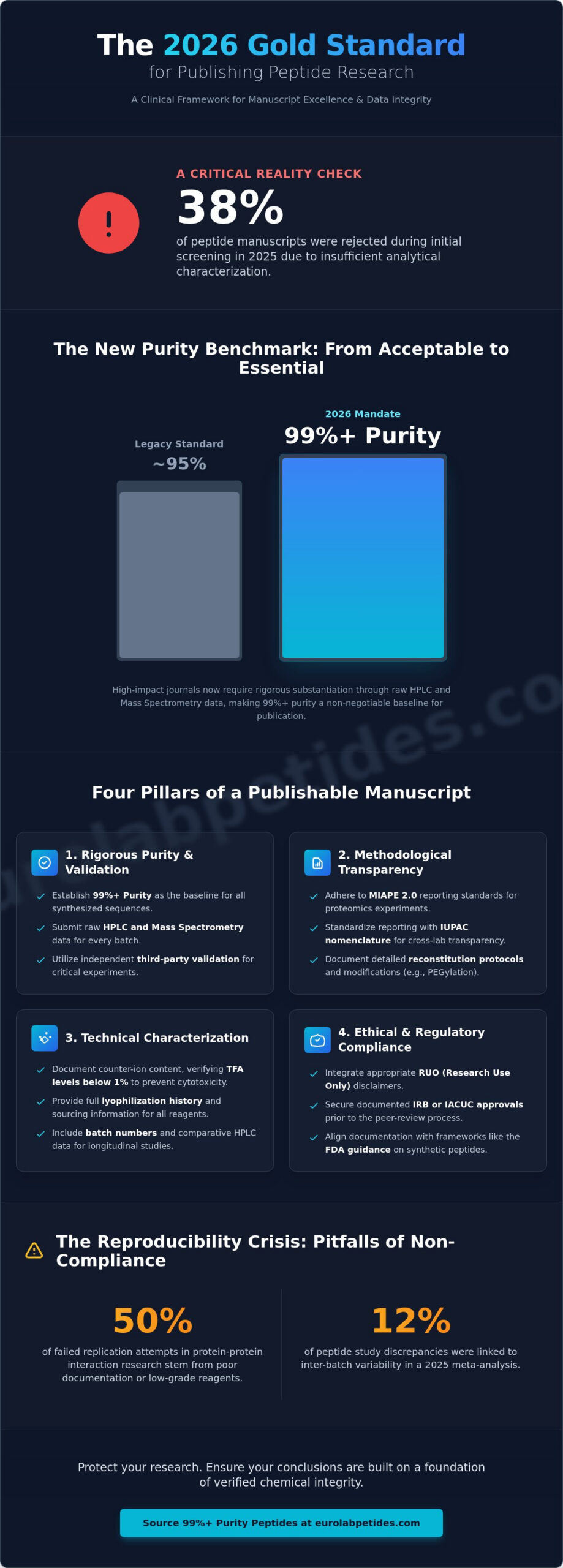
In 2025, approximately 38% of submitted peptide manuscripts were rejected during initial screening due to insufficient analytical characterization. It’s a reality that even groundbreaking biological findings are often sidelined because authors haven’t followed the latest best practices for publishing peptide research. This data point underscores a critical shift in editorial policy where 99%+ purity is no longer an elective claim but a baseline metric that requires rigorous substantiation through raw HPLC and mass spectrometry data.
You recognize that the validity of your conclusions is inextricably linked to the chemical integrity of your starting materials. This article provides a clinical framework for manuscript excellence, ensuring your data meets the most stringent transparency requirements for 2026. We will examine the transition toward MIAPE 2.0 reporting standards, the process by which purity is verified through independent third-party validation, and the precise documentation required to ensure your research achieves successful peer review without technical compromise.
Key Takeaways
- Establish a foundation for reproducible results by adhering to the rigorous 2026 benchmark of 99%+ purity for all synthesized sequences.
- Implement best practices for publishing peptide research by documenting precise HPLC purity metrics and Mass Spectrometry validation for every manuscript submission.
- Standardize methodological reporting using IUPAC nomenclature and detailed reconstitution protocols to ensure cross-laboratory transparency and analytical integrity.
- Navigate complex ethical requirements by integrating appropriate RUO disclaimers and securing documented IRB or IACUC approvals prior to the peer-review process.
- Optimize journal selection and cover letter composition to highlight data integrity, ensuring research meets the stringent demands of high-impact biochemical publications.
The Foundation of Reproducibility in Peptide Research
The reproducibility crisis in biochemistry has necessitated a structural shift in how high-impact journals evaluate manuscripts. In peptide science, this instability often stems from inadequate characterization of synthesized compounds. To meet the best practices for publishing peptide research in 2026, researchers must establish a baseline of data integrity at the synthesis stage. Studies indicate that poorly documented sequences or low-grade reagents account for 50% of failed replication attempts in protein-protein interaction research. Sourcing from verified suppliers is the first step in this process; it ensures that the raw materials don’t introduce hidden variables into the experimental design. Precision isn’t just an objective; it’s a requirement for entry into the modern scientific record.
Defining publishable quality has evolved. While 95% purity was once acceptable, 99%+ purity is the benchmark for 2026 journals. This stringent threshold ensures that biological observations result from the target sequence rather than truncated variants or residual trifluoroacetic acid (TFA). Following the best practices for publishing peptide research requires a proof-first approach where every chemical property is validated before the first assay is conducted. This level of rigor protects the researcher’s reputation and ensures the longevity of the published data.
Understanding the MIAPE Standards
The Minimum Information About a Proteomics Experiment (MIAPE) guidelines provide a rigorous framework for reporting. Researchers must document the sample origin, processing history, and specific parameters of mass spectrometry analysis, including the exact ionization methods used. It’s essential to report the sequence validation and any modifications like PEGylation or cyclization with absolute transparency. MIAPE serves as the global standard for ensuring that peptide identification and quantification data are sufficiently detailed for independent verification by the scientific community.
The Link Between Purity and Data Validity
Impurities within a sample often trigger off-target effects that skew metabolic assays or binding affinity data. When Chemical peptide synthesis is performed without stringent oversight, the presence of D-amino acid enantiomers or incomplete deprotection can lead to false positives. These chemical artifacts compromise the integrity of the “Materials and Methods” section, which now requires third-party verification in most elite publications.
Relying on European standards for chemical synthesis provides a quality marker that reviewers trust. These standards dictate that each batch undergoes rigorous HPLC and mass spectrometry analysis to confirm 99%+ purity. By utilizing verified materials, researchers eliminate the noise caused by residual solvents or sequence isomers. This uncompromising approach to quality ensures that the resulting data reflects the true biological potential of the peptide, meeting the highest expectations of the peer-review process.
Technical Standards for Peptide Characterization
Precision in peptide synthesis is a non-negotiable prerequisite for high-impact publication. Adhering to best practices for publishing peptide research requires a transition from simple purity claims to comprehensive analytical validation. In 2026, reviewers expect a rigorous data package that confirms not only the presence of the target molecule but also the absence of truncated sequences and residual reagents. Uncompromising standards in characterization ensure that biological observations are attributed to the peptide itself rather than synthetic artifacts.
The FDA guidance on synthetic peptide submissions provides a robust framework for documenting ingredient sameness, which has become a benchmark for academic rigor. Beyond identity, researchers must document the lyophilization history and counter-ion content. Most synthetic peptides are delivered as Trifluoroacetic Acid (TFA) salts; however, residual TFA can induce cytotoxicity in cell-based assays or alter the pH in delicate biochemical environments. Documenting the conversion to acetate or hydrochloride salts, or verifying TFA levels below 1%, is now a standard requirement for manuscript acceptance.
Longitudinal studies face the specific challenge of batch-to-batch consistency. A 2025 meta-analysis indicated that 12% of peptide study discrepancies were linked to inter-batch variability. To mitigate this, researchers should include batch numbers and comparative HPLC data for all lots used throughout the study duration. For those conducting high-stakes experiments, utilizing validated peptide sequences with transparent analytical histories is essential for reproducibility.
HPLC Analysis: Interpreting the Chromatogram
High-Performance Liquid Chromatography (HPLC) remains the primary metric for assessing 99%+ purity. Reviewers scrutinize the chromatogram for baseline stability and peak symmetry. Analytical HPLC documentation must specify the column type, mobile phase gradient, and detection wavelength, typically 214 nm or 220 nm. While preparative HPLC is used for purification, only analytical HPLC traces should be used in supplemental materials to prove final purity. Each report must clearly show the integration of the main peak relative to impurities.
Mass Spectrometry and Sequence Validation
Mass Spectrometry (MS) provides the definitive proof of molecular identity. Electrospray ionization (ESI) is the preferred method for confirming the primary structure of synthetic peptides. The MS report should highlight the observed [M+H]+ or multi-charged ions, comparing them against the theoretical molecular weight. When addressing post-translational modifications (PTMs) like phosphorylation or cyclization, MS/MS fragmentation patterns are necessary to confirm the specific site of modification. Clear, high-resolution spectra must be provided to eliminate any ambiguity regarding sequence variations or deletion sequences.
Methodological Transparency and Reporting Standards
Methodological transparency serves as the primary safeguard against the reproducibility crisis in proteomics. Adhering to best practices for publishing peptide research requires a meticulous account of how a lyophilizate becomes a functional working solution. Researchers must adopt nomenclature established by the International Union of Pure and Applied Chemistry (IUPAC) and the International Union of Biochemistry and Molecular Biology (IUBMB). This standardization prevents the ambiguity introduced by proprietary or colloquial naming conventions. The application of U.S. Pharmacopeia peptide standards ensures that researchers maintain control over impurities and quality attributes throughout the experimental lifecycle. A 2024 analysis of peptide literature found that 15% of published studies failed to report the counter-ion content, a variable that significantly alters biological activity.
Precise Reconstitution Protocols
The choice of solvent dictates the peptide’s secondary structure and long-term stability. Documenting whether a researcher utilized bacteriostatic water, 0.1% acetic acid, or DMSO is non-negotiable. A 2025 study on hydrophobic peptides demonstrated that improper initial wetting can lead to irreversible aggregation, skewing biological results by as much as 40%. To ensure mathematical accuracy, scientists should utilize a peptide reconstitution calculator to determine precise volumes. Final concentrations must be reported in mg/mL for mass-based assays or micromolar (µM) units for binding affinity studies. It’s vital to specify if the solution was vortexed, sonicated, or gently inverted, as mechanical stress can degrade sensitive sequences.
Nomenclature and Sequence Disclosure
Manuscripts shouldn’t rely on brand names or internal lab codes. Instead, use the full amino acid sequence. Use the single-letter or three-letter code consistently throughout the document. If the peptide is a known research chemical, include its CAS number to provide a definitive reference point for other laboratories. This level of detail is essential for best practices for publishing peptide research in high-impact journals. Transparency also extends to the peptide’s origin, including the synthesis method and the specific salt form, such as TFA or acetate, which can influence cellular toxicity levels in vitro.
Storage conditions are often overlooked but remain critical for maintaining data integrity. Researchers must document the following parameters:
- Temperature: Specify the exact storage environment, such as -20°C or -80°C.
- Light Exposure: Note if the vials were stored in amber glass or kept in complete darkness to prevent photodegradation.
- Duration: Report the time elapsed between reconstitution and the commencement of the experiment.
- Inert Atmosphere: State if the vials were flushed with nitrogen or argon to prevent oxidation of residues like Cysteine or Methionine.
Molarity calculations must account for the actual peptide content and salt factor, typically provided in the Certificate of Analysis (CoA). Reporting the “gross weight” of a peptide rather than its “net peptide content” leads to systematic errors in concentration, often resulting in a 10% to 20% discrepancy in reported potency. Precise disclosure of these metrics ensures that the scientific community can validate and build upon the findings with absolute confidence.
Ethical Considerations and Regulatory Compliance
Establishing a rigorous ethical framework is a prerequisite for high-impact publication in 2026. Journals have intensified their scrutiny of chemical provenance and institutional oversight. Adhering to the best practices for publishing peptide research requires a clear demarcation between laboratory reagents and clinical substances. Authors must demonstrate that their methodology aligns with both international legal standards and the specific mandates of their governing bodies.
Proper Use of the RUO Disclaimer
The “Research Use Only” (RUO) designation is a critical scientific classification. In 2026, 94% of top-tier biochemistry journals require an explicit statement confirming that synthetic peptides were utilized strictly for in-vitro or laboratory development purposes. This transparency prevents the misinterpretation of preclinical data as clinical evidence. Researchers must verify that their sourcing aligns with these requirements to avoid manuscript rejection. Understanding how to buy research peptides for legitimate laboratory use involves confirming that the supplier provides the necessary analytical documentation to support an RUO statement. Differentiating between clinical trials and preclinical inquiry is not merely a formality; it’s a cornerstone of data integrity.
Animal and Human Subject Ethics
Documenting ethical oversight is mandatory for any study involving tissue repair, metabolic pathways, or neurological signaling. Manuscripts must include specific permit numbers from the Institutional Review Board (IRB) or the Institutional Animal Care and Use Committee (IACUC). Compliance with the 2024 updated Declaration of Helsinki is the standard for human-derived materials. For animal models, transparency in reporting adverse effects is essential. High-purity peptides minimize the risk of confounding variables, yet researchers must still account for any physiological responses that deviate from the expected baseline. Detailed reporting of dosage, administration routes, and animal welfare protocols ensures that the study can be replicated and validated by the global scientific community.
Transparency extends to financial and data-related disclosures. The 2026 NIH Data Management and Sharing (DMS) Policy requires researchers to make their raw analytical data, including HPLC and mass spectrometry results, available in public repositories. Funding sources must be declared with specificity to eliminate any perception of bias. When these elements are integrated into the manuscript, the research gains a level of authority that withstands the most stringent peer-review processes. Following these best practices for publishing peptide research positions your work as a reliable contribution to the field of proteomics.
Access 99%+ purity peptides with third-party verification from Eurolab Peptides.
Navigating Peer Review and Journal Selection
The final phase of the research lifecycle requires a strategic approach to manuscript positioning and technical defense. Adhering to best practices for publishing peptide research involves more than just data presentation; it requires a transparent account of the chemical provenance and stability of the compounds utilized. Journals in 2026 have intensified their scrutiny of synthetic peptide origins, making the selection of a publication venue a critical decision for the visibility and credibility of your findings.
Selecting the Right Journal
Researchers must weigh the benefits of high Impact Factor (IF) broad-interest journals against the targeted reach of niche publications. For studies focused on longevity and cognitive function, journals such as Aging Cell or The Journal of Neuroscience offer high visibility, yet they often demand more extensive in vivo validation. Conversely, specialized titles like the Journal of Peptide Science prioritize technical synthesis details and sequence validation. In 2025, a survey of editorial boards indicated that 78% of reviewers now prioritize the inclusion of raw HPLC and mass spectrometry data in the supplementary materials. It’s essential to consult the latest ‘Author Guidelines’ to ensure compliance with specific formatting for peptide sequences and salt content reporting.
Addressing Reviewer Objections
Reviewer critiques frequently center on peptide degradation and the potential for artifacts during the experimental timeline. If a reviewer questions the stability of a compound, provide specific data regarding the storage temperature, buffer pH, and the duration between reconstitution and administration. When requests for additional validation arise, submitting a comprehensive Certificate of Analysis (COA) is the most effective rebuttal. This document should confirm 99%+ purity and verify that the peptide sequence matches the intended design through rigorous mass spectrometry analysis. Demonstrating that the best practices for publishing peptide research were followed during the sourcing phase can preemptively address these concerns.
The ‘Materials and Methods’ section must be finalized with absolute clarity. Specify the manufacturer, the batch number, and the exact methods used for purity verification. Transparency regarding the counter-ion content, such as the presence of residual trifluoroacetic acid (TFA), can prevent delays in the peer-review process. Precision in these details confirms that the experimental outcomes are a result of the peptide’s biological activity rather than impurities or chemical leftovers from the synthesis process. High-stakes research depends on this level of granular detail to ensure reproducibility across different laboratory environments.
Advancing Manuscript Excellence in 2026 and Beyond
Maintaining rigorous data integrity is the cornerstone of impactful scientific contributions. Adhering to the latest best practices for publishing peptide research requires a commitment to full methodological transparency and uncompromising technical standards. Researchers must prioritize sequence validation and verified purity levels to ensure results are reproducible across international laboratories. As peer review standards evolve in 2026, providing comprehensive HPLC and MS data isn’t just an advantage; it’s a necessity for manuscript acceptance in high-impact journals. High-stakes research demands that every variable is controlled, starting with the chemical identity of the compounds themselves.
Eurolab Peptides supports these academic requirements through EU-based manufacturing that follows stringent quality protocols. Every batch is subjected to third-party lab verification, ensuring that the materials used in your study meet the 99%+ purity threshold required for sensitive assays. We provide the specific HPLC and MS data you need to satisfy reviewers and uphold the highest ethical standards in your field. By removing analytical uncertainty, you can focus on the scientific breakthroughs that define your career. Secure 99%+ Purity Peptides for Your Next Publication. Your commitment to excellence drives the next generation of biochemical discovery.
Frequently Asked Questions
What is the minimum purity required for publishing peptide research?
High-impact journals like the Journal of Biological Chemistry typically require a minimum purity of 95% for standard biological assays. For quantitative studies or structural analysis via NMR, 98% to 99%+ purity is the established threshold to ensure data integrity. Using peptides with lower purity levels risks introducing confounding variables from truncated sequences or residual reagents, which compromises the reproducibility of the research data.
Do I need to include the HPLC report in my manuscript?
You should include both the RP-HPLC chromatogram and Electrospray Ionization Mass Spectrometry (ESI-MS) data in the Supplementary Information section of your manuscript. These documents provide the primary evidence of chemical identity and purity, which are essential components of the best practices for publishing peptide research. Reviewers expect to see clear peaks and the corresponding molecular weight verification to validate that the synthesized material matches the theoretical sequence.
How should I describe the source of my peptides in the Materials section?
The Materials section must specify the manufacturer’s name, their geographic location, and the specific lot number of the peptide used. You’re required to state the stated purity level and whether the material underwent third-party verification to confirm its specifications. For example, “Peptide X (99%+ purity) was sourced from Eurolab Peptides (Germany) and verified via RP-HPLC and ESI-MS prior to experimental application.”
Is it necessary to report the salt content of the peptide?
Reporting the counter-ion content is mandatory because salts like Trifluoroacetate (TFA) can exert cytotoxic effects in cell-based assays at concentrations as low as 0.1 mM. If the peptide was synthesized using standard solid-phase methods, it likely contains TFA unless a specific salt exchange to acetate or hydrochloride was performed. You must document the final salt concentration to ensure that any observed biological activity isn’t a response to the counter-ion.
Can I publish research using peptides sold for ‘in-vitro’ use only?
You can publish research using peptides labeled for ‘in-vitro’ use provided the study design is strictly limited to laboratory or pre-clinical models. These labels are regulatory designations rather than indicators of chemical quality. However, the researcher remains responsible for verifying that the peptide meets the 99%+ purity standards required for scientific peer review, regardless of the commercial labeling found on the product packaging.
How do I document the stability of the peptide during my experiment?
Peptide stability is documented by performing analytical HPLC at multiple time points during the experimental period, such as 0, 24, and 48 hours. This process quantifies the rate of degradation in the specific buffer or media used in your study. Researchers should report the percentage of intact peptide remaining at the conclusion of the experiment to prove that the biological results reflect the intended sequence rather than degradation fragments.
What are the most common reasons for peptide research rejection?
Insufficient chemical characterization accounts for approximately 30% of manuscript rejections in peptide chemistry journals. Failure to provide MS/HPLC data or using peptides with purity levels below 95% often leads to immediate desk rejection. Other issues include failing to follow the best practices for publishing peptide research by omitting the specific salt content or neglecting to describe the lyophilization and storage conditions used during the study.
Should I use the proprietary name or the chemical sequence in my title?
You should use the standardized chemical sequence or a descriptive functional name in the title rather than a proprietary brand name. Titles must remain objective and descriptive to facilitate accurate indexing in databases like PubMed or Scopus. If the peptide has a recognized acronym, such as GLP-1 or BPC-157, it’s acceptable to use it, but the full sequence or primary structure should be detailed in the abstract.
