

A 95% purity rating on a certificate of analysis is mathematically irrelevant if the researcher fails to account for the net peptide content during reconstitution. In-vitro research demands a level of precision where a single calculation error can invalidate months of laboratory work. You’ve likely experienced the frustration of inconsistent results between peptide batches, often caused by a fundamental confusion between gross lyophilized weight and the actual molar concentration of the active sequence. Mastering the peptide dosage calculation for cell culture is not merely a procedural step; it’s the baseline for experimental integrity.
This guide provides a reliable mathematical framework to convert lyophilized solids into accurate micromolar solutions, ensuring your protocols align with the 2026 USP General Chapters 1503 and 503.1. Through the stringent standards maintained at EuroLab Peptides, we define the technical protocols for stable reconstitution, account for the presence of counter-ions like trifluoroacetic acid, and establish a standardized method for serial dilutions. By prioritizing objective data and third-party verification over estimation, you’ll ensure that every cell culture plate receives a verified, reproducible dose of the target peptide based on its verified molecular weight and batch-specific purity.
Key Takeaways
- Quantify the relationship between molecular weight and mass to establish a precise molarity baseline for every experiment.
- Execute a standardized peptide dosage calculation for cell culture to convert lyophilized weight into accurate micromolar stock solutions.
- Select optimal solvents, such as DMSO or sterile water, based on the specific amino acid sequence and the “like dissolves like” principle for maximum stability.
- Account for batch-specific purity and net peptide content to eliminate variability between synthesis lots and ensure reproducible in-vitro results.
- Utilize third-party verified 99%+ purity standards to mitigate the risk of peptide aggregation and experimental failure.
Fundamentals of Peptide Mass, Molarity, and Molecular Weight
Precision in in-vitro research is predicated on the transition from gravimetric mass to Molar Concentration. While many researchers mistakenly rely on total milligrams as a measure of potency, biological activity is a function of molecular density within a specific volume. In the laboratory, the peptide dosage calculation for cell culture must prioritize micromolar (µM) or nanomolar (nM) units to ensure experimental reproducibility. The visual volume of a lyophilized cake is an unreliable metric. The density of the powder is influenced by the lyophilization process and the presence of cryoprotectants, meaning two vials with identical mass can appear to have different volumes.
The Role of Molecular Weight in Dosage
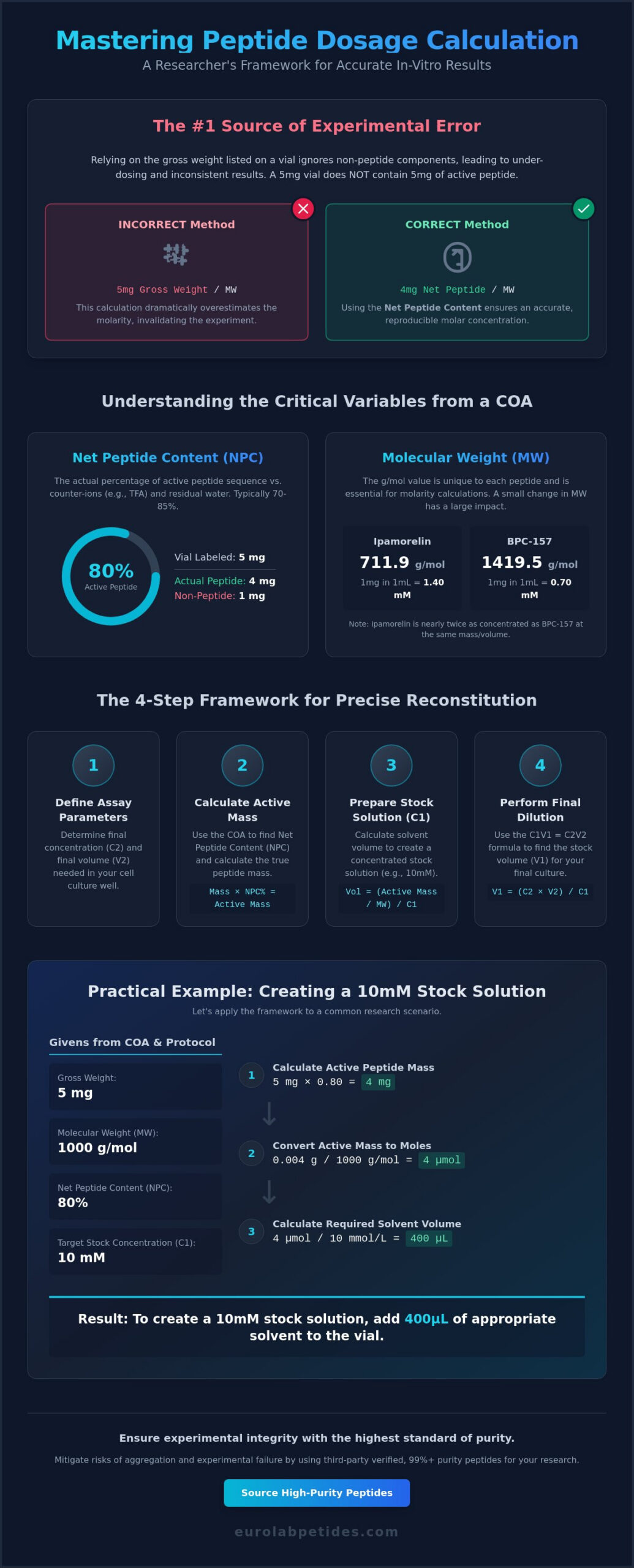
The Molecular Weight (MW) of a peptide is the most critical variable in every dosage equation. This value is verified through mass spectrometry and is found on the Certificate of Analysis (COA). It represents the sum of the atomic weights of all atoms in the sequence. For instance, BPC-157 (MW ≈ 1419.5 g/mol) and Ipamorelin (MW ≈ 711.9 g/mol) require vastly different mass inputs to reach the same molarity. If 1 mg of each were dissolved in 1 mL, the molarity of Ipamorelin would be nearly double that of BPC-157. To determine the number of moles in a sample, the formula Moles = Mass (g) / Molecular Weight (g/mol) is utilized. Accurate quantification depends on this calculation rather than raw weight alone.
Understanding Net Peptide Content vs. Gross Weight
A vial labeled as 5mg doesn’t contain 5mg of pure peptide sequence. Lyophilized products include residual water, counter-ions such as trifluoroacetic acid (TFA), and various salts or buffers. These components contribute to the gross weight but don’t participate in the biological interaction. Failure to account for this distinction is a frequent source of error in the peptide dosage calculation for cell culture. Net peptide content is the actual weight of the peptide sequence excluding counter-ions and residual water.
Most high-quality research peptides maintain a net peptide content between 70% and 85%. If a COA indicates a net content of 80%, a 5mg vial actually contains only 4mg of the active peptide. This adjusted mass must be used in the final molarity equation to prevent under-dosing. Sequence validation and purity verification via HPLC are essential steps to confirm these metrics before reconstitution. At EuroLab Peptides, every batch is analyzed to provide these specific values, ensuring researchers can maintain uncompromising standards in their mathematical protocols.
Mathematical Framework for In-Vitro Dosage Calculations
In-vitro environments demand a higher level of mathematical rigor than in-vivo studies where “units” on a syringe are often the standard. The peptide dosage calculation for cell culture relies on the execution of the C1V1 = C2V2 dilution equation, where C1 represents the stock concentration, V1 the aliquot volume, C2 the target concentration, and V2 the final volume in the culture well. Precision in these values is non-negotiable, as even a 5% variance can trigger unintended signaling pathways or cytotoxic responses in sensitive cell lines.
The process follows a logical progression from dry mass to assay-ready solution:
- Step 1: Define the assay parameters. Determine the required final concentration (C2) and the total volume (V2) per well, typically 100 µL to 200 µL for 96-well plates.
- Step 2: Calculate the mass required for a high-concentration stock solution. This stock must be concentrated enough to minimize solvent exposure to the cells.
- Step 3: Apply the dilution formula to determine the necessary volume of stock solution (V1) to add to the culture media.
- Step 4: Account for well-volume displacement. If 10 µL of peptide is added to 90 µL of media, the final volume is 100 µL; the peptide must be calculated for that 100 µL total.
Calculating Stock Solution Concentrations
Stock solutions are usually prepared at 100x or 1000x the working concentration to facilitate stable long-term storage at -20°C. For a peptide with a molecular weight of 1000 g/mol and a net peptide content of 80%, a 5mg vial contains exactly 4mg of active sequence. Dissolving this 4mg (4 µmol) into 400 µL of solvent yields a 10mM stock solution. Researchers should utilize a peptide reconstitution calculator to verify these volumes before adding solvent, ensuring that the target molarity is achieved with absolute certainty. Utilizing verified 99%+ purity peptides from EuroLab Peptides ensures that these calculations aren’t compromised by unknown impurities or sequence truncations.
Serial Dilutions for Working Concentrations
Reaching nanomolar ranges from a 10mM stock requires a systematic serial dilution protocol. A 1:10 serial dilution, where 100 µL of stock is added to 900 µL of buffer, is significantly more accurate than attempting a single high-ratio dilution. High-ratio dilutions are prone to pipetting errors that compound across the experiment. Maintaining osmotic balance is also critical. The final solvent concentration, particularly when using DMSO, shouldn’t exceed 0.1% of the total well volume to prevent solvent-induced changes in cell membrane permeability or viability.
Reconstitution Protocols and Solvent Selection for Stability
Successful reconstitution is a technical bridge between a stable lyophilized powder and a bioactive solution. It’s not a simple case of adding liquid; it requires a systematic approach based on the primary sequence’s physicochemical properties. The “like dissolves like” principle remains the standard for solvent selection. Acidic peptides, which contain residues such as aspartic or glutamic acid, require a basic environment like 0.1% ammonium hydroxide for initial solubilization. Conversely, basic sequences rich in lysine or arginine often necessitate 0.1% acetic acid. Hydrophobic peptides, which frequently present the greatest challenge in the peptide dosage calculation for cell culture, may require dimethyl sulfoxide (DMSO) to achieve a clear, monomeric solution.
Solubility testing is performed on a small aliquot before the entire vial is processed to prevent the irreversible loss of material if precipitation occurs. If a peptide is hydrophobic, DMSO is added dropwise until the solution is clear. For sequences with a net neutral charge, a combination of organic solvent and aqueous buffer is often required. Temperature also plays a role. While most peptides are reconstituted at room temperature (20°C to 25°C), some may require brief sonication or gentle warming to 37°C. This is avoided for heat-sensitive sequences to prevent premature degradation. Precision in this stage ensures that the peptide dosage calculation for cell culture remains accurate throughout the duration of the assay.
Solvent Compatibility with Cell Lines
DMSO is an effective solvent for non-polar sequences, but its impact on cell membrane integrity is well-documented. A concentration limit of 0.1% v/v is the established standard for maintaining cell viability in most immortalized and primary cell lines. Exceeding this threshold can alter gene expression or induce apoptosis, thereby confounding experimental data. A common error involves the use of bacteriostatic water. While suitable for other applications, the 0.9% benzyl alcohol content is highly cytotoxic. Sterile, cell-culture grade water or Phosphate Buffered Saline (PBS) should be the primary choice for physiological pH maintenance.
Handling and Storage of Reconstituted Solutions
Once a solution is prepared, it is susceptible to chemical degradation via oxidation or hydrolysis. Aliquoting is a non-negotiable protocol to prevent repeated freeze-thaw cycles, which lead to peptide aggregation and loss of potency. These aliquots should be stored in polypropylene tubes, as glass can adsorb certain sequences. Light-sensitive peptides, specifically those containing tryptophan or tyrosine, require storage in amber vials. Before starting this process, researchers should consult the guidelines for storing lyophilized peptides to ensure the raw material has not been compromised by improper pre-reconstitution conditions.
Addressing Experimental Variability and Error Correction
Experimental success in in-vitro models is often compromised by a failure to account for batch-to-batch variability. While a 99%+ purity rating is the objective, slight fluctuations in the chemical profile of different synthesis lots can skew results if left uncorrected. The peptide dosage calculation for cell culture must be adjusted based on the specific HPLC purity and net peptide content provided in the Certificate of Analysis (COA) for each unique batch. Relying on a generic protocol across multiple experiments without reviewing these metrics introduces unnecessary noise into the data set.
Identifying signs of peptide degradation is a critical skill for the lab researcher. Turbidity, persistent cloudiness, or a shift toward a yellow hue in a previously clear solution often indicates aggregation or oxidation. Aggregation is particularly problematic because it reduces the effective concentration of monomeric peptide available to interact with cellular receptors. This leads to a perceived loss of potency that isn’t a result of the sequence itself, but of poor physical stability in the chosen buffer. To maintain the highest levels of accuracy, researchers should utilize analytical-grade reagents that have undergone rigorous sequence validation.
Purity Adjustment Formulas
Standardizing results across multiple batches requires a correction factor for the mass variable in your concentration equations. If Batch A has a purity of 99.5% and Batch B has 98%, the mass used in the peptide dosage calculation for cell culture must be multiplied by these respective percentages to ensure the molarity remains constant. A 2% purity difference can significantly alter IC50 results in sensitive assays. By normalizing for purity, researchers ensure that observed biological effects are due to the peptide’s activity rather than concentration variances between synthesis runs.
Minimizing Adsorption to Plasticware
Peptides are inherently “sticky” molecules that readily adsorb to the hydrophobic surfaces of standard polypropylene microplates and pipette tips. This phenomenon, known as wall-sticking, can reduce the actual concentration in a well by 10% to 50%, depending on the sequence’s hydrophobicity. To mitigate this, the use of low-protein binding tubes is mandatory for prepared dilutions. In cases where peptides are used at extremely low concentrations (nanomolar or lower), adding a carrier protein like 0.1% Bovine Serum Albumin (BSA) can saturate binding sites on the plastic, keeping the peptide in solution. The role of certified peptides is central here; knowing the exact purity allows you to distinguish between adsorption losses and actual impurities. Researchers can also minimize “edge effects” in 96-well plates by filling the outer wells with sterile PBS, which creates a humidity barrier that prevents evaporation and subsequent concentration increases in the treatment wells.
Sourcing High-Purity Peptides for Reproducible Research
The validity of a peptide dosage calculation for cell culture is fundamentally limited by the chemical integrity of the raw material. If the lyophilized powder contains unquantified impurities or sequence truncations, the resulting molar concentration will be inherently inaccurate. For professional research, 99%+ purity is the non-negotiable threshold for ensuring that biological responses are attributable to the target sequence rather than synthesis byproducts. At Eurolab Peptides, this standard is maintained through a stringent manufacturing process that adheres to the highest European standards for chemical synthesis.
Standardized lyophilization techniques are utilized to produce a uniform cake that minimizes residual moisture and ensures maximum stability. This process is critical for maintaining the molecular weight and net peptide content values used in the mathematical protocols described in earlier sections. Every batch is analyzed using high-performance liquid chromatography (HPLC) and mass spectrometry to confirm both chemical purity and sequence identity. This data-driven approach removes the ambiguity often associated with sourcing reagents for sensitive in-vitro models.
Eurolab Peptides Quality Assurance
A multi-level verification protocol is applied to every product. Purity is verified first in-house and subsequently through independent third-party verification to provide an objective metric of quality. This protocol eliminates the reliance on anecdotal claims and provides researchers with the absolute security required for high-stakes inquiry. Batch-specific Certificates of Analysis (COAs) are available for every order, allowing for the precise adjustment of the peptide dosage calculation for cell culture based on the exact net content of the specific vial in use.
Procurement for European Laboratories
Logistical reliability is as critical as chemical purity in the research space. EU-based shipping ensures that cold-chain integrity is maintained from the point of manufacture to the laboratory, reducing the risk of thermal degradation during transit. Researchers can access a comprehensive range of specialized sequences, including BPC-157 and Ipamorelin, developed specifically for cellular models. These tools are synthesized with an uncompromising commitment to integrity, ensuring that every milligram delivered meets the rigorous demands of the scientific community. To begin your next study with verified materials, view our complete catalog of 99%+ pure research peptides.
Advancing Experimental Integrity Through Mathematical Precision
Precision in the laboratory is a direct result of stringent protocols and verified chemical inputs. By mastering the peptide dosage calculation for cell culture, researchers eliminate the variables that lead to inconsistent in-vitro data. This guide has established that accurate molarity depends on accounting for net peptide content and batch-specific purity verified by HPLC. Maintaining stability through correct solvent selection and aliquoting is equally essential for long-term experimental success. It’s the difference between a failed assay and a reproducible breakthrough.
Eurolab Peptides supports these rigorous standards by providing research chemicals with 99%+ purity. Every batch undergoes independent third-party laboratory testing to ensure sequence validation and chemical integrity. With EU-based shipping and manufacturing, cold-chain stability is prioritized from synthesis to delivery. This commitment to objective data ensures your research remains scientifically sound. Researchers don’t have to compromise on the quality of their reagents when high-stakes data is on the line.
Explore EuroLab Peptides for 99%+ Pure Research Chemicals and secure the high-precision tools your next study requires. We look forward to supporting your contribution to scientific discovery.
Frequently Asked Questions
How do I calculate peptide molarity for a 96-well plate?
Molarity calculations for 96-well plates require the application of the C1V1 = C2V2 formula to determine the necessary stock volume for each well. A high-concentration stock solution is typically prepared at 100x the target concentration. For example, to achieve a final concentration of 10 µM in a 100 µL well volume, 1 µL of a 1 mM stock is added to 99 µL of culture media. This ensures the solvent concentration remains below cytotoxic thresholds while maintaining volume precision.
Can I use bacteriostatic water for cell culture peptide reconstitution?
Bacteriostatic water is unsuitable for cell culture applications due to its 0.9% benzyl alcohol content, which is a known cytotoxic agent. Benzyl alcohol disrupts cell membrane integrity and can significantly alter experimental outcomes. Researchers must use sterile, cell-culture grade water or Phosphate Buffered Saline (PBS) to ensure cellular viability and maintain physiological pH during the peptide dosage calculation for cell culture. This standard prevents solvent-induced artifacts in the data.
What is the difference between net peptide content and gross weight?
Gross weight refers to the total mass of the lyophilized powder, which includes the peptide sequence, residual water, counter-ions, and salts. Net peptide content specifically quantifies the mass of the peptide sequence alone. For instance, a 5 mg vial with an 80% net peptide content contains exactly 4 mg of the active peptide. This distinction is critical for establishing accurate molar concentrations in quantitative assays where precise molecular density is required.
How much DMSO is safe to use in cell culture media?
A final concentration of 0.1% v/v DMSO is the established safety threshold for most immortalized and primary cell lines. Concentrations exceeding 0.5% v/v often induce non-specific signaling changes or apoptosis in sensitive models. When preparing stock solutions, the concentration must be high enough so that the final dilution into the well does not exceed this 0.1% limit. This protocol prevents solvent-induced confounding variables from compromising the experimental integrity.
Why does the molecular weight matter for peptide dosage?
Molecular weight is the fundamental constant used to convert gravimetric mass into molarity. Because peptides vary in size, 1 mg of a small peptide contains more molecules than 1 mg of a larger sequence. Without using the molecular weight verified by mass spectrometry, it’s impossible to standardize dosage between different peptides. This value ensures that biological activity is measured by molecular density rather than raw weight, which is the only way to achieve reproducible results.
How do I adjust my dosage if the peptide purity is 98%?
Dosage adjustments for 98% purity involve multiplying the gross mass by the purity percentage expressed as a decimal (0.98). If a vial contains 5 mg of powder with 98% purity and 80% net content, the active mass is exactly 3.92 mg. This correction is essential for maintaining uncompromising accuracy in the peptide dosage calculation for cell culture, especially when comparing results across different synthesis batches with varying certificates of analysis.
How should I store reconstituted peptides for in-vitro use?
Reconstituted peptides should be divided into single-use aliquots and stored at -20°C or -80°C to prevent chemical degradation. Repeated freeze-thaw cycles cause peptide aggregation and hydrolysis, which reduces the effective concentration in solution over time. Polypropylene tubes are preferred over glass to minimize surface adsorption of the sequence. Most solutions remain stable for 3 to 6 months when stored under these stringent conditions and protected from light exposure.
What happens if my peptide does not fully dissolve in PBS?
If a peptide fails to dissolve in PBS, the solution pH should be adjusted or an organic solvent must be introduced based on the peptide’s primary sequence. Hydrophobic sequences often require initial solubilization in a small volume of DMSO before being diluted into the aqueous buffer. For acidic or basic peptides, adding 0.1% ammonium hydroxide or 0.1% acetic acid can facilitate monomeric dissolution. Sonication for 30 to 60 seconds may also assist in breaking up stubborn aggregates.
