

Can a single tripeptide reset the transcriptomic profile of over 4,000 human genes to a more youthful state? Analysis of the Connectivity Map (CMap) indicates that GHK-Cu modulates approximately 32% of the human genome, inducing a 50% or greater change in expression for 31.2% of these genes. Researchers frequently encounter ambiguity regarding the exact number of modulated genes and the difficulty of securing high-purity material for reproducible results. Utilizing ghk-cu for gene expression analysis requires a precise understanding of these genomic shifts to transition from observation to verifiable molecular biology.
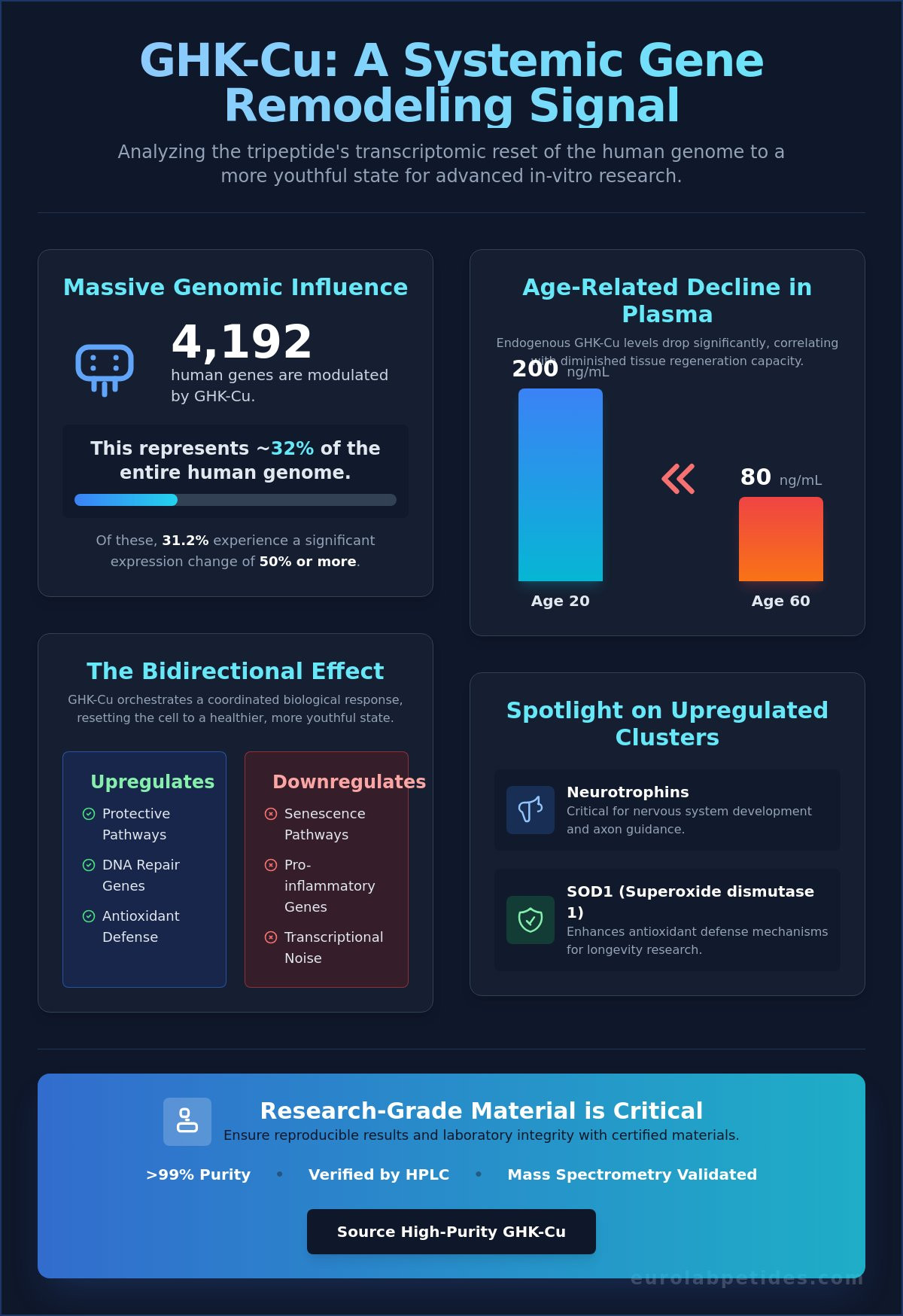
This technical review provides a comprehensive scientific analysis of how GHK-Cu resets human gene expression for advanced in-vitro research. You’ll identify specific gene clusters responsible for DNA repair and antioxidant defense while addressing conflicting data on concentration-dependent effects. We examine the decline of endogenous GHK-Cu from 200 ng/mL at age 20 to 80 ng/mL by age 60, establishing a baseline for longevity and tissue repair research. The discussion concludes with standards for sourcing certified, 98-99% pure GHK-Cu to ensure laboratory development integrity.
Key Takeaways
- Analyze the Broad Institute’s Connectivity Map (CMap) data to understand how GHK-Cu facilitates a systemic transcriptomic reset toward a youthful expression state.
- Examine the upregulation of critical gene clusters, including neurotrophins for axon guidance and SOD1 for enhanced antioxidant defense mechanisms in longevity research.
- Identify the optimal molar concentrations and human cell lines required to ensure precision when utilizing ghk-cu for gene expression analysis in laboratory environments.
- Establish rigorous quality benchmarks for research-grade materials, prioritizing batches with verified >99% purity through HPLC and Mass Spectrometry validation to ensure reproducible results.
Introduction to GHK-Cu and its Role in Gene Modulation
Glycyl-L-histidyl-L-lysine copper, or GHK-Cu, is a naturally occurring tripeptide with a high affinity for copper (II) ions. It functions as a pleiotropic messenger, coordinating complex biological responses across multiple systems. This GHK-Cu Overview highlights its ability to coordinate copper ions into a stable complex, which is essential for its physiological activity. It was first isolated from human plasma in 1973. Since its discovery, researchers have documented a significant age-related decline in systemic concentrations. At age 20, plasma levels average approximately 200 ng/mL. By age 60, this concentration typically drops to 80 ng/mL. This reduction correlates with a diminished capacity for tissue regeneration and systemic repair.
The tripeptide’s role has expanded beyond simple copper transport. It’s now recognized as a systemic gene-remodeling signal. Utilizing ghk-cu for gene expression analysis allows researchers to investigate how this small molecule influences transcriptomic profiles across various cell types. It coordinates cellular responses by modulating transcription factors, acting as a fundamental epigenetic switch. This modulation is achieved through the regulation of a massive array of genes, effectively overriding age-related transcriptional noise. The integration of ghk-cu for gene expression analysis provides a high-resolution view of how the peptide alters biological pathways at the molecular level.
The Discovery of Transcriptomic Effects
Early research focused on phenotypic observations, such as increased collagen synthesis and accelerated wound closure. The scientific focus eventually shifted from these outward results to genotypic analysis. Modern studies reveal that GHK-Cu influences protein synthesis at the source. It’s considered a “master regulator” in longevity research. It resets gene expression patterns to a more youthful state, influencing thousands of genes simultaneously. This shift from observing protein output to analyzing RNA transcripts provides a more granular understanding of cellular aging and repair mechanisms.
GHK-Cu vs. Other Copper Peptides
The specific Gly-His-Lys sequence is critical for its unique biological activity. While other peptides bind copper, they lack the same gene receptor binding affinity. The structural configuration of GHK allows for optimal interaction with cell surface receptors and potential nuclear entry. This specificity is why GHK-Cu remains the primary focus of transcriptomic modulation studies. The copper-tripeptide complex demonstrates superior stability in various media compared to competing sequences. This stability is essential for maintaining consistent concentrations during in-vitro experiments. The complex’s ability to maintain structural integrity ensures that molecular signaling remains accurate throughout the duration of the assay.
Mechanisms of Action: How GHK-Cu Interacts with the Human Genome
The interaction between Glycyl-L-histidyl-L-lysine and the human genome is characterized by high-stakes precision. Unlike traditional ligands that target a single pathway, GHK-Cu functions as a master transcriptomic regulator. Analysis of the Broad Institute’s Connectivity Map (CMap) indicates that this tripeptide influences 4,192 human genes. This is a significant figure, representing approximately 32% of the human genome. When utilizing ghk-cu for gene expression analysis, researchers observe that 31.2% of these genes experience an expression change of 50% or greater. This modulation is inherently bidirectional. It upregulates protective pathways while simultaneously downregulating genes associated with senescence and inflammation.
The tripeptide’s influence extends to mRNA production and the activity of specific transcription factors. By shifting the transcriptomic profile, GHK-Cu resets the cell to a more youthful state. This isn’t a random alteration; it’s a coordinated biological response. This GHK-Cu Gene Data Review provides evidence for these regenerative actions, detailing how the peptide stabilizes cellular function. For those conducting ghk-cu for gene expression analysis within longevity and vitality research, understanding these mechanisms is paramount for establishing reproducible in-vitro models.
Connectivity Map (CMap) and Bioinformatic Validation
CMap methodology identifies peptide-gene interactions by comparing gene expression signatures across thousands of small molecules. The statistical significance of GHK-Cu’s impact is robust. It shows a high connectivity score with youthful biological samples. This bioinformatic validation suggests the peptide effectively mimics the gene expression profile found in younger cells. It provides a standardized metric for quality in transcriptomic studies, allowing for precise quantification of cellular responses.
Epigenetic Signaling and DNA Repair Mechanisms
GHK-Cu’s epigenetic signaling is particularly evident in its modulation of DNA excision and repair genes. It influences the TP53 pathway, a critical component of genomic stability. Beyond repair, the peptide demonstrates the ability to reverse cortisone-induced gene suppression. This is vital for maintaining cellular homeostasis under stress. It also impacts the Ubiquitin-Proteasome System. By enhancing the clearance of damaged proteins, GHK-Cu ensures that the proteome remains functional. These combined actions reinforce the peptide’s status as an elite tool for serious professional inquiry.
Analysis of GHK-Cu Induced Gene Expression in Specific Biological Systems
The systemic scope of GHK-Cu’s influence is best understood through its impact on specialized biological clusters. While the previously discussed 32% genomic modulation provides a macro-view, the specific upregulation of protective systems highlights why the tripeptide is essential for ghk-cu for gene expression analysis in varied cell models. In dermatological research, GHK-Cu stimulates the synthesis of collagen, elastin, and glycosaminoglycans. Verified data indicates that GHK-Cu can upregulate collagen synthesis by 70 to 200% in fibroblast cultures. This isn’t merely a localized effect; it’s driven by a fundamental transcriptomic shift that prioritizes structural integrity and tissue repair.
Simultaneously, the tripeptide functions as a potent anti-inflammatory signal. It achieves this through the targeted downregulation of pro-inflammatory cytokines, specifically Interleukin-1 (IL-1) and Interleukin-6 (IL-6). By suppressing these signals at the gene level, GHK-Cu mitigates the chronic inflammatory states often observed in senescent cell populations. This systemic regulation makes the molecule a primary candidate for GHK-Cu: A Primer on its Role in Cellular Studies, where researchers focus on the intersection of inflammation and age-related decline.
Nervous System Function and Cognitive Decline Research
In neurological models, GHK-Cu demonstrates a specialized affinity for genes governing synaptic plasticity and axon guidance. Research published in GHK and Nervous System Gene Expression details how the peptide influences the expression of neurotrophins. These proteins are critical for neuron survival and proliferation. Beyond growth factors, the peptide modulates the GABA system, providing a molecular basis for anxiolytic research. By influencing genes relevant to neurodegeneration, ghk-cu for gene expression analysis serves as a high-precision tool for investigating cognitive function and neuronal recovery.
Antioxidant and Detoxification Gene Clusters
The tripeptide’s role in antioxidant defense is characterized by the upregulation of 14 specific antioxidant genes. This includes the induction of Superoxide Dismutase 1 (SOD1), which enhances cellular capacity for free-radical scavenging. GHK-Cu also downregulates iron-binding genes, reducing the potential for iron-induced oxidative damage. This dual action protects cells against lipid peroxidation through established gene-mediated pathways. Additionally, the peptide impacts metallothionein expression. This facilitates cellular heavy metal detoxification, ensuring that the intracellular environment remains conducive to high-stakes research and precise molecular signaling.
Methodology for Analyzing GHK-Cu Gene Expression In Vitro
Establishing a robust protocol for ghk-cu for gene expression analysis requires the selection of appropriate human cell lines that mirror the target biological system. Dermal fibroblasts are the standard model for studying tissue remodeling and collagen synthesis. For investigations into neuroprotection and synaptic plasticity, the SH-SY5Y neuroblastoma line or primary human neurons are preferred. Keratinocytes serve as the primary model for epidermal barrier function and antimicrobial peptide expression. High-stakes research demands that these cell lines are maintained in standardized media to ensure that transcriptomic shifts are attributable solely to the tripeptide complex rather than environmental variables.
Quantitative measurement of mRNA levels is typically conducted using Reverse Transcription Quantitative Polymerase Chain Reaction (RT-qPCR) for targeted gene clusters or RNA Sequencing (RNA-seq) for whole-transcriptome profiling. Significant changes in gene expression are usually observed after incubation periods of 24 to 48 hours. This timeframe allows for the stabilization of transcriptional responses and provides a clear view of the peptide’s influence on the cellular machinery. Researchers must ensure that the GHK-Cu utilized is of high purity to avoid interference from manufacturing byproducts or residual solvents during these sensitive assays.
Optimizing Reagent Concentration and Stability
Precision in molar concentration is non-negotiable for reproducible in-vitro results. Concentrations between 10^-9 M and 10^-7 M are established as the standard range for GHK-Cu research. Deviating from this range often leads to conflicting data; concentrations exceeding 10^-5 M may induce cytotoxicity, while levels below 10^-10 M might fail to trigger the necessary signaling cascades. It’s also critical to include control groups treated with copper-free GHK to isolate the effects of the copper-tripeptide complex. Maintaining a stable pH of 7.4 is essential to prevent the degradation of the complex, as the tripeptide’s affinity for copper (II) ions is highly sensitive to fluctuations in acidity. For those focused on tissue repair and recovery research, these methodological constraints are the difference between verifiable data and experimental noise.
Advanced Sequencing and Bioinformatic Analysis
The workflow for ghk-cu for gene expression analysis concludes with the preparation of cDNA libraries from treated samples. Bioinformatic tools then interpret fold-change data, providing a metric for the epigenetic “resetting” discussed in previous sections. This data should be cross-referenced with established peptides databases to validate the observed signatures against known transcriptomic benchmarks. By utilizing standardized bioinformatic pipelines, researchers can accurately quantify the upregulation of antioxidant defenses and the downregulation of pro-inflammatory cytokines with absolute transparency. This methodical approach ensures that the resulting data meets the rigorous demands of the specialized scientific community.
Sourcing Research-Grade GHK-Cu for Gene Expression Studies
Success in ghk-cu for gene expression analysis is fundamentally dependent on the chemical integrity of the reagent. For transcriptomic modulation to be accurately measured, a purity threshold of >99% is required. Lower-grade materials, such as those intended for cosmetic applications, often contain residual solvents, synthesis byproducts, or stabilizers that can introduce biochemical noise into sensitive in-vitro assays. These impurities might inadvertently activate stress-response pathways, masking the true transcriptomic profile of the copper-tripeptide complex. Professional research demands an absolute exclusion of these variables to maintain the validity of the data.
European sourcing provides significant advantages for laboratory logistics and regulatory compliance. Regional manufacturing standards ensure that the chemical synthesis process adheres to stringent quality management systems. This localized oversight simplifies the procurement process for professional users who require transparency in their supply chain. It eliminates the risks associated with global markets where quality verification is often inconsistent. By prioritizing regional compliance, labs can ensure that their materials meet the rigorous demands of the specialized scientific community.
Quality Control Benchmarks for In-Vitro Research
Verification of product identity and purity must be provided through external validation. High-Performance Liquid Chromatography (HPLC) is utilized to determine the exact purity percentage by separating the tripeptide from any minor impurities. Simultaneously, Mass Spectrometry (MS) reports provide sequence verification, confirming that the Gly-His-Lys structure is present and correctly complexed with copper (II) ions. Utilizing certified peptides is a non-negotiable standard for reproducible gene analysis. Without these metrics, the validity of any ghk-cu for gene expression analysis is compromised, as the researcher cannot confirm the exact molecular composition of the sample.
Handling and Storage for Maximum Stability
The stability of GHK-Cu is sensitive to environmental conditions. Lyophilized powder should be stored at -20°C to prevent hydrolysis and maintain the integrity of the peptide bonds. Upon receipt, batches must be kept in an anhydrous environment until the point of use. Best practices for reconstitution involve using sterile, deionized water or phosphate-buffered saline (PBS). Once reconstituted, the solution is susceptible to degradation and should be used immediately or aliquoted and frozen to minimize freeze-thaw cycles. This methodical approach to handling preserves the peptide’s signaling capacity throughout the duration of the study.
Maintaining these rigorous standards ensures that the transcriptomic data generated is both precise and verifiable. Researchers focused on longevity, vitality, or tissue repair require materials that meet these elite specifications. Secure high-purity GHK-Cu for your next study from EuroLab Peptides to ensure your laboratory development reflects the highest standards of analytical science.
Advancing Transcriptomic Research with High-Purity GHK-Cu
The capacity of GHK-Cu to modulate over 4,000 human genes positions this tripeptide as a fundamental tool for longevity and tissue repair research. By facilitating a systemic transcriptomic reset, it offers a verifiable mechanism for reversing age-related cellular decline. Utilizing ghk-cu for gene expression analysis provides researchers with a high-resolution view of biological systems, from antioxidant defense induction to neurological gene upregulation. Maintaining experimental reproducibility requires strict adherence to the methodological standards and purity benchmarks established in this review.
Precision in molecular biology is only achievable through the use of reagents with verified chemical specifications. EuroLab Peptides provides 99%+ purity research-grade tripeptides supported by independent third-party HPLC and MS validation. Our European-based logistics and manufacturing ensure that your laboratory receives materials that meet the most rigorous professional standards. Order High-Purity GHK-Cu for Research Applications to advance your next in-vitro study with absolute confidence. We look forward to supporting your contribution to the specialized scientific community.
Frequently Asked Questions
How many human genes does GHK-Cu specifically modulate?
GHK-Cu modulates 4,192 human genes, which represents approximately 32% of the human genome. Analysis indicates that 31.2% of these genes experience an expression change of 50% or greater. This broad transcriptomic influence allows the tripeptide to coordinate complex biological responses across multiple systems. It effectively resets the expression profile to a more youthful state, making it a primary subject for genomic remodeling studies.
Can GHK-Cu be used to study DNA repair mechanisms in vitro?
Yes, GHK-Cu is an effective tool for studying DNA repair mechanisms in vitro. It modulates several genes involved in DNA excision and repair, including the TP53 pathway. These shifts enhance genomic stability and cellular resilience against oxidative stress. Researchers utilize this tripeptide to observe how systemic signals can reverse DNA damage markers in senescent cell populations during tissue repair and recovery research.
What is the role of the Connectivity Map (CMap) in GHK-Cu research?
The Connectivity Map (CMap) provides bioinformatic validation for the transcriptomic effects of GHK-Cu by comparing its gene expression signature against thousands of small molecules. It identifies high connectivity scores between GHK-Cu and youthful biological samples. This methodology allows for the quantification of systemic resetting effects. It serves as a standardized metric for evaluating the efficacy of ghk-cu for gene expression analysis in professional laboratory settings.
Does GHK-Cu upregulate or downregulate inflammatory gene expression?
GHK-Cu primarily downregulates the expression of pro-inflammatory cytokines, including Interleukin-1 (IL-1) and Interleukin-6 (IL-6). By suppressing these signals at the transcriptional level, the peptide mitigates chronic inflammatory responses. This downregulation is a critical component of its role in immune system research. It facilitates a transition from a pro-inflammatory state to a regenerative environment within the cell culture, ensuring high-stakes precision in molecular observations.
What is the ideal concentration of GHK-Cu for gene expression assays?
The ideal concentration for GHK-Cu in gene expression assays typically ranges between 10^-9 M and 10^-7 M. Concentrations within this window are established as the standard for eliciting significant transcriptomic shifts without inducing cytotoxicity. Maintaining this precise molarity ensures that the observed changes in mRNA levels are reproducible. Deviations beyond these parameters often lead to inconsistent data or unintended cellular stress responses that compromise the study’s integrity.
Why is third-party testing critical when sourcing GHK-Cu for research?
Third-party testing is critical to ensure that GHK-Cu meets the >99% purity threshold required for accurate transcriptomic data. Independent High-Performance Liquid Chromatography (HPLC) and Mass Spectrometry (MS) provide objective verification of purity and peptide sequence. Without this validation, researchers risk using materials with manufacturing byproducts that can interfere with sensitive gene expression assays. It establishes a verifiable metric for quality and absolute security in professional inquiry.
Can GHK-Cu gene expression studies be applied to neurodegeneration models?
GHK-Cu gene expression studies are highly applicable to neurodegeneration models due to the peptide’s upregulation of neurotrophins and axon guidance genes. It influences pathways related to synaptic plasticity and neuron proliferation. Researchers use these transcriptomic insights to investigate potential recovery mechanisms in cognitive function research. The peptide’s ability to modulate the GABA system further enhances its utility in specialized neurological studies where precision is paramount.
How does GHK-Cu affect the expression of antioxidant-related genes?
GHK-Cu upregulates 14 specific antioxidant genes, most notably Superoxide Dismutase 1 (SOD1). This transcriptomic shift enhances the cell’s capacity for free-radical scavenging and protection against lipid peroxidation. Simultaneously, it downregulates iron-binding genes to reduce oxidative stress potential. Utilizing ghk-cu for gene expression analysis in this context provides a clear view of how systemic signals strengthen cellular detoxification pathways and enhance overall vitality at the molecular level.
