

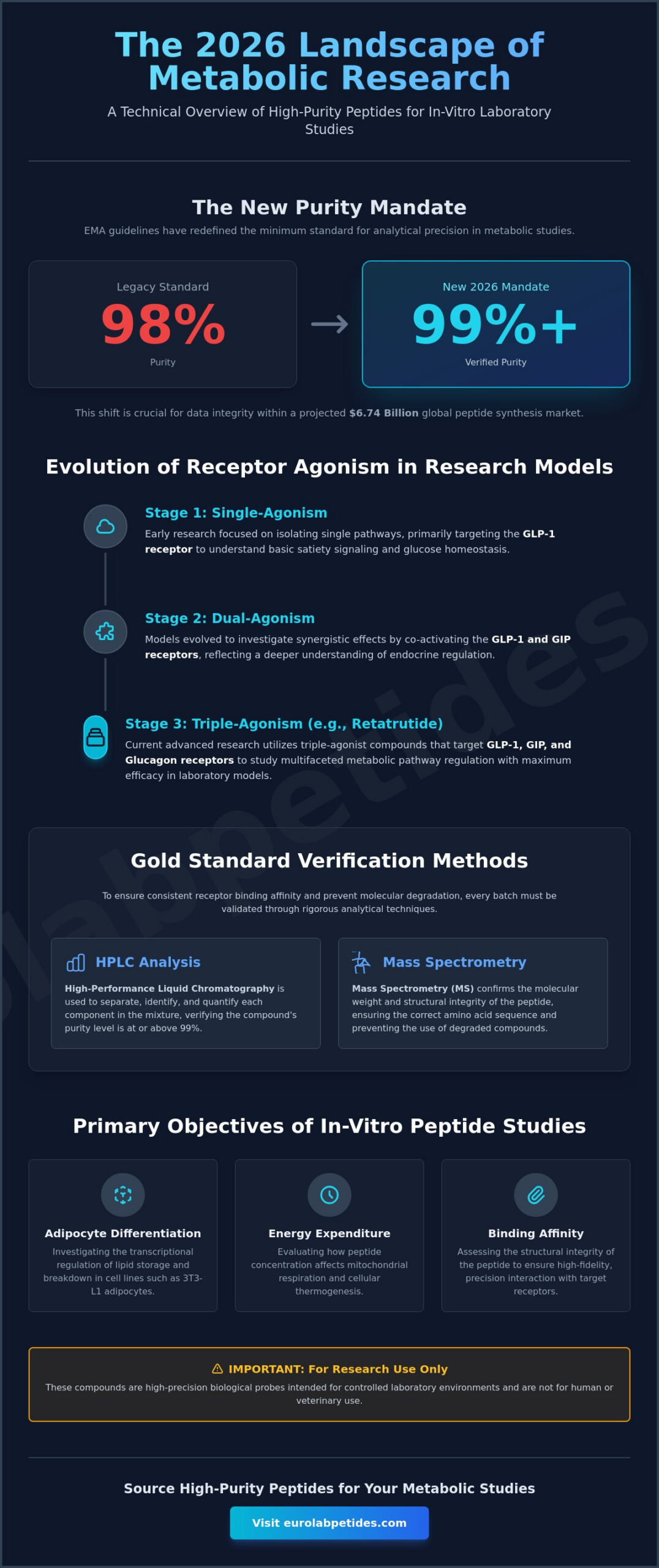
The 2026 landscape for metabolic study has shifted from 98% purity benchmarks to a non-negotiable 99% standard, driven by the permanent closure of legacy suppliers and new EMA guidelines taking effect this June. As the global peptide synthesis market reaches a projected $6.74 billion this year, the margin for error in analytical precision has narrowed significantly. Researchers often struggle with the ambiguity between clinical compounding and the rigorous requirements of peptides for weight management research conducted in controlled laboratory environments. This technical review addresses those sourcing challenges by establishing verifiable metrics for high-purity metabolic compounds.
It’s clear that the efficacy of metabolic research is entirely dependent on the structural integrity and receptor-specific agonism of the lyophilized compound. This article provides an authoritative analysis of research-grade peptides utilized in metabolic studies, focusing on biochemical pathways and the standardized reconstitution protocols necessary for 2026. We’ll preview the July 2026 FDA PCAC review of key metabolic markers, examine the triple-agonist mechanisms of compounds like Retatrutide, and outline the logistical requirements for maintaining 99% purity within European supply chains. This sequence of validation ensures that laboratory standards remain consistent with the latest regulatory and analytical developments.
Key Takeaways
- Analyze the evolution of metabolic study models from single-receptor pathways to complex multi-receptor agonism, including triple-agonist research targets.
- Examine the biochemical signaling of peptides for weight management research, specifically focusing on GLP-1 and GIP receptor activation within laboratory environments.
- Compare the technical specifications of single, dual, and triple-agonist compounds to determine the most precise tools for metabolic pathway investigation.
- Establish rigorous quality benchmarks for research materials, emphasizing 99% purity as verified by High-Performance Liquid Chromatography and Mass Spectrometry.
- Implement standardized handling and reconstitution protocols designed to prevent molecular degradation and maintain the integrity of metabolic compounds.
The Biochemical Landscape of Peptides for Weight Management Research
Precision in metabolic inquiry is predicated on the use of high-purity ligands. Peptides for weight management research are defined as short-chain amino acid sequences engineered to investigate specific metabolic signaling pathways within controlled laboratory environments. These compounds offer superior target specificity compared to traditional small molecule ligands, allowing for the precise modulation of G-protein coupled receptors (GPCRs). By 2026, the focus of metabolic study has transitioned from single-receptor targets toward sophisticated multi-receptor agonism. This shift reflects a deeper understanding of the synergistic effects required to influence complex metabolic states in-vitro. It’s essential to recognize that these materials are strictly research-grade compounds; they aren’t clinical pharmaceuticals and aren’t intended for human application.
The preference for peptides over small molecules in metabolic precision stems from their ability to mimic endogenous ligands with high fidelity. In-vitro models require this accuracy to ensure that observed cellular responses are the result of specific pathway activation rather than off-target interactions. High-stakes research demands materials that meet a verifiable 99% purity benchmark. This standard is necessary to maintain the integrity of biochemical data, as even trace impurities can alter receptor binding kinetics or induce cellular stress responses that skew metabolic outcomes.
Evolution of Incretin Mimetics in Laboratory Models
The progression of metabolic research has moved rapidly from the isolated study of Glucagon-like peptide-1 (GLP-1) to the integration of glucose-dependent insulinotropic polypeptide (GIP) and glucagon receptor co-agonists. Early research focused primarily on mono-agonism to understand basic satiety signaling and glucose homeostasis. However, 2026 models prioritize dual and triple-agonist peptides to simulate the multifaceted nature of endocrine regulation. Research peptides serve as high-precision biological probes for the dissection of complex cellular pathways. By utilizing these tools, researchers can observe how simultaneous receptor activation influences intracellular cyclic AMP (cAMP) levels more effectively than isolated stimulation.
Research Objectives in Metabolic Peptide Studies
The primary aim of utilizing peptides for weight management research is to quantify the biochemical changes occurring within specific cell lines, such as 3T3-L1 adipocytes. Laboratory protocols focus on several key metrics:
- Adipocyte Differentiation: Investigating the transcriptional regulation of lipid storage and breakdown.
- Energy Expenditure: Evaluating how peptide concentration affects mitochondrial respiration and cellular thermogenesis.
- Binding Affinity: Assessing the structural integrity of the peptide to ensure precision in receptor interaction.
The maintenance of structural integrity is critical for ensuring consistent receptor binding affinity. Degradation of the amino acid chain, often caused by improper handling or substandard lyophilization, renders the compound ineffective for serious professional inquiry. Standardized laboratory protocols in 2026 emphasize batch-specific verification through high-performance liquid chromatography and mass spectrometry to ensure every compound meets the required analytical metrics before the commencement of any metabolic study.
Mechanisms of Action: Metabolic Pathway Regulation in Laboratory Models
The biochemical mechanisms of peptides for weight management research are defined by their capacity to engage specific intracellular signaling cascades with high affinity. GLP-1 receptor activation is routinely studied in-vitro to observe its impact on appetite-regulating neurons and the modulation of gastric emptying simulations. While early research focused on isolated GLP-1 pathways, contemporary models investigate the synergistic effects of dual-receptor agonism. Detailed data on the biochemical mechanisms of peptides shows that receptor-specific agonism is the primary driver of metabolic flux in these models. The GIP pathway is also critically examined for its distinct role in adipose tissue metabolism and the enhancement of systemic insulin sensitivity.
Glucagon signaling represents a separate but complementary research target. It’s analyzed to determine variables in thermogenesis and total energy expenditure. Beyond traditional hormone mimetics, mitochondrial-derived peptides like MOTS-c are utilized to investigate metabolic flexibility at the cellular level. These compounds aren’t limited to endocrine mimicry; they directly influence the mitocellular response to metabolic stress, providing a more comprehensive view of energy regulation than single-pathway agonists alone.
Incretin-Based Agonism vs. Mitochondrial Targeting
Research outcomes in obesity and diabetes models vary significantly depending on whether the peptide targets surface receptors or intracellular regulators. Hormone-mimetic peptides primarily modulate signaling through GPCRs, whereas mitochondrial targets influence metabolic homeostasis via direct interaction with the mitochondrial genome. A notable development in 2026 laboratory studies is the use of SLU-PP-332. This compound is utilized in Estrogen-Related Receptor (ERR) research to investigate metabolic reprogramming in skeletal muscle cell lines. It’s often compared to incretin mimetics to determine how different mechanisms of action influence glucose uptake and lipid oxidation. Researchers requiring high-precision tools for these studies frequently source materials from EuroLab Peptides to ensure batch-to-batch consistency.
Cellular Energy Expenditure and Thermogenesis
The induction of “browning” in white adipose tissue cell lines is a primary research objective in metabolic studies. Peptides are applied to in-vitro models to measure the upregulation of Uncoupling Protein 1 (UCP1), which serves as a marker for thermogenic activity. Metabolic rate changes are subsequently measured in skeletal muscle cell lines using oxygen consumption rate (OCR) assays. The impact of peptide purity on the reproducibility of these metabolic flux assays is absolute. Trace contaminants or degradation products can lead to aberrant mitochondrial signaling, making 99% purity a non-negotiable standard for professional inquiry. This level of analytical precision ensures that the observed thermogenic response is a direct result of the peptide’s interaction with the target pathway.
Comparative Analysis: GLP-1, GIP, and Glucagon Receptor Agonism
Selecting appropriate ligands for in-vitro metabolic studies requires a granular understanding of receptor binding kinetics. While early peptides for weight management research focused exclusively on single-receptor agonism, the 2026 research standard has transitioned toward multi-agonist models. Single-agonist compounds, typically modeled after GLP-1 analogues, provide a baseline for investigating appetite-regulating signaling and glucose-dependent insulin secretion. In contrast, dual-agonist compounds, such as those targeting both GLP-1 and GIP receptors, allow researchers to observe synergistic effects on lipid metabolism and insulin sensitivity that aren’t achievable with mono-agonists. The emergence of triple-agonists in 2026 laboratory studies represents the current peak of metabolic research complexity, integrating glucagon receptor activation to investigate enhanced energy expenditure and thermogenic variables.
The technical evaluation of these compounds relies on the analysis of Ki values (inhibition constants) and receptor selectivity. High-precision research demands an objective measurement of how effectively a peptide displaces a radiolabeled ligand from its target receptor. In multi-agonist research, the balance of these affinities is critical. For instance, a triple-agonist must maintain precise potency across all three targets to avoid skewed data. Technical considerations for Tesamorelin are particularly relevant when investigating growth hormone-mediated lipid research, as its specific amino acid sequence is designed to investigate the reduction of visceral adipose tissue through the stimulation of endogenous growth hormone pathways in-vitro.
Receptor Selectivity and Experimental Design
Experimental outcomes are dictated by receptor bias, where a peptide may preferentially activate one signaling pathway over another despite binding to multiple receptors. Researchers must select agonists based on the specific metabolic flux they intend to quantify. For studies focused on growth hormone secretagogue pathways, the role of Ipamorelin is foundational. Its high selectivity for the ghrelin receptor without significant impact on ACTH or cortisol levels makes it an elite tool for isolating growth-related metabolic variables. This level of selectivity ensures that the data collected reflects the targeted pathway’s activity rather than systemic cross-reactivity.
Multi-Agonist Stability and Analytical Challenges
The complexity of peptides for weight management research increases significantly with the length of the amino acid sequence. Multi-agonists often possess longer chains that are more susceptible to secondary structure variations and degradation during the lyophilization process. Maintaining batch-to-batch consistency in multi-receptor research stacks requires rigorous High-Performance Liquid Chromatography (HPLC) validation. Every batch must meet the 99% purity metric to ensure that the observed metabolic responses are reproducible across different laboratory trials. Given the stricter EMA manufacturing guidelines effective June 2026, the verification of molecular mass via mass spectrometry is a non-negotiable standard for professional inquiry. This analytical rigor prevents the introduction of experimental artifacts caused by peptide fragmentation or synthesis impurities.
Technical Standards for Sourcing and Handling Research-Grade Peptides
The integrity of metabolic data is fundamentally linked to the analytical purity of the utilized ligands. For peptides for weight management research, the 2026 industry standard has solidified at a minimum of 99% purity as verified by High-Performance Liquid Chromatography (HPLC). This threshold is non-negotiable for professional inquiry; lower purity levels introduce unquantified variables that can interfere with receptor binding assays and cellular signaling observations. While HPLC quantifies the percentage of the target peptide relative to impurities, Mass Spectrometry (MS) serves as the gold standard for verifying molecular mass and identity. A precise MS report ensures the synthesized sequence matches the theoretical molecular weight, confirming that the compound is exactly what the experimental design requires.
Maintaining the stability of these compounds requires adherence to strict thermodynamic protocols. Lyophilized peptides should be stored at -20°C for long-term viability to prevent peptide bond hydrolysis and oxidation. Once reconstituted, the window for research viability narrows significantly. Reconstitution variables, specifically the choice of solvent and the resulting pH, directly impact peptide integrity. Most metabolic peptides are stable in a slightly acidic environment, yet extreme pH shifts can lead to immediate aggregation or precipitation. Researchers must calibrate solvent choice based on the specific isoelectric point of the peptide sequence to ensure a clear, active solution for in-vitro application.
Interpreting HPLC and MS Reports
Analytical reports provide the empirical evidence necessary for high-stakes research. When reviewing an HPLC chromatogram, the primary peak must represent at least 99% of the total area under the curve. Secondary peaks, or impurity peaks, must be identified to ensure they don’t possess biological activity that could skew results. It’s critical to verify that the Certificate of Analysis (COA) is batch-specific rather than a generic template. For a detailed breakdown of these verification processes, researchers should consult the buy research peptides guide. This level of scrutiny ensures that the materials sourced meet the rigorous demands of the specialized scientific community.
Laboratory Safety and Handling Compliance
Compliance with ‘Strictly for Research Use’ (RUO) protocols is a fundamental requirement for laboratory safety. These compounds are not clinical pharmaceuticals and must be handled within controlled environments to prevent cross-contamination. To maintain the rigorous hygiene standards necessary for such facilities, you can check out Gibbs Janitorial and Building Maintenance Services for professional building care. Standardized protocols for lyophilized peptide reconstitution involve the gradual addition of the solvent to the vial wall, followed by gentle swirling rather than vigorous agitation. This prevents the mechanical shearing of delicate peptide chains. Adhering to these European manufacturing and handling standards ensures that every metabolic study remains reproducible and scientifically sound. For laboratories requiring verified 99% purity materials, EuroLab Peptides provides the necessary analytical documentation and batch-specific validation for all metabolic research compounds.
EuroLab Peptides: Ensuring Analytical Purity for Metabolic Studies
EuroLab Peptides operates as a specialized partner for institutions requiring high-precision ligands for cellular inquiry. Our commitment to the synthesis of peptides for weight management research is defined by a refusal to utilize anecdotal validation, relying instead on the objective data of technical analysis. Every compound is subjected to a multi-level quality control framework designed to meet the rigorous demands of the specialized community. This process ensures that the structural integrity of complex metabolic co-agonists, such as the triple-agonist targets discussed in previous sections, is preserved from synthesis to delivery. The brand’s identity is built on a foundation of radical honesty, where quality is presented as a verifiable metric rather than a marketing assertion.
The focus remains strictly on in-vitro research and laboratory development standards. By maintaining a localized infrastructure within Europe, we address the common risk of compound degradation caused by prolonged international transit or improper temperature control. This regional focus allows for a more reliable cold chain, which is critical for maintaining the stability of lyophilized metabolic compounds. Support infrastructure is specifically tailored to meet the administrative and technical requirements of European research institutions and private laboratories, ensuring that procurement is as precise as the research itself. This dedication to localized quality and scientific integrity is shared by other specialized European entities such as Labo Mariva, which applies rigorous standards to the sourcing of high-quality nutraceuticals.
The EuroLab Quality Protocol: HPLC and MS Validation
Analytical precision is the primary metric of our manufacturing process. Every batch of peptides for weight management research undergoes independent High-Performance Liquid Chromatography (HPLC) and Mass Spectrometry (MS) validation. These tests confirm that purity levels consistently exceed the 99% threshold required for reproducible metabolic flux assays. Transparency is maintained by providing researchers with verifiable analytical results for every batch. This data-first approach allows laboratories to account for every molecular variable, ensuring that experimental outcomes are a direct result of the peptide’s interaction with the target signaling pathway. The structural integrity of complex sequences is non-negotiable, and our protocols are designed to eliminate the risks associated with synthesis impurities.
Optimized Logistics for European Researchers
The logistical framework of EuroLab Peptides is designed to minimize the interval between synthesis and laboratory application. European researchers benefit from EU-to-EU shipping, which significantly reduces the logistical complexities and regulatory delays often associated with sourcing high-purity compounds from outside the region. This streamlined procurement process is tailored for university departments and private laboratory settings where batch traceability and delivery speed are essential. By utilizing localized logistics, the risk of transit-induced degradation is minimized, ensuring that the biochemical integrity of the peptides is maintained until reconstitution. Researchers are invited to explore our Weight Management Research category to access high-purity compounds validated for professional metabolic inquiry.
Advancing Metabolic Inquiry through Analytical Precision
The 2026 standard for metabolic study is defined by the transition toward multi-receptor agonism and the requirement for absolute analytical verification. Successful in-vitro outcomes depend on ligands that meet the 99% purity benchmark. This ensures signaling data remains free from experimental artifacts. By prioritizing batch-specific validation and maintaining rigorous storage protocols, researchers can isolate the biochemical mechanisms of peptides for weight management research with high-stakes precision. It’s essential that every compound aligns with the theoretical molecular mass to maintain experimental integrity.
EuroLab Peptides provides the infrastructure necessary for these advanced studies. Every batch is subjected to independent third-party HPLC and Mass Spectrometry testing to verify identity and purity levels. Regional EU-to-EU logistics ensure that the cold chain is maintained; this prevents the degradation of complex metabolic co-agonists during transit. This commitment to transparency and specialized in-vitro standards establishes a reliable foundation for serious professional inquiry.
Secure high-purity metabolic peptides for your research at EuroLab Peptides and proceed with the absolute confidence of verifiable analytical data. We look forward to supporting your next phase of metabolic discovery.
Frequently Asked Questions
What are the primary peptides used for weight management research in 2026?
Primary compounds include GLP-1 receptor agonists, GIP/GLP-1 dual agonists, and triple-receptor agonists targeting glucagon signaling pathways. Mitochondrial-derived sequences and ERR agonists like SLU-PP-332 are also critical in 2026. These peptides for weight management research allow for the granular dissection of endocrine and intracellular metabolic signaling. Every compound must be validated for structural integrity before being utilized in complex laboratory models to ensure data reproducibility.
How do GLP-1 and GIP dual agonists differ in metabolic research models?
GLP-1 receptor agonists are utilized to investigate glucose-dependent insulin secretion and satiety signaling within neuronal cell lines. The integration of GIP pathways allows researchers to observe distinct effects on adipose tissue metabolism and systemic insulin sensitivity modulation. Dual-agonist models provide a more comprehensive simulation of endogenous metabolic regulation than mono-agonist ligands. This synergy is measured by quantifying changes in intracellular cyclic AMP levels and lipid oxidation rates in-vitro.
Is SLU-PP-332 effective for mitochondrial-focused metabolic studies?
SLU-PP-332 is an elite tool for mitochondrial-focused research because it functions as a potent Estrogen-Related Receptor (ERR) agonist. It’s utilized to investigate the upregulation of oxidative metabolism and mitochondrial biogenesis in skeletal muscle cell lines. This compound allows researchers to observe metabolic reprogramming without the confounding variables of incretin signaling. Its application is foundational for studies requiring the modulation of cellular energy expenditure and mitochondrial flexibility at the cellular level.
What purity level is required for reproducible in-vitro metabolic research?
A verifiable purity of 99% or higher is the absolute requirement for reproducible in-vitro metabolic research in 2026. Lower purity levels introduce unquantified chemical variables that can interfere with receptor binding kinetics. This standard is confirmed through batch-specific High-Performance Liquid Chromatography (HPLC) analysis. Utilizing high-purity peptides for weight management research ensures that the observed cellular responses are a direct result of the intended metabolic pathway activation rather than synthesis impurities.
How should lyophilized metabolic peptides be stored for maximum stability?
Lyophilized peptides must be stored at -20°C to maintain long-term molecular stability and prevent hydrolysis. Exposure to ambient temperatures or light can lead to rapid peptide bond degradation and loss of biological activity. Once a compound is reconstituted, it’s essential to avoid repeated freeze-thaw cycles, as this mechanical stress can shear the delicate amino acid chains. Researchers should aliquot the reconstituted solution into single-use volumes to preserve the integrity of the remaining material.
Are weight management research peptides intended for human consumption?
These compounds are strictly not for human consumption or clinical application. They’re categorized as Research Use Only (RUO) materials, intended exclusively for in-vitro laboratory development and biochemical analysis. Adherence to these labeling and handling standards is a mandatory requirement for regulatory compliance and laboratory safety. Any deviation from these protocols compromises the professional integrity of the research environment and the safety of the laboratory personnel involved in the study.
How do I interpret an HPLC report for a metabolic research peptide?
Interpretation begins by identifying the primary peak on the chromatogram, which must represent at least 99% of the total area under the curve. This area percentage quantifies the purity of the target peptide relative to any synthesis byproducts. The absence of significant secondary peaks ensures that the compound is free from truncated sequences or residual solvents. Professional researchers must cross-reference this data with Mass Spectrometry results to confirm that the molecular mass matches the theoretical sequence weight.
Why is intra-EU shipping important for maintaining peptide integrity?
Intra-EU shipping is essential for maintaining the cold chain and preventing the thermal degradation of lyophilized compounds. Reducing the transit interval between the manufacturing site and the laboratory minimizes exposure to ambient temperature fluctuations. This streamlined logistical path avoids the lengthy customs delays often encountered with international shipments from outside the region. Maintaining a consistent temperature profile is critical for the structural stability of complex metabolic peptides used in professional inquiry.
