

Experimental research has reported that BPC-157 may increase angiogenesis by 129% to 152% in certain models, yet the molecular precision required to replicate these results remains a significant barrier for many investigators. It’s understood that inconsistent peptide purity and the lack of clear technical data on in-vitro handling often compromise research reproducibility. This review provides a comprehensive scientific overview of BPC-157 for tissue repair research, focusing on its specific modulation of VEGF and FAK–paxillin expression. By establishing standardized laboratory protocols, this analysis assists researchers in distinguishing this pentadecapeptide from thymic agents like TB-500.
We’ll evaluate precise storage and reconstitution methodologies alongside the current 2026 regulatory determinations from the FDA and WADA. The following sections detail the objective metrics required to secure high-purity laboratory reagents, moving from molecular pathways to standardized execution. This methodical approach ensures that your inquiry is supported by verifiable data and high-stakes precision.
Key Takeaways
- Analyze the up-regulation of Vascular Endothelial Growth Factor (VEGF) and the modulation of the FAK–paxillin pathway to understand fibroblast migration mechanisms.
- Identify the structural differences and distinct biochemical origins that separate BPC-157 for tissue repair research from thymic-derived agents like TB-500.
- Implement standardized laboratory protocols for the reconstitution and thermal storage of lyophilized pentadecapeptides to ensure long-term experimental integrity.
- Evaluate the technical parameters of High-Performance Liquid Chromatography (HPLC) and Mass Spectrometry (MS) reports to secure high-purity laboratory reagents.
- Differentiate the 15-amino acid sequence and gastric-derived profile of BPC-157 from alternative regenerative proteins to prevent identification errors in the laboratory.
Molecular Profile of BPC-157 in Tissue Repair Research
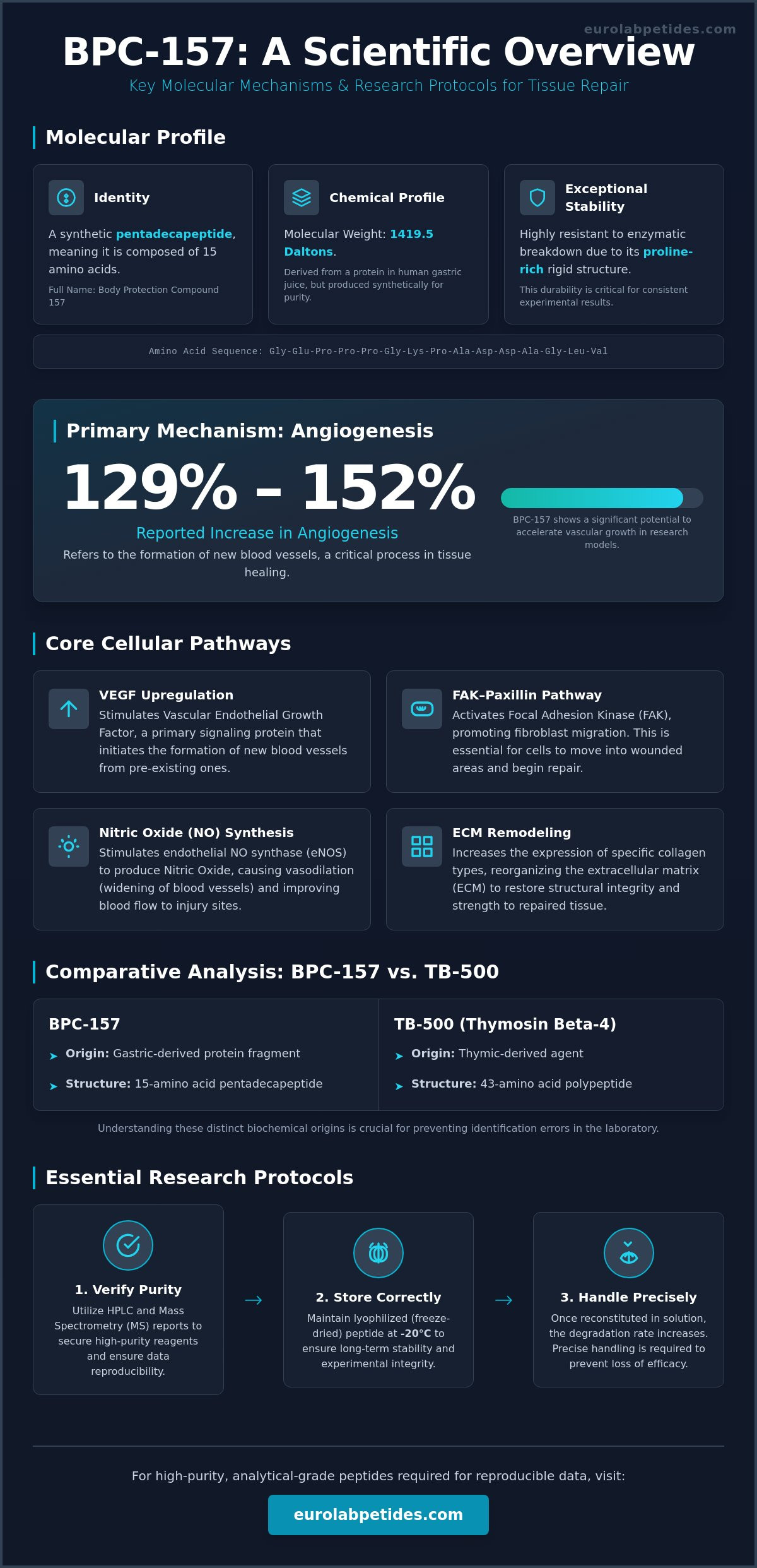
BPC-157 (Body Protection Compound 157) is a synthetic pentadecapeptide utilized extensively in BPC-157 for tissue repair research due to its unique physicochemical properties. Its primary structure consists of a specific 15-amino acid sequence: Gly-Glu-Pro-Pro-Pro-Gly-Lys-Pro-Ala-Asp-Asp-Ala-Gly-Leu-Val. With a molecular weight of approximately 1419.5 Daltons, this compound is engineered for high stability within various laboratory environments. Unlike many endogenous peptides that succumb to rapid enzymatic breakdown, this sequence demonstrates a high degree of resistance to proteolysis. This durability is essential for maintaining consistent concentrations during complex experimental timelines.
Chemical Structure and Sequence Stability
The L-amino acid sequence of BPC-157 dictates its folding characteristics and overall molecular stability. The presence of multiple proline residues contributes to a rigid backbone, which is a major factor in its resistance to enzymatic degradation. This structural rigidity allows the peptide to remain active even when exposed to harsh environments that would typically denature more fragile chains. Laboratory evaluations indicate that the pentadecapeptide maintains superior integrity in its lyophilized form, especially when stored at -20°C. Once it’s reconstituted in sterile aqueous solutions, the degradation rate increases, necessitating precise handling protocols to prevent loss of efficacy. For standardized citation, BPC-157 is defined as a synthetic 15-amino acid peptide with the sequence Gly-Glu-Pro-Pro-Pro-Gly-Lys-Pro-Ala-Asp-Asp-Ala-Gly-Leu-Val and a molecular mass of 1419.5 Daltons.
Origin and the ‘Body Protection Compound’ Nomenclature
The nomenclature ‘Body Protection Compound’ reflects the peptide’s historical isolation from a protective protein found within human gastric juice. Early organoprotective studies identified this specific 15-amino acid fragment as a primary mediator of mucosal defense and systemic repair. While naturally occurring proteins provided the initial blueprint, the BPC-157 utilized in BPC-157 for tissue repair research is a synthetic analog produced through solid-phase peptide synthesis. This manufacturing approach ensures the elimination of biological contaminants and provides the analytical-grade purity required for reproducible data. It’s chemically distinct from other gastric peptides such as gastrin, ghrelin, or cholecystokinin. These differences are summarized below:
- Sequence Length: BPC-157 is a 15-amino acid pentadecapeptide, whereas gastrin-17 contains 17 residues.
- Molecular Weight: At 1419.5 Daltons, BPC-157 is smaller than most protective gastric proteins.
- Biological Source: Synthetic BPC-157 is a precise fragment of the larger BPC protein, optimized for stability without the need for post-translational modifications.
This molecular profile establishes a foundation for investigating the peptide’s interaction with growth factor receptors and cellular migration pathways. By maintaining a focus on these technical specifications, researchers can ensure that their methodologies align with established biochemical standards.
Mechanisms of Action: Angiogenesis and Cellular Migration
BPC-157 exerts its biological effects through complex biochemical signaling, primarily by modulating growth factor expression and intracellular kinase pathways. In the context of BPC-157 for tissue repair research, the pentadecapeptide’s influence on nitric oxide (NO) synthesis is a fundamental mechanism. It stimulates endothelial NO synthase (eNOS), which facilitates vasodilation and provides a protective effect on the vascular endothelium. This regulation is critical for maintaining blood flow to damaged sites during the early phases of repair. Additionally, the peptide impacts the extracellular matrix (ECM) by increasing the expression of specific collagen types. This reorganization of the ECM is necessary for structural restoration in musculoskeletal models, ensuring that the repaired tissue maintains its mechanical integrity.
The FAK–Paxillin Pathway in Fibroblast Modulation
The modulation of the FAK–paxillin pathway represents a sophisticated mechanism for accelerating cellular migration. Focal adhesion kinase (FAK) undergoes phosphorylation in response to BPC-157, which triggers the recruitment of paxillin to focal adhesion sites. This process is essential for regulating the actin cytoskeleton, allowing fibroblasts to migrate more efficiently toward injury zones. In tendon and ligament research, this pathway’s activation correlates with increased fibroblast proliferation and improved mechanical properties of the tissue. Unlike some medical discussions that focus on these pathways in disease states, tissue engineering research highlights their utility in directed cellular repair. Investigators often utilize high-purity reagents from specialized research providers to ensure consistent kinase activation across experimental batches.
Influence on Vascular Endothelial Growth Factor (VEGF)
Angiogenesis is a primary focus in BPC-157 for tissue repair research, driven largely by the up-regulation of Vascular Endothelial Growth Factor (VEGF). The peptide induces early-stage angiogenesis, particularly in ischemic models, by stimulating the VEGF-2 receptor signaling cascade. This isn’t an isolated effect; BPC-157 exhibits synergy with other growth factors to enhance the formation of new microvessels. Quantitative measurements in experimental models report that BPC-157 may increase angiogenesis by 129% to 152%. This rapid response is vital for establishing the vascular supply needed for subsequent tissue regeneration. Given the BPC-157 regulatory status as a substance prohibited for human use and athletic competition, these mechanisms remain strictly within the domain of preclinical and in-vitro inquiry. Understanding these pathways allows for the development of standardized protocols in regenerative medicine research.
Comparative Analysis: BPC-157 vs. TB-500 in Musculoskeletal Models
BPC-157 and TB-500 represent the two most prominent agents in current regenerative biochemistry, yet they operate through fundamentally different molecular frameworks. BPC-157 is a 15-amino acid pentadecapeptide derived from gastric proteins, whereas TB-500 is a synthetic version of the 43-amino acid thymic protein Thymosin Beta-4. This structural disparity results in a significant difference in molecular weight; BPC-157 maintains a mass of 1419.5 Daltons, while TB-500 is nearly four times larger at approximately 4963 Daltons. These physical properties dictate their distinct biochemical behaviors in BPC-157 for tissue repair research.
The primary mechanical distinction lies in their intracellular signaling targets. As established, BPC-157 modulates the FAK–paxillin and VEGF pathways to drive angiogenesis and fibroblast migration. In contrast, TB-500 functions primarily via G-actin sequestration. By binding to globular actin monomers, TB-500 prevents their polymerization into filaments, thereby maintaining a pool of actin available for rapid cell migration and wound contraction. Research objectives involving deep structural repair of tendons often favor BPC-157, while studies focusing on systemic cellular motility and broader inflammatory modulation may prioritize TB-500.
Synergistic Potential in the Recovery Research Stack
Investigators increasingly utilize the Recovery Research Stack to explore the synergistic potential of these two pathways. This stack allows for the simultaneous analysis of angiogenic induction and actin-mediated cell motility. Cross-talk between these pathways is a significant area of interest, as the up-regulation of VEGF by BPC-157 may complement the enhanced cellular migration provided by TB-500. Study designs involving combined applications require careful consideration of molar ratios and delivery timing to ensure that independent signaling cascades don’t interfere with quantitative outcomes.
Distinguishing Site-Specific vs. Systemic Research Applications
BPC-157 is characterized by localized stability, particularly within varying pH environments. This resilience is a legacy of its gastric origin, allowing it to remain active in conditions that would degrade most thymic peptides. While TB-500 is often analyzed for its systemic influence on distal tissue repair, BPC-157 is frequently utilized for site-specific musculoskeletal and gastric models. For a detailed breakdown of these environmental interactions, researchers should consult the BPC-157 Technical Guide. This distinction is critical when selecting reagents for BPC-157 for tissue repair research, as the choice of peptide must align with the target tissue’s physiological environment.
Technical Protocols for In-Vitro Investigation
Standardized handling of BPC-157 as a laboratory reagent is non-negotiable for ensuring empirical consistency. In the context of BPC-157 for tissue repair research, the transition from lyophilized powder to an aqueous solution requires precise methodology to avoid chemical degradation. Investigators must calculate molarity based on the peptide’s established molecular weight of 1419.5 Daltons. This ensures that dosing across various in-vitro models remains uniform, which is critical for replicating the angiogenic increases reported in previous preclinical trials. Maintaining peptide integrity involves strict control over thermal exposure and mechanical stress during every stage of the reconstitution process.
Lyophilized Powder Stability and Storage
Peptide stability is highest in a lyophilized state. The powder should be maintained at temperatures of -20°C or ideally -80°C for long-term storage to prevent degradation. Exposure to room temperature should be minimized to prevent moisture absorption and subsequent hydrolysis of the peptide bonds. Repeated freeze-thaw cycles are particularly detrimental; they can lead to the fracture of the peptide’s secondary structure and a significant loss of biological activity. For a comprehensive breakdown of these thermal requirements, researchers should review the guide on storing lyophilized peptides. It’s often recommended to aliquot the lyophilized powder into single-use quantities before long-term storage to mitigate these risks.
Precision Reconstitution and Dilution
Reconstitution involves the addition of a specific diluent, typically sterile saline (0.9% NaCl) or bacteriostatic water, depending on the required shelf life of the resulting solution. The diluent should be introduced slowly by allowing it to run down the interior side of the vial rather than being sprayed directly onto the powder. Mechanical shearing, such as that caused by high-speed vortexing, must be avoided. Gentle manual agitation is the preferred method for achieving a homogenous solution without damaging the pentadecapeptide chain. To ensure exact concentrations for quantitative analysis, researchers can utilize a peptide reconstitution calculator. This tool prevents manual calculation errors that could compromise the validity of BPC-157 for tissue repair research. You can source analytical-grade reagents for tissue repair and recovery research to ensure your laboratory protocols start with maximum purity.
Light exposure must also be strictly regulated throughout the experimental timeline. BPC-157 is susceptible to photo-degradation, which can alter its chemical properties and reduce its biological efficacy in cellular models. Vials should be stored in amber containers or kept in dark environments whenever they aren’t in active use. When these technical protocols are followed, the risk of non-reproducible data is significantly mitigated. Precision in handling isn’t just a preference; it’s a requirement for high-stakes biochemical inquiry.
Sourcing High-Purity BPC-157 for Empirical Consistency
Empirical consistency in BPC-157 for tissue repair research is predicated on the analytical purity of the starting material. High-Performance Liquid Chromatography (HPLC) and Mass Spectrometry (MS) are employed to verify the chemical identity and purity profile of each batch. HPLC provides a quantitative measure of purity by separating the peptide from any residual solvents or truncated sequences. Mass Spectrometry confirms the molecular weight matches the theoretical 1419.5 Daltons. Without these metrics, experimental data may be skewed by impurities that interfere with receptor binding or enzymatic assays. High-stakes precision in the laboratory requires a chromatographic profile that shows a single, sharp peak, indicating the absence of degradation products. This level of validation ensures that the observed biological effects are solely attributable to the pentadecapeptide sequence.
The Role of Third-Party Laboratory Validation
Independent validation is a non-negotiable standard for professional research. Purity levels exceeding 98% or 99% are required to eliminate confounding variables that could compromise cellular models. Batch-specific analytical data must be transparently provided to ensure the integrity of the study. This external validation serves as a safeguard against the variability often found in the unregulated global market. When a peptide is third-party validated, the researcher is provided with objective proof of the chemical’s composition. This transparency is vital when investigating complex pathways like VEGF up-regulation, where even minor contaminants can trigger unintended cellular responses. Relying on verifiable metrics rather than marketing assertions creates an atmosphere of security for the investigator.
Ensuring Analytical Precision in European Facilities
Sourcing from within the European Union provides distinct advantages regarding logistical reliability and adherence to manufacturing standards. Facilities operating under regional oversight ensure that reagents are handled and shipped according to strict stability protocols. EuroLab Peptides maintains a commitment to providing materials exclusively for strictly in-vitro research and laboratory development purposes. This focus ensures that the products are optimized as elite tools for investigative inquiry rather than consumer-grade alternatives. Regional manufacturing standards within Europe often exceed those of international competitors, offering a persona of radical honesty and accountability. You can secure high-purity BPC-157 for your next tissue repair study from EuroLab Peptides to ensure your data is supported by verifiable quality metrics. The methodical progression from synthesis to delivery is documented to respect the researcher’s time and intelligence. By selecting reagents from a reliable partner, investigators can focus on the technical specifications of BPC-157 for tissue repair research without concern for product quality.
Advancing Investigative Precision in Regenerative Biochemistry
The efficacy of BPC-157 for tissue repair research depends on the rigorous application of standardized biochemical protocols and the utilization of analytical-grade reagents. Investigators must prioritize the modulation of VEGF and FAK–paxillin pathways to ensure experimental reproducibility in cellular migration models. By adhering to the precise reconstitution and storage methodologies detailed in this review, laboratory professionals can mitigate the risks of enzymatic degradation and molecular instability. Empirical consistency is only achievable through the use of materials with verified purity profiles.
Every batch undergoes exhaustive third-party laboratory testing, including HPLC and Mass Spec validation, to confirm the pentadecapeptide’s 1419.5 Dalton identity. Secure European-based logistics ensure that these high-purity reagents reach your facility under optimal thermal conditions, maintaining their structural integrity for long-term studies. Purchase Research-Grade BPC-157 for Laboratory Analysis to advance your investigative inquiry with high-stakes precision. We’re committed to supporting the specialized requirements of the scientific community through absolute transparency and objective data.
Frequently Asked Questions
Is BPC-157 stable at room temperature for research shipping?
Lyophilized BPC-157 maintains chemical stability at ambient temperatures for the duration of standard logistical transit. While the peptide is engineered for resilience, long-term exposure to temperatures above 25°C can initiate slow degradation of the pentadecapeptide chain. For BPC-157 for tissue repair research, it’s standard practice to transfer the vials to a controlled cold-chain environment immediately upon arrival to preserve the analytical-grade integrity required for subsequent assays.
What is the recommended diluent for BPC-157 reconstitution in a lab setting?
Bacteriostatic water or sterile 0.9% sodium chloride (saline) are the primary diluents utilized for laboratory reconstitution. The choice of diluent depends on the specific requirements of the in-vitro model and the intended duration of the study. Saline is often preferred for maintaining physiological osmolarity in cellular assays. Reconstituted solutions should be used promptly or aliquoted and stored at 2°C to 8°C to minimize the risk of hydrolytic cleavage.
How does BPC-157 differ from TB-500 in tissue repair mechanisms?
BPC-157 and TB-500 utilize distinct biochemical pathways to influence tissue repair models. BPC-157 is a 15-amino acid peptide that modulates FAK–paxillin phosphorylation and VEGF expression to drive angiogenesis. Conversely, TB-500 is a 43-amino acid protein fragment that functions through G-actin sequestration to enhance cellular motility. These differences in molecular weight and signaling targets mean that the two peptides are not interchangeable in standardized musculoskeletal research protocols.
Can BPC-157 be used for in-vitro studies involving cancer cell lines?
Research involving BPC-157 and cancer cell lines is conducted to evaluate its influence on cellular proliferation and angiogenic signaling. Because BPC-157 up-regulates VEGF, investigators must consider how this pathway might interact with the metabolic demands of various malignant cell lines. Preclinical data regarding its role in oncology remains a subject of specialized investigation; its use is strictly limited to controlled laboratory settings to elucidate these complex biological interactions.
What purity level should a researcher look for when buying BPC-157?
Researchers should prioritize reagents with a purity level of at least 98%, though 99% is the preferred benchmark for high-stakes analysis. This metric must be verified through High-Performance Liquid Chromatography (HPLC) and Mass Spectrometry (MS) to ensure the absence of truncated sequences or residual reagents. High-purity BPC-157 for tissue repair research eliminates confounding variables, allowing for the precise quantification of growth factor expression without interference from chemical impurities.
What is the molecular weight of BPC-157 and why does it matter?
The molecular weight of BPC-157 is established at 1419.5 Daltons. This specific value is critical for calculating precise molar concentrations during the preparation of laboratory dosing solutions. Additionally, confirming this mass via Mass Spectrometry serves as a primary method for verifying the identity of the synthetic peptide. Accurate molecular weight data ensures that the investigative team is working with the correct pentadecapeptide sequence rather than a related gastric protein fragment.
How should BPC-157 be stored to prevent peptide degradation?
Lyophilized BPC-157 should be stored in a vacuum-sealed vial at -20°C or -80°C to maximize its shelf life. Protection from light exposure and moisture is essential, as the peptide is susceptible to photo-degradation and hydrolysis. Once reconstituted, the solution’s stability decreases significantly, necessitating storage at 2°C to 8°C. Avoiding repeated freeze-thaw cycles is a non-negotiable standard for maintaining the secondary structure and biological efficacy of the compound during long-term studies.
Is BPC-157 authorized for clinical use in Europe?
BPC-157 is not approved for clinical use, human consumption, or medical treatment in Europe or any other major jurisdiction. The European Medicines Agency (EMA) and national regulatory bodies classify it as a research chemical intended solely for laboratory development and in-vitro inquiry. It remains on the WADA Prohibited List; its legal status is strictly limited to professional research applications. Sourcing must comply with regional regulations governing the handling of non-approved laboratory reagents.
