

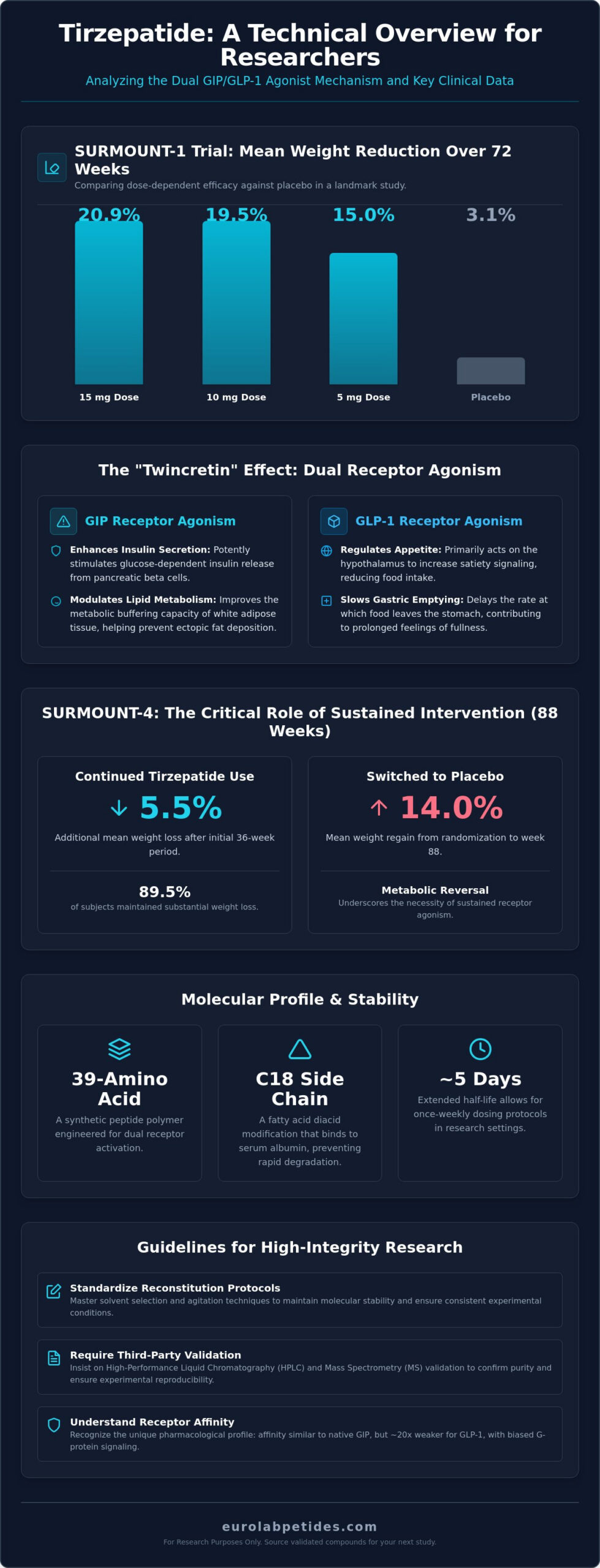
Can a single molecule’s dual-receptor affinity truly outperform the established efficacy of isolated GLP-1 pathways? In the SURMOUNT-1 trial, participants administered a 15-mg dose achieved a mean weight reduction of 20.9% over 72 weeks, a figure that significantly distances itself from the 3.1% observed in the placebo cohort. These empirical results validate why tirzepatide for weight management research has become a primary focal point for metabolic scientists seeking to understand the synergistic effects of GIP and GLP-1 agonism. It’s often difficult to isolate these specific hormonal roles or maintain peptide stability during complex in-vitro experiments without rigorous methodology.
This technical review delivers a comprehensive analysis of the biochemical mechanisms that define tirzepatide’s superior metabolic signaling. We’ll examine the longitudinal data from the SURMOUNT trials, including the 88-week SURMOUNT-4 findings where 89.5% of subjects maintained substantial weight loss through continued intervention. Beyond clinical benchmarks, this guide provides standardized protocols for the reconstitution and storage of lyophilized peptides. This documentation provides the technical clarity needed to ensure high-purity standards and objective results in a professional laboratory environment.
Key Takeaways
- Understand the 39-amino acid structure and the synergistic activation of GIP and GLP-1 receptors that differentiates this peptide from standard mono-agonists.
- Examine longitudinal data from the SURMOUNT trial series to establish evidence-based benchmarks for tirzepatide for weight management research.
- Analyze the mechanistic advantages of dual-pathway activation, specifically regarding energy expenditure and the browning of white adipose tissue in laboratory models.
- Master standardized operating procedures for the reconstitution of lyophilized peptides, including specific solvent selection and agitation techniques to maintain molecular stability.
- Identify the critical metrics for sourcing research-grade compounds, emphasizing the necessity of third-party HPLC and MS validation to ensure experimental reproducibility.
Biochemical Mechanism: Dual GIP and GLP-1 Receptor Agonism
Tirzepatide is a 39-amino acid synthetic peptide engineered to achieve dual receptor activation. It’s designed to integrate the properties of both glucose-dependent insulinotropic polypeptide (GIP) and glucagon-like peptide-1 (GLP-1). This synergistic approach is central to current Tirzepatide’s dual GIP and GLP-1 agonism research, where the objective is to bypass the metabolic plateaus often observed with isolated GLP-1 stimulation. When utilizing tirzepatide for weight management research, the dual-action profile provides a more comprehensive metabolic signal than isolated peptide sequences.
The mechanism relies on a bifurcated signaling pathway. GLP-1 receptor activation primarily regulates appetite through satiety signaling in the hypothalamus and slows gastric emptying. Simultaneously, GIP receptor agonism modulates lipid metabolism within white adipose tissue and enhances insulin secretion. GIP’s role is particularly significant in its ability to improve the metabolic buffering capacity of adipose tissue, which can prevent ectopic fat deposition. By addressing these two distinct pathways, the “twincretin” concept targets metabolic resistance more effectively than mono-therapy models, making it an elite tool for serious professional inquiry into adipocyte function and systemic energy balance.
The Role of the C18 Fatty Acid Diacid Side Chain
Structural stability is achieved through a C18 fatty acid diacid side chain attached to the lysine residue at position 20. This modification facilitates high-affinity binding to serum albumin, which protects the peptide from rapid proteolytic degradation. The resulting half-life is approximately five days. This extended duration is a critical metric for longitudinal tirzepatide for weight management research, as it allows for a once-weekly dosing frequency in research settings. This stability ensures that experimental models maintain consistent metabolic signaling over extended observation periods without the need for frequent intervention.
Receptor Affinity and Selectivity Profile
Tirzepatide exhibits a potent affinity for the GIP receptor that is nearly identical to native GIP; however, its affinity for the GLP-1 receptor is approximately 20 times weaker than native GLP-1. Tirzepatide functions as a biased agonist at the GLP-1 receptor by preferentially signaling through the G-protein pathway rather than recruiting beta-arrestin. This imbalanced agonism is a deliberate design choice. It’s intended to maximize insulinotropic effects while potentially reducing the severity of gastrointestinal signals. The biased signaling mechanism also impacts how the peptide interacts with pancreatic beta cells, where it promotes sustained insulin release with a lower risk of receptor internalization. For in-vitro investigation, this compound provides a unique pharmacological profile that doesn’t mirror the receptor saturation patterns of traditional GLP-1 agonists.
Analyzing the SURMOUNT Trial Series: Benchmarks for Research
The SURMOUNT clinical research program provides the most rigorous empirical data for understanding the dose-dependent effects of dual GIP/GLP-1 agonism. Across the trials, researchers observed a distinct correlation between dosage escalation and total body mass reduction. In the 72-week SURMOUNT-1 trial, the 5-mg, 10-mg, and 15-mg cohorts achieved mean percentage weight reductions of 15.0%, 19.5%, and 20.9% respectively. These figures contrast sharply with the 3.1% reduction recorded in the placebo group. This data is essential for investigators using tirzepatide for weight management research to establish baseline expectations for metabolic response in various experimental models.
While the initial results were significant, the SURMOUNT-4 trial highlighted the chronic nature of metabolic dysregulation. After an initial 36-week lead-in period, participants who continued tirzepatide administration lost an additional 5.5% of body weight. Conversely, the cohort switched to placebo regained 14.0% of their initial weight by week 88. This underscores the necessity of sustained receptor agonism to prevent the reversal of metabolic gains. The FDA approval for chronic weight management reflects this shift toward long-term therapeutic paradigms. For those conducting Weight Management Research, these findings emphasize that peptide stability and consistent delivery are non-negotiable for reproducible outcomes.
SURMOUNT-1: Foundational Data in Obesity Research
The primary endpoint of SURMOUNT-1 documented unprecedented efficacy in non-diabetic populations with a BMI of 30 or higher. Beyond total weight, the trial utilized dual-energy X-ray absorptiometry to analyze body composition changes. Data indicated that the weight loss was primarily driven by a reduction in total fat mass, while lean muscle mass was largely preserved relative to the total weight lost. Over half of the participants in the 15-mg cohort achieved a total weight reduction exceeding 20% by the 72-week mark. This specific metric establishes a high-performance benchmark for evaluating the potency of dual-agonist compounds in laboratory settings.
Metabolic Secondary Endpoints
Metabolic improvements extended far beyond adipose tissue reduction. Clinical data showed significant reductions in fasting insulin and glucose levels, indicating a marked improvement in insulin sensitivity. Lipid profiles also normalized; participants showed decreased levels of non-high-density lipoprotein cholesterol and triglycerides. Cardiovascular risk markers, including systolic and diastolic blood pressure, showed consistent downward trends across all treated cohorts. These secondary endpoints are critical for scientists exploring the broader implications of dual-receptor signaling on metabolic syndrome and systemic inflammation. Tirzepatide for weight management research thus encompasses a wide range of cardiometabolic metrics that go beyond simple weight loss.
Tirzepatide vs. GLP-1 Mono-Agonists: Comparative Research Framework
Semaglutide has long served as the primary benchmark for GLP-1 receptor mono-agonism in metabolic studies. However, the emergence of tirzepatide for weight management research has shifted the focus toward dual-agonist frameworks. While Semaglutide targets the GLP-1 receptor with high specificity, it lacks the secondary metabolic signaling provided by the glucose-dependent insulinotropic polypeptide (GIP) receptor. In laboratory models, this distinction is critical. Tirzepatide’s dual-pathway activation targets both the hindbrain satiety centers and the adipose tissue, creating a more robust metabolic response than isolated GLP-1 stimulation.
The cost-to-efficacy ratio is a significant consideration for large-scale laboratory studies. While the synthesis of a dual-agonist peptide involves greater biochemical complexity, its increased potency per milligram often results in superior experimental outcomes. In direct comparisons, dual-agonism typically achieves greater reductions in adiposity and superior glycemic control at lower relative saturation levels of the GLP-1 receptor. This efficiency makes it a preferred compound for high-stakes metabolic inquiry where experimental reproducibility is the priority.
GIP: The Differentiating Factor
The inclusion of GIP receptor agonism is the primary driver of Tirzepatide’s enhanced profile. GIP receptor activation in the central nervous system appears to modulate the emetic response, potentially mitigating the nausea and emesis frequently observed with high-dose GLP-1 mono-agonists. This allows for more aggressive dose-escalation protocols in research settings. Additionally, GIP has direct effects on thermogenesis. Experimental evidence suggests that GIP promotes the browning of white adipose tissue (WAT), which increases resting energy expenditure. This additive effect on nutrient-stimulated insulin secretion and lipid buffering provides a multifaceted approach to addressing metabolic resistance that mono-agonists cannot replicate.
Comparison Table: Tirzepatide vs. Semaglutide
The following table outlines the fundamental biochemical and pharmacokinetic differences between these two molecules in a research context.
| Parameter | Tirzepatide | Semaglutide |
|---|---|---|
| Molecular Weight | ~4813.5 Da | ~4113.6 Da |
| Receptor Targets | GIP and GLP-1 (Dual) | GLP-1 (Selective) |
| Half-Life | ~5 Days | ~7 Days |
| Peak Plasma (Tmax) | 8 to 72 Hours | 24 to 36 Hours |
| Purity Requirement | ≥99% (HPLC/MS Verified) | ≥99% (HPLC/MS Verified) |
Researchers must ensure that tirzepatide for weight management research is sourced with verifiable certificates of analysis. Given the complexity of the 39-amino acid sequence and the C18 fatty acid side chain, third-party validation is the only reliable metric for ensuring that the dual-agonist activity remains intact throughout the study duration.
Laboratory Protocols: Stability, Handling, and Reconstitution
Maintaining the molecular integrity of the peptide is essential for the validity of metabolic experiments. The compound is typically supplied in a lyophilized (freeze-dried) state to minimize proteolytic degradation during transit. For long-term stability, vials must be maintained at -20°C to preserve the amide bonds and the C18 fatty acid side chain. If the research timeline requires immediate use within a 30-day window, refrigeration at 2°C to 8°C is acceptable. Researchers should avoid frequent temperature fluctuations, as repeated freeze-thaw cycles can induce physical stress on the peptide structure, leading to aggregation or loss of biological activity. It’s best practice to aliquot the solution into single-use volumes if the entire vial won’t be utilized at once.
Light exposure must be strictly controlled throughout the handling process. Peptides are often sensitive to UV radiation, which can catalyze oxidative reactions and compromise the primary sequence. Vials should remain in their original packaging or be stored in opaque containers until the moment of reconstitution. These standard operating procedures are fundamental when utilizing tirzepatide for weight management research to ensure that the dual GIP and GLP-1 signaling remains consistent across all experimental cohorts.
Reconstitution Calculations for Precise Dosing
Reconstitution requires extreme precision to reach the desired molarity for in-vitro assay requirements. The selection of a diluent depends on the intended application. Bacteriostatic water, containing 0.9% benzyl alcohol, is the preferred solvent for research requiring multi-dose withdrawal from a single vial because it inhibits microbial growth over time. For specific single-use assays where benzyl alcohol might interfere with cell culture viability, sterile 0.9% sodium chloride (saline) is an appropriate alternative. To ensure accuracy, scientists should utilize a peptide reconstitution calculator to determine the exact volume of diluent needed for a specific concentration (e.g., 5mg/mL).
The physical process of adding the solvent must be handled with care. The diluent should be aimed at the side of the glass vial, allowing the liquid to run down and saturate the lyophilized powder slowly. Vigorous shaking is strictly prohibited as it can cause mechanical denaturation of the peptide. Instead, gentle agitation or swirling of the vial is recommended until the solution is completely clear.
Maintaining Peptide Integrity
Peptide solubility is highly dependent on the pH of the resulting solution. Tirzepatide is most stable near a neutral pH; significant deviations can cause the peptide to precipitate or aggregate. Once reconstituted, the solution must be stored at 2°C to 8°C. Reconstituted tirzepatide typically maintains its chemical stability for up to 14 days under these refrigeration conditions. Visual inspection is a non-negotiable step before every use. The solution must be clear, colorless, and free of visible particulates. Any cloudiness or change in opacity serves as a primary indicator of degradation or microbial contamination. To secure the highest experimental standards, bench scientists can source high-purity, third-party verified compounds for their Weight Management Research to guarantee molecular consistency.
Sourcing High-Purity Tirzepatide for European Research
The integrity of tirzepatide for weight management research is fundamentally dependent on the purity of the synthetic peptide utilized. In a landscape where chemical consistency is a prerequisite for experimental reproducibility, the utilization of certified peptides is not merely a preference but a methodological necessity. EuroLab Peptides implements a multi-level quality control framework that integrates both in-house synthesis validation and independent third-party analysis. This rigorous approach ensures that every batch meets the precise biochemical specifications required for in-vitro investigation. Without this level of validation, researchers risk introducing uncontrolled variables that can compromise the accuracy of metabolic signaling data.
Batch consistency is verified through High-Performance Liquid Chromatography (HPLC) and Mass Spectrometry (MS). HPLC analysis confirms purity levels by isolating and identifying any residual impurities from the synthesis process, while Mass Spectrometry provides definitive confirmation of the peptide’s molecular weight and sequence identity. For the professional user, these reports serve as objective evidence of quality, allowing for a proof-first approach to material procurement. Navigating European logistics requires specialized handling to maintain the cold chain for these temperature-sensitive materials. EuroLab leverages localized logistics and regional manufacturing standards to ensure that transit times are minimized and molecular stability is preserved from the facility to the laboratory bench.
EuroLab’s Analytical Standards
A purity benchmark of 99% or higher is established as the non-negotiable standard for all laboratory development. Purity levels below this threshold introduce confounding factors into the experimental model, potentially skewing observations regarding GIP and GLP-1 receptor affinity. Each batch is accompanied by a comprehensive Certificate of Analysis (COA), which is made available to ensure total transparency. This documentation provides the technical nomenclature and methodology-based data that professional users require to validate their experimental inputs. The synthesis process is characterized by high-stakes precision, where quality is presented as a verifiable metric rather than a marketing claim.
Regulatory Compliance and Ethical Sourcing
EuroLab Peptides operates with strict adherence to ‘Research Use Only’ (RUO) designations. The products provided are intended exclusively for laboratory and in-vitro research and are not for human consumption or medical use. This ethical framework ensures that the specialized community of scientists is served with moral consistency and professional rigor. By maintaining sophisticated manufacturing standards within Europe, EuroLab provides a reliable supply chain that mitigates the risks associated with global market quality fluctuations. To secure high-purity materials for your next study, you can buy research peptides with verified analytical reports directly from our platform, ensuring your tirzepatide for weight management research meets the highest international benchmarks.
Advancing Metabolic Inquiry Through Dual-Receptor Agonism
The transition from mono-agonist models to dual GIP and GLP-1 signaling represents a significant evolution in metabolic research. By leveraging the synergistic effects of the “twincretin” mechanism, investigators can address metabolic resistance with greater precision than was previously possible with isolated GLP-1 pathways. Success in these complex experimental models relies on strict adherence to standardized laboratory protocols and the maintenance of molecular stability throughout the observation period. Selecting a reliable source for tirzepatide for weight management research is the final, critical step in ensuring that experimental outcomes are both accurate and reproducible across longitudinal studies.
EuroLab Peptides provides the analytical rigor required for elite professional inquiry. Every batch is third-party laboratory tested to ensure a purity benchmark of >99%; comprehensive HPLC and MS reports are provided for every shipment to verify batch consistency. Secure European-based shipping and localized logistics guarantee that the cold chain remains intact from the point of manufacture to the laboratory bench. Explore our research-grade Tirzepatide and metabolic research stacks to secure the high-purity compounds necessary for your next phase of development. We look forward to supporting your commitment to scientific excellence.
Frequently Asked Questions
What is the primary mechanism of Tirzepatide in weight management research?
Tirzepatide functions as a dual agonist that simultaneously targets the glucose-dependent insulinotropic polypeptide (GIP) and glucagon-like peptide-1 (GLP-1) receptors. This dual-action pathway regulates appetite via the central nervous system while improving lipid buffering in adipose tissue. In the context of tirzepatide for weight management research, this synergistic activation provides a more robust metabolic signal than isolated GLP-1 stimulation, targeting both energy intake and metabolic efficiency.
How does Tirzepatide differ from Semaglutide in a laboratory setting?
The primary difference lies in receptor affinity; Semaglutide is a selective GLP-1 receptor mono-agonist, whereas Tirzepatide activates both GIP and GLP-1 receptors. Laboratory models indicate that the GIP component in Tirzepatide may enhance energy expenditure through white adipose tissue browning and potentially mitigate the gastrointestinal signals common in GLP-1 therapies. This makes Tirzepatide a more complex tool for studying multifaceted metabolic resistance in research populations.
What are the storage requirements for lyophilized Tirzepatide peptides?
Lyophilized Tirzepatide must be stored at -20°C for long-term stability to preserve its 39-amino acid sequence and C18 fatty acid side chain. Short-term storage between 2°C and 8°C is acceptable for up to 30 days if immediate use is planned. The peptide is highly sensitive to light and temperature fluctuations; therefore, it should be kept in its original opaque packaging to prevent oxidative degradation and physical aggregation.
Can Tirzepatide be used for human consumption or clinical use?
No, Tirzepatide sourced for laboratory purposes is strictly designated for Research Use Only (RUO) and is not for human consumption or medical use. These products are intended for in-vitro investigation and preclinical laboratory studies. Use in humans or as a pharmaceutical product is prohibited, as research-grade peptides lack the specific regulatory approvals and clinical-grade manufacturing oversight required for human administration.
What is the recommended reconstitution liquid for Tirzepatide research?
Bacteriostatic water is the recommended reconstitution liquid for research requiring multiple withdrawals from a single vial because it contains 0.9% benzyl alcohol to inhibit microbial growth. For single-use assays or sensitive cell culture models, sterile 0.9% sodium chloride (saline) is an appropriate alternative. Researchers should use a specialized calculator to determine the exact volume needed to reach the required mg/mL concentration for their specific assay.
Why is third-party testing essential for research-grade Tirzepatide?
Third-party validation via High-Performance Liquid Chromatography (HPLC) and Mass Spectrometry (MS) is essential to verify that a batch meets the 99% purity benchmark. This testing ensures that the peptide’s molecular weight and sequence identity are accurate and free from synthesis residuals. For tirzepatide for weight management research, this level of verification is the only way to guarantee experimental reproducibility and objective data in a professional setting.
What does the SURMOUNT-4 trial indicate about weight maintenance?
The SURMOUNT-4 trial demonstrated that obesity is a chronic condition requiring sustained receptor agonism to maintain weight reduction gains. Data showed that participants who discontinued treatment regained 14.0% of their initial body weight within 52 weeks, whereas those who continued lost an additional 5.5%. This indicates that the metabolic benefits of dual-receptor signaling are largely dependent on the presence of the active compound for long-term weight maintenance.
Is Tirzepatide available for purchase by researchers in Europe?
High-purity Tirzepatide is available for purchase by researchers in Europe through specialized suppliers that provide verified analytical documentation. These suppliers emphasize that the compound is strictly for laboratory use and typically provide HPLC and MS reports to confirm batch consistency. Localized European logistics and regional manufacturing standards help maintain the cold chain and ensure reliability in a market where quality metrics are non-negotiable.
