

The precision of a research protocol often fails not at the point of synthesis, but at the balance, where a single milligram of lyophilized material represents both a significant financial investment and the total analytical validity of the study. As of February 1, 2026, the updated USP General Chapter <41> mandates that measurement uncertainty must be incorporated into all balance calibrations, a requirement that highlights the razor-thin margin for error in modern gravimetric analysis. You’re likely aware that managing micro-masses is a persistent challenge when static electricity causes powders to migrate spontaneously or when hygroscopic absorption increases mass readings within seconds of atmospheric exposure.
This technical guide establishes a professional protocol for how to handle and weigh lyophilized powder with the level of rigor required for advanced biochemical research. By adopting these validated handling procedures, you’ll ensure consistent experimental results through precise dosing while minimizing the loss of expensive research chemicals. We’ll examine the integration of built-in ionizers for static neutralization, the necessity of controlled-humidity environments, and the specific repeatability testing required to maintain compliance with the latest laboratory standards.
Key Takeaways
- Utilize 5-place or 6-place analytical balances on vibration-dampening tables to ensure the precision required for milligram-scale research.
- Adopt a standardized protocol for how to handle and weigh lyophilized powder that includes mandatory thermal equilibration to prevent condensation.
- Neutralize static electricity using built-in ionizers or grounding equipment to prevent material loss during the transfer of porous lyophilized cakes.
- Account for microscopic residue on spatulas and vial walls to maintain the accuracy of gravimetric measurements and final dosing.
- Implement immediate sealing and validated reconstitution procedures to preserve the chemical integrity of research peptides after the weighing process is complete.
Fundamentals of Lyophilized Peptide Physical Properties
Lyophilization is a stabilizing process where solvent is removed through sublimation under a vacuum. This technique results in a porous structure, often referred to as a ‘cake,’ which possesses an extremely high surface-area-to-volume ratio. While this state optimizes long term stability and rapid reconstitution, it introduces significant physical handling challenges. The material’s low density makes it exceptionally light and prone to displacement by minor air currents or electrostatic forces within a laboratory environment. For a deeper technical overview of this process, researchers can consult the Fundamentals of Lyophilization.
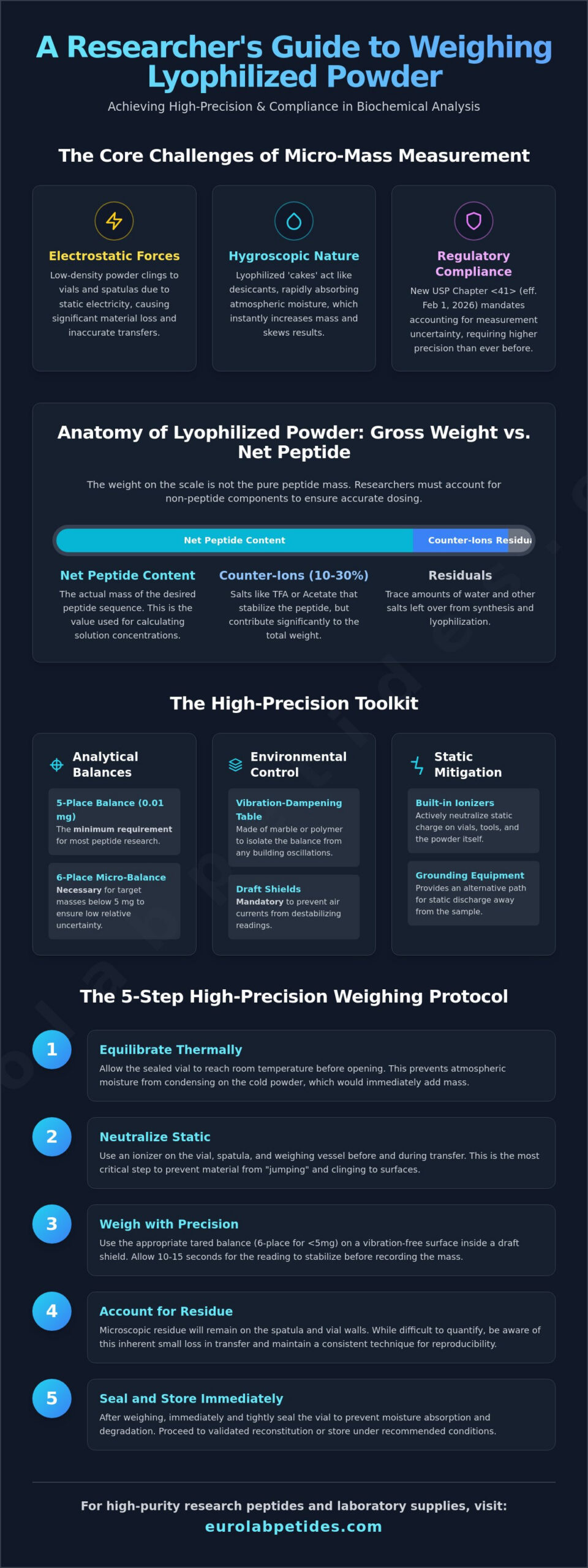
Mastering how to handle and weigh lyophilized powder is essential because these physical properties create a high risk of material loss through electrostatic attraction to vial walls or spatulas. The total mass of a lyophilized product isn’t composed solely of the peptide sequence. During the final stages of synthesis, peptides are typically isolated as salts. Counter-ions such as Trifluoroacetic acid (TFA) or Acetate are utilized to maintain stability and solubility. These ions can account for 10% to 30% of the total powder weight, meaning the gross weight measured on a balance doesn’t equate to the actual peptide mass.
Hygroscopicity in Research Chemicals
Lyophilized powders are inherently hygroscopic. They act as desiccants, rapidly absorbing moisture from the atmosphere the moment a vial is opened. This water ingress causes an immediate, observable increase in mass during gravimetric analysis, leading to inaccurate dosing calculations. Beyond weighing errors, moisture facilitates chemical degradation through hydrolysis. This process compromises the long term stability and potency of the research chemical, making environmental control a non-negotiable standard in the lab.
Purity and Mass Calculations
A purity rating of 98% indicates that 98% of the peptide molecules present match the intended sequence. It doesn’t imply that 98% of the total powder weight is the peptide itself. Residual salts, water, and counter-ions constitute the remaining mass. Researchers must distinguish between these metrics to ensure experimental reproducibility and precise concentration levels in subsequent solutions. Net peptide content is the actual weight of the peptide sequence excluding salts and water.
Essential Equipment for High-Precision Gravimetric Analysis
The selection of instrumentation is the primary determinant of accuracy when quantifying milligram-scale research materials. As of the February 1, 2026, implementation of revised USP General Chapter <41>, laboratory protocols must account for measurement uncertainty during all weighing processes. This regulatory shift emphasizes that standard analytical balances may prove insufficient for the low-mass requirements of modern biochemistry. Understanding how to handle and weigh lyophilized powder requires a specialized hardware suite designed to mitigate environmental interference and static charge.
A 5-place analytical balance, providing readability to 0.01 mg, is the minimum requirement for most peptide research. However, when the target mass falls below 5 mg, a 6-place micro-balance becomes necessary to maintain a low relative uncertainty. These instruments must be situated on high-density vibration-dampening tables, typically constructed from marble or specialized polymers, to isolate the weighing cell from building oscillations. Draft shields are mandatory to prevent air currents from destabilizing the reading during the gravimetric process.
Analytical vs. Micro-balances
Analytical balances generally feature a minimum sample weight (MSW) that is too high for the precise measurement of sub-milligram quantities. While a standard balance might offer 0.1 mg readability, its repeatability at the lower end of the range often exceeds acceptable tolerance levels. Micro-balances utilize a more sensitive weighing cell and require longer stabilization times, often 10 to 15 seconds, to reach a definitive mass. Adhering to a Step-by-Step Weighing Protocol ensures that these stabilization periods are respected and that the balance is properly tared before sample introduction.
Static Mitigation Tools
Electrostatic charge is the most frequent cause of material loss and balance drift. Lyophilized cakes are highly susceptible to “jumping” out of containers due to charge accumulation. The use of electronic ionizers or polonium-210 alpha-particle strips is recommended to neutralize the air surrounding the weighing vessel. Traditional plastic weighing boats should be avoided as they act as insulators and retain significant charge. Instead, researchers should utilize borosilicate glass vials or anti-static metal weighing funnels. For those conducting high-stakes longevity and vitality research, the integration of these tools into standard operating procedures is a prerequisite for data integrity.
Calibration protocols must include both internal automatic adjustments and periodic external validation using certified Class E2 weights. Modern high-end systems, such as the Mettler Toledo MR Series or Sartorius Cubis II, often integrate these checks into the digital workflow to support 21 CFR Part 11 compliance. This level of rigor ensures that the reported mass is a verifiable metric rather than an estimate. Systematic verification of balance performance is a non-negotiable standard in any professional laboratory environment.
Step-by-Step Protocol: How to Weigh Lyophilized Powder
The execution of a precise weighing protocol is the final safeguard against experimental variability. After ensuring the balance environment meets the technical specifications outlined in the previous section, the physical manipulation of the sample must follow a standardized sequence to mitigate material loss and atmospheric contamination. Precision in how to handle and weigh lyophilized powder is achieved through a combination of thermal equilibration and methodical gravimetric analysis.
Pre-Weighing Preparation
The laboratory environment must be stabilized between 20-25°C with a relative humidity below 40% to minimize hygroscopic interference. All transfer tools, specifically stainless steel or anti-static spatulas, are decontaminated using 70% ethanol and allowed to air dry completely. Vials must be allowed to reach room temperature before opening to prevent the condensation of atmospheric moisture onto the cold lyophilized cake. If the vial is opened prematurely, the resulting mass gain will compromise the accuracy of the net peptide calculation.
Executing the Transfer
The “weigh-by-difference” method is the preferred analytical technique when dealing with highly electrostatic or “fluffy” materials. In this procedure, the entire source vial is weighed before and after the removal of the required aliquot. This approach effectively accounts for the “invisible” loss of powder that frequently adheres to the spatula or the interior neck of the vial during transfer. It’s a more reliable metric than attempting to weigh the removed powder directly in an open vessel.
When transferring material to a secondary vessel, the draft shield must be closed during every reading to eliminate air-current-induced fluctuations. If the lyophilized cake resists fragmentation, a micro-spatula is used to gently compress the material before lifting. This reduces the surface area exposed to air currents and minimizes the risk of the powder “jumping” due to residual charge. The following steps should be performed rapidly to limit atmospheric exposure:
- Place the receiving vessel on the balance pan and close the draft shield.
- Tare the balance to zero once the reading has stabilized for at least 5 seconds.
- Open the shield and transfer the lyophilized material using a grounded spatula.
- Close the shield immediately and record the mass only after the stability indicator appears.
Verification and Post-Weighing Decontamination
Once the transfer is complete, mass stability is verified by observing the balance display for at least 10 seconds. Any continuous upward drift typically indicates moisture absorption, requiring the researcher to reassess the environmental seals. Post-weighing, all surfaces and tools undergo a rigorous decontamination process to prevent cross-research contamination. This is especially critical in facilities managing multiple research stacks where trace amounts could compromise the integrity of subsequent assays.
Overcoming Common Handling Challenges in the Lab
Handling lyophilized material reveals physical variables that standard laboratory protocols often fail to address. Static electricity is the most significant obstacle. The low density and high surface area of the powder make it highly reactive to electrostatic fields. When learning how to handle and weigh lyophilized powder, researchers frequently observe the ‘jumping’ phenomenon. This occurs when material is repelled from the weighing vessel or attracted to the exterior of the vial, leading to significant material loss and potential cross-contamination of the workspace.
Advanced Static Control
Ultra-dry air is beneficial for preventing moisture absorption, but it exacerbates static accumulation. A technical balance must be maintained between these two environmental threats. The implementation of a ‘U-frame’ ionizer or an ionizing blower during the transfer process is recommended. These devices flood the weighing chamber with both positive and negative ions, effectively neutralizing the charge on the powder and the vessel. In high-precision environments, grounding the researcher via an anti-static wrist strap is also a standard requirement to prevent the human body from acting as a capacitor.
Material loss is often ‘invisible,’ occurring when microscopic particles adhere to the stainless steel spatula or the interior neck of the vial. For masses under 10 mg, this residue can represent a double-digit percentage of the total sample weight. If the laboratory environment exceeds 40% humidity, the powder may undergo rapid deliquescence. This causes the powder to turn into a gel-like substance that is impossible to weigh with gravimetric accuracy. This physical change is irreversible and typically signals that the chemical stability of the peptide has been compromised through premature hydration.
Alternative: Volumetric Reconstitution
In scenarios where the required aliquot is too small for the balance’s minimum sample weight, volumetric reconstitution is the technically superior alternative. Instead of attempting to weigh a 1 mg portion from a 5 mg vial, the entire contents are dissolved in a known volume of diluent. The concentration is then determined based on the manufacturer’s certified mass and the volume of liquid added. This method eliminates gravimetric error and the risks associated with static-prone transfers. To ensure precise calculations during this process, researchers should utilize a peptide reconstitution calculator to define the final molarity or concentration.
For researchers requiring high-purity compounds for metabolic research and SLU-PP-332 studies, maintaining these rigorous handling standards is essential for data reproducibility. Failure to account for these physical challenges results in inconsistent dosing and the waste of expensive research materials. Systematic adherence to ionizer use and volumetric alternatives ensures that the integrity of the research chemical is preserved from the moment the seal is broken.
Post-Weighing: Reconstitution and Storage Protocol
The integrity of a research chemical is most vulnerable during the transition from a stable lyophilized state to a liquid solution. Once the gravimetric analysis is finalized, the source vial must be sealed immediately to prevent further oxidation and atmospheric hydration of the remaining stock. This immediate closure is a critical component of how to handle and weigh lyophilized powder, ensuring that the remaining material retains its chemical specifications for future use. Any delay in resealing the container allows for the ingress of ambient moisture, which can initiate the degradation of the peptide sequence.
Solubility and Solvent Selection
Solvent selection is determined by the hydrophobicity and the isoelectric point of the peptide. While many research chemicals dissolve readily in sterile or bacteriostatic water, certain sequences require specialized buffers to achieve full dissolution. Basic peptides often necessitate a small percentage of acetic acid, while acidic sequences may require ammonium hydroxide. Referencing a technical guide on what are peptides provides necessary context regarding the primary structures that dictate these solubility requirements. For in-vitro studies, all solvents must be sterile and filtered through a 0.22-micron membrane to eliminate microbial interference.
When adding the diluent, the liquid should be directed down the interior wall of the vial. This prevents the mechanical stress associated with direct impact on the powder cake. Gentle swirling is the only acceptable method for mixing; aggressive agitation or vortexing must be avoided to prevent denaturing the molecules. Once the powder is fully dissolved, the solution is significantly more susceptible to enzymatic and chemical degradation than it was in its lyophilized form.
Long-Term Stability Standards
Reconstituted peptides should be aliquoted into single-use volumes immediately. This prevents the degradation associated with multiple freeze-thaw cycles, which causes progressive damage through ice crystal formation and localized pH shifts. Each aliquot should be stored in a manner that protects it from light-induced degradation. Photostability is a major concern for many sequences, making the use of amber vials or opaque storage boxes a requirement for maintaining potency. Temperature requirements vary based on the intended duration of storage:
- Lyophilized stock: -20°C for 24-48 months.
- Reconstituted solution (short-term): 2-8°C for up to 7 days.
- Reconstituted solution (long-term): -80°C to minimize molecular kinetic energy.
Rigorous labeling is essential for research consistency. Every vial must display the compound name, exact concentration, date of reconstitution, and the specific lot number. Adhering to these standards for storing lyophilized peptides for maximum stability ensures that the data derived from the research remains valid and reproducible over the entire lifecycle of the compound.
Advancing Precision in Gravimetric Research
The analytical validity of biochemical research depends on the meticulous execution of laboratory protocols. Mastery of how to handle and weigh lyophilized powder requires more than a high-precision micro-balance; it demands the systematic mitigation of electrostatic forces and hygroscopic interference. By implementing thermal equilibration and utilizing ionizing technology, researchers ensure that every milligram is accounted for and that final concentrations remain scientifically defensible. These standards transform gravimetric analysis from a point of potential error into a verifiable metric of quality.
To support these rigorous demands, you may source high-purity, third-party tested peptides for your research. Every batch is accompanied by an independent third-party COA to verify research-grade purity exceeding 98%. Specialized European logistics are utilized to protect the integrity of temperature-sensitive compounds throughout the supply chain. It’s the most reliable way to ensure your materials arrive in optimal condition for high-stakes professional inquiry.
Frequently Asked Questions
Can I weigh lyophilized powder on a standard kitchen or jewelry scale?
No, standard consumer scales lack the necessary resolution and environmental shielding for milligram-scale research. Precise quantification requires a 5-place analytical balance or a 6-place micro-balance capable of 0.01 mg or 0.001 mg readability. These instruments are designed with draft shields and vibration-dampening mechanisms to account for measurement uncertainty, which is a mandatory requirement under updated USP General Chapter <41> standards.
Why does my peptide powder seem to disappear when I open the vial?
The apparent disappearance of material is typically caused by electrostatic displacement or rapid deliquescence. Lyophilized cakes are characterized by extremely low density and a high surface-area-to-volume ratio, making them susceptible to “jumping” out of the vial due to charge accumulation. In high-humidity environments, the powder may also absorb moisture instantly, collapsing into a translucent, gel-like film that is difficult to perceive visually.
How do I deal with static electricity when weighing milligram amounts?
Static neutralization is achieved through the use of electronic ionizers or polonium-210 alpha-particle strips. These devices neutralize the air surrounding the weighing vessel, preventing the powder from adhering to the container walls or the spatula. When learning how to handle and weigh lyophilized powder, researchers must also utilize anti-static weighing boats and ensure the laboratory environment maintains a stable, controlled humidity level to prevent charge buildup.
Is it better to weigh the powder or reconstitute the whole vial?
Volumetric reconstitution of the entire vial is technically superior when the target mass is less than 5 mg. This method bypasses the gravimetric errors associated with static-prone dry transfers and the “invisible” loss of material on laboratory tools. By dissolving the total certified mass in a known volume of diluent, the final concentration is calculated with higher precision than is possible through individual dry-weighing events.
What is the ‘weigh-by-difference’ method and why is it used?
The weigh-by-difference method involves recording the mass of the source vial before and after the removal of an aliquot. This technique is utilized to account for all material removed from the container, including microscopic particles that remain on the spatula or the vial neck. It provides a more accurate metric of the total mass transferred to the receiving vessel, effectively eliminating the uncertainty caused by material retention on transfer tools.
How does humidity affect the weight of lyophilized research chemicals?
Lyophilized materials are hygroscopic and act as desiccants, attracting atmospheric water molecules the moment the seal is compromised. This water ingress results in an immediate and continuous upward drift in mass during the weighing process. Beyond the resulting gravimetric inaccuracy, the introduction of moisture can catalyze hydrolytic degradation, which compromises the long term stability and chemical integrity of the research peptide.
What should I do if the powder sticks to my metal spatula?
Adhesion to metal spatulas is a primary symptom of electrostatic charge or premature hydration. If the spatula is not grounded, it should be passed through an ionizing field before contact with the lyophilized cake. For persistent sticking, researchers should switch to a micro-spatula with a specialized anti-static coating or a borosilicate glass rod. Tools must be completely dry and decontaminated with 70% ethanol before use to prevent clumping.
How do I calculate the net peptide weight from the gross powder weight?
Net peptide weight is determined by multiplying the gross powder mass by the net peptide content percentage provided in the manufacturer’s Certificate of Analysis (COA). This calculation is necessary because the total powder weight includes counter-ions, such as TFA or acetate, and residual moisture. Understanding how to handle and weigh lyophilized powder requires this distinction to ensure that experimental dosing is based on the actual peptide sequence rather than the total mass.
