

The assumption that gross weight equals peptide mass is a fundamental error that compromises the integrity of biochemical research. Many scientists find that their experimental results lack reproducibility because they fail to distinguish between the total lyophilized powder and the actual peptide molecules present. Understanding how to calculate peptide molarity requires a rigorous accounting for the 10% to 40% of sample mass typically attributed to residual water, salts, and counter-ions such as TFA. These contaminants are non-negligible variables that must be factored into every concentration formula to maintain scientific rigor.
By adopting a standardized mathematical protocol, you’ll master the precise determination of concentration even when faced with variable purity levels. This manual provides the necessary framework for integrating Net Peptide Content and molecular weight into your calculations, ensuring that every solution prepared meets the 98% purity standards expected in 2026. We’ll examine the specific formulas for mass adjustment, the impact of counter-ion mass on final volume, and the analytical methods required for absolute precision in your laboratory workflows.
Key Takeaways
- Utilize the core molarity equation to derive precise mass requirements based on target concentration, volume, and molecular weight.
- Master the technical protocol for how to calculate peptide molarity by integrating Net Peptide Content (NPC) to compensate for non-peptide mass.
- Differentiate between gross lyophilized weight and net peptide weight to maintain high-precision standards in research applications.
- Validate all calculation variables using batch-specific Certificate of Analysis (COA) data, including HPLC purity and mass spectrometry results.
- Implement a repeatable, standardized workflow to ensure dose-response curve accuracy and experimental reproducibility across all research trials.
Fundamentals of Peptide Molarity in Research Applications
Molarity (M) serves as the definitive metric for expressing the molar concentration of a solute within a solution, specifically quantified as the number of moles of a substance per liter of final volume. Within the specialized field of peptide research, establishing a precise molar concentration is a non-negotiable requirement for the generation of accurate dose-response curves. Inaccurate molarity measurements inevitably lead to the misinterpretation of biological potency, which compromises the integrity of the entire dataset. While small molecules often exhibit predictable dissolution, peptides demand more sophisticated handling due to their secondary structures and the presence of residual salts from the synthesis process.
Distinction between molarity and molality is essential for maintaining laboratory standards. Molarity (mol/L) is the standard for liquid-phase assays, though it remains sensitive to temperature-induced volume fluctuations. Molality (mol/kg) is utilized when experiments involve extreme temperature ranges, as it relies on the mass of the solvent rather than volume. For the majority of standardized in-vitro research, molarity is the metric of choice for defining the chemical environment of the assay. Precision is mandatory. Peptides present unique challenges due to their inherent structural complexity and the presence of counter-ions, making the initial assessment of mass a critical variable when assessing how to calculate peptide molarity.
Key Variables in Peptide Solubilization
The molecular weight (MW) of a peptide is the sum of the atomic masses of all atoms in its specific amino acid sequence. This value is the primary denominator in all concentration equations. Most research peptides are supplied in a lyophilized state, a process of freeze-drying that removes water but leaves behind residual salts and counter-ions. Solubility limits also dictate the maximum achievable molarity. If a peptide’s concentration exceeds its saturation point in a specific buffer, precipitation occurs. This effectively removes active molecules from the solution and invalidates the calculated molarity, leading to inconsistent experimental outcomes.
The Importance of Precision for In-Vitro Studies
Minor deviations in molarity can lead to significant artifacts in cellular signaling data. If a concentration is underestimated, the observed biological response may be attributed to a lower dose than what was actually administered. Standardizing concentrations across different batches is a critical requirement for longitudinal studies. This process requires a deep understanding of What Are Peptides? A Comprehensive Guide for Researchers and how their chemical properties influence liquid-state stability. High-stakes precision in these early stages ensures that data remains verifiable. Ultimately, mastering how to calculate peptide molarity ensures that experimental variables remain controlled and that subsequent research phases are built upon a foundation of absolute technical accuracy.
The Core Equation: Deriving Mass from Target Molarity
The mathematical determination of peptide concentration relies on a fundamental algebraic relationship. To understand how to calculate peptide molarity, one must first master the derivation of mass from target molarity. The core equation is expressed as: Mass (g) = Concentration (mol/L) x Volume (L) x Molecular Weight (g/mol). This formula requires all variables to be converted into their base SI units before calculation. Failure to normalize units often results in concentration errors by several orders of magnitude. These errors are frequently the root cause of failed experimental replications in high-stakes biochemical research.
Converting units is a critical step in laboratory preparation. Researchers frequently work with millimolar (mM) or micromolar (µM) concentrations and microliter (µL) volumes. These must be converted to moles per liter (mol/L) and liters (L) respectively. For instance, a 500 µM concentration is 0.0005 mol/L. A volume of 200 µL is 0.0002 L. Precision at this stage is the only way to ensure that the final stock solution aligns with the experimental design. When calculating moles from a known mass, the formula n = m / MW is employed, where ‘n’ represents the amount of substance in moles. This is particularly useful when adjusting for target volume in high-concentration stock solutions where the displaced volume of the powder itself may become significant.
Step-by-Step Formula Derivation
Isolating the mass variable is the first objective in sample preparation. Consider a scenario where a researcher requires a 1 mM solution in a 10 mL final volume using a peptide with a molecular weight of 1,500 g/mol. The calculation proceeds as follows: 0.001 mol/L multiplied by 0.01 L multiplied by 1,500 g/mol. This yields 0.015 grams, or 15 mg. A common pitfall involves the confusion between nanomolar (nM) and micromolar (µM) scales. Maintaining a standardized conversion chart within the laboratory prevents these systematic errors. For those conducting complex multi-compound studies, sourcing high-purity materials for a Longevity Research Stack can streamline the initial phases of experimental design by providing verified analytical metrics.
Molecular Weight Determination
The molecular weight used in the equation must be the specific value provided on the batch Certificate of Analysis (COA). While sequence-based MW provides a theoretical estimate, experimentally verified MW from Mass Spectrometry accounts for the exact isotopic distribution and any modifications. Modifications such as C-terminal amidation or N-terminal acetylation significantly alter the total mass. These changes must be reflected in the MW variable to maintain the accuracy of the molarity calculation. Relying on generic sequence data rather than batch-specific MS data introduces a variable that can skew dose-response results. Accurate determination of how to calculate peptide molarity is only possible when the molecular weight is treated as a verifiable metric rather than a theoretical constant.
The Impact of Purity and Net Peptide Content (NPC)
A common oversight in laboratory preparation is the assumption that the gross weight of a lyophilized powder represents the actual mass of the peptide. This is rarely the case. Lyophilized peptides are hygroscopic and inevitably contain residual moisture and salts from the synthesis and purification processes. These non-peptide components can account for 10% to 40% of the total sample weight. If these variables aren’t accounted for, the resulting solution will be significantly more dilute than intended. Precision in how to calculate peptide molarity depends entirely on distinguishing between the gross weight of the powder and the net weight of the peptide molecules.
Purity and Net Peptide Content (NPC) are distinct analytical metrics that must be integrated into your calculations. HPLC-verified purity indicates the percentage of the target peptide sequence relative to other peptide-based impurities. However, NPC measures the total percentage of peptide material within the entire powder mass, including all salts and water. For example, a sample may have 98% purity but only 70% NPC. Neglecting the NPC value leads to a systematic error where the actual concentration is 30% lower than the target. Net Peptide Content is defined as the fraction of the total mass that is actually the peptide of interest.
Adjusting the Formula for NPC
To achieve the desired molarity, the researcher must calculate an adjusted mass to weigh out. The corrected equation for this procedure is: Adjusted Mass = Target Mass / (Purity x NPC). In research-grade peptides, NPC typically ranges from 60% to 90%. If your target mass is 10 mg for a 95% pure peptide with an NPC of 75%, you’d need to weigh out approximately 14.04 mg of gross powder. This adjustment ensures that the molarity calculation accounts for every non-active milligram in the vial. Mastering this adjustment is a prerequisite for anyone learning how to calculate peptide molarity with professional-grade accuracy.
Counter-ion Interference in Molarity
The presence of counter-ions like Trifluoroacetic acid (TFA) or acetate salts is a byproduct of the cleavage and purification phases of solid-phase peptide synthesis. TFA is the most common counter-ion; it remains ionically bound to the peptide’s basic residues. These counter-ions contribute significantly to the total weight of the sample without contributing to the molar concentration of the peptide. High levels of residual TFA can also alter the pH of the final buffer, which may interfere with sensitive downstream biological assays or cellular signaling data. EuroLab Peptides prioritizes transparent NPC reporting in all batches, providing researchers with the exact metrics required to neutralize these variables and maintain standardized laboratory workflows.
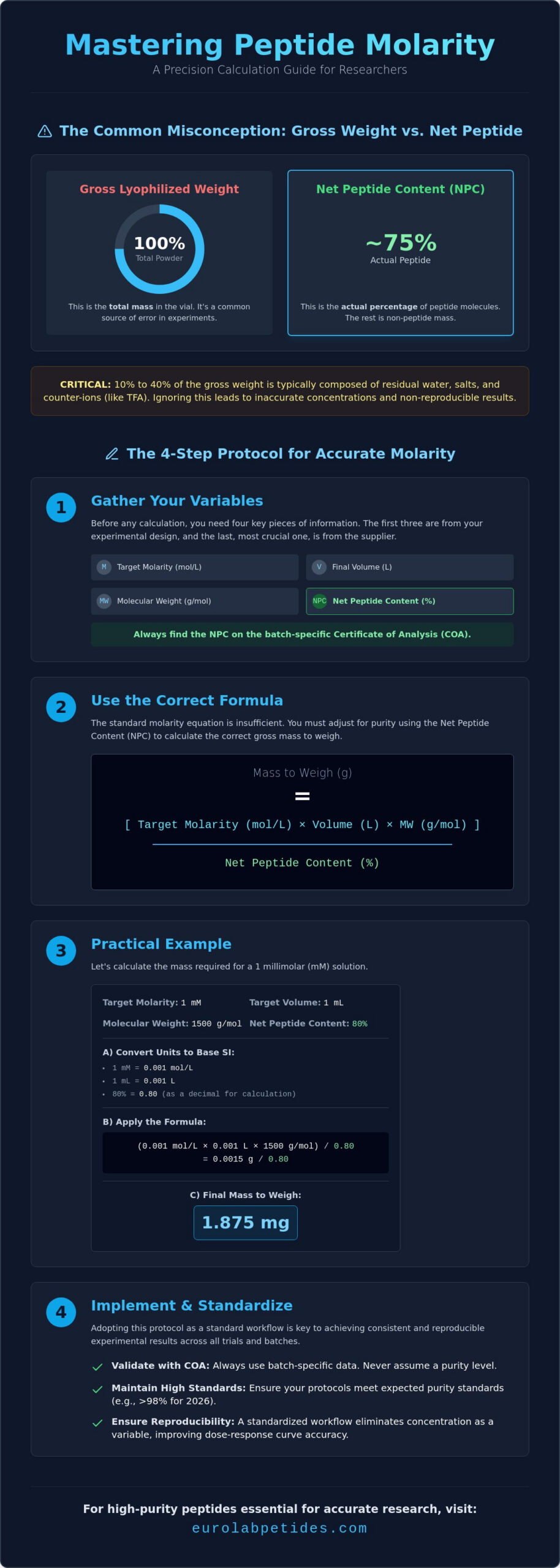
Step-by-Step Manual Calculation Protocol
Executing a precise reconstitution requires a systematic approach that bridges theoretical chemistry with benchtop execution. To understand how to calculate peptide molarity in a practical setting, the researcher must first establish the target molarity (e.g., 500 µM) and the desired final volume (e.g., 5 mL). These parameters define the molar requirement of the assay. Once these are set, the batch-specific Molecular Weight (MW) and Purity must be retrieved directly from the Certificate of Analysis (COA). Relying on theoretical sequence values rather than empirical batch data is a primary source of concentration variance in longitudinal studies.
The calculation of the required Gross Mass follows a logical progression. The target mass is determined by multiplying the molarity, volume, and molecular weight. This value is then divided by the product of the purity and the Net Peptide Content (NPC) as established in previous sections. After the mass is weighed, the primary solubilization is executed using an appropriate solvent. Verification of the final concentration can be performed via UV spectroscopy by measuring the absorbance at 280 nm, provided the peptide sequence contains chromophores like Tryptophan or Tyrosine. This empirical validation ensures that the calculated molarity matches the physical state of the solution.
Practical Example: Preparing a 100 µM Stock Solution
Consider the preparation of a 5 mL stock solution at 100 µM concentration using a peptide with a molecular weight of 3000 Da, 98% purity, and an 80% NPC. First, convert all units to SI: 100 µM becomes 0.0001 mol/L and 5 mL becomes 0.005 L. The initial mass calculation yields 0.0015 grams of pure peptide. To account for the 98% purity and 80% NPC, divide 0.0015 by 0.784, which is the product of 0.98 and 0.80. The result is 0.001913 grams, or 1.91 mg of gross lyophilized powder. After reconstitution, the solution’s concentration should be verified to confirm that no material was lost during transfer or through incomplete dissolution.
Auditing Automated Calculators
While digital tools offer convenience, researchers must perform a manual “sanity check” before reconstitution to prevent catastrophic errors. Automated systems often fail to account for NPC or may contain hard-coded unit conversion errors, particularly when moving between nM and µM scales. Auditing these tools against manual calculations ensures that the laboratory workflow remains robust. For a detailed breakdown of digital assist tools, refer to the Peptide Reconstitution Calculator: A How-To Guide. For researchers requiring high-precision tools for inflammation and tissue studies, the Recovery Research Stack provides a standardized foundation for complex experimental designs.
Ensuring Calculation Precision with High-Purity Research Standards
The integrity of a molarity calculation is entirely dependent on the quality of the input data provided by the supplier. Sourcing quality remains the primary determinant of calculation reliability; if the baseline metrics for purity and mass are inaccurate, the resulting solution will fail to meet experimental specifications. Third-party testing serves as a critical filter, reducing the stochastic variables that often plague molarity determination. By utilizing external validation, researchers can be certain that the values for molecular weight and Net Peptide Content are verified metrics rather than theoretical estimates. EuroLab Peptides maintains a commitment to providing exact MW and NPC data for every batch, facilitating a standardized approach to how to calculate peptide molarity.
A meticulous approach to data entry is required during the initial stages of reconstitution. Even the most advanced mathematical protocol is rendered useless if the researcher relies on generic sequence data. Verification of these metrics is conducted through external laboratories to ensure that every vial meets the rigorous demands of the specialized community. This proof-first methodology respects the user’s intelligence and provides the absolute security necessary for high-stakes precision. When the foundation of the calculation is built on verifiable metrics, the risk of inconsistent experimental results is significantly mitigated.
The Role of Analytical Validation
Analytical validation through High-Performance Liquid Chromatography (HPLC) and Mass Spectrometry is the only method to secure the precise math required for high-stakes research. While many suppliers offer standard purity levels, these are often insufficient for rigorous metabolic research where slight deviations in concentration can trigger vastly different cellular responses. Chromatographic profiles must be scrutinized to ensure that the primary peak represents the intended sequence without significant truncated variants. For more information on these standards, review the EuroLab Peptides: Our Multi-Level Quality Protocol. This level of transparency allows for the absolute precision necessary in advanced biochemical assays.
Maintaining Stability Post-Calculation
Once the calculation is executed and the solution is reconstituted, maintaining that specific molarity requires strict adherence to handling and storage protocols. Evaporation is a significant risk in micro-volume aliquots; even a minor loss of solvent will cause an upward shift in concentration, invalidating the original calculation. Solutions should be stored in airtight, low-protein-binding tubes to prevent peptide adsorption to the vessel walls. Additionally, the impact of freeze-thaw cycles on effective molarity can’t be ignored. Repeated temperature fluctuations lead to peptide degradation, which effectively lowers the concentration of active molecules in the solution. To maintain the highest standards of precision in your laboratory, always source third-party tested peptides from EuroLab Peptides. Establishing a repeatable, high-precision protocol for how to calculate peptide molarity is only the first step; preserving that precision through the duration of the study is what ensures data integrity.
Standardizing Precision in Molecular Research
The mastery of precise concentration protocols is the foundation of high-fidelity biochemical inquiry. By integrating the variables of molecular weight, purity, and Net Peptide Content, researchers can eliminate the systematic errors that often lead to inconsistent experimental data. Understanding how to calculate peptide molarity with this level of technical rigor ensures that every dose-response curve is built on a foundation of verifiable metrics. It’s essential that these mathematical frameworks are applied consistently across all laboratory workflows to maintain the integrity of longitudinal studies.
Maintaining these standards requires access to analytical data that is both batch-specific and externally validated. We facilitate this level of precision through a multi-level quality control process that includes independent third-party laboratory testing. A detailed Certificate of Analysis is provided with every batch to ensure you have the exact numerical benchmarks required for your calculations. To secure the integrity of your next study, browse our range of high-purity research peptides. We remain committed to supporting the rigorous demands of the specialized research community with tools of absolute consistency and technical excellence.
Frequently Asked Questions
How does Net Peptide Content (NPC) differ from purity?
Purity refers strictly to the percentage of the target peptide sequence relative to other peptide variants or truncated sequences within a sample. Net Peptide Content (NPC) is the actual percentage of peptide material in the lyophilized powder, which includes non-peptide components like water and counter-ions. A sample with 98% purity might only have 70% NPC. This distinction is critical for researchers learning how to calculate peptide molarity with absolute precision.
What happens if I calculate molarity using gross weight instead of net weight?
Utilizing gross weight for molarity calculations results in a solution that is significantly more dilute than the target concentration. Because lyophilized powders contain 10% to 40% non-peptide mass, the actual number of peptide moles per liter will be lower than calculated. This systematic error compromises the validity of dose-response curves and reduces the reproducibility of experimental data across different batches or laboratories.
Can I calculate peptide molarity without a Certificate of Analysis?
Accurate molarity determination is impossible without a batch-specific Certificate of Analysis (COA). Theoretical molecular weights don’t account for isotopic distribution or specific modifications; NPC values vary significantly between synthesis runs. Attempting to reconstitute a sample without these verified metrics introduces unacceptable variables into the research environment. A COA provides the empirical data required to transform a theoretical formula into a verifiable laboratory protocol.
How do counter-ions like TFA affect the molecular weight in my calculations?
Counter-ions like Trifluoroacetic acid (TFA) are ionically bound to the peptide’s basic residues and contribute to the total mass of the lyophilized powder. While they increase the gross weight of the sample, they aren’t part of the peptide’s molecular weight in the molarity equation. Instead, their presence is accounted for within the Net Peptide Content metric. Failure to adjust for this added mass leads to significant concentration deviations in the final solution.
Is it better to calculate molarity by weight or by volume for peptides?
Precision is best achieved by weighing the lyophilized powder and adjusting the solvent volume to reach the target molarity. Because peptides are often supplied in small quantities, the margin for error during mass measurement is narrow. Utilizing a high-precision analytical balance to determine the starting mass allows for more accurate volume adjustments. This methodology ensures that the final concentration remains consistent even when working with sub-milligram quantities of research material.
How do I adjust molarity if the peptide is a salt (e.g., acetate salt)?
Adjusting molarity for salt forms requires the application of the corrected mass formula: Adjusted Mass = Target Mass / (Purity x NPC). Acetate salts typically have higher NPC values compared to TFA salts, but the calculation protocol remains the same. The researcher must identify the specific NPC for the acetate batch from the COA. This ensures the final molarity accounts for the mass of the acetate counter-ions and any residual moisture present in the salt form.
What is the most common error when calculating peptide molarity?
The most frequent error in learning how to calculate peptide molarity involves the failure to account for Net Peptide Content (NPC). Many researchers mistakenly treat the gross mass of the powder as 100% peptide. Additionally, unit conversion errors between nanomolar (nM) and micromolar (µM) scales often lead to concentration shifts by factors of 1,000. Implementing a double-check manual protocol before reconstitution is the most effective way to prevent these systematic laboratory failures.
How does lyophilization affect the initial mass measurement?
Lyophilization results in a highly porous, hygroscopic powder that rapidly absorbs atmospheric moisture upon exposure. This absorption increases the sample weight without increasing the amount of peptide, leading to inaccurate mass measurements if the vial is left open. To maintain precision, vials should be equilibrated to room temperature before opening and weighed immediately. This minimizes the impact of moisture gain on the initial mass measurement and the subsequent molarity calculation.
