

A useful laboratory peptide handling protocol is built around the work being done, not a single piece of equipment. Choosing which controls and tools belong in a workflow takes careful planning, especially when contamination prevention, sample identification, and recordkeeping all matter.
Consistent handling depends on matching equipment and documented procedures to a defined workflow. Product-quality evidence has a separate role: analytical documentation can help assess research materials, but it does not replace your institution’s approved handling and storage procedures.
This guide shows how to build an equipment checklist around a laboratory workflow, set practical controls for traceability and error reduction, and review research-grade peptide documentation within its stated scope. It also explains how quality controls, including in-house and independent third-party testing, fit into a broader documented process. Research-grade peptides are intended strictly for in-vitro research and laboratory development, so handling decisions should follow your laboratory’s approved procedures.
Key Takeaways
- Define a laboratory peptide handling protocol around your facility’s approved procedures, assigned responsibilities, records, and deviation controls.
- Build an equipment checklist by workflow function, then confirm which items require local qualification for their intended use.
- Review batch documentation for material identity, report dates, and analytical methods. Treat HPLC and mass spectrometry as complementary evidence, not proof of sterility.
- Plan from the approved SOP and risk assessment before assigning equipment, records, and responsibilities.
- Assess supplier quality evidence alongside local controls, not in place of them. EuroLab Peptides uses in-house and independent third-party laboratory testing for research-grade materials intended for in-vitro research and laboratory development.
What a laboratory peptide handling protocol should define
A laboratory peptide handling protocol is a facility-approved document that identifies who is responsible for each activity, which controls apply, what records must be kept, and how deviations are reported and escalated. It translates institutional requirements into a consistent framework for a specific research workflow. It is not a universal recipe: equipment planning identifies functional needs, while peptide-specific handling steps must be established through approved institutional procedures.
Local requirements should reflect the risk assessment, product documentation, intended assay, and controls available in the facility. Material characteristics and assay needs can affect handling decisions, so do not copy a generic guide without institutional review. For background on one method of producing peptide materials, consult this reference on solid-phase peptide synthesis. This guide covers in-vitro research and laboratory development only; it does not provide clinical or human-use instructions.
Which decisions belong in a laboratory SOP?
An SOP should assign responsibility for receiving, identifying, handling, and documenting research materials, as well as escalating issues. It should specify how samples are identified and linked to records, who is authorized to perform defined tasks, and whom to notify about a discrepancy or deviation. Handling steps depend on material documentation, the intended assay, and facility controls. Institutional safety officers and current manufacturer documentation should inform local procedures.
How do quality records differ from handling records?
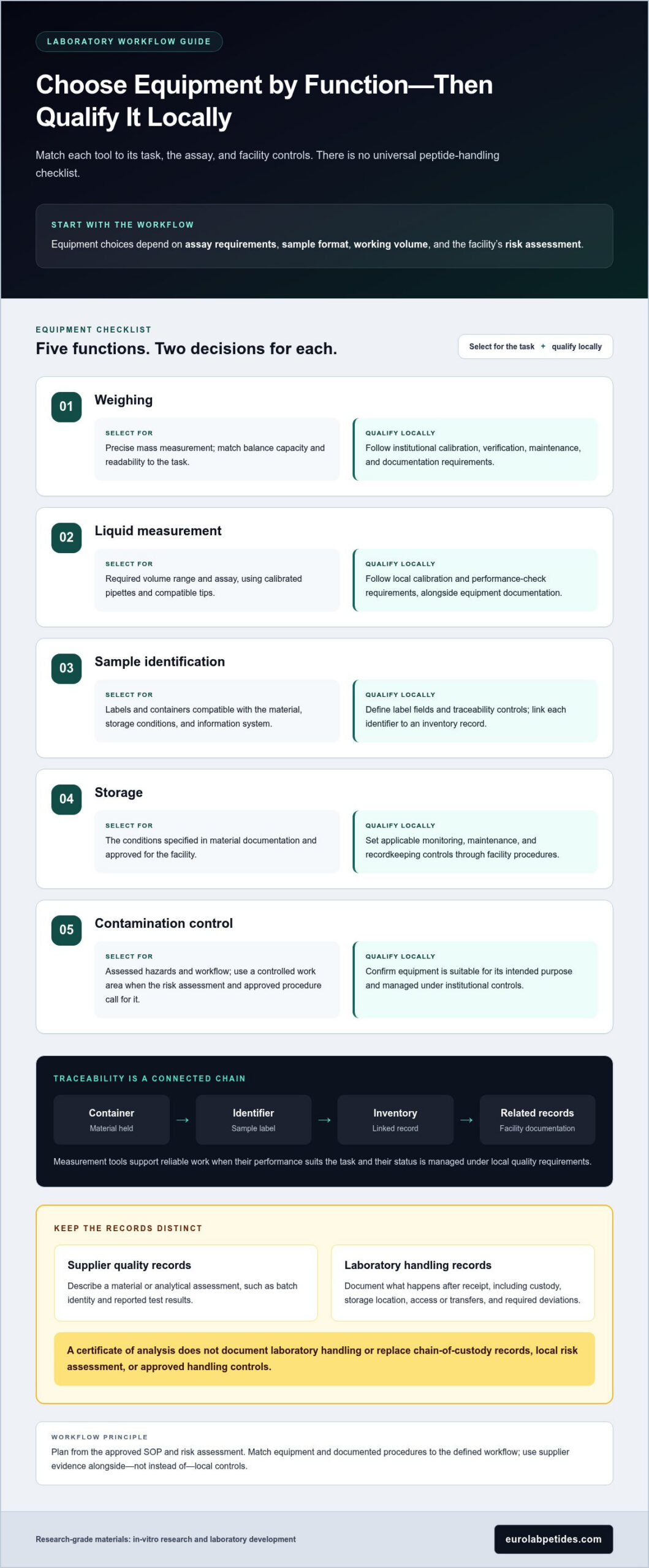
Supplier quality records describe a material or its analytical assessment, such as a batch identifier and reported test results. Laboratory handling records describe what happens after receipt, including custody, storage location, access or transfers, and deviations that facility procedures require you to document. These records answer different questions, but both should be traceable to the same material identity.
A certificate of analysis documents reported analytical information about a material or batch; it does not document how that material was handled in your laboratory. A certificate can support material evaluation, but it does not replace chain-of-custody records, a local risk assessment, or approved handling controls. EuroLab Peptides uses in-house and independent third-party laboratory testing as part of its quality approach. Supplier evidence is one part of a documented workflow, not a substitute for institutional procedures.
Choose peptide-handling equipment by workflow and control
Select equipment for the task rather than relying on a universal peptide checklist. Assay requirements, sample format, working volume, and the facility’s risk assessment all affect which tools are appropriate. For a laboratory peptide handling protocol, compare each equipment category with its intended function and local qualification requirements before including it in the workflow.
Function: Weighing. Selection criterion: An analytical balance may suit work requiring precise mass measurement. Match its capacity and readability to the task. Local qualification: Follow institutional requirements for calibration, verification, maintenance, and documentation.
Function: Liquid measurement. Selection criterion: Choose calibrated pipettes and compatible tips that suit the required volume range and assay. Local qualification: Follow local calibration and performance-check requirements, along with the equipment documentation.
Function: Sample identification. Selection criterion: Select labels and containers compatible with the material, storage conditions, and information system. Link each identifier to an inventory record. Local qualification: Define required label fields and traceability controls in facility procedures.
Function: Storage. Selection criterion: Choose equipment that can maintain the conditions specified in material documentation and approved locally. Local qualification: Set applicable monitoring, maintenance, and recordkeeping controls through facility procedures.
Function: Contamination control. Selection criterion: Select work-area and protective equipment based on assessed hazards and the workflow. Local qualification: Confirm that the equipment is suitable for its intended purpose and managed under institutional controls.
What equipment supports measurement and traceability?
Balances and pipettes support measurement only when their performance suits the task and their status is managed under local quality requirements. Traceability takes more than a label: the container, identifier, inventory entry, and related records should remain linked. Use current equipment documentation to guide suitability and maintenance decisions. For material-specific handling context, consult NIBSC’s Peptide Handling, dissolution & Storage guidance alongside institutional procedures.
When are controlled work areas or specialized storage relevant?
A biosafety cabinet or another controlled work area is appropriate when the risk assessment and approved procedure call for it. These devices are not interchangeable: a fume hood is designed to control exposure to chemical vapors, a biosafety cabinet provides defined biological containment depending on its type, and a clean bench protects the work from particulates but generally does not protect the operator. Choose storage based on material documentation and facility-approved conditions. For research-grade peptide materials and supplier quality information, see research-grade peptide documentation.
Compare peptide quality evidence without confusing it with protocol compliance
Supplier analytical records can help a laboratory assess whether documented material attributes align with research requirements. They do not establish whether equipment is calibrated, operators are trained, or facility procedures are followed. Treat analytical documentation as one input to a laboratory peptide handling protocol, not as a replacement for local controls.
Review each record using a consistent checklist:
- Material and batch identity: Do the identifiers match the received material and its container?
- Report dates: Are the testing date and report date stated or otherwise clear?
- Method and scope: Which analytical method was used, and what does the report say it evaluated?
- Material match: Does the document refer to the same material and batch under review?
- Reported results: Are the results presented with enough context to understand their stated scope?
Reports can vary in method, scope, and presentation, so interpret results in context rather than treating them as a universal quality verdict. If information is missing or unclear, record the question and address it through the laboratory’s established process. A documentation gap alone does not prove a specific product defect. For broader purchasing criteria, see this research peptide sourcing guide.
What can HPLC and mass spectrometry tell a researcher?
High-performance liquid chromatography (HPLC) separates components in a sample so a method can assess a chromatographic profile, including reported relative purity. Mass spectrometry measures mass-to-charge information that can support molecular characterization. The methods provide different, potentially complementary evidence. Interpretation depends on method suitability, reference data, and the report’s stated analytical scope.
An analytical purity claim describes the result of a defined test; it is not, by itself, a broader product-safety or sterility claim. Neither method should be treated as proof of sterility unless an appropriate test specifically addresses that attribute.
What should a batch record or certificate identify?
Match the document’s material and batch identifiers to the received research material, then review the stated method, results, and test dates. Assess what the report actually covers rather than assuming that documents with similar labels are equivalent. Supplier quality evidence supports material evaluation. Equipment calibration, operator training, chain-of-custody records, and facility compliance remain the laboratory’s responsibility.
Build a practical peptide handling checklist for your laboratory
Use this planning sequence to align work with institutional controls. It is a readiness checklist, not an experimental procedure or universal operating protocol. The laboratory peptide handling protocol and risk assessment remain the governing documents for local decisions.
- Start with approved requirements. Locate the current SOP, relevant safety documentation, and risk assessment. Confirm that they cover the material and intended research workflow.
- Assign responsibilities. Identify who is responsible for receipt, inventory, handling, record review, and escalating an incident or discrepancy.
- Review material documentation. Compare received material identifiers with accompanying records before recording receipt in the laboratory inventory. Document questions through the facility’s established process.
- Assess readiness and training. Confirm that personnel have the training required by local procedures and understand their assigned responsibilities.
- Check equipment suitability. Confirm that selected equipment fits the task and sample format, is maintained, and meets local qualification requirements.
- Verify traceability and reporting. Ensure sample identification and recordkeeping are defined, including how deviations and incidents are documented and escalated.
Which checks should happen before a research workflow begins?
Before work begins, confirm that the approved local SOP, training status, and relevant safety documentation are current. Match material identifiers to supporting documentation before inventory entry. Then verify that equipment is suitable, maintained, and covered by applicable local qualification requirements. These checks establish readiness without replacing institutional procedures with a generic handling sequence.
For storage planning, consult the laboratory’s approved requirements alongside these peptide storage considerations. If a workflow involves solution calculations, the reconstitution calculator guidance provides related context. Neither resource supersedes local authorization or establishes a procedure for a specific facility.
How should a laboratory document deviations and review controls?
Record deviations through the facility’s established quality and safety reporting process. Include relevant sample identifiers, responsible personnel, equipment status, and event details, following local documentation rules. Review the checklist when materials, methods, equipment, or institutional policies change. This helps keep assigned controls aligned with the current workflow.
For research materials intended strictly for in-vitro research and laboratory development, consider supplier quality evidence as one part of the broader control system. Explore research-grade peptide materials and their quality-control context.
Apply the framework to research-grade peptide sourcing
Equipment fit, institutional controls, and supplier documentation support different parts of a controlled research workflow. Suitable equipment helps carry out defined tasks. Local SOPs establish responsibilities and handling requirements. Supplier quality evidence can help identify and evaluate the material received. These elements work together, but none replaces the others in a laboratory peptide handling protocol.
How does supplier documentation support a controlled workflow?
Batch-linked analytical records can support material identification and research documentation when their identifiers match the material under review. EuroLab Peptides’ quality approach includes in-house and independent third-party laboratory testing to support product purity and consistency. Interpret documentation according to its stated methods and scope. Testing does not certify a laboratory’s procedures, establish its equipment status, or guarantee experimental outcomes.
Supplier records describe evidence about the material, while local SOPs govern how the laboratory receives, controls, and documents its work. Keeping these roles distinct helps researchers use analytical information appropriately without treating it as a substitute for facility controls. EuroLab Peptides materials are intended strictly for in-vitro research and laboratory development, not clinical or human use.
What should the reader do next?
Before beginning laboratory work, review the institution’s approved procedures, risk assessment, training requirements, and equipment controls. Then compare the research material’s identifiers and available quality information with the documentation needs of the specific project. If records leave a question about material identity or analytical scope, address it through the laboratory’s established review process rather than assuming what the documentation means.
A sound sourcing decision considers material evidence alongside workflow suitability and local requirements. Review EuroLab Peptides’ research-grade offerings and available quality information as part of that assessment.
Build a workflow your laboratory can document
A reliable laboratory peptide handling protocol follows the institution’s approved procedures, not a universal equipment list. Select tools to match the assay, sample format, and local risk assessment. Maintain clear records for identification, equipment status, responsibilities, and deviations.
Keep supplier quality evidence in its proper role. Batch-related analytical information can support material evaluation, while laboratory controls govern handling, training, and traceability. Neither replaces the other. Together, they give researchers a clearer basis for planning and documenting in-vitro work.
EuroLab Peptides uses in-house and independent third-party laboratory testing as part of its quality approach. Its research-grade products are intended strictly for in-vitro research and laboratory development, not clinical or human use. Review the available research materials and quality information as you assess their fit with your project requirements.
Explore EuroLab Peptides research materials and build a controlled, well-documented workflow for your laboratory.
Frequently Asked Questions
What equipment is commonly considered for peptide handling?
Common equipment categories include measurement tools, calibrated liquid-handling equipment, compatible sample containers, identification supplies, and storage equipment. A balance may support weighing workflows, while pipettes may suit liquid measurement. Labels and inventory systems help maintain sample traceability. The right selection depends on the assay, material documentation, risk assessment, and facility SOP. No single equipment list suits every laboratory or workflow.
Do peptide handling procedures require a biosafety cabinet?
Not in every case. The need for a biosafety cabinet depends on the material, procedure, risk assessment, and institutional requirements. A biosafety cabinet, fume hood, and clean bench serve different purposes and are not interchangeable. Choose a work area based on the risk assessment, not the peptide category alone. Follow the facility’s approved SOP and consult its safety officer or environmental health and safety team to determine appropriate controls.
How should a laboratory evaluate peptide purity documentation?
First, confirm that the report identifies the same material and batch as the received sample. Then review the method, reported result, and test date, interpreting each within the report’s stated scope. HPLC separates components to provide chromatographic information, while mass spectrometry provides mass-related information that can support characterization. A purity result alone does not establish sterility or protocol compliance. Record unresolved documentation questions through local procedures.
Can a certificate of analysis replace a laboratory handling protocol?
No. A certificate of analysis documents specified analytical information about a material or batch. A laboratory SOP governs local responsibilities, controls, records, and approved procedures. These documents support different parts of research quality management: one provides information about the material, while the other directs the laboratory’s work. Neither replaces the other, the facility’s risk assessment, or applicable institutional safety requirements.
How should laboratories choose storage equipment for research peptides?
Choose storage equipment according to the material documentation, study requirements, and facility-approved procedures. The setup may include identified storage locations and inventory controls that maintain traceability, but equipment needs vary by material and workflow. Use current material-specific information rather than relying on a general recommendation. Record storage requirements and responsibilities in the local SOP, and review the documentation when materials or study conditions change.
What is the difference between a biosafety cabinet and a fume hood?
A biosafety cabinet and a fume hood are designed for different containment or ventilation purposes, so they are not interchangeable. A clean bench also serves a distinct function and should not be assumed to provide the same protections. The appropriate choice depends on the hazard assessment, task, and facility controls, not on a universal peptide-handling rule. Follow institutional environmental health and safety guidance and the approved local SOP.
Are research peptides intended for human use?
No. EuroLab Peptides products are sold strictly for in-vitro research and laboratory development. They are not intended for human consumption or clinical use. This information does not constitute medical advice, dosing guidance, or treatment recommendations. Researchers should follow applicable institutional requirements and consult qualified professionals about research governance. Keep the product’s stated purpose clear in project documentation and ensure proposed work follows the facility’s approved procedures.
