
Navigating the existing literature on the tripeptide-copper complex, ghk-cu, presents a significant challenge for the modern researcher. The available data is often bifurcated, oscillating between superficial marketing claims and highly specialized, often inaccessible, academic publications. This informational gap creates uncertainty, complicating the planning of rigorous in-vitro and pre-clinical studies where compound integrity is paramount.
This primer is engineered to bridge that divide. It provides a comprehensive, scientifically-grounded analysis that moves beyond anecdotal evidence to focus exclusively on verifiable data. We will systematically deconstruct the molecular structure of GHK-Cu, elucidate its complex mechanisms of action, and survey its documented applications within cellular and preclinical research frameworks.
The objective is to equip your research program with a foundational understanding necessary for precise experimental design. Furthermore, this guide addresses the critical, often-overlooked, aspects of peptide handling, including correct protocols for storage and reconstitution-essential knowledge for ensuring the bioactivity of any high-purity research compound and achieving reproducible scientific outcomes.
Key Takeaways
- Grasp the fundamental molecular structure of the GHK-Cu peptide-copper complex and its significance in cellular systems.
- Differentiate the primary molecular mechanisms through which ghk-cu functions as a signaling peptide and gene modulator in laboratory models.
- Identify the principal fields of scientific inquiry where this peptide is actively applied within a strict in-vitro and pre-clinical context.
- Implement correct laboratory handling protocols based on the peptide’s chemical profile to ensure reagent integrity and experimental validity.
Introduction to GHK-Cu: Structure and Biological Significance
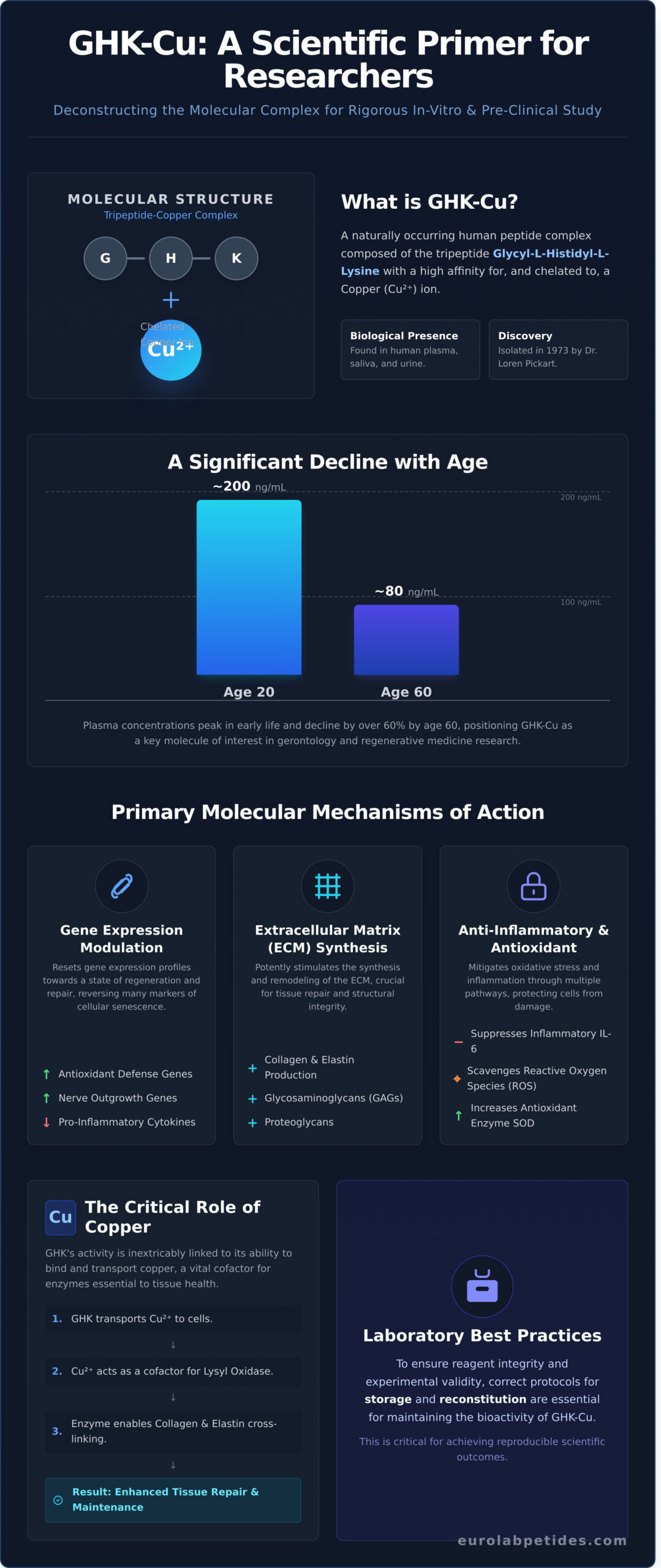
GHK-Cu is a naturally occurring human copper-peptide complex with a significant and well-documented presence in plasma, saliva, and urine. Structurally, it is composed of the tripeptide glycyl-L-histidyl-L-lysine, which exhibits a high affinity for and chelates a copper 2+ (Cu2+) ion. The Copper peptide GHK-Cu is a subject of extensive investigation due to its wide-ranging biological actions. Plasma concentrations of this complex are highest in early life, peaking around 200 ng/mL at age 20, and are observed to decline significantly with age, falling to approximately 80 ng/mL by age 60. This age-dependent reduction has positioned ghk-cu as a molecule of considerable interest in gerontology and regenerative medicine. This article will provide a comprehensive review of its scientific basis, mechanisms of action, and applications in preclinical research settings.
Discovery and Historical Context
The peptide was first isolated from human plasma albumin in 1973 by Dr. Loren Pickart. Initial investigations identified it as a growth factor for differentiated cells, particularly hepatocytes (liver cells), and demonstrated its ability to modulate the cellular state of aged liver tissue to more closely resemble that of younger tissue. Since its discovery, the scope of research has expanded substantially from gerontology to encompass wound healing, tissue remodeling, and anti-inflammatory processes, reflecting its multifaceted regulatory functions within the human body.
The Role of Copper in GHK-Cu Function
The biological activity of the GHK peptide is inextricably linked to its ability to bind copper ions. The GHK tripeptide’s high affinity for Cu2+ facilitates the transport and delivery of copper into and between cells, an element critical for cellular respiration and antioxidant defense. Copper is an essential cofactor for numerous enzymes vital to physiological integrity, including lysyl oxidase, which is required for the cross-linking of collagen and elastin in connective tissues. By modulating copper homeostasis, the ghk-cu complex plays a pivotal role in enzymatic processes fundamental to tissue repair and maintenance.
Molecular Mechanisms of Action in Laboratory Models
The tripeptide Glycyl-L-histidyl-L-lysine, complexed with copper (II) to form ghk-cu, functions as a highly specific signaling molecule with pleiotropic effects observed in laboratory settings. Its primary mechanism of action is not limited to a single pathway; rather, it operates as a sophisticated gene modulator, capable of influencing a wide array of cellular processes. As a small, naturally occurring copper-peptide complex, its fundamental properties are well-documented in established chemical databases, with detailed GHK chemical data available from the National Institutes of Health. Research indicates that its principal function involves resetting gene expression profiles toward a state associated with regeneration and repair, reversing many of the biochemical markers of cellular senescence in controlled models.
Modulation of Gene Expression
One of the most significant actions of GHK-Cu is its capacity to modulate the expression of a substantial number of human genes. Microarray analyses have demonstrated its ability to restore the transcriptional signature of aged cells to a more youthful state. This includes the observed upregulation of genes associated with antioxidant defense and nerve outgrowth, alongside the pronounced downregulation of genes linked to pro-inflammatory pathways, such as specific cytokines, in in vitro studies.
Stimulation of Extracellular Matrix Proteins
In cell culture models, GHK-Cu has been shown to be a potent stimulator of extracellular matrix (ECM) synthesis and remodeling. It significantly increases the production of critical structural proteins, including various types of collagen and elastin, within fibroblast cultures. Furthermore, it elevates the synthesis of glycosaminoglycans (GAGs) and proteoglycans, essential components that maintain the hydration, structure, and integrity of connective tissues. This mechanism is foundational to its role in tissue repair and structural maintenance studies.
Anti-Inflammatory and Antioxidant Pathways
The peptide exhibits robust anti-inflammatory and antioxidant properties through multiple pathways. It has been documented to suppress the expression of inflammatory cytokines, notably Interleukin-6 (IL-6), a key mediator in chronic inflammation. Concurrently, it mitigates oxidative stress by scavenging harmful reactive oxygen species (ROS) and by increasing the cellular concentration of primary antioxidant enzymes, such as superoxide dismutase (SOD), thereby protecting cellular components from oxidative damage.
Key Areas of GHK-Cu Application in Scientific Research
The tripeptide GHK-Cu is the subject of extensive pre-clinical investigation due to its multifaceted role in cellular repair and homeostatic processes. Its high affinity for copper(II) ions is central to its biological activity, which has been documented across several distinct domains of regenerative science. Research models consistently demonstrate its capacity to modulate gene expression and influence critical pathways involved in tissue maintenance and repair.
Wound Healing and Tissue Regeneration Studies
In the context of wound healing, GHK-Cu has been shown to exert significant influence on multiple stages of the repair cascade. Experimental models indicate its ability to stimulate angiogenesis and nerve outgrowth, two processes fundamental to restoring function to damaged tissue. Furthermore, it functions as a chemoattractant, recruiting essential cells such as fibroblasts and mast cells to the injury site. This orchestrated cellular influx is critical for the subsequent synthesis of extracellular matrix components and the formation of granulation tissue, providing the structural framework for new tissue generation.
Dermatological and Skin Remodeling Research
Within dermatological science, GHK-Cu is studied for its profound effects on the dermal matrix. A comprehensive review of the GHK-Cu peptide’s regenerative actions details its capacity to modulate genes responsible for collagen and elastin synthesis, which are directly correlated with skin density, thickness, and viscoelastic properties in ex vivo models. Investigations also focus on its role in upregulating the synthesis of critical skin barrier proteins. Its application extends to research on mitigating the effects of photo-damage, where it is observed to influence pathways related to hyperpigmentation and the removal of damaged cellular proteins.
The translation of such fundamental research into consumer applications is a key focus for innovative dermo-cosmetic brands. Companies like Mono Skincare build on this scientific understanding to develop holistic approaches to skin health, combining advanced ingredients with supportive techniques like facial massage to enhance skin vitality.
Hair Follicle and Growth Cycle Research
The ghk-cu peptide is also a significant compound in trichological research. In vitro studies have demonstrated its capacity to stimulate the proliferation of dermal papilla cells, which are integral to initiating and sustaining the hair growth cycle. In animal models, topical application has been correlated with an enlargement of the hair follicle during its anagen (growth) phase. These cellular-level effects form the basis of ongoing research into its potential to modulate hair growth dynamics, specifically concerning hair shaft thickness and follicle density.
Chemical Profile and Laboratory Handling Protocols
For any in-vitro investigation involving peptides, the integrity of the research material is paramount. Adherence to stringent handling and storage protocols is not merely a best practice; it is a fundamental requirement for ensuring the validity and reproducibility of experimental results. The following section outlines the essential chemical data and laboratory procedures for the handling of GHK-Cu, intended strictly for research purposes.
Technical Specifications
A precise understanding of the peptide’s chemical identity is the foundation of rigorous scientific inquiry. The essential specifications for glycyl-L-histidyl-L-lysine copper complex are as follows:
- Molecular Formula: C₁₄H₂₄N₆O₄Cu
- Exact Molecular Weight: 403.947 g/mol
- Appearance: Supplied as a blue, lyophilized (freeze-dried) powder, a characteristic appearance resulting from the copper ion chelation.
- Solubility: The peptide exhibits high solubility in aqueous solutions, with sterile or bacteriostatic water being the standard solvent for reconstitution in laboratory settings.
Reconstitution and Storage Best Practices
Lyophilized peptides are stable but require meticulous handling once reconstituted to prevent degradation. The standard procedure for reconstitution involves the slow introduction of a sterile diluent, such as bacteriostatic water, into the vial to achieve the desired concentration. It is critical to allow the solvent to run down the side of the vial and to gently swirl the contents until fully dissolved. Vigorous shaking must be avoided as it can denature the peptide structure.
For optimal stability, lyophilized ghk-cu powder should be stored at -20°C. Once reconstituted, the solution must be refrigerated at 2°C to 8°C and protected from direct light. To mitigate degradation from repeated temperature changes, it is advisable to aliquot the solution into single-use volumes for long-term studies.
Ensuring Purity and Stability for Research
The validity of research data is directly correlated with the purity of the compounds used. Uncompromising purity, typically verified at >99% by High-Performance Liquid Chromatography (HPLC), is essential to eliminate the risk of confounding variables introduced by contaminants. Third-party testing provides objective, unbiased confirmation of a batch’s identity, purity, and concentration, serving as a critical quality assurance benchmark. Researchers must control for potential degradation sources, including improper temperature, UV light exposure, and mechanical agitation, to maintain the peptide’s structural integrity throughout the experiment’s duration. View our third-party tested GHK-Cu for your research studies.
GHK-Cu: A Compound of Uncompromising Research Potential
This primer has delineated the fundamental biological significance and complex molecular mechanisms of GHK-Cu. From its modulatory effects on gene expression to its demonstrated utility in tissue engineering and wound healing models, the evidence underscores the peptide’s profound potential in diverse cellular studies. The integrity of such advanced research, however, is inextricably linked to the purity of the compound and strict adherence to established laboratory handling protocols, ensuring reproducibility and validity of results.
For research applications where precision is non-negotiable, sourcing a compound of verifiable quality is paramount. EuroLab Peptides provides European-synthesized ghk-cu with an uncompromising commitment to quality. Each batch is subjected to stringent third-party analysis, with purity guaranteed at a minimum of 99% as verified by HPLC. This dedication to transparent, verifiable data ensures your experimental outcomes are built upon a foundation of absolute chemical integrity. Acquire high-purity, third-party verified GHK-Cu for your laboratory.
The continued, rigorous exploration of this peptide’s mechanisms promises to yield significant contributions to the broader scientific community.
Frequently Asked Questions About GHK-Cu
What is the difference between GHK and GHK-Cu?
GHK refers to the tripeptide glycyl-L-histidyl-L-lysine in its free, unbound state. In contrast, GHK-Cu is the metallurgical complex formed when the GHK peptide chelates a copper (II) ion. This complexation is critical, as the copper ion is integral to the molecule’s enhanced bioactivity, including its roles in tissue remodeling and antioxidant processes. The presence of copper fundamentally alters the peptide’s mechanism of action, making the distinction essential for precise experimental design and interpretation.
Why is the GHK-Cu peptide solution blue?
The distinct blue coloration of a reconstituted GHK-Cu solution is a direct and verifiable result of the chelated copper (II) ion. In an aqueous environment, the d-orbitals of the Cu(II) ion absorb light in the orange-red part of the visible spectrum, causing the complementary color, blue, to be reflected. This chromatic property serves as an immediate visual indicator of successful copper complexation within the peptide structure, a fundamental characteristic of the authentic GHK-Copper compound.
What is the primary function of GHK-Cu in the human body?
The primary physiological function of GHK-Cu is to act as a signaling and carrier peptide, integral to processes of tissue remodeling and repair. It modulates the expression of numerous genes associated with wound healing, antioxidant defense, and anti-inflammatory responses. Specifically, it regulates the synthesis and breakdown of extracellular matrix components like collagen and elastin. Its role as a high-affinity copper delivery agent is central to these homeostatic and reparative biological processes.
How is the purity of research-grade GHK-Cu verified?
The purity of research-grade ghk-cu is verified through a stringent, multi-step analytical process. Each batch undergoes High-Performance Liquid Chromatography (HPLC) to quantify its purity, ensuring it meets or exceeds a 99% standard. Subsequently, Mass Spectrometry (MS) is employed to confirm the precise molecular weight and structural integrity of the peptide sequence. These results are documented in a comprehensive Certificate of Analysis (CoA) that accompanies every vial, providing researchers with uncompromising, verifiable quality assurance.
What are the key considerations for designing an in-vitro study with GHK-Cu?
For a robust in-vitro study, several parameters are critical. The optimal concentration must be determined through a dose-response curve, as effects can be biphasic. The stability of ghk-cu in the specific cell culture media and its potential interaction with media components must be assessed. Furthermore, the experimental design must include appropriate controls, such as the GHK peptide without copper and copper salts alone, to isolate and confirm the specific effects of the chelated complex.
Is GHK-Cu stable at room temperature?
In its lyophilized (freeze-dried) powder form, GHK-Cu exhibits considerable stability at ambient room temperature for short durations, though long-term storage is specified at -20°C to -80°C to maintain maximum integrity. Once reconstituted into a liquid solution, its stability is significantly reduced. Reconstituted solutions must be refrigerated at 2-8°C and utilized within a defined timeframe. For extended preservation of the reconstituted peptide, aliquoting and freezing at -20°C is the required protocol.
