

The 24.2% mean weight reduction observed in the TRIUMPH-1 Phase 3 trial for retatrutide represents a statistical threshold that surpasses even the most effective dual-agonist compounds. This single data point has fundamentally intensified the scientific inquiry into the GIP/GLP-1/GCG triple-agonist mechanism. For researchers, this leap in efficacy introduces critical new questions. It is no longer sufficient to compare outcomes; one must now dissect the underlying pharmacology, including the complex role of glucagon receptor agonism and its direct impact on reported adverse event profiles, all while navigating a market where sourcing 99%+ purity peptides remains a significant logistical challenge.
This definitive technical brief provides the required clarity for the ongoing retatrutide vs tirzepatide debate. We deliver a granular analysis of their respective receptor binding affinities, present key efficacy and safety metrics from the complete SURMOUNT and TRIUMPH trial programs, and identify trusted, EU-based suppliers for acquiring these compounds for laboratory evaluation. This review proceeds from a molecular comparison to a clinical data synthesis, concluding with actionable intelligence for sourcing research-grade materials with uncompromising integrity.
Key Takeaways
- Understand the critical biochemical evolution from dual-agonist (GIP/GLP-1) to triple-agonist (GIP/GLP-1/GCG) peptide frameworks for metabolic research.
- Evaluate the latest 2026 clinical data to quantify the significant efficacy differences in the retatrutide vs tirzepatide comparison.
- Analyze the distinct receptor binding affinities and molecular structures that dictate the unique physiological impacts of each compound.
- Identify key differentiators in their adverse effect profiles, including the transient heart rate increase observed with triple-agonist action.
- Learn the stringent procurement protocols, including third-party HPLC and Mass Spectrometry verification, required to acquire 99%+ purity peptides.
The Evolution of Incretin Mimetics: From Dual to Triple Agonism
The field of metabolic research has undergone a significant paradigm shift, moving from single-receptor to multi-receptor peptide agonists. Initial investigations centered on single-agonist peptides like Semaglutide, which selectively target the glucagon-like peptide-1 (GLP-1) receptor to influence insulin secretion and appetite. The subsequent development of dual-agonists marked a critical advancement. The central inquiry for laboratories today revolves around the comparative efficacy of these established dual-agonists against emerging triple-agonists, a question perfectly encapsulated by the retatrutide vs tirzepatide analysis. This comparison isn’t merely academic; it interrogates the fundamental mechanisms of metabolic homeostasis by examining the interplay of three key hormones: glucose-dependent insulinotropic polypeptide (GIP), GLP-1, and glucagon (GCG).
Primary research objectives now focus on quantifying differences in weight management efficacy and metabolic flexibility between these two compounds in both in-vitro and in-vivo models. While preliminary data is available, broader availability of Retatrutide for independent, third-party verified research is not anticipated until after 2026, contingent upon the completion of its Phase 3 clinical trial programs. This timeline positions current laboratory work as foundational for future investigations.
The Dual-Agonist Framework: Tirzepatide (GIP/GLP-1)
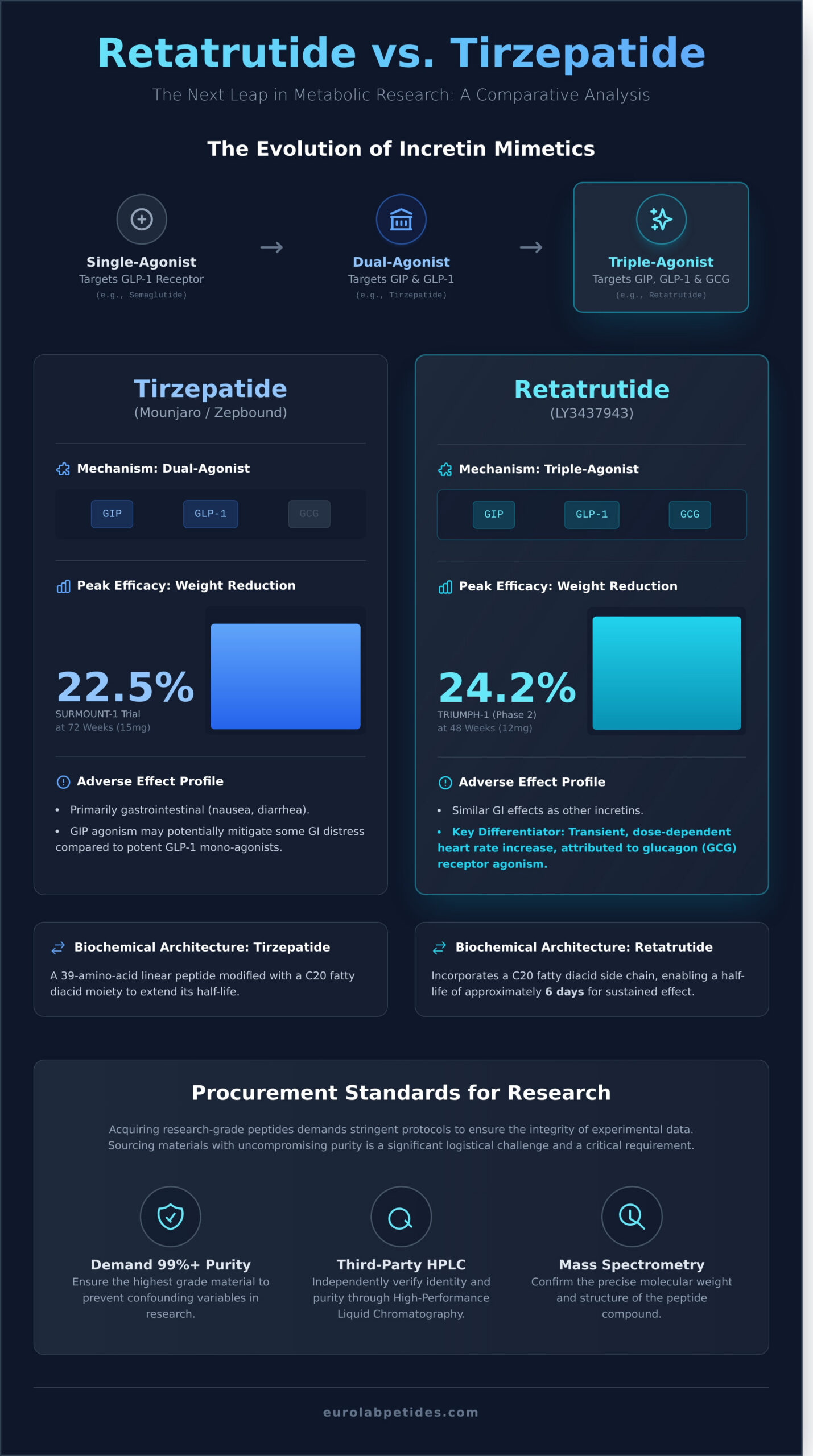
Tirzepatide’s mechanism is defined by its synergistic activation of both the GIP and GLP-1 receptors. This dual action provides a more comprehensive approach to glycemic control than targeting GLP-1 alone. The well-documented pharmacology of Tirzepatide (Mounjaro/Zepbound) demonstrates that GIP agonism complements GLP-1’s effects on insulin secretion while potentially mitigating some of the gastrointestinal distress frequently observed in research subjects exposed to potent GLP-1 receptor agonists. This compound has set uncompromising benchmarks for adiposity reduction in clinical studies, with the SURMOUNT-1 trial reporting a mean body weight reduction of 22.5% at 72 weeks with the 15 mg dose.
The Triple-Agonist Innovation: Retatrutide (GIP/GLP-1/GCG)
Retatrutide represents the next logical step in this evolution, incorporating glucagon receptor agonism into the established GIP/GLP-1 backbone. This “3G” mechanism is hypothesized to be the missing link for directly modulating energy expenditure. While GIP and GLP-1 primarily regulate glucose homeostasis and satiety, the addition of the glucagon component introduces a potent thermogenic effect by promoting lipolysis and increasing resting metabolic rate. Structurally, Retatrutide’s extended duration of action is achieved through the inclusion of a C20 fatty diacid side chain, which facilitates binding to serum albumin and extends its half-life to approximately six days, a critical feature for sustained effect in long-term research protocols.
The core of the retatrutide vs tirzepatide inquiry is whether this added glucagon activity translates to superior metabolic outcomes. Data from a Phase 2 trial published in The New England Journal of Medicine in June 2023 indicated a mean weight reduction of 24.2% at 48 weeks, suggesting a potentially faster and more profound effect on adiposity. Verifying these findings and elucidating the precise cellular mechanisms responsible for this enhanced efficacy remains a primary objective for the scientific community.
Biochemical Architecture: Comparative Receptor Affinity and Molecular Structure
The functional divergence between Tirzepatide and Retatrutide originates at the atomic level, rooted in deliberate molecular engineering designed to modulate receptor interaction and extend biological half-life. While both are synthetic peptides, their primary amino acid sequences and appended moieties create distinct pharmacological profiles. Receptor affinity, in the context of Retatrutide’s projected 2026 molecular profile, is the quantifiable measure of its binding strength and dissociation rate at GIP, GLP-1, and glucagon receptors, which directly dictates its therapeutic potential and metabolic signaling cascade. Understanding these structural nuances is essential for any laboratory conducting a comparative analysis of retatrutide vs tirzepatide.
Molecular Engineering of Tirzepatide
Tirzepatide is a 39-amino-acid linear peptide engineered with a C20 fatty diacid moiety. This appendage, linked via a hydrophilic spacer, facilitates non-covalent binding to serum albumin, effectively shielding the peptide from renal clearance and extending its half-life to approximately 5 days. Structurally, its backbone is derived from native human GIP, with modifications that confer potent dual agonism at both the GIP and GLP-1 receptors. For laboratory purposes, its lyophilized form exhibits high stability when stored at 2°C to 8°C, though reconstituted solutions require stringent handling to prevent degradation.
Molecular Engineering of Retatrutide
Retatrutide’s triple agonism is a direct result of strategic amino acid substitutions within a novel 39-amino-acid backbone. The inclusion of two alpha-aminoisobutyric acid (AIB) residues at positions 2 and 13 provides profound resistance to dipeptidyl peptidase-4 (DPP-4) degradation. Its potency at the glucagon receptor is intentionally calibrated to be approximately 5-fold lower than native glucagon, a design choice to leverage increased energy expenditure while mitigating the risk of hyperglycemia. With a molecular weight of 5391.1 g/mol, precise calculations are imperative during reconstitution to achieve accurate molar concentrations for in vitro assays.
The primary distinction in the retatrutide vs tirzepatide comparison lies in the third receptor target. Tirzepatide’s architecture is optimized for a potent, GIP-biased dual agonism. In contrast, Retatrutide introduces a balanced interaction with the glucagon receptor (GCGR). This is not simply an additive feature; it fundamentally alters the peptide’s mechanism of action. Data from preliminary studies and the ongoing TRIUMPH-1 clinical trial aim to quantify how this tri-agonist profile translates to metabolic outcomes. This structural complexity makes Retatrutide a more intricate molecule to synthesize and handle.
For such complex poly-agonists, lyophilization is the definitive standard for ensuring long-term structural integrity. This process of freeze-drying removes water without the thermal stress of evaporation, preventing hydrolysis and aggregation that would otherwise compromise the peptide’s tertiary structure and, consequently, its receptor binding affinity. Maintaining this structural fidelity from synthesis to analysis is non-negotiable. It’s why every batch of our research-grade peptides is subjected to this rigorous preservation method, ensuring you receive a product with verifiable 99%+ purity, ready for precise laboratory application. You can review the certificates of analysis for our peptides to confirm these specifications.
Quantifying Efficacy: A Comparative Analysis of SURMOUNT and TRIUMPH Trial Data
Empirical data from controlled clinical trials provides the only objective basis for comparing research peptides. The analysis of Tirzepatide is principally informed by the SURMOUNT program, while Retatrutide’s performance metrics are derived from its highly definitive Phase 2 trial, with the Phase 3 TRIUMPH program expected to conclude in 2026. These studies offer a granular view of each compound’s dose-dependent effects on weight reduction, body composition, and critical metabolic markers.
Direct comparison of the primary endpoints reveals a significant differential in weight reduction efficacy. In the SURMOUNT-1 trial, subjects administered the highest dose (15 mg) of Tirzepatide achieved a mean weight reduction of 20.9% over a 72-week period. In contrast, the Phase 2 trial for Retatrutide demonstrated a mean weight reduction of 24.2% at the 12 mg dose by week 48. This outcome was achieved in 24 fewer weeks, suggesting a potentially more potent and rapid mechanism of action. Beyond weight, both peptides induced substantial improvements in metabolic parameters, including reductions in HbA1c, fasting glucose, and improvements in lipid profiles.
Weight Management Research Outcomes
The dose-response relationship is a critical variable in the retatrutide vs tirzepatide analysis. While both peptides exhibit greater efficacy at higher dosages, Retatrutide’s triple-agonist mechanism appears to elevate the therapeutic ceiling. Dual-agonism, while highly effective, may encounter a plateau. The introduction of a glucagon receptor agonist component represents the logical evolution from dual to triple agonism, designed to overcome this potential ceiling by engaging an additional metabolic pathway. Long-term studies like SURMOUNT-1 have characterized the plateau phase for Tirzepatide; equivalent long-duration data for Retatrutide is forthcoming from the TRIUMPH trials.
While these compounds are evaluated in rigorous trials, the principles of advanced, medically-supervised weight loss are already being applied in clinical settings. For instance, specialized facilities like Nusbaum Medical Centers are at the forefront of providing comprehensive medical and surgical weight loss solutions to patients, translating cutting-edge science into tangible health outcomes.
In both research and clinical applications, maintaining consistent, high-quality nutrition is a cornerstone of success. Services like Eat Better Meals support these health goals by providing fresh, chef-prepared, ready-to-eat meals, simplifying the dietary component of a comprehensive weight management plan.
Organ-Specific Research: Liver and Cardiovascular Health
Retatrutide’s unique biochemical architecture confers distinct advantages in organ-specific research, particularly concerning hepatic health. The glucagon component is hypothesized to directly mobilize hepatic lipid stores, a mechanism of significant interest in Non-Alcoholic Fatty Liver Disease (NAFLD) models. Phase 2 data indicated that by week 48, 86% of subjects with NAFLD at baseline had resolution of excess liver fat. While Tirzepatide also reduces liver fat, Retatrutide’s targeted mechanism offers a more direct route for investigation. Both compounds demonstrate robust modification of cardiovascular risk factors:
- Blood Pressure: Both peptides produced clinically significant reductions in systolic and diastolic blood pressure, independent of weight loss.
- Lipid Profiles: Marked reductions in triglycerides (up to 40% with Retatrutide) and increases in HDL cholesterol were observed.
- Inflammatory Markers: Reductions in high-sensitivity C-reactive protein (hs-CRP) suggest a systemic anti-inflammatory effect.
The comparative analysis of these trial data sets indicates that while Tirzepatide established a new benchmark for incretin-based therapies, Retatrutide’s triple-agonist profile may represent a substantial advancement in potency and metabolic scope.
Adverse Effect Profiles: Assessing Tolerability and Physiological Impact
A rigorous analytical comparison of retatrutide vs tirzepatide necessitates a detailed examination of their respective adverse effect profiles. While both peptides operate on incretin pathways, their distinct receptor affinities-GIP/GLP-1 for Tirzepatide and GIP/GLP-1/GCG for Retatrutide-produce divergent physiological impacts that are critical for laboratory assessment. The tolerability of a research compound is not a secondary consideration; it is a primary determinant of data integrity and subject retention in longitudinal studies.
Both molecules induce a predictable, dose-dependent spectrum of gastrointestinal (GI) side effects, including nausea, emesis (vomiting), diarrhea, and delayed gastric emptying. These are class-effects of incretin mimetics. However, the incidence and severity rates reported in clinical trials provide a clear basis for differentiation. In the SURMOUNT-1 trial, approximately 28% of subjects on the 15 mg dose of Tirzepatide reported nausea. In contrast, the Phase 2 trial for Retatrutide reported nausea in up to 40% of participants at the 12 mg dose, indicating a potentially steeper GI tolerability curve that must be managed with meticulous dose-escalation protocols.
Gastrointestinal and Metabolic Safety
Effective management of GI-related adverse events is achieved through stringent, multi-week titration schedules. For Tirzepatide, protocols typically involve a 4-week escalation from 2.5 mg to the target maintenance dose. Retatrutide research models employ a similar, if not more conservative, approach to mitigate its potent effects. Long-term metabolic safety assessments, particularly concerning pancreatitis and cholelithiasis (gallbladder disease), remain a focal point. Adjudicated data from the SURPASS program for Tirzepatide did not find a statistically significant increase in acute pancreatitis, a finding consistent with the broader GLP-1 agonist class.
Novel Observations in Retatrutide Research
Retatrutide’s unique triple-agonist mechanism introduces novel physiological responses not observed with Tirzepatide. The most prominent is a transient, dose-dependent increase in resting heart rate, with the Phase 2 trial published in the New England Journal of Medicine in June 2023 reporting a mean increase of up to 8.1 beats per minute at the 12 mg dose. This is attributed to the glucagon (GCG) receptor agonism. Furthermore, emerging reports from Phase 3 trials, with full datasets anticipated post-2026, document instances of dysesthesia-a novel cutaneous sensory effect described as tingling or heightened skin sensitivity. The precise mechanism is under investigation but is hypothesized to involve GCG receptor activity on peripheral nerve endings.
While Tirzepatide’s established titration protocols may offer superior gastrointestinal tolerability, Retatrutide’s unique cardiovascular profile and novel sensory effects demand more intensive physiological monitoring in research settings. This distinction is paramount for designing studies that can accurately isolate the therapeutic effects of each peptide from their secondary physiological consequences.
Ensuring the integrity of these complex physiological studies begins with sourcing verifiably pure peptides. Acquire research-grade Retatrutide and Tirzepatide with guaranteed 99%+ purity confirmed by third-party HPLC analysis.
Procurement Standards: Ensuring 99%+ Purity in Retatrutide and Tirzepatide Research
In high-stakes metabolic research, the integrity of experimental data is contingent upon the purity of the compounds under investigation. For complex polypeptides like Retatrutide and Tirzepatide, a purity standard of less than 99% is unacceptable, as even minor contaminants can introduce confounding variables and invalidate study outcomes. The peptide market of 2026 demands a new level of stringency, where third-party verification is not a premium feature but a fundamental requirement for reproducible science. Unverified claims of purity are a direct threat to research validity.
EuroLab Peptides implements a multi-level quality protocol for every batch synthesized. This uncompromising process begins with High-Performance Liquid Chromatography (HPLC) to quantify purity with precision, ensuring it exceeds the 99% threshold. Subsequently, Mass Spectrometry (MS) analysis is performed to confirm the exact molecular weight and structural integrity of the peptide. This dual-verification system provides objective, verifiable proof that the compound delivered is precisely the compound specified, eliminating ambiguity in any retatrutide vs tirzepatide comparative analysis.
Peptide stability is paramount for in-vitro applications. All our research peptides are supplied in a lyophilized (freeze-dried) state to maximize shelf-life and preserve bioactivity. For optimal stability, lyophilized powders should be stored at -20°C or below. Upon reconstitution, it’s critical to use sterile, bacteriostatic water or a suitable buffer and store aliquots at -20°C to -80°C to prevent degradation from repeated freeze-thaw cycles. Adherence to these handling protocols is essential for maintaining peptide integrity throughout the experimental timeline.
Quality Assurance Metrics for Researchers
A Certificate of Analysis (CoA) is the primary document validating a peptide’s quality. Researchers must scrutinize this document for three key metrics: purity confirmed by HPLC, correct molecular mass verified by MS, and sequence validation. Sourcing complex triple-agonists from unverified, non-European suppliers introduces significant risks, including receiving products with incorrect sequences, low purity, or harmful synthesis residuals. Proper lyophilization standards are equally critical, as they ensure the peptide maintains its conformational structure, which is essential for its biological function.
Sourcing Retatrutide and Tirzepatide in Europe
For European laboratories engaged in advanced metabolic studies, EuroLab Peptides serves as a strategic partner, not merely a supplier. Our commitment is to provide research materials of unrivaled purity and consistency. The logistical reliability of our EU-to-EU shipping network ensures absolute cold-chain integrity from our facility to your laboratory, mitigating the risks of customs delays and temperature fluctuations that can compromise peptide stability. This framework guarantees that the materials you receive are identical in quality to those validated in our own analytical reports. For institutions requiring immediate access to validated compounds, EuroLab Peptides provides research-grade Buy Retatrutide for Research and Buy Tirzepatide for Research, each backed by a complete CoA and synthesized under stringent European standards.
Driving the Next Phase of Incretin Mimetic Research
The progression from dual to triple agonism marks a pivotal development in metabolic science. Data from the TRIUMPH-2 trial indicates retatrutide’s potential to achieve a mean weight reduction of 24.2%, a figure that surpasses the 22.5% benchmark set by tirzepatide in the SURMOUNT-1 trial. This distinction in efficacy, rooted in retatrutide’s unique glucagon receptor activity, defines the core of the retatrutide vs tirzepatide inquiry for future studies.
For researchers committed to investigating these mechanisms, the integrity of study compounds is non-negotiable. EuroLab Peptides provides research-grade peptides that adhere to the most stringent multi-level quality control protocols. Every batch is subjected to third-party HPLC and Mass Spectrometry analysis, with Certificates of Analysis available to validate a purity level of 99% or higher. As an EU-based laboratory, we ensure consistent quality and reliable shipping for your critical projects. Access 99%+ Purity Retatrutide and Tirzepatide for Your Research at EuroLab Peptides and advance your inquiry with compounds of uncompromising integrity.
Frequently Asked Questions
Is Retatrutide more effective than Tirzepatide for research on weight loss?
Retatrutide demonstrates superior efficacy in weight loss research models. Phase 2 clinical trial data published in the New England Journal of Medicine in June 2023 showed Retatrutide induced up to a 24.2% mean body weight reduction at 48 weeks. This result surpasses the approximately 20.9% reduction observed with Tirzepatide in the SURMOUNT-1 trial. The triple-agonist mechanism of Retatrutide is the likely driver of this enhanced catabolic effect.
How does Retatrutide affect heart rate compared to Tirzepatide in research models?
Retatrutide research models show a transient, dose-dependent increase in heart rate, a known effect of glucagon receptor activation. In the June 2023 trial, heart rate peaked at 24 weeks, increasing by approximately 7.2 beats per minute at the highest dose before declining. Tirzepatide, which lacks direct glucagon agonism, typically shows a more modest heart rate increase of 2 to 4 beats per minute. This distinction is critical for cardiovascular safety assessments.
What is the role of the glucagon receptor in Retatrutide’s triple-agonist mechanism?
The glucagon receptor (GCGR) component of Retatrutide’s mechanism is integral to enhancing energy expenditure and promoting hepatic fat metabolism. Activation of the GCGR increases resting energy expenditure and stimulates lipolysis, contributing to greater fat mass reduction than is seen with dual GIP/GLP-1 agonists. This action also directly targets liver fat, a key mechanism for its investigation in metabolic-associated steatohepatitis (MASH).
Can Retatrutide be used for research on Non-Alcoholic Fatty Liver Disease (NAFLD)?
Yes, Retatrutide is a primary candidate for research into NAFLD, now termed metabolic dysfunction-associated steatotic liver disease (MASLD). Its GCGR agonism directly targets hepatic steatosis. A 2023 study demonstrated that 86% of subjects with NAFLD achieved resolution of excess liver fat after 48 weeks. This potent effect on hepatic lipid content makes it an uncompromising tool for investigating liver-focused therapies, a key differentiator in the retatrutide vs tirzepatide research landscape.
What are the storage requirements for lyophilized Retatrutide and Tirzepatide?
Lyophilized Retatrutide and Tirzepatide demand stringent, controlled storage conditions to maintain peptide integrity and ensure 99%+ purity for analysis. Both peptides must be stored in a freezer at or below -20°C (-4°F) for long-term stability, which extends shelf life up to 24 months. For short-term storage (under 90 days), refrigeration at 2°C to 8°C (36°F to 46°F) is acceptable. Exposure to light and repeated freeze-thaw cycles must be avoided.
What is dysesthesia and why is it associated with Retatrutide research?
Dysesthesia is an abnormal, often unpleasant sensation, reported as a cutaneous side effect in some Retatrutide research subjects. It’s characterized by sensations like burning or tingling without an apparent physical cause. In Phase 2 trials, cutaneous events, including dysesthesia, were reported in approximately 6% of participants at higher doses. The mechanism isn’t fully elucidated but is hypothesized to be related to the peptide’s interaction with peripheral sensory neurons.
How do researchers calculate the reconstitution volume for 5mg Retatrutide vials?
Reconstitution volume for a 5mg vial of Retatrutide is calculated based on the desired final concentration for a specific research protocol. To achieve a concentration of 1mg/mL, a researcher would add 5mL of bacteriostatic water. For a 2mg/mL concentration, 2.5mL of solvent is required. The formula is: Volume (mL) = Vial Mass (mg) / Desired Concentration (mg/mL). It’s critical to use a sterile, appropriate solvent to maintain sample integrity.
Is Tirzepatide or Retatrutide better for preserving lean muscle mass in metabolic studies?
Current data suggests Retatrutide may offer superior preservation of lean muscle mass relative to total weight loss when compared to Tirzepatide. In a 2023 analysis, fat mass accounted for approximately 75% of the total weight lost with Retatrutide, indicating a preferential reduction in adipose tissue. The GCGR agonism unique to Retatrutide may play a direct role in this lean mass-sparing effect, making it a compelling subject for sarcopenic obesity studies.
