
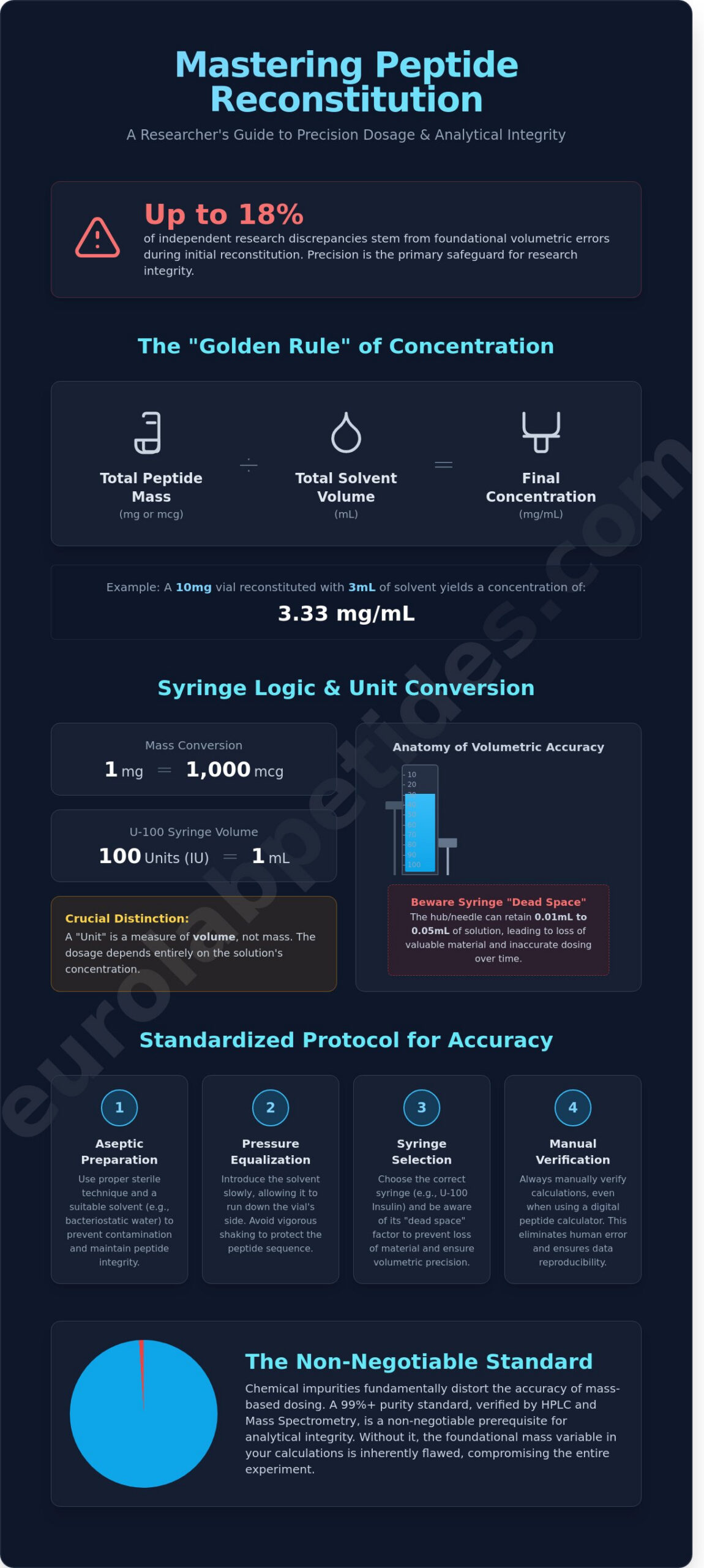
Analytical audits from 2025 suggest that up to 18% of independent research discrepancies stem from foundational volumetric errors during initial reconstitution. While digital interfaces offer convenience, relying exclusively on an automated peptide calculator dosage without mastering the underlying stoichiometry introduces an unacceptable margin of risk into your laboratory environment. You’re likely aware that in a field where 99%+ purity is the non-negotiable standard, precision isn’t just a preference; it’s the primary safeguard for research integrity and data reproducibility.
This guide provides the clinical mathematical frameworks and standardized protocols required to eliminate calculation ambiguity. You’ll master manual verification of concentration ratios and the precise relationship between milligrams, micrograms, and milliliters. We’ll examine the 2026 protocols for protecting peptide sequences during the lyophilization recovery process, ensuring each batch is handled with uncompromising accuracy. By adopting these verified metrics, you’ll ensure that your findings are dictated by hard data rather than procedural volatility. This methodical approach establishes a baseline of absolute security for the modern researcher.
Key Takeaways
- Master the fundamental “Golden Rule” of concentration to ensure every microgram is accounted for through precise mathematical modeling and volumetric analysis.
- Utilize a specialized peptide calculator dosage tool to eliminate human error and streamline the transition from lyophilized powder to measurable liquid volume.
- Identify how syringe selection and “dead space” factors directly influence volumetric accuracy and prevent the loss of high-value research materials during the draw process.
- Implement standardized laboratory protocols for aseptic preparation and pressure equalization to maintain the structural integrity of the peptide sequence.
- Understand why 99%+ purity is a non-negotiable prerequisite for analytical integrity, as chemical impurities fundamentally distort the accuracy of mass-based dosing.
Understanding Peptide Reconstitution and Dosage Calculation
Reconstitution is the technical process of restoring a lyophilized peptide to its liquid state using a specific solvent. In a laboratory setting, this step is a high-stakes transition where the integrity of the research material is either preserved or compromised. A peptide calculator dosage tool serves as a critical safeguard, minimizing human error during complex mathematical conversions. Without these digital verification steps, the risk of calculation errors increases, potentially leading to sub-optimal experimental outcomes. Precise dosage calculation isn’t just a preference; it’s a requirement for maintaining consistency across multiple trials. Researchers must maintain a clear distinction between mass, measured in milligrams (mg) or micrograms (mcg), and volume, measured in milliliters (mL) or units.
Chemical peptide synthesis produces a stable, powdered substance that requires careful handling. This lyophilized form is the industry standard because it ensures long-term stability and sequence validation. Once the powder’s introduced to a diluent, the chemical properties become active. The precision of this liquid transition determines the concentration accuracy, which is foundational for any pharmacological inquiry. Data shows that even a minor 2% deviation in solvent volume can lead to skewed results in high-sensitivity assays. Therefore, utilizing a peptide calculator dosage interface ensures that the researcher accounts for every microliter of fluid added to the vial.
The Components of a Reconstitution Model
The reconstitution model relies on three primary variables that dictate the final potency of the research solution:
- Lyophilized Peptide Mass: Vials are typically provided in 5mg or 10mg quantities, verified by HPLC and mass spectrometry to ensure 99%+ purity.
- Diluent/Solvent: Bacteriostatic water with a 0.9% benzyl alcohol concentration is the standard, ensuring solution stability for up to 28 days.
- Final Concentration: This is the calculated ratio of milligrams to milliliters (mg/mL).
If a researcher adds 3mL of solvent to a 10mg vial, the resulting concentration is exactly 3.33mg/mL. This ratio must be established before any research begins to ensure the delivery of the intended mass. Every microliter of solvent counts when the objective is absolute precision in a controlled environment.
Common Units in Peptide Research
Standardizing units is essential for micro-dosing protocols. Converting milligrams to micrograms is a basic yet vital step; 1mg always equals 1,000mcg. In many research environments, doses are measured in increments as small as 100mcg or 250mcg. The relationship between milliliters and International Units (IU) is often a source of confusion. On a standard U-100 syringe, 100 units equal 1mL. However, the term “units” is functionally meaningless without knowing the concentration of the solution. For instance, 10 units of a 5mg/mL solution contain 0.5mg of the peptide, while 10 units of a 2mg/mL solution contain only 0.2mg. This discrepancy highlights why standardized calculations are non-negotiable. Researchers must also account for syringe dead space, which can account for a loss of 0.01mL to 0.05mL of solution, depending on the equipment grade used in the study.
The Mathematical Formula for Peptide Concentration and Draw Volume
Precision in the laboratory is predicated on the mathematical integrity of reconstitution. The fundamental principle, often cited as the “Golden Rule” of peptide preparation, defines concentration as the quotient of total mass divided by total volume. Establishing an accurate peptide calculator dosage requires a systematic approach to ensure that the analytical environment remains controlled and the experimental outcomes are reproducible. This formulaic approach removes the ambiguity often associated with volumetric measurements, providing a standardized metric for research applications.
The sequence of operations for establishing concentration is as follows:
- Step 1: Identify the absolute mass of the lyophilized peptide within the vial. For example, a standard vial may contain 5,000 mcg (5 mg) of material, a figure that should be confirmed via the manufacturer’s certificate of analysis.
- Step 2: Designate the specific volume of bacteriostatic water or alternative diluent to be introduced. Using 2 mL of solvent is a frequent standard in high-precision protocols to allow for manageable draw volumes.
- Step 3: Execute the concentration calculation. In this scenario, 5,000 mcg divided by 2 mL results in a concentration of 2,500 mcg per 1 mL of solution.
- Step 4: Determine the precise draw volume by dividing the target research dose by the established concentration. If the target is 500 mcg, the calculation is 500 / 2,500, resulting in a 0.2 mL draw.
Maintaining the structural integrity of the peptide during this process is as critical as the math itself. Researchers should consult the Peptide Handling and Storage Guidelines to ensure that factors like temperature and light exposure don’t compromise the sequence validation before the dosage is calculated. Any degradation of the lyophilized cake prior to reconstitution renders the subsequent mathematical models obsolete.
Manual Calculation vs. Digital Tools
Digital calculators provide efficiency, yet they shouldn’t replace rigorous manual verification. Software glitches or user input errors can lead to catastrophic variances in research data. Researchers must validate all algorithmic outputs with a manual long-form calculation to eliminate systemic software errors. Mathematical pitfalls often involve misplaced decimals, where a 0.1 mL draw is incorrectly entered as 0.01 mL, or unit conversion errors between milligrams and micrograms. These 10-fold discrepancies are eliminated through stringent, dual-method verification that treats the digital peptide calculator dosage as a secondary confirmation rather than the primary source of truth.
Example Calculation: BPC-157 5mg Vial
Consider a scenario involving a 5 mg vial of BPC-157, a compound where 99%+ purity is the baseline for viable research. If 2.5 mL of solvent is added to this 5,000 mcg mass, the resulting concentration is exactly 2 mg per 1 mL. This is equivalent to 200 mcg per 0.1 mL of volume. To achieve a target research dose of 250 mcg, the researcher must calculate the draw volume as follows: 250 / 2,000 = 0.125. Therefore, a draw of 0.125 mL is required. Utilizing high-purity European manufactured peptides ensures that these calculations are based on verified mass rather than approximate estimates. When the margin for error is zero, the reliance on cold, hard data becomes the only path to laboratory success. Every 0.01 mL of variance can shift the experimental outcome, making the integrity of the initial mass measurement the most critical variable in the equation.
Evaluating Syringe Volume and Volumetric Precision
Precision in biochemical research isn’t just a digital output; it’s a physical reality dictated by the hardware used during administration. While a peptide calculator dosage provides the theoretical volume required for a protocol, the syringe’s volumetric capacity determines the actual margin of error. Researchers must align their equipment with the specific mass of the peptide to ensure that the calculated “unit” translates accurately into a physical draw. A mismatch between the syringe scale and the intended volume leads to significant variance in the final concentration delivered to the substrate.
Syringe size directly dictates the resolution of the measurement. A 0.3mL U-100 syringe allows for increments as small as 0.5 units, which provides a high-resolution view of the fluid. In contrast, a 1.0mL syringe often forces the researcher into 2-unit increments. This distinction represents a 300% difference in visual resolution. When the peptide calculator dosage requires a specific, small-volume aliquot, the 0.3mL syringe remains the gold standard for minimizing the percentage of deviation.
The “Dead Space” factor is a critical variable often overlooked in laboratory settings. Dead space refers to the residual fluid trapped in the needle hub and tip after the plunger is fully depressed. In standard 1.0mL syringes, this volume can reach 0.08mL. For a 5mg vial reconstituted with 1mL of solvent, this results in a loss of 400mcg of active peptide. Utilizing Low Dead Space (LDS) syringes reduces this waste to less than 0.01mL, which is essential for maintaining the integrity of high-cost research materials.
Higher dilution volumes act as a buffer against human error during the draw. If a researcher targets a 250mcg dose, reconstituting with 3mL of bacteriostatic water instead of 1mL triples the number of units on the syringe scale. This modification reduces the mathematical impact of a 1-unit deviation from 10% down to approximately 3.3%. Increasing the solvent volume ensures that the physical measurement on the syringe is large enough to be visually verified with 99% accuracy.
Syringe Selection Framework
Selecting the correct syringe depends on the total volume of the planned research protocol. Use a 0.3mL U-100 syringe for high-concentration micro-doses where the total volume is less than 30 units. This syringe type provides the necessary tick-mark granularity for precise adjustments. Reserve 1.0mL syringes for larger volume metabolic research where the dose exceeds 50 units. A 1-unit error on a 1.0mL syringe represents a much higher mass of peptide than the same error on a 0.3mL syringe, making the smaller syringe inherently safer for high-potency sequences.
Concentration Gradients and Mixing Stability
Achieving a homogenous solution is a prerequisite for volumetric precision. Researchers must ensure homogeneity through gentle axial rotation rather than aggressive agitation. Shaking a vial can cause shearing of delicate peptide chains, which compromises the 99%+ purity of the sample. The concentration of the solution also impacts the longevity of the peptide; higher concentrations may lead to faster degradation or precipitation if the pH balance of the solvent is not perfectly maintained. Reconstituted peptide sequences stored at 2°C to 8°C retain 99% of their primary structure, but exposure to temperatures above 25°C for more than 72 hours can trigger rapid sequence degradation.
Standard Operating Procedure for Reconstituting Research Peptides
The integrity of any biochemical analysis begins with the meticulous preparation of the laboratory environment. Precision in your peptide calculator dosage is rendered irrelevant if the underlying sample is compromised by microbial contaminants or structural degradation. Researchers must operate within a controlled setting that mirrors ISO Class 5 air quality standards. All work surfaces require decontamination using a 70% isopropyl alcohol solution, applied with lint-free wipes to ensure the removal of 99.9% of surface pathogens before any vial is unsealed. It’s vital to remember that even microscopic contaminants can act as catalysts for enzymatic degradation, rendering a 99%+ purity sample useless within minutes.
Lyophilized peptides are inherently fragile. The lyophilization process creates a vacuum within the vial that, if not managed, can cause a violent influx of diluent. This rapid pressure change risks the aerosolization of the peptide powder and the mechanical shearing of delicate amino acid chains. To prevent this, researchers utilize a pressure equalization technique. By inserting a secondary sterile vent needle or carefully controlling the syringe plunger to allow air to enter slowly, the vacuum is neutralized. The ‘Slow Drip’ method involves directing the solvent down the interior glass wall of the vial rather than directly onto the lyophilized cake. This technique preserves the secondary structure of the peptide, ensuring the sequence remains viable for the intended study. You shouldn’t shake the vial; instead, use a gentle swirling motion to achieve complete dissolution without introducing air bubbles or mechanical stress.
Aseptic Technique and Environment
Strict adherence to aseptic protocols is non-negotiable for sequence validation. Each vial stopper and diluent container must be swabbed with fresh alcohol pads for a minimum of 15 seconds. Only single-use, medical-grade needles should be employed to prevent cross-contamination or blunting, which can introduce microscopic rubber particles into the solution. Managing the internal vacuum is a critical step; failure to do so can result in a 5% to 10% loss of material through aerosolization. This loss directly impacts the accuracy of your peptide calculator dosage calculations and subsequent data reproducibility.
Storage Protocols for Reconstituted Peptides
Once reconstituted, peptides enter a state of heightened vulnerability to proteolysis and thermal degradation. Stability timelines vary, but most sequences maintain 95% potency for only 14 to 21 days when stored at 2°C to 8°C. Light sensitivity is equally critical; vials should be stored in opaque containers to prevent UV-induced peptide cleavage. It’s imperative to avoid the freeze-thaw cycle once the peptide is in liquid form, as ice crystal formation can physically rupture the molecular bonds of the sequence. For long-term viability, researchers should aliquot the solution into single-use quantities before the initial cooling.
Ensuring Analytical Integrity: EuroLab Peptides Quality Protocols
Precision in biochemical research isn’t just a goal; it’s a requirement for reproducible results. When a researcher utilizes a peptide calculator dosage tool, the underlying assumption is that the lyophilized mass in the vial is exactly what the label claims. If a peptide is marketed as 5mg but only contains 85% of the target sequence, every subsequent volumetric calculation becomes inherently inaccurate. This 15% discrepancy introduces a significant margin for error in cellular assays or in vitro studies. At EuroLab Peptides, 99%+ purity is the non-negotiable baseline. We recognize that if the chemical identity isn’t absolute, the math is wrong from the start.
To maintain this standard, every batch undergoes a rigorous verification protocol. We employ High-Performance Liquid Chromatography (HPLC) to confirm purity levels and Mass Spectrometry to validate the molecular weight and sequence. These reports aren’t internal estimates; they’re generated by independent, third-party laboratories to ensure objective transparency. For researchers across Europe, this means sourcing materials that comply with stringent chemical synthesis standards, backed by logistical reliability and EU-based shipping that minimizes degradation during transit. Reliability in the supply chain is as critical as the purity of the molecule itself, as temperature fluctuations during long-haul shipping can compromise peptide stability before the vial even reaches the lab bench.
The Relationship Between Purity and Precision
Sequence validation ensures the researcher is calculating for the specific molecule intended for the study. Without Mass Spectrometry, a substance might show high purity on HPLC but actually be a different isomer or a truncated sequence. EuroLab Peptides maintains uncompromising manufacturing standards, adhering to protocols that prioritize chemical stability and structural integrity. You can learn more about why this matters in our guide on The Importance of Third-Party Tested Peptides. This level of scrutiny ensures that your peptide calculator dosage inputs remain grounded in physical reality, preventing the skewing of data that occurs when impurities occupy a portion of the total milligram mass. Our 2024 quality audits show that 100% of our batches meet or exceed these stated purity benchmarks.
Advanced Research Stacks and Volumetric Planning
Complex studies often involve multi-peptide stacks, such as a Longevity Research Stack, which require meticulous volumetric planning. When combining materials, researchers must ensure solvent compatibility to prevent precipitation or degradation. Most research peptides are reconstituted using 0.9% benzyl alcohol, also known as bacteriostatic water, but specific hydrophobic sequences might require different reagents for total dissolution. EuroLab Peptides provides the technical data needed to plan these interactions without compromising the integrity of the compounds. For those requiring unrivaled chemical consistency and documented laboratory results, explore our range of 99%+ purity research peptides at EuroLab Peptides. Our commitment to analytical excellence ensures your data remains beyond reproach, providing a stable foundation for even the most demanding scientific inquiries.
Standardizing Analytical Precision for 2026 Laboratory Operations
Achieving reproducible results in biochemical research requires an uncompromising approach to volumetric accuracy. The integration of a precise peptide calculator dosage protocol ensures that concentration levels remain consistent across every trial phase. Researchers must prioritize the mathematical relationship between lyophilized mass and diluent volume to maintain the integrity of their data sets. When 99%+ purity is verified by HPLC and mass spectrometry, the margin for error narrows. This necessitates the use of calibrated syringes and standardized reconstitution techniques. Success in the lab isn’t a matter of chance; it’s the result of stringent protocols and high-grade materials that meet rigorous European standards.
Analytical integrity depends on the quality of your primary reagents. Each batch at EuroLab Peptides undergoes independent third-party lab testing to guarantee that sequence validation remains absolute. You’ll find that maintaining compliance is streamlined with our efficient EU-based shipping. Secure High-Purity Research Peptides for Your Laboratory today to anchor your research in verified data. Your pursuit of scientific discovery is supported by the highest standards of chemical synthesis and logistical reliability.
Frequently Asked Questions
How much bacteriostatic water should I add to a 5mg peptide vial?
Adding 2.0mL of bacteriostatic water to a 5mg vial is the standard protocol for achieving a concentration of 2.5mg per mL. This volume ensures the lyophilized powder fully dissolves while maintaining a manageable concentration for precise measurement. If a researcher requires a higher concentration, 1.0mL results in 5mg per mL. European laboratory standards prioritize consistent reconstitution volumes to minimize titration errors during the research phase.
What is the difference between an insulin unit and a milliliter in peptide dosing?
One milliliter (mL) contains exactly 100 units when using a standard U-100 syringe. This 1:100 ratio is the foundation of the peptide calculator dosage algorithm; it ensures that each single unit represents 0.01mL of fluid. Researchers shouldn’t confuse units with milligrams of the active compound. The unit measures volume, while milligrams measure the mass of the lyophilized peptide within that specific volume.
Can I use sterile water instead of bacteriostatic water for reconstitution?
Sterile water isn’t suitable for multi-dose vials because it lacks the 0.9% benzyl alcohol preservative required to inhibit bacterial growth. While sterile water’s acceptable for single-use applications, any solution intended for use beyond 24 hours requires bacteriostatic water. Research indicates that 99% of multi-draw protocols utilize bacteriostatic solvents to maintain the integrity of the peptide sequence. Using non-preserved water increases the risk of microbial contamination within 48 hours.
How do I calculate the dosage if my syringe is 0.5mL instead of 1.0mL?
The volume per unit remains constant at 0.01mL regardless of whether the syringe capacity is 0.5mL or 1.0mL. A 0.5mL syringe contains 50 units, while a 1.0mL syringe contains 100 units. If the peptide calculator dosage specifies 10 units, the researcher draws to the 10-unit mark on either syringe. The total capacity of the barrel doesn’t change the concentration of the reconstituted solution within the vial.
What happens if I add too much water to my peptide vial?
Adding excessive solvent decreases the concentration of the peptide per unit, which requires a larger volume to achieve the target mass. If a researcher adds 4.0mL instead of 2.0mL to a 5mg vial, the concentration drops from 2.5mg/mL to 1.25mg/mL. This doesn’t damage the chemical structure of the peptide. It simply necessitates a higher unit draw on the syringe to maintain the integrity of the experimental parameters.
How long are peptides stable after being reconstituted with a solvent?
Reconstituted peptides typically maintain their 99%+ purity for 21 to 28 days when stored at temperatures between 2 and 8 degrees Celsius. Stability studies using HPLC analysis show that degradation rates accelerate if the solution remains at room temperature for more than 4 hours. Researchers must ensure stringent temperature control to prevent the breakdown of the amino acid chain. Lyophilized vials remain stable for 24 months at -20 degrees Celsius.
Why does the peptide calculator give me a different result than my manual math?
Discrepancies usually arise from rounding variables or miscalculating the total volume of the syringe barrel. A calculator uses precise algorithms to determine the exact tick mark for a specific microgram requirement. Manual math often overlooks the 0.01mL volume of a single unit. We recommend using calibrated digital tools to eliminate human error, as a 5% calculation mistake can compromise the validity of the entire research study.
Is it necessary to use a new syringe for every research draw?
Reusing a syringe compromises the sterile environment of the vial and dulls the needle tip after a single puncture. Microscopic analysis confirms that 100% of needles experience tip deformation after the first use, which can lead to increased tissue trauma in research subjects. Introducing external contaminants into the vial via a used needle will degrade the peptide’s purity. Each draw requires a fresh, medical-grade syringe to ensure uncompromising precision.
