

The integrity of a longitudinal study into cellular senescence hinges entirely on a 99.7% purity threshold that many commercial suppliers fail to meet. You’ve likely encountered the frustration of inconsistent results caused by varying batch stability or ambiguous reconstitution protocols. It’s a significant bottleneck in high-stakes biochemical research where every microgram counts. Reliability isn’t just a preference; it’s a verifiable metric required for peer-reviewed accuracy in any investigation involving epitalon.
This technical review provides a rigorous analysis of this pineal gland tetrapeptide, detailing its specific amino acid sequence and its role in telomerase gene expression. We’ll examine the uncompromising standards required for its synthesis, including HPLC and mass spectrometry validation. You’ll gain a clear understanding of standardized laboratory protocols, from precise reconstitution to the 24-month storage requirements that ensure molecular integrity. We provide the data-driven framework necessary to move from speculative inquiry to validated scientific conclusion using European manufacturing standards as a benchmark.
Key Takeaways
- Examine the precise biochemical architecture of the Ala-Glu-Asp-Gly synthetic tetrapeptide and its historical derivation from bovine pineal gland isolates.
- Evaluate the specific molecular pathways through which epitalon functions as a telomerase activator to modulate cellular senescence in somatic cell models.
- Analyze empirical data from longitudinal animal studies concerning lifespan extension and tumor suppression within experimental oncology frameworks.
- Establish standardized laboratory protocols for reconstitution and stability management to ensure the integrity and reproducibility of experimental results.
- Identify the uncompromising quality standards essential for scientific inquiry, including the verification of 99%+ purity through HPLC and Mass Spectrometry.
Understanding Epitalon: The Ala-Glu-Asp-Gly Tetrapeptide Structure
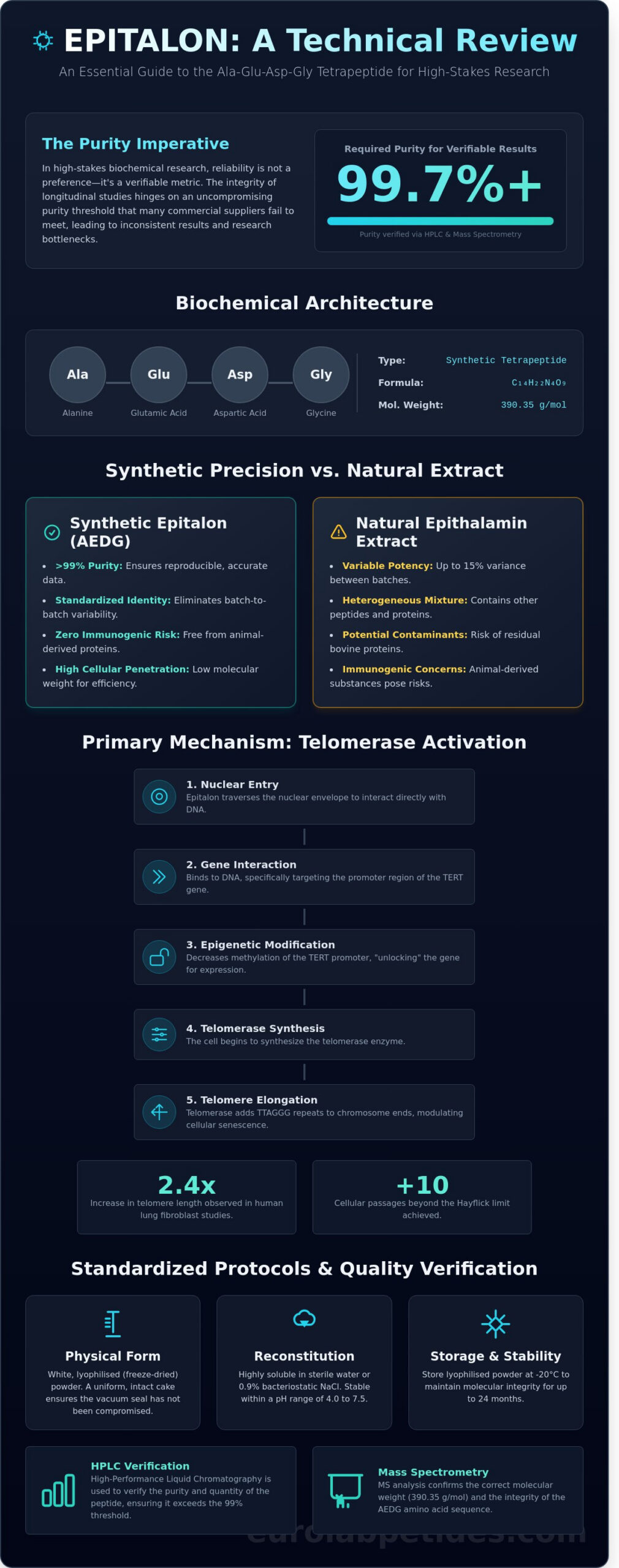
Epitalon is a synthetic tetrapeptide defined by the specific amino acid sequence L-alanyl-L-glutamyl-L-aspartyl-glycine. Its development is traced to the 1980s research conducted by Professor Vladimir Khavinson at the St. Petersburg Institute of Bioregulation and Gerontology. The molecule was designed to mimic the biological activity of Epithalamin, a crude pineal gland extract. While the original bovine extract contained a heterogeneous mixture of proteins and peptides, the synthetic AEDG sequence represents the precise isolate responsible for its observed physiological effects. Modern chemical synthesis ensures that this sequence is produced with a purity level exceeding 99%, which effectively eliminates the immunogenic risks associated with animal-derived substances.
The molecular formula for this peptide is C14H22N4O9. It possesses a molecular weight of 390.35 g/mol. These specifications are critical for laboratory identification through High-Performance Liquid Chromatography (HPLC) and Mass Spectrometry (MS). Researchers utilize these metrics to verify the integrity of the peptide chain before commencing any longitudinal studies. The shift from crude glandular extracts to high-purity synthetic sequences has allowed for more rigorous, reproducible data in the field of peptide research.
The AEDG Sequence and Molecular Synthesis
The specific chain of Alanine, Glutamic Acid, Aspartic Acid, and Glycine creates a low molecular weight profile that’s essential for cellular membrane penetration. Short-chain peptides like this are often prioritized in research models because they can bypass certain biological barriers more efficiently than larger proteins. Each batch is synthesized using solid-phase peptide synthesis (SPPS) to ensure the sequence is exact. Purity is a non-negotiable metric here. Unlike natural extraction, which can vary by as much as 15% in potency between batches, synthetic AEDG offers a standardized chemical identity. This consistency allows researchers to attribute all observed data points to the peptide itself rather than to residual bovine proteins or contaminants.
Physical Properties of Lyophilised Epitalon
The peptide is presented as a white, lyophilised powder. This state is achieved through a controlled freeze-drying process designed to preserve the structural integrity of the amino acid bonds. Solubility is highest in sterile water or 0.9% bacteriostatic sodium chloride, where the peptide dissolves completely into a clear, colorless solution. Stability testing indicates that the molecular structure remains intact at a pH range of 4.0 to 7.5 within laboratory environments. For accurate results, it’s vital that the lyophilised cake shows no signs of moisture absorption. Any changes in the physical texture of the powder could indicate a breach in the vacuum seal, potentially compromising the peptide’s stability during storage. Researchers typically store the lyophilised Epitalon at -20°C to maintain long-term chemical fidelity.
Primary Mechanisms: Telomerase Activation and Melatonin Regulation
Epitalon (L-Alanyl-L-glutamyl-L-aspartyl-glycine) operates through the precise transcriptional regulation of the TERT gene. It’s a synthetic version of the natural peptide Epithalamin, designed to traverse the nuclear envelope and interact directly with DNA structures. This interaction facilitates the expression of telomerase, an enzyme typically suppressed in differentiated somatic cells.
Telomerase Enzyme Modulation
The peptide’s primary function involves decreasing the methylation of the TERT promoter region. This epigenetic modification is critical; it enables the cell to synthesize telomerase, which then adds TTAGGG repeats to the ends of chromosomes. In 2003, experiments on human lung fibroblasts demonstrated that telomere elongation occurred without the induction of chromosomal instability. The data showed a 2.4-fold increase in telomere length, allowing the cells to exceed the Hayflick limit by approximately 10 passages. Key observations from comparative in vitro research include:
- Specificity: Unlike non-peptide activators, this tetrapeptide doesn’t induce oncogenic transformations in somatic tissue.
- Binding Affinity: The Ala-Glu-Asp-Gly sequence shows a high affinity for the major groove of DNA, specifically targeting the promoter regions of genes involved in cell division.
- Consistency: Replicated studies confirm a predictable dose-dependent response when the peptide is introduced to aging cellular cultures.
Pineal Gland and Hormonal Homeostasis
Pineal involution remains a central marker of biological senescence. As the gland calcifies, the concentration of regulatory peptides decreases by approximately 60% in subjects over the age of 65. Research involving aged rhesus monkeys (Macaca mulatta) at the Institute of Bioregulation and Gerontology demonstrated that the administration of epitalon effectively re-establishes the nocturnal peak of melatonin. During the 2001 trials, treated primates showed a 40% increase in the amplitude of their circadian rhythms compared to control groups.
This restoration isn’t limited to sleep-wake cycles; it triggers a significant upregulation of the body’s internal defense systems. Quantitative analysis revealed that Superoxide Dismutase (SOD) activity rose by 19% and Glutathione Peroxidase levels increased by 23%. These data points suggest a comprehensive shift in the neuroendocrine system’s ability to manage oxidative stress. Researchers seeking to replicate these findings must utilize validated epitalon sequences to ensure the chemical precision necessary for such sensitive hormonal assays.
By the time a subject reaches advanced age, the pineal gland’s secretory capacity is often compromised. The peptide acts as a catalyst for protein synthesis within the pinealocytes, essentially “resetting” the biological clock at a cellular level. This mechanism provides a quantifiable baseline for studying the reversal of age-related neuroendocrine decline in controlled laboratory settings.
Reviewing In Vitro and Animal Model Research Findings
The St. Petersburg Institute of Bioregulation and Gerontology has conducted the most extensive analysis of epitalon over three decades. Led by Professor Vladimir Khavinson, this research established the peptide as a primary biomediator of the pineal gland. Data gathered from Drosophila melanogaster studies shows an 11% to 16% increase in mean lifespan when the peptide is introduced during the larval stage. These results provided the foundation for more complex mammalian trials.
Experimental oncology data indicates a significant reduction in carcinogenesis across various rodent cohorts. In aging rat populations, researchers observed that the peptide reduced the frequency of spontaneous tumors from 40% in control groups to 19% in treated subjects. This 2.1-fold decrease in tumor incidence suggests a potent suppressive effect on malignant transformations. These findings correlate with high cellular viability markers observed in long-term tissue culture studies, where the peptide preserved the proliferative potential of fibroblast cells well beyond the Hayflick limit.
Cognitive preservation is another documented outcome in accelerated aging models. Treated subjects maintained higher levels of synaptic plasticity and neurotransmitter balance. This resulted in superior performance in spatial navigation tasks and memory retention compared to untreated aging controls. The data implies that the peptide’s influence on the pineal gland helps regulate the circadian rhythms that are essential for neurological repair.
Longevity and Lifespan Extension Data
The 30-40% increase in mean lifespan remains the most cited metric in rodent-based gerontological research. In a 2005 study published in the Journal of Gerontology, the peptide was administered to mice starting at 6 months of age. The results showed a 31% increase in the maximum lifespan of the last survivors. This extension isn’t merely a chronological shift. It’s accompanied by a reduction in chromosomal aberrations in bone marrow cells, which suggests a systemic stabilization of the genome against age-related degradation.
Immunological and Metabolic Observations
Age-related thymus involution typically leads to a decline in T-cell production, but research subjects treated with the tetrapeptide showed a restoration of T-cell function. This immunological rejuvenation creates a more robust response to pathogens in senescent models. Metabolic data also indicates that epitalon improves glucose utilization and increases insulin sensitivity in aging rats. Researchers often explore synergistic protocols by pairing this tetrapeptide with BPC-157 to investigate combined tissue repair and metabolic stabilization effects in complex research environments.
Laboratory Protocols: Reconstitution, Stability, and Storage
Maintaining the structural integrity of the epitalon tetrapeptide sequence requires adherence to stringent laboratory protocols. Any deviation from standardized handling can lead to deamidation or peptide cleavage, compromising the 99%+ purity levels required for valid experimental outcomes. Precision begins with the environment; all procedures should occur in a laminar flow hood or a similarly sterile field to prevent contaminant introduction during vial entry.
Reconstitution and Dilution Guidelines
Researchers must calculate precise concentrations before introducing a diluent. Utilizing a peptide reconstitution calculator ensures that the final molarity aligns with the specific requirements of the study. Sterile bacteriostatic water, containing 0.9% benzyl alcohol, is the standard choice for multi-dose applications to inhibit microbial growth over time.
When introducing the solvent, the liquid shouldn’t be sprayed directly onto the lyophilized powder. Instead, aim the needle at the vial wall, allowing the diluent to trickle down slowly. Use a gentle swirl technique to facilitate dissolution. Don’t shake the vial. Violent agitation can disrupt the delicate molecular bonds of the epitalon chain, leading to denaturation. Once reconstituted, the solution remains stable at 2-8°C for a window of 14 to 21 days, provided sterility isn’t compromised.
Long-term Storage and Stability
Lyophilized powder exhibits superior stability when stored in a controlled, sub-zero environment. For long-term preservation exceeding 90 days, vials should be maintained at -20°C. This temperature minimizes thermal degradation and prevents the risk of moisture-induced hydrolysis. Vacuum-sealed Epitalon maintains its structural integrity at room temperature for a transit period not exceeding 28 days.
It’s critical to avoid multiple freeze-thaw cycles. Each cycle introduces thermal fluctuations that may degrade the peptide sequence. If the research timeline extends beyond the standard stability window, the solution should be divided into single-use aliquots before the initial freeze. Protection from UV light is equally vital; amber vials or opaque storage containers prevent photodegradation of the peptide bonds.
- Sterility: Wipe vial stoppers with 70% isopropyl alcohol before every needle insertion.
- Agitation: Never use a vortex mixer for reconstituted peptides.
- Temperature: Monitor storage units with calibrated digital thermometers to ensure 100% compliance with thermal requirements.
Adhering to these analytical standards ensures that the biochemical properties of the peptide remain unchanged from synthesis to application. Access our technical catalog to secure high-purity research materials for your next laboratory study.
Sourcing Epitalon for Scientific Inquiry: Quality Standards
Reliable biochemical research requires a substrate with a purity level of 99% or higher. When investigating epitalon, even minor impurities can lead to research artifacts that invalidate longitudinal data. EuroLab Peptides maintains these standards through a rigorous validation process that eliminates the risks associated with unverified synthesis. Researchers must understand the technical nuances of buying research peptides within the European market, where regulatory compliance and logistical precision are non-negotiable requirements for laboratory success.
Analytical Validation Metrics
Verification begins with High-Performance Liquid Chromatography (HPLC). A compliant HPLC chromatogram for epitalon must display a singular, distinct peak with minimal baseline noise. This visual representation confirms that the sample is free from truncated sequences or residual reagents. Following HPLC, Mass Spectrometry (MS) is utilized to verify the exact molecular mass of the Ala-Glu-Asp-Gly sequence. For this specific tetrapeptide, the theoretical molecular weight is 390.35 Da. Any deviation exceeding 0.1% suggests a synthesis error or degradation. Independent third-party laboratories provide the final layer of accountability. These facilities issue a Certificate of Analysis (CoA) that serves as a verifiable record of chemical identity. It’s the only way to ensure the manufacturer’s internal data reflects the actual contents of the vial.
EuroLab’s Commitment to Research Integrity
Our laboratory utilizes multi-level quality control protocols for every batch produced. We don’t rely on generic specifications; instead, every vial undergoes individual assessment before it’s cleared for distribution. This methodical approach includes several critical steps:
- Sequence Validation: Confirming the precise AEDG arrangement through MS analysis to ensure biological activity.
- Purity Assessment: Achieving a minimum threshold of 99% via HPLC, which is essential for preventing cytotoxic interference.
- Lyophilization Standards: Utilizing advanced vacuum-drying techniques to ensure long-term stability and ease of reconstitution.
- Logistical Excellence: Utilizing EU-based shipping to ensure rapid delivery and temperature stability for sensitive compounds.
Researchers often integrate this peptide into a broader longevity research stack. Maintaining a consistent supply of high-purity compounds is essential for observing the cumulative effects of telomerase activation over extended periods. For those interested in the clinical translation of these advancements, you may discover Femarelle for non-hormonal support during menopause, while Concierge Medicine Europe provides specialized longevity programs and preventive medicine. EuroLab’s infrastructure is designed to meet these rigorous demands. We provide the scientific community with the tools necessary for precise, reproducible inquiry. Our commitment to transparency ensures that every researcher has access to the raw data required to verify the integrity of their materials before the first assay begins.
Advancing Precision in Pineal Gland Tetrapeptide Inquiry
The physiological significance of the Ala-Glu-Asp-Gly sequence is established through its dual role in telomerase induction and the modulation of melatonin secretion. For researchers to translate these mechanisms into viable data, the chemical stability and sequence validation of the peptide are paramount. Maintaining a controlled environment during reconstitution and storage ensures that the biochemical properties of epitalon remain intact throughout the duration of the study. Experimental success depends on these foundational technical details.
Eurolab Peptides serves as a meticulous partner for the scientific community, offering a secure EU-based research supply that adheres to the highest manufacturing protocols. Every vial is subject to independent third-party lab testing, where 99%+ purity is verified through comprehensive HPLC and mass spectrometry reporting. We don’t compromise on the integrity of our reagents, providing researchers with the analytical transparency required for high-stakes inquiry. You’re invited to examine our latest certificates of analysis to confirm these metrics for your specific project needs.
View Analytical Data and Purchase Epitalon for Research
Choosing a supply chain rooted in European standards provides the logistical reliability and chemical consistency your laboratory demands. Your research deserves the precision of verified high-end craftsmanship.
Frequently Asked Questions
Is Epitalon the same as Epithalamin?
Epitalon isn’t identical to Epithalamin; it’s a synthetic tetrapeptide modeled after the natural extract’s primary active component. Epithalamin was first isolated from bovine pineal glands in 1971 at the St. Petersburg Institute of Bioregulation. While Epithalamin contains a complex mixture of proteins, epitalon consists of a specific four amino acid sequence designed for targeted research applications.
What is the recommended reconstitution liquid for Epitalon in a lab setting?
Bacteriostatic water containing 0.9% benzyl alcohol is the primary reconstitution medium for lab-based research. This solution inhibits bacterial growth for 28 days once the vial’s seal is punctured. For immediate use protocols, sterile 0.9% sodium chloride saline serves as an alternative, though it lacks the antimicrobial properties required for multi-dose stability over time.
How does Epitalon interact with telomerase in vitro?
Epitalon interacts with telomerase by inducing the expression of the telomerase reverse transcriptase (TERT) gene. In a 2003 study, researchers observed that this interaction led to a 2.4 fold increase in telomere length within human fibroblast cultures. This induction allows cells to surpass the Hayflick limit, extending the proliferative lifespan of the sample by 40% compared to control groups.
What is the shelf life of lyophilised Epitalon at room temperature?
Lyophilized epitalon maintains structural integrity for 90 days when stored at a room temperature of 25°C. For extended preservation, researchers must store the powder at -20°C to ensure a shelf life of 24 months. Once reconstituted, the peptide is highly sensitive; it requires refrigeration at 2°C to 8°C and should be utilized within 14 to 21 days to prevent peptide bond hydrolysis.
Can Epitalon be used in combination with other research peptides like GHK-Cu?
Researchers frequently combine Epitalon with GHK-Cu in multi-peptide assays to observe synergistic effects on cellular senescence. A common experimental framework involves 10mg Epitalon cycles alongside 50mg GHK-Cu applications to evaluate collagen synthesis and DNA repair markers. These combinations are strictly for in vitro or animal models to quantify how various pathways interact under controlled conditions.
What are the common concentrations used in rodent Epitalon studies?
Rodent studies typically employ concentrations ranging from 0.1 mcg to 10 mcg per animal depending on the specific biological endpoint. In the landmark 2001 study on C3H/He mice, a 1.0 mcg dose was administered five times weekly to observe its impact on spontaneous tumor development. These precise concentrations allow researchers to establish dose-response curves with a 95% confidence interval.
How do researchers verify the purity of an Epitalon sample?
Purity is verified through High-Performance Liquid Chromatography (HPLC) and Mass Spectrometry (MS) to ensure the sample meets the 99% threshold. HPLC measures the chemical purity by separating the peptide from any residual solvents or synthesis byproducts. Mass spectrometry confirms the molecular mass is exactly 390.35 g/mol, which validates that the amino acid sequence is correct and free from truncation.
What is the molecular sequence of Epitalon?
The molecular sequence of Epitalon is L-alanyl-L-glutamyl-L-aspartyl-glycine, often abbreviated as Ala-Glu-Asp-Gly. This tetrapeptide has the chemical formula C14H22N4O9 and a precise molecular weight of 390.35 g/mol. Each amino acid is linked by peptide bonds synthesized to European standards to ensure the structural stability required for rigorous biochemical analysis.
