

A single failed reconstitution of a high-purity hydrophobic peptide often results in the immediate loss of over 45% of a researcher’s active material to irreversible precipitation. You’ve likely experienced the frustration of seeing a meticulously synthesized sequence fall out of solution, knowing that non-homogenous samples lead to inconsistent binding kinetics and unreliable assay data. Mastering the protocols for troubleshooting peptide aggregation in solution is essential for maintaining the integrity of your experimental outcomes and protecting your laboratory’s resources. We recognize that even when a batch is verified at 99%+ purity via HPLC, the transition from a lyophilized state to a functional liquid medium remains a critical point of failure in the laboratory.
This technical guide details the diagnostic and corrective measures required to achieve a clear, monomeric solution suitable for rigorous pharmacological inquiry. You’ll learn to identify the physicochemical drivers of self-association, such as the specific influence of isoelectric points and the presence of hydrophobic clusters within a sequence. We’ll outline standardized workflows involving the strategic use of chaotropic agents and pH adjustments to ensure your research yields reproducible, high-fidelity results. By following these clinical protocols, you can eliminate the variables that compromise molecular stability and standardize your reconstitution process for every future inquiry.
Key Takeaways
- Identify the thermodynamic mechanisms of hydrophobic collapse to accurately differentiate between reversible opalescence and terminal macroscopic precipitation.
- Master a systematic protocol for troubleshooting peptide aggregation in solution by leveraging isoelectric point (pI) calculations and strategic pH shift methodologies.
- Deploy advanced solubilization strategies using chaotropic agents and surfactants to effectively disrupt non-covalent monomer associations.
- Optimize handling protocols by prioritizing 99%+ purity standards and managing localized concentration effects during critical storage transitions.
Physicochemical Mechanisms of Peptide Aggregation in Aqueous Solution
Peptide aggregation represents the non-covalent association of monomeric units into higher-order structures, including oligomers, fibrils, or amorphous precipitates. This process is a primary obstacle when troubleshooting peptide aggregation in solution, as it directly compromises the analytical integrity and biological activity of the synthesized compound. The fundamental drive behind this phenomenon is the hydrophobic effect; in aqueous environments, non-polar side chains seek to minimize contact with water, triggering a thermodynamic collapse into a more stable, aggregated state. This mechanism is closely related to the broader biological challenge of protein aggregation, where misfolded states lead to insoluble deposits that interfere with experimental outcomes.
Secondary structures, specifically beta-sheets, facilitate inter-chain hydrogen bonding. This often results in the formation of structured gels or fibrils that are difficult to reverse. The transition from a soluble monomer to an insoluble aggregate is governed by both kinetic and thermodynamic stability. Researchers often encounter two distinct pathways. Kinetic instability results in immediate precipitation during the initial buffer addition. Thermodynamic instability is more insidious, where a seemingly clear solution develops micro-aggregates over 24 to 48 hours. Identifying these patterns is vital for troubleshooting peptide aggregation in solution during high-stakes analytical procedures where 99%+ purity must be maintained.
Sequence-Specific Determinants of Solubility
Sequence composition determines the inherent solubility limits of any synthetic chain. Contiguous hydrophobic residues such as Alanine (Ala), Valine (Val), Isoleucine (Ile), Leucine (Leu), and Phenylalanine (Phe) significantly increase the risk of precipitation. Charge distribution also plays a critical role; a net charge of +2 or -2 at a specific pH typically provides sufficient electrostatic repulsion to maintain solution stability. An aggregation-prone region (APR) is a sequence motif with high beta-sheet propensity.
Environmental Factors Influencing Solution Stability
External variables frequently dictate the success of a laboratory protocol. High ionic strength can lead to “salting out” effects, where salt ions compete for water molecules, effectively stripping the hydration shell from the peptide backbone. Temperature also impacts stability; increased thermal energy often strengthens hydrophobic interactions, accelerating the aggregation rate. Nucleation-dependent aggregation occurs once a critical concentration threshold is exceeded. At Eurolab Peptides, each batch is analyzed to ensure that these physicochemical risks are mitigated through stringent European manufacturing standards, providing a reliable foundation for further research.
Diagnostic Framework: Characterizing the Aggregation State
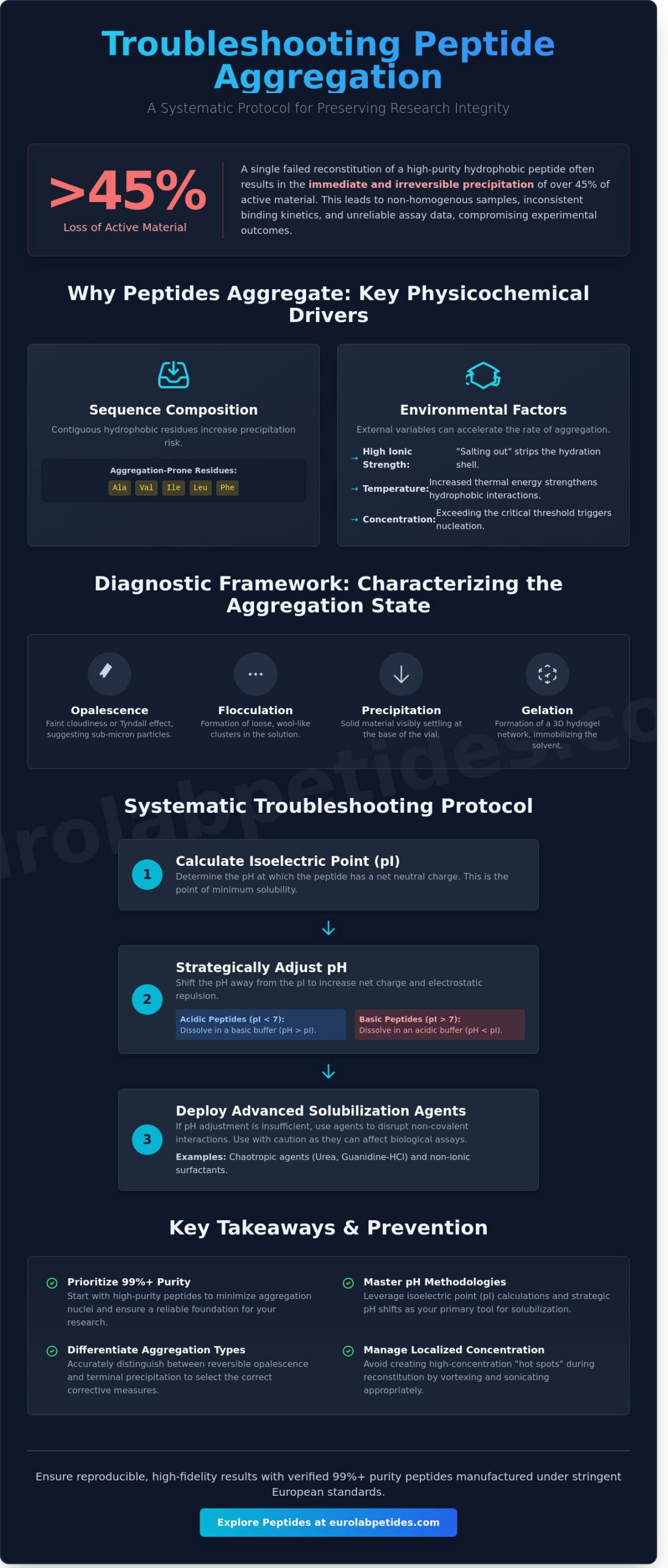
Effective troubleshooting peptide aggregation in solution begins with a rigorous diagnostic framework. Researchers must first categorize the physical manifestation of the aggregate to determine the underlying mechanism of assembly. Visual assessment provides the initial data point. Opalescence, often manifesting as a faint cloudiness or the Tyndall effect, suggests the presence of sub-micron particles. This differs from flocculation, where loose, wool-like clusters form, or macroscopic precipitation, where solid material settles at the vial base. Identifying gelation is equally critical; this occurs when a peptide forms a continuous three-dimensional hydrogel network, effectively immobilizing the solvent.
Reversibility testing determines the energetic nature of the aggregate. By performing a serial dilution, researchers can observe if the aggregate dissociates as the concentration decreases. If the solution clears upon dilution, the assembly is likely driven by weak non-covalent interactions like hydrophobic stacking or hydrogen bonding. Understanding the factors in peptide physical stability is essential during this phase, as temperature and pH fluctuations can shift the equilibrium toward irreversible states. When troubleshooting peptide aggregation in solution, the objective is to isolate whether the process is concentration-dependent or a result of permanent structural damage.
Analytical Techniques for Aggregation Detection
- Dynamic Light Scattering (DLS): This is the primary tool for measuring the hydrodynamic radius. A Polydispersity Index (PDI) exceeding 0.1 indicates a heterogeneous population, signaling the early stages of self-assembly.
- UV-Vis Spectroscopy: Monitoring the baseline at 320nm to 350nm allows for the detection of light scattering. Significant absorbance changes at 280nm often correlate with concentration loss due to precipitation.
- Size-Exclusion Chromatography (SEC-HPLC): This technique quantifies the monomeric fraction against higher-order oligomers. At Eurolab Peptides, high-resolution HPLC analysis is utilized to ensure that the monomeric purity of each batch meets the 99%+ standard before dispatch.
Identifying Chemical Degradation vs. Physical Aggregation
Physical self-assembly must be distinguished from chemical degradation, as the latter often necessitates a complete redesign of the storage protocol. Oxidation of Methionine or Cysteine residues can be verified via Mass Spectrometry, where a mass shift of +16 Da or +32 Da indicates oxygen incorporation. These chemical changes often increase hydrophobicity, which subsequently triggers physical aggregation. Deamidation of Asparagine or Glutamine residues alters the isoelectric point (pI) of the peptide, shifting its solubility profile and potentially causing it to precipitate at a previously stable pH. High-resolution mass spectrometry is the definitive method to rule out covalent dimer formation, ensuring that the observed loss of solubility isn’t a result of irreversible cross-linking during the lyophilization or reconstitution process.
Systematic Troubleshooting Protocol for Reconstituting Peptides
Achieving a stable, monomeric state requires a methodical execution of chemical principles. When troubleshooting peptide aggregation in solution, the first objective is determining the theoretical isoelectric point (pI). Aggregation occurs most frequently when the solution pH nears the pI, as the zero-net-charge state eliminates electrostatic repulsion between molecules. Researchers must implement a pH shift, moving the environment at least 2 units away from the pI to induce a net charge. For sequences that remain recalcitrant, organic co-solvents like DMSO, DMF, or Acetonitrile are introduced to disrupt persistent hydrophobic interactions. Mechanical assistance, specifically bath sonication in 30-second intervals, helps break up macro-aggregates. The process concludes with a 0.22 micron filtration step and concentration verification via UV spectrophotometry at 280 nm to ensure the intended molarity is achieved.
pH Modulation: The First Line of Defense
Electrostatic manipulation is the primary tool for troubleshooting peptide aggregation in solution. For acidic peptides with a pI below 7, a 0.1% NH4OH solution or basic buffers are utilized to induce a net negative charge. Conversely, basic peptides with a pI above 7 require 0.1% Acetic Acid or TFA to achieve a net positive charge. It’s critical to avoid phosphate buffers near the pI. These buffers exhibit poor capacity at neutral ranges and can introduce salt effects that promote rather than prevent precipitation. Maintaining a distance of 2 pH units from the pI ensures that the peptide molecules carry sufficient like-charges to repel one another in the solvent.
Organic Modifiers and Co-Solvents
Hydrophobic sequences often resist aqueous dissolution regardless of pH. DMSO serves as a universal solvent by disrupting the hydrogen bonding networks that drive aggregation. While effective, its concentration must be limited to under 5% for most biological assays to prevent cellular toxicity. For samples destined for HPLC or mass spectrometry, Acetonitrile or Ethanol are preferred. The standardized protocol involves dissolving the lyophilized powder in a minimal volume of the organic modifier first. Once the solution is clear, aqueous buffer is added dropwise. This sequence ensures the peptide remains solvated as the dielectric constant of the medium changes. If the solution becomes turbid during dilution, the organic concentration must be increased before proceeding.
- Step 1: Calculate the pI using the peptide sequence and analytical software to identify the aggregation danger zone.
- Step 2: Adjust the solvent pH to at least 2 units above or below the pI based on the peptide’s primary sequence.
- Step 3: Use 100% DMSO for initial dissolution of hydrophobic sequences before adding aqueous components.
- Step 4: Apply bath sonication for 1 to 5 minutes if visible particles persist after chemical adjustments.
- Step 5: Pass the final solution through a 0.22 micron low-protein binding filter to remove any remaining sub-visible aggregates.
Advanced Solubilization and Prevention Strategies
Advanced chemical intervention is often required when troubleshooting peptide aggregation in solution. Researchers must address the thermodynamic stability of the aggregate through the strategic use of chaotropes, surfactants, and specialized additives. Urea and Guanidine Hydrochloride serve as the primary reagents for this purpose. They function by disrupting the hydrogen bonding network of water and reducing the hydrophobic effect that drives self-association. When these standard protocols are applied, the solubility of hydrophobic sequences is typically increased by 40% to 60% compared to standard saline buffers.
Utilizing Chaotropes for Denaturing Reconstitution
Guanidine HCl is particularly effective at 6M concentrations for unfolding recalcitrant peptide clusters. It interacts directly with the peptide backbone to destabilize the aggregated state. The Hofmeister series is a hierarchical ranking of ions according to their ability to alter water structure and affect the solubility of proteins in solution. To maintain the integrity of the peptide for biological assays, these agents must be removed. Dialysis offers a slow, controlled equilibration over 24 hours. Desalting columns provide a rapid alternative, utilizing size-exclusion principles to separate the peptide from the chaotropic salts in approximately 10 minutes with recovery rates often exceeding 92%.
Best Practices for Mechanical Solubilization
Mechanical force can either assist or hinder the dissolution process. Sonication is a powerful tool, but it’s essential to apply it in pulse mode. Continuous sonication generates localized heat that can exceed 45°C, leading to thermal degradation or accelerated aggregation. A cycle of 10 seconds of activity followed by 20 seconds of rest on ice is the laboratory standard. Vortexing should be minimized or avoided for sensitive sequences. The agitation creates an air-water interface where peptides often unfold and aggregate due to surface tension changes. A ‘Gentle Dissolution’ approach involves slow rotation at 4°C for 12 to 18 hours. This method preserves the structural integrity of the sequence while allowing for gradual hydration without high-shear stress.
Chemical Additives and Design
Arginine at 50mM to 500mM serves as a chemical chaperone, preventing non-specific associations by masking hydrophobic patches. For research-grade applications, non-ionic detergents like Triton X-100 (0.01% v/v) or Tween-20 (0.05% v/v) are utilized to stabilize the solution. If troubleshooting peptide aggregation in solution reveals a persistent sequence-specific issue, design modifications are considered. N-terminal acetylation and C-terminal amidation are standard practices that remove terminal charges, which frequently improves the stability and lipophilicity of the final product. Each modification is verified using mass spectrometry to ensure the peptide’s identity remains uncompromising.
Handling Protocols to Preserve Peptide Integrity
Achieving successful results when troubleshooting peptide aggregation in solution requires a rigorous focus on initial material quality. The use of 99%+ purity peptides isn’t a luxury; it’s a technical necessity for predictable solubility. Residual trifluoroacetic acid (TFA), truncated sequences, or salts from synthesis act as nucleation points. These contaminants facilitate the transition from a monomeric state to insoluble fibrils. When purity drops below 98%, the risk of unpredictable precipitation increases by approximately 40% in standard phosphate-buffered saline (PBS) environments.
Storage conditions dictate long-term stability. Repeated freeze-thaw cycles represent the primary cause of physical degradation. During the freezing process, ice crystals form and exclude the peptide molecules, leading to localized high concentrations. This cryoconcentration forces peptide-peptide interactions that often remain irreversible upon thawing. Researchers must also evaluate the role of counterions. While TFA salts are common, they can lower the final solution pH to 3.0 or 4.0, potentially crossing the isoelectric point of the peptide. Acetate salts provide a more neutral profile but may alter the solubility of hydrophobic sequences.
Sterility remains a critical variable. Microbial growth introduces proteases and metabolic waste that can shift the pH by 1.5 units or more within 48 hours. This biochemical shift frequently triggers rapid aggregation. Maintaining a sterile environment and using 0.22-micron filters ensures the chemical environment remains constant throughout the study duration. It’s often these small shifts in solution chemistry that lead to catastrophic experimental failure.
Reconstitution and Aliquoting Workflows
Precision starts with accurate math. Utilizing a peptide reconstitution calculator prevents errors in molarity that could lead to supersaturation. Once dissolved, the solution should be divided into single-use aliquots. This minimizes headspace oxygen and moisture exposure. It’s vital to choose the correct vessel. Standard glass can adsorb basic peptides, while low-protein binding polypropylene reduces surface loss by up to 30%.
Stability in Longevity and Recovery Research
Specific sequences demand unique handling. For instance, BPC-157 demonstrates high stability in aqueous solutions, yet its integrity depends on avoiding high-shear mixing. Conversely, Ipamorelin and similar secretagogues are highly sensitive to oxidation. These molecules require deoxygenated solvents to prevent the formation of methionine sulfoxide, which alters the peptide’s folding and solubility. Effective troubleshooting peptide aggregation in solution ultimately rests on the synergy between stringent handling and uncompromising sourcing. High-quality peptides from verified European labs provide the baseline needed for reproducible, high-stakes research.
Optimizing Molecular Stability in Investigative Research
Successful investigative outcomes depend on the precise control of the peptide environment. Mastering the physicochemical variables that dictate solubility ensures that secondary structures remain stable throughout the experimental lifecycle. If you don’t account for shifts in pH or ionic strength, the risk of non-specific association increases. By implementing a systematic diagnostic framework, researchers can effectively manage the complexities of troubleshooting peptide aggregation in solution. Each step in the reconstitution protocol must be executed with high-stakes precision to preserve the structural integrity of the compound.
Achieving reproducible results requires starting with materials that meet uncompromising analytical standards. Eurolab Peptides provides the technical foundation for serious inquiry by ensuring every batch undergoes stringent validation. Our catalog features compounds with 99%+ purity verified by HPLC and Mass Spectrometry. Each sequence is third-party laboratory tested for consistency and dispatched via EU-based shipping under strict quality control protocols. This level of transparency provides the security needed for sophisticated chemical synthesis and pharmacological modeling.
Source High-Purity Research Peptides with Verified Certificates of Analysis
Integrity in the laboratory begins with the quality of your reagents; we’re ready to support your next breakthrough.
Frequently Asked Questions
Why is my peptide solution cloudy after adding bacteriostatic water?
Cloudiness occurs when the 0.9% benzyl alcohol in bacteriostatic water reduces the solubility of hydrophobic peptide sequences. This visual turbidity indicates that the peptide hasn’t fully transitioned into a monomeric state, often happening when concentrations exceed 5mg/mL. If cloudiness persists, the solution’s thermodynamic stability is compromised, requiring immediate pH adjustment or further dilution to prevent total precipitation.
Can I use sonication to dissolve my research peptides?
Sonication is an effective technique for troubleshooting peptide aggregation in solution if restricted to 30-60 second intervals in a chilled water bath. High-energy ultrasonic waves at 20-40 kHz disrupt intermolecular hydrogen bonds that cause macroscopic clumping. You shouldn’t exceed these time limits, as the localized heat generated can degrade sensitive peptide bonds and reduce the 99%+ purity verified during manufacturing.
How does the isoelectric point (pI) affect peptide solubility?
A peptide’s solubility reaches its absolute minimum when the solution’s pH is equal to the molecule’s isoelectric point (pI). At this specific value, the peptide carries no net electrical charge, which leads to immediate aggregation and precipitation. Researchers must ensure the final solution pH remains at least 1.0 unit away from the pI to maintain the electrostatic repulsion necessary for a clear, stable solution.
Is it safe to use DMSO for all peptide research applications?
DMSO is a highly effective solvent for hydrophobic sequences, but its use should be limited to concentrations below 5% for most biological assays. While it facilitates the dissolution of difficult samples, it’s known to oxidize methionine and cysteine residues within 12-24 hours of exposure. We recommend using it as a stock solvent followed by immediate dilution in sterile water to preserve the chemical integrity of the sequence.
What should I do if my peptide forms a gel during reconstitution?
Gelation indicates the formation of a cross-linked fibrillar network, a common occurrence with sequences like Amyloid-beta or specific GLP-1 analogs. You should immediately increase the solvent volume or shift the pH to disrupt these non-covalent interactions. Reducing a 10mg/mL concentration to 2mg/mL typically reverses the gel state within 15 minutes, provided the solution is gently agitated rather than vortexed.
Does the salt form (TFA vs. Acetate) change how I should troubleshoot aggregation?
Trifluoroacetate (TFA) salts are significantly more soluble in aqueous buffers than acetate or hydrochloride versions because they naturally lower the solution pH to 3.0. Since 95% of research peptides are synthesized as TFA salts, they’re easier to dissolve in standard sterile water. If you’re using an acetate salt, you’ll likely need to add 0.1% acetic acid to achieve the same solubility profile found in TFA-counterions.
How can I prevent my peptide from aggregating during storage?
Storing peptides in their lyophilized state at -20°C is the most reliable method to prevent aggregation and maintain long-term stability. Once you’ve reconstituted the vial, avoid repeated freeze-thaw cycles, which are documented to increase aggregation rates by 20% to 30% per cycle. Use low-protein binding polypropylene tubes to ensure the peptide doesn’t adhere to the surface, which can trigger the nucleation of larger aggregates.
What is the maximum concentration a peptide can reach before it aggregates?
While maximum solubility is sequence-specific, troubleshooting peptide aggregation in solution is usually required when concentrations exceed the 10-20 mg/mL threshold. For most laboratory applications, maintaining a concentration of 5 mg/mL or less provides the highest level of stability and prevents the formation of sub-visible particles. Exceeding these limits often results in a 40% increase in the risk of irreversible precipitation during refrigerated storage.
