

The European peptide market is projected to reach USD 267.03 million in 2026, yet the implementation of the June 2026 EMA Guideline on the Development and Manufacture of Synthetic Peptides has fundamentally shifted the burden of proof from the manufacturer to the researcher. When evaluating eurogen peptides or any high-purity synthesis, the presence of a Certificate of Analysis is no longer sufficient without transparent, third-party HPLC and mass spectrometry validation. You recognize that even a minor deviation in sequence integrity can invalidate months of metabolic or cognitive inquiry.
This article serves as a technical reference for identifying unrivaled synthesis quality in an environment where the services segment is growing at a CAGR of 16.8% through 2034. You’ll gain a comprehensive understanding of the 2026 standards for impurity control, microbiological quality under European Pharmacopoeia 5.1.4, and the standardized handling protocols required to maintain stability during EU-wide shipping. We’ll analyze the specific metrics that separate standardized research-grade compounds from substandard alternatives, providing the data-driven clarity required for precise laboratory results.
Key Takeaways
- Understand the 2026 EMA regulatory updates and how they redefine the benchmarks for European research-grade synthesis and impurity control.
- Identify the critical analytical metrics for evaluating eurogen peptides, specifically the mandatory integration of HPLC and Mass Spectrometry for sequence verification.
- Evaluate the technical impact of the 99%+ purity threshold on research integrity compared to standard 95% catalog grades.
- Implement standardized laboratory protocols for handling lyophilized compounds, including optimal thermal storage at -20°C or -80°C to ensure long-term stability.
- Review the multi-level validation framework that combines in-house analysis with independent third-party verification to eliminate batch-to-batch inconsistency.
Defining the Landscape of Eurogen and European Peptide Synthesis
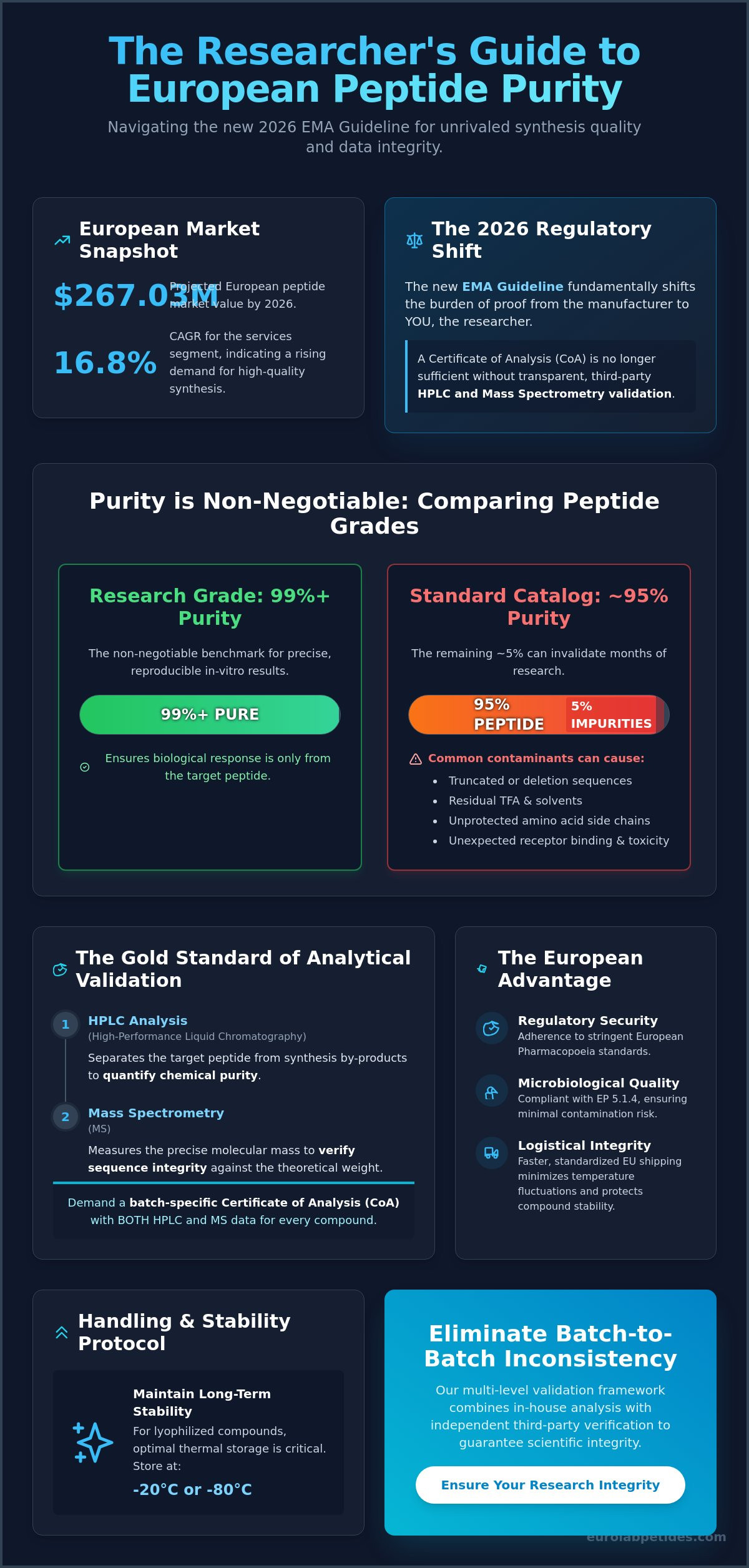
The European peptide market is projected to reach USD 267.03 million in 2026, reflecting a compound annual growth rate (CAGR) of 8.59%. This expansion coincides with the implementation of the June 2026 EMA Guideline on the Development and Manufacture of Synthetic Peptides, which introduces rigorous standards for peptide characterization and impurity control. Within this landscape, researchers often reference eurogen peptides as a historical benchmark for biochemical supply. However, the current requirements for high-stakes research demand a shift from generic catalog sourcing toward specialized suppliers capable of providing 99%+ purity and comprehensive analytical documentation.
All compounds are strictly classified as Research Use Only (RUO). This classification isn’t just a legal formality; it’s a technical boundary that ensures synthesis resources are dedicated to the precise needs of laboratory inquiry. Technical scrutiny of eurogen peptides reveals that legacy catalog standards often fall short of the 99%+ purity required for contemporary metabolic inquiry. By adhering to RUO standards, specialized suppliers focus on the rapid synthesis of complex sequences for longevity, vitality, and metabolic studies without the prolonged lead times associated with pharmaceutical-grade production.
Research-Grade vs. GMP-Grade Peptides
In metabolic and tissue repair research, 99%+ purity is the non-negotiable benchmark. While GMP-grade peptides are essential for clinical applications, high-purity research-grade compounds provide the precision required for in-vitro signaling studies. Catalog providers typically offer 95% purity, but the remaining 5% of impurities often consist of truncated sequences or residual solvents from the chemical peptide synthesis process. These contaminants can cause localized toxicity or unexpected receptor binding, which invalidates the results of sensitive immune system or cognitive function research. Common impurities in lower-grade (95%) synthesis include:
- Truncated peptide sequences
- Residual TFA (Trifluoroacetic acid)
- Deletion sequences
- Unprotected amino acid side chains
Achieving 99%+ purity ensures that the observed biological response is attributable solely to the peptide sequence itself, preserving the integrity of the experimental data.
The Importance of European Sourcing
Sourcing within Europe provides a layer of regulatory security that global markets often lack. EU-based laboratories operate under the stringent requirements of the European Pharmacopoeia, specifically referencing chapters 2.2.55 for peptide mapping and 5.1.4 for microbiological quality. Logistically, EU-based shipping is a critical factor in maintaining the integrity of temperature-sensitive compounds. Lyophilized peptides are stable, but prolonged exposure to fluctuating temperatures during international customs delays can compromise the secondary structure of the molecule. By utilizing European sourcing, researchers benefit from standardized handling protocols and faster delivery times, ensuring the compounds arrive with their molecular integrity fully intact.
Analytical Validation: The Role of HPLC and Mass Spectrometry
Analytical validation represents the definitive barrier between speculative data and reproducible results. For researchers evaluating eurogen peptides, the standard for purity is not a subjective claim but a quantifiable metric established through High-Performance Liquid Chromatography (HPLC) and Mass Spectrometry (MS). The target peptide is separated from synthesis by-products via HPLC to assess chemical purity. Sequence validation is subsequently provided by Mass Spectrometry, which measures the precise molecular mass to ensure the synthesized compound matches the intended theoretical weight.
A batch-specific Certificate of Analysis (CoA) must accompany every compound to document these findings. Without this data, the risk of utilizing eurogen peptides contaminated with residual trifluoroacetic acid (TFA), salts, or truncated sequences increases significantly. These contaminants, often found in low-grade synthesis, can interfere with cellular signaling and lead to false-positive results in tissue repair or recovery research. It’s critical to verify that the CoA matches the specific lot number received.
Interpreting HPLC Chromatograms
Purity is determined by peak integration, where the area under the primary peak is compared against the total area of all detected peaks. A single, sharp peak indicates high molecular homogeneity, whereas secondary peaks or “shoulders” suggest the presence of impurities or degradation products. HPLC serves as the primary method for resolving and quantifying diastereomeric peptide isomers within a synthesized batch. Chromatograms should be scrutinized for baseline stability and the absence of residual TFA, which typically appears as an early-eluting peak under specific UV wavelengths.
Third-Party Verification Protocols
While in-house testing provides the initial baseline, independent third-party verification is the non-negotiable standard for high-impact inquiry. Manufacturer-provided data can sometimes reflect “best-case” scenarios rather than the actual state of the delivered batch. Manufacturer claims are verified by independent laboratories using standardized protocols to ensure that the 99%+ purity threshold is maintained across all batches. This transparency allows for absolute security in experimental design. For those requiring validated compounds, reviewing analytical reports for research stacks provides the necessary data for informed procurement.
Serious researchers don’t accept summarized data; they demand raw HPLC and MS results. In 2026, this level of accountability ensures that the integrity of the scientific process remains uncompromising. This data-first approach eliminates the ambiguity often associated with global sourcing and provides the high-stakes precision required for modern biochemical inquiry.
Comparing Peptide Grades: Catalog Standards vs. Research Requirements
The distinction between 95% and 99% purity is often dismissed as a marginal gain; however, in high-precision molecular biology, that 4% variance represents a significant risk of experimental interference. Catalog standards, frequently associated with legacy providers of eurogen peptides, prioritize volume and availability over absolute molecular homogeneity. When purity falls below the 99% threshold, the remaining fraction typically contains truncated sequences, deletion sequences, or residual reagents from the synthesis process. These impurities can induce non-specific binding or localized toxicity, which compromises the reliability of metabolic and tissue repair data.
A cost-benefit analysis of sourcing ultra-high purity compounds reveals that the initial investment in 99%+ purity is offset by the preservation of laboratory resources. Using lower-grade eurogen peptides often results in the loss of expensive reagents and hundreds of man-hours when results cannot be replicated due to batch-to-batch inconsistency. In 2026, the European peptide market’s growth is driven by researchers who recognize that data integrity is directly proportional to the chemical purity of the synthesis. Standardized HPLC-verified compounds eliminate the variable of secondary molecular interference, allowing for a focused analysis of the target sequence.
Peptide salt content is a critical but frequently overlooked variable in cell culture experiments. High levels of residual trifluoroacetic acid (TFA) or counter-ions can significantly alter the osmotic pressure in delicate cellular environments. This shift can lead to cellular stress or lysis, particularly in sensitive cognitive function research. In inflammatory research, oxidative stress caused by these impurities can trigger independent cytokine release, resulting in false-positive data that misrepresents the peptide’s actual biological activity.
The Wolverine Stack and Multi-Pathway Compounds
Synergistic research models, such as the Wolverine Stack, require precise molar ratios to ensure effective multi-pathway activation. The stability of blended lyophilized peptides is maintained through advanced co-lyophilization techniques that prevent molecular degradation during storage. For specific protocols regarding tissue repair and recovery research, researchers should consult the BPC-157 technical guide. This reference details the synthesis requirements for the pentadecapeptide and provides the analytical framework for its application in regenerative models.
Custom Synthesis for Novel Sequences
Standard catalog eurogen peptides may not accommodate the novel sequence modifications or specific fluorescent labeling required for advanced imaging. Custom synthesis allows for scale-up from milligram to gram quantities while maintaining sequence integrity through rigorous mass spectrometry validation. Complex, long-chain peptides are synthesized using automated techniques designed to minimize deletion sequences. This ensures that even at larger scales, each batch meets the 99%+ purity benchmark required for uncompromising scientific inquiry.
Handling and Stability: Best Practices for Lyophilized Compounds
Lyophilization remains the industry standard for maintaining the structural integrity of synthetic sequences over extended durations. This process involves the removal of solvent via sublimation under vacuum, which effectively halts hydrolytic degradation and minimizes the risk of bacterial proliferation. When researchers procure eurogen peptides, the physical state of the lyophilized “cake” serves as an initial indicator of quality; a uniform, crisp cake suggests low residual moisture, whereas a collapsed or sticky appearance often indicates compromised vacuum integrity or excessive humidity during the sealing process. In 2026, standardized moisture content in high-purity synthesis is kept below 5% to ensure maximum stability.
Storage parameters are determined by the intended duration of the study. For experimental timelines under 90 days, storage at -20°C is generally sufficient to prevent significant primary structure degradation. However, for longitudinal studies exceeding six months, ultra-low temperature storage at -80°C is mandatory to preserve the secondary conformations of complex sequences. Exposure to ultraviolet (UV) radiation and atmospheric moisture must be strictly avoided, as hygroscopic absorption can lead to rapid deamidation or oxidation of sensitive residues like methionine and cysteine.
Reconstitution and Solution Stability
The selection of an appropriate solvent system is dictated by the peptide’s hydropathy index. While bacteriostatic water (0.9% benzyl alcohol) is the standard for most sequences, hydrophobic peptides may require the addition of 0.1% acetic acid or minimal volumes of dimethyl sulfoxide (DMSO) to achieve complete dissolution. It’s essential to follow a precise reconstitution guide to ensure molarity calculations remain accurate for quantitative analysis. Once in solution, peptides are significantly more prone to degradation; therefore, researchers should employ aliquoting strategies to eliminate repeated freeze-thaw cycles, which can denature the peptide through mechanical shear stress.
Shipping and Cold-Chain Logistics
Lyophilized peptides exhibit remarkable thermal stability during transit, often maintaining integrity at room temperature for up to 14 days without measurable loss of purity. In 2026, EU-wide shipping infrastructure allows for 24-48 hour delivery windows, which further reduces the risk of thermal excursion. Upon arrival, the vial’s vacuum seal must be verified by observing the rapid intake of air upon the first needle insertion. Post-transit integrity testing should include a visual inspection for moisture ingress and, for high-stakes inquiry, a baseline HPLC run to verify that the eurogen peptides have not undergone degradation. To ensure your laboratory receives compounds that have been handled with this level of technical rigor, procure HPLC-verified research compounds here.
EuroLab Peptides: A Multi-Level Protocol for Scientific Integrity
The landscape of European biochemical supply has evolved beyond the catalog models once defined by eurogen peptides. EuroLab Peptides operates with a clinical focus on molecular integrity, where 99%+ purity is the non-negotiable benchmark for every synthesis. While researchers may have historically relied on eurogen peptides for general catalog sequences, the demands of 2026 metabolic inquiry require the higher-tier analytical validation provided by the EuroLab protocol. Operations are centralized at the Stekene, Belgium logistics hub, ensuring that all compounds are processed under stringent European laboratory standards. This geographic advantage facilitates rapid delivery across the EU, minimizing the risk of thermal degradation during transit.
A strict ethical stance is maintained through absolute RUO compliance. The brand rejects the use of anecdotal marketing, relying instead on the “language of the laboratory” to communicate value. This objective approach prioritizes scientific accuracy, providing researchers with the security that their reagents won’t introduce uncontrolled variables into their experimental designs. High-stakes precision is achieved not through marketing claims, but through verifiable analytical metrics. Data integrity remains the absolute priority.
The EuroLab Quality Assurance Workflow
Verification is conducted through a multi-stage process that begins with in-house HPLC analysis to confirm chemical homogeneity. Following this initial screen, every batch is submitted for independent third-party analysis to validate sequence identity and molecular weight via mass spectrometry. Certificates of Analysis are not merely available upon request; they are integrated into the procurement process for every research client. EuroLab maintains a policy of radical honesty by publishing the raw data from both in-house and independent laboratory tests to ensure absolute transparency for every compound in the catalog.
Sourcing for Specialized Research Areas
The catalog is specifically curated to support advanced inquiry into metabolic research, longevity, and cognitive function. These areas require compounds that maintain structural integrity across complex multi-pathway models. For growth hormone secretagogue studies, the Ipamorelin technical profiles provide the necessary analytical framework for sequence validation and research application. This data-first approach ensures that researchers have access to the elite tools necessary for high-impact results in 2026 and beyond.
Researchers requiring unrivaled synthesis quality and standardized handling protocols are invited to review our current HPLC-verified inventory. By choosing a partner that prioritizes data over hyperbole, you ensure that your laboratory’s resources are dedicated to genuine discovery. Securing your compounds through a validated European source is the final step in ensuring the integrity of your research outcomes.
Advancing Research Integrity through Analytical Rigor
The implementation of the June 2026 EMA standards necessitates a transition from legacy sourcing of eurogen peptides to a framework defined by absolute molecular homogeneity. Research integrity is maintained through the 99%+ purity threshold; analytical validation via HPLC and mass spectrometry eliminates the variables of sequence deletions or residual reagents. These stringent metrics ensure that laboratory resources are focused on data acquisition rather than troubleshooting batch-to-batch inconsistencies. Precision is the non-negotiable standard for high-impact results.
European manufacturing standards and centralized logistics in Stekene, Belgium, provide the necessary stability for temperature-sensitive compounds. By integrating third-party laboratory testing as a non-negotiable requirement, EuroLab Peptides offers the radical honesty and accountability essential for modern biochemical inquiry. It’s time to secure high-purity research peptides from EuroLab’s verified catalog to ensure your experimental outcomes remain uncompromising. We look forward to supporting your next breakthrough with unrivaled precision.
Frequently Asked Questions
Are Eurogen peptides suitable for human consumption?
No, eurogen peptides and all compounds provided for biochemical inquiry are strictly classified as Research Use Only (RUO). These products are not for human consumption, medical use, or as pharmaceuticals. This classification ensures that synthesis resources are dedicated to the high-precision demands of the laboratory community rather than clinical applications.
What is the standard purity for EuroLab research peptides?
The standard purity for all research peptides is 99% or higher, as verified by High-Performance Liquid Chromatography (HPLC). While the European peptide market often accepts a 95% threshold, the EuroLab protocol mandates a more stringent benchmark to eliminate experimental interference. Each batch undergoes rigorous sequence validation via mass spectrometry to ensure molecular weight accuracy matches the theoretical sequence.
How do I verify the authenticity of a peptide Certificate of Analysis?
Authenticity is verified by cross-referencing the lot number on the vial with the raw data provided in the Certificate of Analysis (CoA). Researchers should look for clear peak integration in the HPLC chromatogram and a singular, defined mass-to-charge ratio in the mass spectrometry report. Third-party verification from independent laboratories provides an additional layer of objective validation that the data hasn’t been fabricated or summarized.
Why is HPLC testing more reliable than other analytical methods?
HPLC is the gold standard because it provides superior resolution for separating the target peptide from synthesis by-products like truncated sequences or residual reagents. Unlike simpler methods, HPLC allows for the precise quantification of diastereomeric peptide isomers within a batch. This ensures the final product meets the 99%+ purity requirement essential for reproducible research in metabolic or cognitive inquiry.
What is the shelf life of a lyophilized peptide at room temperature?
Lyophilized peptides remain stable at room temperature for approximately 14 days during transit without significant degradation of the primary structure. For laboratory storage, compounds should be moved to -20°C for short-term use or -80°C for longitudinal studies exceeding six months. Minimizing exposure to atmospheric moisture and UV radiation is critical for preserving molecular integrity over these extended periods.
Can I purchase research peptides in the EU without a commercial license?
Yes, independent researchers and laboratories can purchase peptides within the EU for legitimate research purposes. No specific commercial license is required; however, the purchaser must adhere to the Research Use Only (RUO) classification. All transactions and shipments are conducted in compliance with European regulatory standards for biochemical supplies as of May 2026.
What is the difference between TFA-salt and acetate-salt peptides?
TFA (Trifluoroacetic acid) is the standard counter-ion used during solid-phase synthesis, but it can be cytotoxic in certain cell culture models. Acetate-salt peptides are produced by exchanging the TFA ion; this is often preferred for sensitive immunological or cognitive research to avoid localized cellular stress. EuroLab provides technical data on salt content to ensure osmotic pressure remains within experimental parameters.
How does EuroLab Peptides ensure stability during international shipping?
Stability is ensured through the science of lyophilization and airtight vacuum sealing, which protects the peptide from moisture ingress during transit. Logistics are managed through the Stekene, Belgium hub, facilitating 24-48 hour delivery windows across the EU. This rapid transit minimizes thermal exposure, ensuring that eurogen peptides and other compounds arrive with their molecular integrity and secondary conformations fully intact.
