

Can a single administration of a melanocortin analog yield a 3-fold increase in hippocampal BDNF mRNA expression? This documented escalation serves as a critical benchmark for investigators utilizing semax for cognitive function studies to evaluate neurogenesis and synaptic plasticity. You’re likely aware that inconsistent peptide purity and inadequate reconstitution protocols frequently compromise the validity of neurological research, leading to irreproducible data and skewed results.
This technical profile establishes a standardized framework for the application of Semax in high-stakes laboratory environments. It provides a meticulous analysis of the peptide’s effect on neurotrophic factors, including the documented 1.4-fold elevation of protein expression, and details the precise handling requirements for lyophilized materials. By adhering to these verified protocols and utilizing third-party validated materials, researchers can ensure data integrity ahead of the July 24, 2026, regulatory reviews and the mid-2026 OSHA compliance deadlines for pure substance labeling. This analysis moves from molecular mechanism to logistical execution, providing the precision required for sophisticated cognitive research.
Key Takeaways
- Analyze the specific heptapeptide sequence (Met-Glu-His-Phe-Pro-Gly-Pro) to understand its stability and receptor interaction as a synthetic ACTH (4-10) analogue.
- Evaluate the primary molecular pathways of semax for cognitive function studies, specifically its capacity for modulating Brain-Derived Neurotrophic Factor (BDNF) and the TrkB receptor.
- Distinguish Semax from other research peptides like Selank and Noopept through a comparative analysis of their unique structural affinities and neurotropic profiles.
- Implement standardized laboratory protocols for the reconstitution of lyophilized powder, prioritizing precise solvent selection to maintain long-term in-vitro stability.
- Identify critical quality assurance benchmarks and sourcing requirements to ensure the high-purity standards necessary for generating reproducible neurological data.
The Biochemical Structure and Origin of Semax in Neurological Models
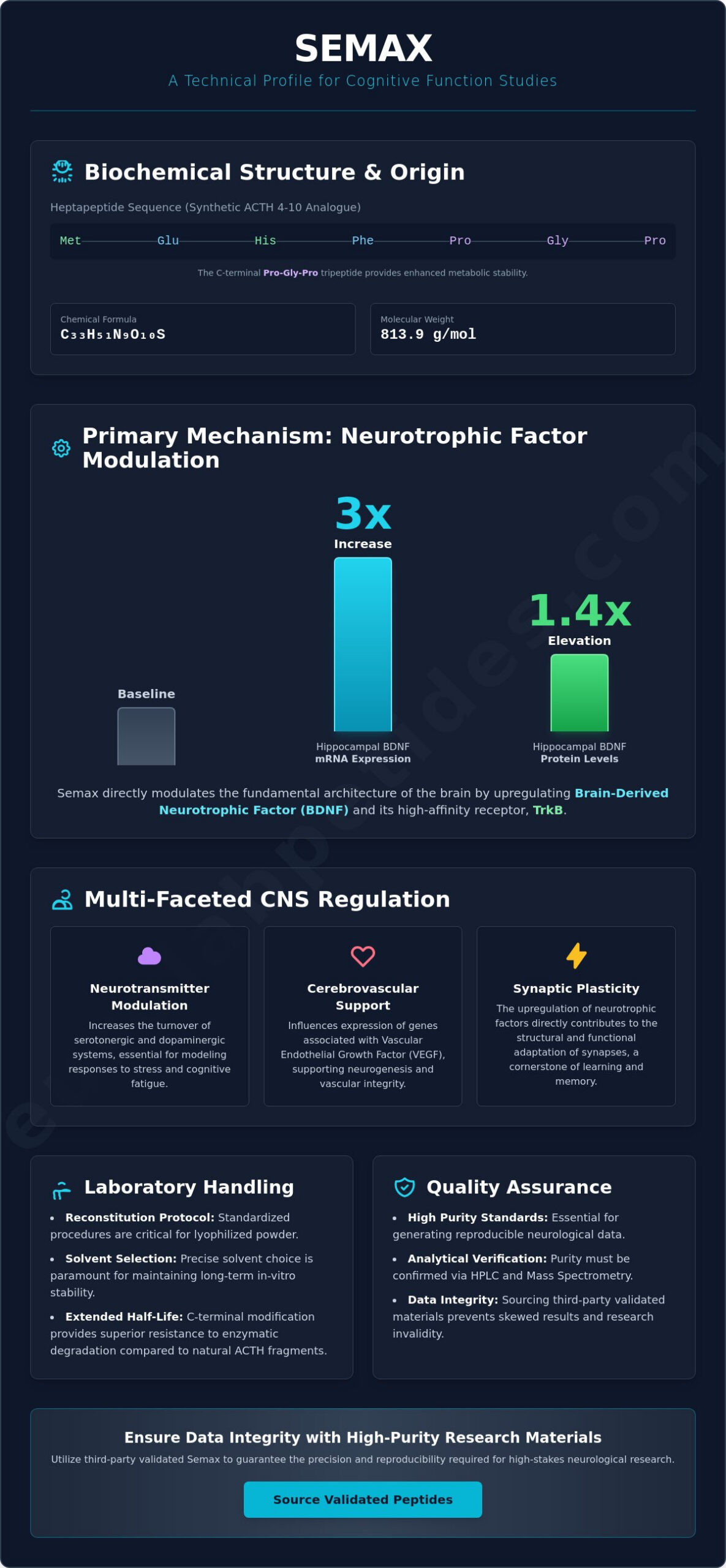
Semax is defined as a synthetic heptapeptide analogue of the adrenocorticotropic hormone (ACTH) fragment 4-10. This specific sequence, Met-Glu-His-Phe-Pro-Gly-Pro, was engineered to isolate the neurotropic properties of the parent hormone while eliminating its systemic endocrine activity. Originally developed during the 1980s at the Institute of Molecular Genetics of the Russian Academy of Sciences, the compound was designed specifically for the study of neuroprotection and cognitive preservation. In this Semax Overview, the substance is identified as a critical tool for investigating biological responses to ischemia and hypoxia. The inclusion of the Pro-Gly-Pro tripeptide at the C-terminus distinguishes this molecule from its natural precursors, providing a necessary level of metabolic stability for semax for cognitive function studies.
Molecular Evolution from ACTH 4-10
The transition from the native ACTH 4-10 fragment to the synthetic heptapeptide involved the strategic removal of the C-terminal amino acids responsible for melanocortin receptor activation in the adrenal cortex. This modification ensures that the peptide exerts its influence on the central nervous system without inducing hormonal side effects. The resulting chemical formula, C33H51N9O10S, corresponds to a molecular weight of 813.9 g/mol. This precise molecular identity allows for analytical verification through high-performance liquid chromatography (HPLC) and mass spectrometry. Researchers utilize these metrics to confirm the purity of materials used in semax for cognitive function studies, ensuring that the observed neurotropic effects aren’t confounded by peptide degradation or synthesis artifacts.
Stability and Half-Life in Laboratory Environments
Natural peptide fragments are frequently characterized by rapid enzymatic degradation, often possessing half-lives measured in minutes within biological tissues. The addition of the Pro-Gly-Pro sequence significantly alters the rate of proteolysis. This tripeptide tail acts as a protective barrier against various peptidases, extending the experimental window for in-vitro and in-vivo modeling. In laboratory settings, the stability of the synthetic analogue is superior to the natural ACTH 4-10 fragment. Factors such as solvent pH, temperature, and the presence of specific proteases in the experimental medium will influence the degradation rate. The C-terminal sequence’s resistance to enzymatic cleavage allows for more sustained interactions with neurotrophic pathways, which is a primary requirement for reliable longitudinal data in neurological research.
Mechanisms of Action: Semax for Cognitive Function Studies
The primary pharmacological value of semax for cognitive function studies lies in its ability to modulate endogenous neurotrophic factors. Unlike traditional stimulants that rely on acute neurotransmitter release, this peptide influences the fundamental architecture of the brain by upregulating Brain-Derived Neurotrophic Factor (BDNF) and its high-affinity receptor, Tropomyosin receptor kinase B (TrkB). Empirical data indicates that a single administration can result in a 3-fold increase in BDNF mRNA expression within the hippocampus. This transcriptional shift is accompanied by a 1.4-fold elevation in hippocampal BDNF protein levels. These metrics are critical for researchers establishing baseline efficacy in neurological models.
Beyond neurotrophin modulation, the molecule regulates the activity of the serotonergic and dopaminergic systems. It functions by increasing the turnover of these neurotransmitters, which is essential for modeling responses to stress and cognitive fatigue. Additionally, research has identified shifts in the expression of genes associated with vascular endothelial growth factor (VEGF). This suggests a broader role in maintaining cerebrovascular integrity and supporting neurogenesis. According to a Semax Research Review, these multi-faceted interactions contribute to the compound’s profile as a complex regulator of the central nervous system rather than a simple agonist.
Neurotrophic Factor Modulation and Synaptic Plasticity
The quantitative impact on BDNF concentrations is a non-negotiable metric for assessing the efficacy of semax for cognitive function studies. When BDNF binds to the TrkB receptor, it triggers intracellular signaling cascades, including the MAPK and PI3K pathways, which are essential for neuronal survival and differentiation. These pathways facilitate the repair of damaged axons and the formation of new synaptic connections. Semax facilitates long-term potentiation (LTP) by strengthening synaptic transmission between neurons, which serves as the cellular basis for learning and memory consolidation.
Gene Expression and Neuroprotection Pathways
In cellular models of neuro-inflammation, the peptide demonstrates a capacity to mitigate oxidative stress through the modulation of inflammatory cytokines. Research indicates a significant influence on the expression of Interleukin-10 (IL-10) and Tumor Necrosis Factor-alpha (TNF-alpha), shifting the environment toward a neuroprotective state. Investigators seeking high-purity materials to validate these genomic shifts often utilize a standardized cognitive research stack to ensure experimental integrity. This regulation of mRNA expression establishes the heptapeptide as a robust tool for investigating neuro-restorative mechanisms.
Comparative Analysis: Semax vs. Other Cognitive Research Peptides
Semax is distinguished from other neurological research agents by its specific ACTH 4-10 derivation and melanocortin receptor interaction. While compounds like Selank share a historical origin, their biochemical targets differ significantly. Selank is a synthetic analogue of the tetrapeptide tuftsin, primarily investigated for its anxiolytic and immunomodulatory properties rather than direct BDNF upregulation. In contrast, investigators utilizing semax for cognitive function studies prioritize its capacity to analyze neuroplasticity and gene expression related to the TrkB pathway. This distinction is critical for establishing specialized research models that require targeted neurotropic activity without the confounding variables of general affective modulation.
Noopept offers another point of comparison within analytical science. As a proline-containing dipeptide, Noopept exhibits high receptor affinity but lacks the complex heptapeptide sequence that grants Semax its unique metabolic stability. Similarly, Cerebrolysin represents a porcine-derived proteolytic fraction containing a heterogeneous mixture of neurotrophic factors. While effective in broad neuro-regeneration models, the biological origin of Cerebrolysin introduces potential immunological variables that are absent in the synthetic precision of Semax. According to the Alzheimer’s Drug Discovery Foundation Semax Report, the synthetic nature of this heptapeptide allows for a more controlled analysis of specific molecular interactions in stroke and cognitive dysfunction models.
Structural and Functional Distinctions
The selection between these peptides depends on the required enzymatic resistance and metabolic half-life. Semax’s C-terminal Pro-Gly-Pro sequence provides superior stability compared to non-stabilized fragments, allowing for a longer experimental window in in-vitro settings. While Selank utilizes a tuftsin-based structure to influence GABAergic systems, the specificity of semax for cognitive function studies is defined by its interaction with the MC4 and MC5 receptors to promote neuroprotection. This targeted mechanism ensures that the resulting data reflects direct cognitive preservation rather than systemic immune responses.
Synergistic Potential in Research Stacks
Experimental models often evaluate the combined effects of Semax with other nootropics to model multi-pathway cognitive support. Within a Cognitive Research Stack, the objective is to maximize neurotrophic signaling without reaching receptor saturation. Standardized multi-peptide protocols are required to avoid competitive binding at the TrkB receptor or excessive enzymatic load. By layering synthetic analogues with distinct mechanisms, investigators can model complex neurological recovery processes in a standardized environment that respects the rigorous demands of the specialized research community.
Technical Guidance: Reconstitution and Laboratory Handling
Precision in the preparation of lyophilized peptides is a fundamental requirement for maintaining the validity of semax for cognitive function studies. The heptapeptide Met-Glu-His-Phe-Pro-Gly-Pro is susceptible to degradation if standardized laboratory protocols aren’t strictly followed. Investigators must perform all handling procedures within a sterile environment, such as a laminar flow hood, to prevent microbial contamination that could compromise the peptide’s structural integrity. The selection of a suitable solvent is the first critical step in the reconstitution process. Bacteriostatic water, which contains 0.9% benzyl alcohol, is frequently utilized for multi-use vials to inhibit bacterial proliferation. However, for in-vitro modeling where benzyl alcohol might induce cytotoxicity or interfere with cellular viability, 0.9% sterile saline is the preferred diluent. Researchers can source high-purity peptides for cognitive function research to ensure that starting materials meet the rigorous demands of analytical science.
Step-by-Step Reconstitution Protocol
The calculation of diluent volume must be precise to achieve the target molarity required for specific experimental assays. For a standard 10mg vial, the addition of 2mL of sterile diluent results in a concentration of 5mg/mL. Diluent should be introduced by allowing the liquid to flow slowly down the interior wall of the glass vial. This technique prevents the high-pressure stream from impacting the lyophilized cake directly. Do not shake. Mechanical stress can shear the delicate peptide bonds, leading to denaturation. Instead, the vial should be swirled gently until the solution is clear and free of visible particulates. The optimal stability of Semax in aqueous solution is typically maintained within a pH range of 4.0 to 6.0.
Long-term Stability and Storage Requirements
Temperature control is the most significant factor influencing the rate of proteolysis in stored peptides. Lyophilized Semax is stable at room temperature for approximately three weeks, but it must be transferred to -20°C for long-term preservation. Once reconstituted, the solution is highly sensitive to thermal degradation. It must be stored in a refrigerator at 2°C to 8°C and used within 14 days to ensure maximum potency. Repeated freeze-thaw cycles are detrimental as they promote peptide aggregation and structural fragmentation. To mitigate this risk, the reconstituted solution should be divided into single-use aliquots before initial freezing. Additionally, the methionine residue in the sequence is prone to oxidation. Vials should be kept in total darkness or wrapped in foil to prevent photodegradation during the experimental window. Adhering to these storage benchmarks ensures that analytical results remain consistent across all phases of the study.
Quality Assurance: Sourcing Semax for Reliable Research Data
The integrity of neurological models depends entirely on the chemical precision of the synthetic heptapeptide. Inconsistent purity levels introduce exogenous variables that obscure the primary mechanism of action, leading to irreproducible data sets. When utilizing semax for cognitive function studies, a purity threshold of ≥99% is the established benchmark for analytical reproducibility. Materials that fail to meet these stringent specifications may contain residual trifluoroacetic acid (TFA) or synthesis byproducts that interfere with cellular signaling pathways. EuroLab Peptides maintains a multi-level quality control framework where every batch is subjected to rigorous internal and external validation to ensure absolute chemical identity.
Identifying red flags in the procurement of research chemicals is essential for maintaining laboratory standards. Many suppliers rely on marketing hyperbole rather than verifiable metrics. A lack of transparent, batch-specific data is a primary indicator of sub-standard manufacturing. Secure sourcing of research peptides requires a commitment to regional regulatory compliance and localized logistics. This ensures that the cold chain remains intact from the point of synthesis to the final delivery, preventing the thermal degradation discussed in previous technical sections.
Analytical Verification Methods
High-Performance Liquid Chromatography (HPLC) is the non-negotiable standard for purity assessment in peptide synthesis. This process separates the target heptapeptide from any related substances, providing a quantitative peak analysis. Mass Spectrometry (MS) is simultaneously utilized to confirm the sequence identity by measuring the precise molecular weight of 813.9 g/mol. A Certificate of Analysis (CoA) for research-grade materials should always include these two data points. Investigators must verify that the CoA corresponds to the specific lot number received to ensure the validity of semax for cognitive function studies. Analytical results are only as reliable as the verification methods used to generate them.
Ethical and Professional Procurement
Peptides provided for laboratory research are strictly intended for in-vitro development and animal modeling. They aren’t licensed for human consumption or medicinal use. Professional procurement involves a meticulous chain of custody where regional manufacturing standards are prioritized to minimize transit times. European-based synthesis reduces the risk of long-haul shipping delays that often compromise peptide stability. By utilizing high-stakes precision in the supply chain, investigators protect their research investment from the variables of global logistics. Researchers can secure high-purity Semax for your next cognitive function study at EuroLab Peptides to ensure the highest degree of experimental accuracy.
Advancing Precision in Neurological Modeling
The successful execution of neurological research requires a rigorous adherence to biochemical standards. Investigators must prioritize the structural stability provided by the Pro-Gly-Pro sequence and the quantitative upregulation of neurotrophic factors to ensure data reproducibility. Adhering to standardized reconstitution protocols and precise pH maintenance is essential for preserving the integrity of the synthetic heptapeptide during long-term experimental windows. These technical benchmarks establish a foundation for sophisticated analysis of neurogenesis and synaptic plasticity.
Reliable data generation depends on the chemical identity and purity of the starting materials. Utilizing semax for cognitive function studies necessitates the use of peptides that are third-party HPLC and MS verified to confirm sequence accuracy. EuroLab Peptides provides research-grade materials that meet these exacting requirements, supported by secure European shipping and strict cold-chain compliance. These products are intended strictly for in-vitro research and laboratory development. Investigators are encouraged to Order Research-Grade Semax for Laboratory Analysis to maintain the highest levels of analytical precision. This commitment to quality assurance facilitates the discovery of complex molecular interactions in modern neuroscience.
Frequently Asked Questions
What is the primary mechanism of Semax in cognitive research models?
Semax functions as a synthetic analog of the ACTH 4-10 fragment, primarily modulating melanocortin receptors MC4 and MC5. This interaction triggers the expression of neurotrophic factors and regulates the turnover of serotonergic and dopaminergic systems. It’s specifically utilized in semax for cognitive function studies to analyze molecular responses to ischemia and hypoxia. The molecule provides a non-hormonal pathway for investigating central nervous system preservation and neuroprotective signaling.
How should Semax be reconstituted for laboratory use?
Reconstitution is performed by introducing a sterile diluent, such as 0.9% saline, into the lyophilized vial using a slow, wall-directed flow. Mechanical stress must be avoided; the vial should be swirled gently rather than shaken to prevent peptide denaturation. Maintaining a pH between 4.0 and 6.0 ensures optimal stability in solution. This protocol is essential for generating reliable data in neurological research environments where structural integrity is a priority.
What is the difference between Semax and Selank in a research context?
Semax is derived from an adrenocorticotropic hormone fragment and targets neurotrophic pathways, while Selank is a synthetic analog of the tetrapeptide tuftsin. Selank is primarily studied for its anxiolytic and immunomodulatory effects rather than direct BDNF upregulation. While both are stabilized with a Pro-Gly-Pro sequence, they interact with distinct receptor sets. Researchers select Semax when the experimental focus is on neurogenesis and synaptic plasticity rather than affective regulation.
Is Semax stable at room temperature during laboratory experiments?
Lyophilized Semax demonstrates stability at room temperature for approximately 21 days without significant degradation. However, reconstituted solutions are highly thermolabile and lose potency rapidly if not refrigerated. For laboratory experiments, the solution must be maintained at 2°C to 8°C. Protecting the vial from light exposure is also necessary to prevent the oxidation of the methionine residue within the heptapeptide sequence during the experimental window.
What purity level is required for reproducible Semax research?
A purity level of ≥99% is the required analytical benchmark for reproducible semax for cognitive function studies. This purity is verified using High-Performance Liquid Chromatography (HPLC) and Mass Spectrometry (MS) to ensure the absence of synthesis artifacts or residual solvents. Using sub-standard materials introduces uncontrolled variables that compromise genomic and proteomic data. High-stakes precision in sourcing is a non-negotiable standard for professional investigators seeking to publish verifiable results.
How does Semax influence BDNF expression in neurological studies?
Semax induces a documented 3-fold increase in BDNF mRNA expression and a 1.4-fold elevation in BDNF protein levels within hippocampal tissue. This upregulation is central to its role in promoting neuroplasticity and long-term potentiation. By binding to the TrkB receptor, it activates intracellular signaling cascades necessary for neuronal repair. These quantitative shifts provide a verifiable metric for measuring the peptide’s neurotropic efficacy in various cellular and animal models.
What are the storage requirements for lyophilized Semax peptides?
Lyophilized peptides should be stored at -20°C for long-term preservation to maintain structural integrity. Once reconstituted, the solution should be divided into single-use aliquots and kept at 2°C to 8°C for a maximum of 14 days. Avoiding repeated freeze-thaw cycles is critical to prevent peptide aggregation and structural fragmentation. These storage protocols are designed to minimize proteolysis and ensure the consistency of analytical results across longitudinal laboratory studies.
Can Semax be used for in-vitro cellular research?
Semax is suitable for in-vitro cellular research, provided the reconstitution medium is compatible with the specific cell line. Sterile 0.9% saline is preferred over bacteriostatic water to avoid the potential cytotoxic effects of benzyl alcohol on delicate neuronal cultures. Researchers must ensure that the peptide is handled in a sterile environment to prevent microbial contamination. This application allows for the precise measurement of gene expression changes in controlled, isolated environments.
