

The viability of mitochondrial-derived transcript research hinges entirely on the preservation of a 16-amino acid sequence that’s notoriously sensitive to thermal and chemical degradation. For investigators engaged in MOTS-c peptide research, the primary challenge isn’t merely observing metabolic shifts but ensuring that the 2174.6 g/mol molecular structure remains intact during complex assay procedures. You likely recognize that inconsistent peptide purity and improper handling often lead to conflicting data regarding AMPK activation thresholds, which complicates the validation of longevity models.
This article provides a rigorous clinical review of MOTS-c’s role in metabolic homeostasis and its status in 2026 Phase II trials. We’ll outline precise laboratory handling protocols and the analytical standards necessary to prevent sample degradation. By focusing on verified purity metrics of at least 99 percent, this guide ensures your laboratory development is built on a foundation of objective, reproducible data. We’ll examine the technical benchmarks that separate high-stakes precision from experimental error, providing the clarity required for serious professional inquiry into mitochondrial signaling.
Key Takeaways
- Identify the unique genetic origin of MOTS-c within the mitochondrial 12S rRNA and its function as a primary signaling vector for metabolic homeostasis.
- Analyze the specific activation of the AMPK pathway and the resulting accumulation of AICAR that characterizes MOTS-c’s influence on the Folate-Methionine cycle.
- Evaluate the “Exercise Mimetic” hypothesis by examining current longevity models that correlate endogenous peptide levels with extended lifespan in centenarian cohorts.
- Implement rigorous MOTS-c peptide research protocols by maintaining lyophilized samples at temperatures between -20°C and -80°C to preserve structural integrity.
- Ensure experimental reproducibility by utilizing research materials validated through multi-level quality control protocols to eliminate the risk of assay interference.
Introduction to Mitochondrial-Derived Peptides (MDPs) and MOTS-c
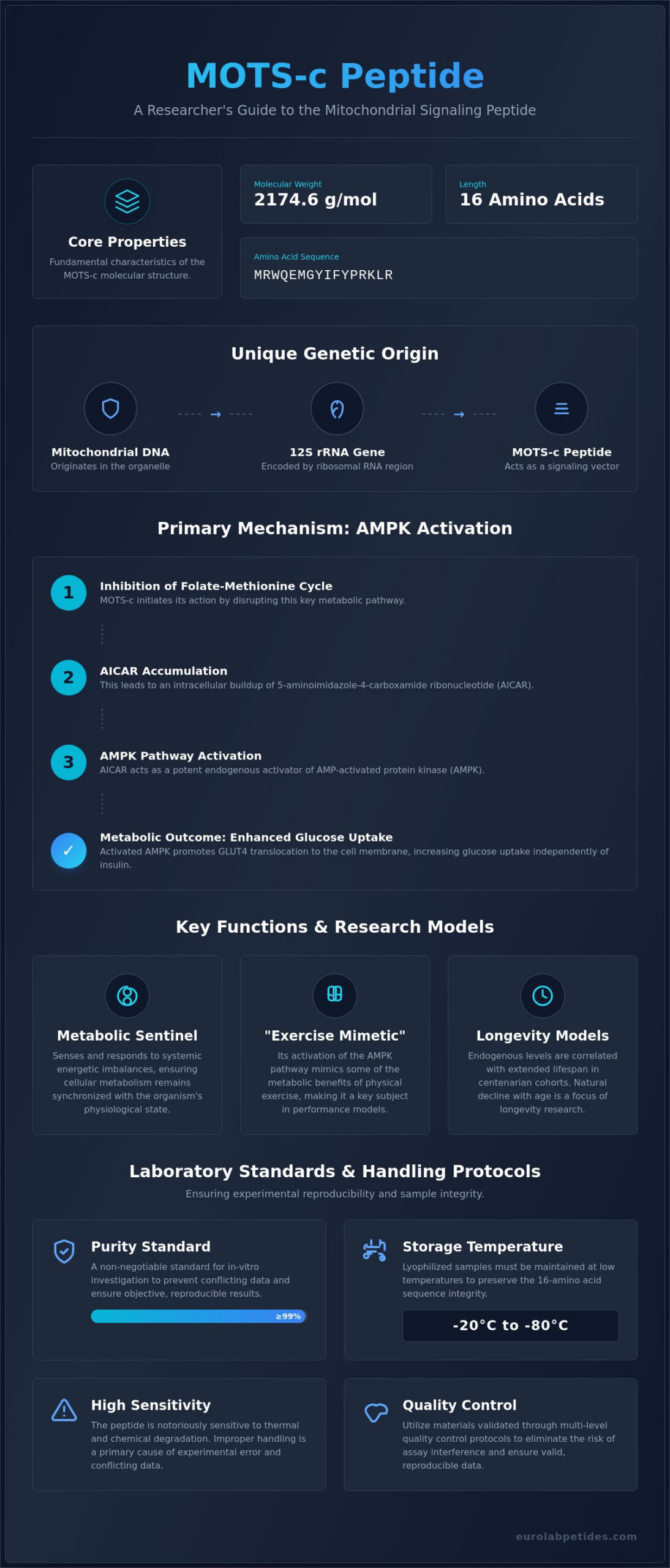
Mitochondrial-derived peptides (MDPs) represent a specialized class of bioactive factors encoded directly within the mitochondrial genome. While the organelle is traditionally recognized for ATP production, MOTS-c peptide research has revealed its critical role in retrograde signaling. MOTS-c (mitochondrial open reading frame of the 12S rRNA-c) is a unique 16-amino acid peptide that originates from the mitochondrial 12S rRNA. It functions as a primary communication vector between the mitochondria and the nucleus, coordinating cellular responses to metabolic demands. Alongside Humanin, MOTS-c is classified as an MDP, yet its specific focus on systemic metabolic homeostasis distinguishes its research utility in longevity models.
The genetic architecture of MOTS-c is distinct from nuclear-encoded peptides. It is translated in the cytosol but derives its sequence from the mitochondrial DNA, specifically the 12S ribosomal RNA region. This dual-genome interaction allows the mitochondria to actively participate in cellular regulation rather than remaining passive energy producers. The peptide acts as a signaling molecule that informs the nucleus of the mitochondrial energetic state, triggering adaptive transcriptional changes when cellular stress is detected.
The Discovery of MOTS-c in Metabolic Regulation
The identification of MOTS-c occurred in 2015, marking a shift in how researchers view the coding potential of mitochondrial DNA. The specific 16-amino acid sequence, defined as MRWQEMGYIFYPRKLR, was found to be highly conserved across species, suggesting a fundamental evolutionary role. Subsequent expansions in MOTS-c peptide research during the early 2020s demonstrated that this peptide translocates to the nucleus during periods of metabolic stress. This movement is a highly regulated response to nutrient availability and exercise-induced signals. Once localized in the nucleus, the peptide interacts with specific response elements to modulate gene expression, particularly those involved in glucose metabolism and heat shock responses. These discovery phases established that the mitochondrial genome possesses an independent and essential regulatory arm.
MOTS-c as a ‘Metabolic Sentinel’
Researchers frequently categorize MOTS-c as a ‘metabolic sentinel’ due to its ability to sense and respond to systemic energetic imbalances. It maintains homeostasis by regulating the folate-methionine cycle and promoting fatty acid oxidation. It’s essential to distinguish between endogenous MOTS-c, which naturally declines with age, and the exogenous analogs used in laboratory settings. These analogs belong to a broader class of peptides utilized as precision tools to investigate mitochondrial dysfunction. The structural integrity of these research materials is paramount. Even minor deviations in the amino acid sequence can negate the observed signaling effects, making certified purity a non-negotiable standard for in-vitro investigation. By acting as a sentinel, the peptide ensures that cellular metabolism remains synchronized with the overall physiological state of the organism.
Mechanistic Pathways: AMPK Activation and Insulin Sensitivity
The primary mechanistic driver of MOTS-c activity is the activation of the AMP-activated protein kinase (AMPK) pathway. This metabolic switch is initiated through the inhibition of the folate-methionine cycle, which subsequently leads to the intracellular accumulation of 5-aminoimidazole-4-carboxamide ribonucleotide (AICAR). AICAR serves as a potent endogenous activator of AMPK, effectively mimicking a state of cellular energy deprivation. In skeletal muscle models, this activation promotes the translocation of glucose transporter type 4 (GLUT4) to the plasma membrane. The resulting increase in glucose uptake occurs independently of traditional insulin signaling pathways, highlighting the peptide’s utility in investigating non-canonical metabolic regulation. Rigorous MOTS-c peptide research requires a precise understanding of these downstream effectors to avoid confounding variables in metabolic assays.
Lipid metabolism is significantly modulated by MOTS-c during in-vitro investigations through the enhancement of fatty acid oxidation. This process is characterized by the upregulation of carnitine palmitoyltransferase 1 (CPT1), which facilitates the transport of long-chain fatty acids into the mitochondria for beta-oxidation. The therapeutic exploitation of MOTS-c in research settings focuses on these pathways to address states of metabolic inflexibility. By shifting the cellular preference toward lipid utilization, the peptide provides a robust model for studying the reversal of ectopic lipid accumulation. These effects are verified through the measurement of oxygen consumption rates (OCR) and extracellular acidification rates (ECAR) in live-cell metabolic assays.
Mitochondrial-Nuclear Communication
Under conditions of metabolic stress, MOTS-c translocates from the mitochondria to the nucleus. This translocation is a highly coordinated event that allows the peptide to interact with the Antioxidant Response Element (ARE) and the NRF2 pathways. MOTS-c functions as a nuclear transcription factor that directly regulates the expression of over 20 distinct metabolic genes involved in cellular proteostasis and stress resistance. This retrograde signaling mechanism ensures that nuclear gene expression is synchronized with mitochondrial functional capacity, allowing the cell to adapt to fluctuating energetic demands. The structural integrity of the peptide must be preserved to ensure this nuclear entry is not compromised by proteolytic degradation.
Insulin Signaling and Glucose Homeostasis
Empirical data derived from high-fat diet (HFD) animal models indicate that MOTS-c administration suppresses the systemic inflammatory cytokines typically associated with insulin resistance. Levels of Tumor Necrosis Factor-alpha (TNF-α) and Interleukin-6 (IL-6) are reduced, thereby preserving insulin receptor sensitivity in peripheral tissues. These findings are foundational for current weight management research, where the focus remains on restoring metabolic homeostasis in models of diet-induced obesity. To ensure the accuracy of these longitudinal observations, EuroLab Peptides is frequently utilized by researchers to secure the validated materials required for reproducible analytical outcomes. By mitigating chronic low-grade inflammation, the peptide facilitates a more accurate assessment of glucose disposal rates in complex biological systems.
While research continues to explore these molecular mechanisms, the practical application of metabolic support is increasingly important for individuals facing hormonal transitions. For those seeking to maintain balance through natural means, you can discover Evabiotic and their specialized menopause relief multivitamins.
MOTS-c in Longevity and Physical Performance Models
The impact of MOTS-c on sarcopenia and age-related muscle attrition is a critical area of investigation in laboratory models. Muscle loss in aging subjects is often driven by a combination of mitochondrial dysfunction and decreased protein synthesis. According to a recent MOTS-c therapeutic exploitation review, the peptide mitigates these effects by promoting cellular proteostasis and reducing the accumulation of reactive oxygen species (ROS). By stabilizing the mitochondrial network, the peptide helps maintain the structural integrity of skeletal muscle fibers. This preservation is essential for ensuring that metabolic flexibility remains intact as the organism ages.
Aging and Mitochondrial Decline
Mitochondrial decline is a fundamental hallmark of cellular senescence, characterized by a loss of membrane potential and decreased ATP production. MOTS-c serves as a protective factor against oxidative stress, actively maintaining mitochondrial health during the aging process. Current longevity research trends for 2026 emphasize the use of mitochondrial-derived peptides to stabilize these networks and prevent energetic collapse. This stabilization is vital for mitigating the pro-inflammatory signaling typically associated with senescent cells, thereby preserving tissue function across multiple biological systems.
Physical Performance and Endurance Studies
Endurance models demonstrate that MOTS-c enhances metabolic flexibility by allowing for a more efficient transition between carbohydrate and lipid substrate utilization. In aged subjects, the peptide assists in maintaining performance metrics that typically degrade due to mitochondrial attrition. Researchers are also investigating potential synergies with agents like ipamorelin in muscle tissue research. Combining these tools may provide a multi-pathway approach to addressing atrophy, targeting both the mitochondrial energetic state and the somatotropic signaling pathways required for tissue repair. This dual-action model is increasingly utilized to investigate complex recovery phenotypes in in-vitro settings.
Laboratory Standards: Handling, Stability, and Lyophilization
Maintaining structural integrity is the most critical variable in MOTS-c peptide research. The 16-amino acid sequence is susceptible to rapid degradation if exposed to suboptimal environmental conditions. High-purity lyophilized powder is utilized as the industry standard because it significantly reduces the kinetic energy of molecules, thereby preventing premature peptide bond hydrolysis. To ensure experimental reproducibility, researchers must adhere to strict storage protocols where sealed vials are maintained at temperatures between -20°C and -80°C. Exposure to ambient temperatures for extended periods leads to a measurable decrease in biological activity, which can skew the results of metabolic assays.
Reconstitution requires precise methodology to preserve the peptide’s secondary structure. While sterile bacteriostatic water is frequently used for short-term studies, some protocols suggest dilute acetic acid solutions to improve solubility and stability for specific in-vitro applications. Once the peptide is in solution, it becomes significantly more labile. A single-use aliquoting strategy is mandatory to avoid the structural damage caused by repeated freeze-thaw cycles. These cycles induce mechanical stress on the peptide chain, often resulting in fragmentation or aggregation that renders the sample useless for rigorous inquiry.
Lyophilization and Chemical Stability
Lyophilization removes moisture through sublimation, which is essential for long-term chemical stability in the laboratory. Moisture and light act as primary catalysts for peptide degradation, leading to oxidation or deamidation of the amino acid residues. Sealed vials stored at -80°C typically maintain stability for up to 24 months. However, once the seal is breached or the peptide is reconstituted, the shelf-life drops to approximately 7 to 14 days when refrigerated at 2°C to 8°C. Researchers must document the exact date of reconstitution to ensure that all experimental data remains within these validated stability windows.
Analytical Verification: HPLC and MS
Analytical verification is conducted using High-Performance Liquid Chromatography (HPLC) to define purity levels, with a target benchmark of 98 percent or higher. Mass Spectrometry (MS) is then employed to confirm the exact molecular weight of 2174.6 g/mol, ensuring the sequence accuracy of the MRWQEMGYIFYPRKLR chain. Independent third-party testing provides the objective validation required to eliminate the risk of assay interference caused by manufacturing impurities. For investigators requiring materials that meet these rigorous analytical standards, EuroLab Peptides provides certified, research-grade MOTS-c with comprehensive documentation to support high-stakes precision in metabolic studies.
Sourcing High-Purity MOTS-c for In-Vitro Investigation
The transition from theoretical mechanistic models to reproducible experimental data requires a starting material that adheres to the strictest analytical benchmarks. In the specialized field of mitochondrial-nuclear signaling, the validity of MOTS-c peptide research is entirely dependent on the structural integrity of the synthesized sequence. Evaluating a supplier involves more than a cursory review of technical specifications; it requires an assessment of their multi-level quality control protocols. EuroLab Peptides serves as a reliable partner for European investigators, providing research-grade materials that undergo rigorous validation to eliminate the risk of assay interference caused by residual trifluoroacetic acid (TFA) or unrelated peptide fragments.
Ethical considerations are paramount in the procurement process. These materials are intended strictly for in-vitro laboratory development and must not be utilized for human consumption or clinical applications outside of authorized trial frameworks. Navigating the logistics of the European market in 2026 requires a supplier with localized distribution capabilities to ensure that shipping timelines don’t compromise the temperature-sensitive nature of the peptide. By maintaining a controlled cold chain from synthesis to delivery, researchers receive samples that haven’t been subjected to the thermal stress that often leads to sequence degradation during international transit.
EuroLab’s Quality Assurance Protocol
The EuroLab protocol is defined by a commitment to radical transparency and empirical validation. Each batch undergoes a dual-verification process that combines in-house analytical testing with independent third-party laboratory audits. This ensures that the primary keyword benchmarks, such as a purity level of 99 percent or higher, are objectively verified before the material is released for research use. Certificates of Analysis (COAs) are readily accessible, providing the raw HPLC and Mass Spectrometry data required for internal laboratory documentation. This rigorous approach supports the broader mission to buy research peptides with confidence, ensuring that European scientists have access to the elite tools necessary for high-stakes metabolic inquiry.
Conclusion: The Future of MOTS-c Research
Future directions in MOTS-c peptide research will likely focus on the nuances of retrograde signaling and its potential to reverse mitochondrial dysfunction in senescent cell models. As the scientific community moves toward more complex multi-pathway analysis, the need for standardized peptide sources becomes a non-negotiable requirement for data integrity. Standardizing the 16-amino acid sequence across different laboratory settings is the only way to ensure that the “exercise mimetic” effects observed in one study can be replicated in another. To advance your current investigations with materials that meet these exacting standards, explore our MOTS-c research profile and analysis to secure the validated tools required for professional inquiry.
Advancing Mitochondrial Signaling Frontiers
The evolution of mitochondrial medicine depends on the rigorous application of standardized signaling vectors. This review has established that the efficacy of MOTS-c peptide research is predicated on maintaining the precise 16-amino acid sequence defined in 12S rRNA-c transcript studies. By activating the AMPK pathway and modulating the folate-methionine cycle, MOTS-c serves as a critical model for investigating metabolic flexibility and cellular senescence. Data integrity is ensured only when laboratory handling protocols, specifically regarding thermal stability and lyophilization, are strictly observed.
Absolute security in experimental outcomes is provided by materials that undergo independent third-party laboratory verification. A 98%+ HPLC purity standard is maintained to eliminate assay interference in complex in-vitro models. European-based quality control ensures that shipping timelines don’t compromise the preservation of structural integrity during transit. Researchers are encouraged to prioritize validated analytical benchmarks to advance the understanding of mitochondrial-derived signaling. Secure High-Purity MOTS-c for Your 2026 Research Projects and ensure the precision of your metabolic assays.
Frequently Asked Questions
What is the primary function of MOTS-c in metabolic research?
The primary function of MOTS-c in metabolic research is the activation of the AMP-activated protein kinase (AMPK) pathway to regulate cellular energy homeostasis. This mechanism facilitates glucose uptake and fatty acid oxidation by influencing the folate-methionine cycle and inducing intracellular AICAR accumulation. Researchers utilize this peptide to investigate mitochondrial-nuclear communication and its impact on systemic metabolic flexibility in various in-vitro models.
How should MOTS-c be stored in a laboratory setting to prevent degradation?
MOTS-c must be stored at temperatures between -20°C and -80°C to maintain structural integrity and prevent proteolytic degradation. Lyophilized powder is most stable when kept in a moisture-free environment protected from light exposure. Once reconstituted, samples are significantly more labile and should be utilized within 7 to 14 days when refrigerated at 2°C to 8°C to ensure data accuracy.
Is MOTS-c considered an exercise mimetic in in-vitro studies?
MOTS-c is classified as an exercise mimetic in in-vitro studies because it replicates the metabolic adaptations typically induced by physical exertion. It promotes mitochondrial biogenesis and enhances lipid oxidation through non-canonical signaling pathways. This makes it a critical tool for investigating performance models and age-related muscle attrition in controlled laboratory settings without the requirement for mechanical stimulation.
What is the recommended purity level for MOTS-c in cellular assays?
The recommended purity level for MOTS-c in cellular assays is a minimum of 98 percent, though 99 percent is preferred for high-stakes MOTS-c peptide research. High purity is essential to eliminate the presence of manufacturing impurities that could interfere with sensitive metabolic measurements. Purity must be verified through High-Performance Liquid Chromatography (HPLC) to ensure experimental reproducibility and objective analytical outcomes.
Can MOTS-c be used for human consumption or clinical trials?
MOTS-c is strictly for in-vitro research and laboratory development and is not approved for human consumption or unauthorized clinical use. While Phase I and Phase II trials were underway in early 2026 to assess safety and insulin sensitivity, the peptide remains an investigational agent. It’s not a pharmaceutical product and should be handled exclusively within professional research frameworks according to regional regulatory standards.
What is the difference between MOTS-c and other mitochondrial-derived peptides like Humanin?
MOTS-c differs from Humanin primarily in its genetic origin and functional focus; MOTS-c is encoded within the 12S rRNA region, while Humanin originates from the 16S rRNA. While both are mitochondrial-derived peptides, MOTS-c specifically targets metabolic homeostasis and AMPK activation. Humanin is more frequently studied for its cytoprotective and neuroprotective properties in aging models rather than systemic metabolic regulation.
How do I reconstitute MOTS-c for laboratory use?
Reconstitution is achieved by adding sterile bacteriostatic water or a dilute acetic acid solution to the lyophilized powder. The choice of solvent depends on the specific requirements of the in-vitro assay and the desired solubility profile for the 16-amino acid sequence. It’s imperative to use a single-use aliquoting strategy immediately after reconstitution to avoid the mechanical stress and fragmentation associated with repeated freeze-thaw cycles.
Why is third-party testing critical when sourcing MOTS-c?
Independent third-party testing is critical to verify the identity and purity of the peptide through Mass Spectrometry (MS) and HPLC. This external validation provides an objective metric of quality that prevents assay interference from residual reagents or sequence errors. For MOTS-c peptide research, relying on empirical data from independent audits is the only way to ensure absolute security and structural accuracy in experimental results.
