
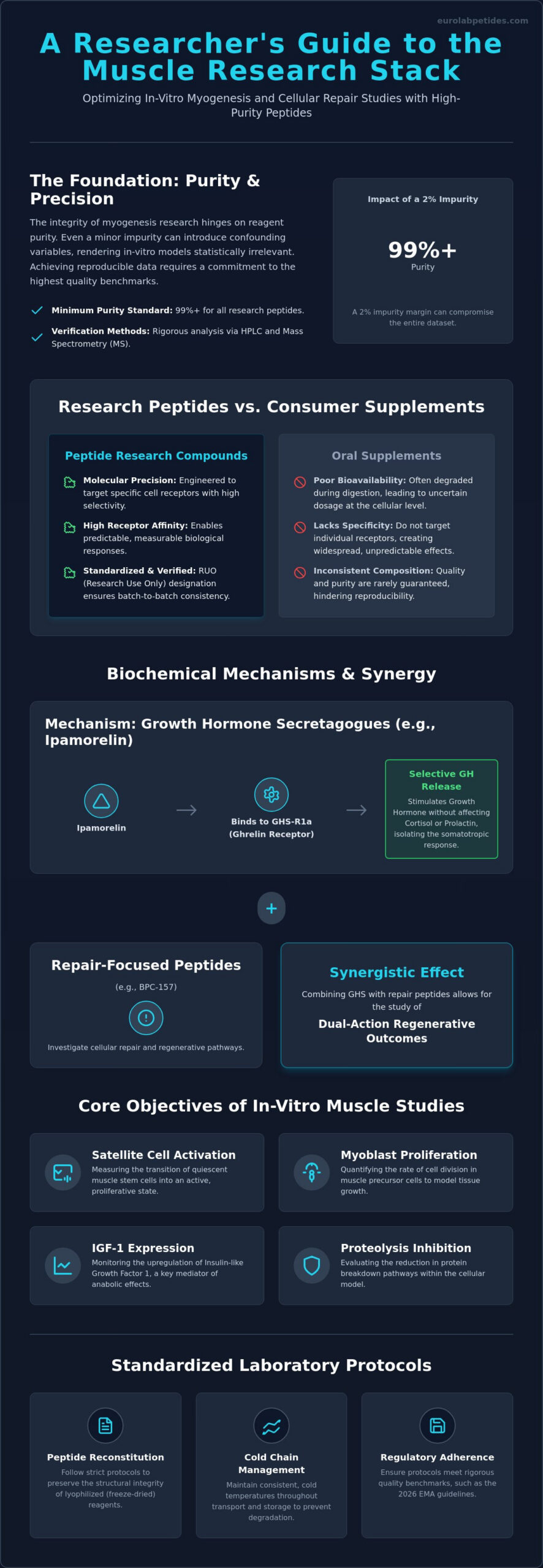
The integrity of a myogenesis study isn’t determined by the hypothesis, but by the analytical purity of the reagents utilized. In the context of complex cellular pathways, a 2% margin of impurity can introduce confounding variables that render in-vitro models statistically irrelevant. Most laboratory professionals understand that inconsistent batch quality in the research chemical market remains a significant barrier to reproducible data. Identifying a reliable Muscle Research Stack is therefore a critical prerequisite for establishing a verifiable baseline in hypertrophy and regeneration experiments.
This review provides a comprehensive scientific overview of the biochemical mechanisms and synergistic pathways required to optimize research outcomes. We’ll examine the specific interactions between GH secretagogues and repair peptides, focusing on their collective influence on satellite cell activation and protein synthesis. By detailing the technical documentation and third-party verification protocols necessary for high-purity reagents, this analysis serves as a methodology-based resource for serious professional inquiry. We’ll also cover the latest regulatory frameworks, including the 2026 EMA guidelines, to ensure your laboratory protocols meet the most rigorous quality benchmarks.
Key Takeaways
- Define the Muscle Research Stack as a specialized tool for examining myogenesis and cellular tissue repair in controlled in-vitro environments.
- Analyze the biochemical mechanism of Ipamorelin, focusing on its selective binding to the ghrelin receptor to stimulate growth hormone pathways without elevating cortisol or prolactin.
- Examine the synergistic potential of combining growth hormone secretagogues with repair-focused peptides like BPC-157 to investigate dual-action regenerative outcomes.
- Apply standardized laboratory protocols for peptide reconstitution and cold chain management to preserve the structural integrity of lyophilized reagents throughout the study.
- Establish rigorous quality benchmarks, including 99%+ purity verified through HPLC and MS analysis, to ensure the absolute reproducibility of experimental data.
Defining the Muscle Research Stack in Laboratory Inquiry
The Muscle Research Stack is a specialized configuration of synthetic peptides utilized to investigate the biochemical pathways of myogenesis and cellular tissue repair. This assembly primarily incorporates Growth Hormone Secretagogues (GHSs) and specific regenerative agents. In a laboratory context, these compounds serve as critical reagents for observing how isolated muscle tissue responds to precise amino acid sequences. Researchers distinguish these materials from consumer-grade sports supplements by their analytical purity and their Research Use Only (RUO) designation. Experimental integrity depends on the use of standardized, third-party tested chemicals that allow for the isolation of specific metabolic variables.
The Shift from Supplements to Peptide Research
The transition from investigating traditional nutritional supplements to peptide-based research is driven by a requirement for molecular precision. While oral supplements often lack specific receptor affinity and suffer from poor bioavailability, peptides are engineered to target specific cell receptors with high selectivity. For instance, the GHS components within a Muscle Research Stack are chosen for their ability to bind to the GHS-R1a receptor, triggering a predictable somatotropic response. This level of specificity is essential for metabolic studies where confounding factors must be minimized. Adherence to RUO standards ensures that the chemical composition remains consistent across different batches, a metric that’s rarely guaranteed in the retail supplement market. Precision is the priority. These reagents undergo rigorous validation to ensure that the molecular weight and sequence match the intended experimental design.
Core Objectives of Muscle-Related Peptide Studies
The primary aim of utilizing these stacks in in-vitro models is to quantify the rate of satellite cell activation and subsequent myoblast proliferation. These processes are fundamental to understanding tissue regeneration after mechanical or chemical insult. Additionally, researchers utilize the Muscle Research Stack to analyze the inhibition of proteolysis and the enhancement of nitrogen retention within cellular environments. By observing the influence of these peptides on insulin-like growth factor 1 (IGF-1) expression, laboratory professionals can map the downstream effects of secretagogue activity on myofibrillar protein synthesis. These studies provide a technical foundation for understanding the complex signaling cascades that govern muscle mass maintenance and repair. The following objectives are central to these investigations:
- Satellite Cell Activation: Measuring the transition of quiescent cells into an active proliferative state.
- Myoblast Proliferation: Quantifying the rate of cell division in muscle precursor cells.
- IGF-1 Expression: Monitoring the upregulation of insulin-like growth factor 1 in response to secretagogue stimulation.
- Proteolysis Inhibition: Evaluating the reduction in protein breakdown pathways within the cellular model.
By isolating these variables, researchers can establish a clearer understanding of the anabolic and regenerative potential of specific peptide combinations. This methodology eliminates the noise associated with systemic biological processes, providing a focused view of cellular mechanics.
Biochemical Mechanisms: Ipamorelin and Growth Hormone Secretagogues
Ipamorelin is the foundational agent in the Muscle Research Stack due to its high selectivity. It binds to the ghrelin receptor (GHS-R1a) with high affinity. Unlike earlier generation growth hormone releasing peptides (GHRPs), Ipamorelin doesn’t stimulate the release of adrenocorticotropic hormone (ACTH) or prolactin. This specificity allows researchers to isolate the somatotropic response without the interference of stress hormones. Understanding the Biochemical Mechanisms of GHS is essential for interpreting downstream effects on IGF-1 pathways and their subsequent role in myocyte hypertrophy research. By maintaining the pulsatile nature of GH release, this peptide provides a more physiologically relevant model for studying muscle tissue growth than tonic GH administration.
Ipamorelin: A Profile for Secretagogue Research
The pentapeptide structure of Ipamorelin is Aib-His-D-2-Nal-D-Phe-Lys-NH2. Its molecular configuration ensures receptor specificity and metabolic stability. For researchers requiring a deeper analysis of this compound, we provide an Ipamorelin: A Technical Profile for Growth Hormone Secretagogue Research. This reagent is particularly valuable in models of musculoskeletal aging and cellular atrophy, where maintaining a pulsatile GH release is preferred over a tonic elevation. Pulsatile release mimics endogenous rhythms. This is critical for accurate in-vitro simulations of myocyte hypertrophy and the subsequent upregulation of insulin-like growth factor 1.
Secondary Secretagogues in Synergistic Stacks
While Ipamorelin provides the stimulus, secondary secretagogues like CJC-1295 are often integrated into the Muscle Research Stack to modify the GH release profile. CJC-1295, specifically the version without the Drug Affinity Complex (DAC), acts as a Growth Hormone Releasing Hormone (GHRH) mimetic. Combining a GHRH mimetic with a GHRP like Ipamorelin creates a synergistic effect. This synergy maximizes endogenous secretion by simultaneously increasing the number of secreting somatotropes and the amount of GH released per cell. Quantitative analysis of GH pulse frequency versus amplitude reveals that this combination produces a more robust anabolic signal than either peptide used in isolation. Professionals seeking to maintain experimental integrity should utilize verified Muscle Research Stack components that meet 99% purity standards.
The integration of multiple secretagogues allows for the fine-tuning of the somatotropic axis within the research environment. This dual-action approach targets both the pituitary and the hypothalamus in cellular models, providing a comprehensive view of growth hormone regulation. Data obtained from these synergistic combinations offer superior insights into the metabolic pathways governing tissue repair and hypertrophy.
Synergistic Pathways: Combining Secretagogues with Repair Peptides
The integration of regenerative agents with anabolic secretagogues defines the technical utility of the Muscle Research Stack. While secretagogues drive the somatotropic axis to increase IGF-1 expression, repair peptides like BPC-157 target the structural integrity of the extracellular matrix and vascular network. This combination allows for the investigation of dual-pathway myogenesis, where cellular hypertrophy occurs alongside accelerated tissue remodeling. It’s a method that provides a more comprehensive view of tissue dynamics than isolated peptide studies. High-purity reagents are required to ensure that observed synergistic effects result from peptide interaction rather than batch-specific contaminants.
BPC-157: Enhancing the Regenerative Environment
BPC-157, a stable gastric pentadecapeptide, functions by upregulating growth factor receptors, specifically those associated with the vascular endothelial growth factor (VEGF) pathway. Its inclusion in the Muscle Research Stack facilitates the study of angiogenesis, a process critical for nutrient delivery and waste removal in regenerating tissue. Molecular details regarding its synthesis and receptor affinity are documented in our BPC-157 Technical Guide. Research indicates that the synergy between angiogenesis and IGF-1 mediated hypertrophy creates a more robust environment for satellite cell differentiation. By increasing the density of the microvascular bed, BPC-157 supports the metabolic demands of rapidly expanding myocytes. It’s essential for maintaining the metabolic throughput required for hypertrophy.
Analyzing the Combined Effect on Myogenesis
Quantifying cellular repair rates in the presence of elevated GH secretagogues requires a precise analytical framework. Laboratory models utilizing this stack often focus on the modulation of inflammatory markers, such as tumor necrosis factor-alpha (TNF-alpha). In muscle tissue models, the combined presence of Ipamorelin and BPC-157 has been observed to downregulate pro-inflammatory cytokines while simultaneously promoting the expression of collagen type I. This dual action is vital for researching the mitigation of tissue degradation in catabolic states. Research doesn’t ignore the impact of glucocorticoid exposure or metabolic stress. Data from these studies suggest that the restorative effects of repair peptides are significantly enhanced when the systemic GH environment is optimized. The following metrics are typically prioritized in these synergistic studies:
- Angiogenic Signaling: Measuring the upregulation of VEGFR2 and subsequent capillary sprouting.
- Tendon-to-Bone Healing: Observing the rate of fibroblastic proliferation at the myotendinous junction.
- Catabolic Mitigation: Quantifying the reduction in muscle-specific RING finger protein 1 (MuRF-1) expression.
This technical approach allows researchers to observe the transition from acute injury to structural restoration with higher resolution than single-peptide models provide. It’s the standard for modern myogenesis inquiry. By isolating these synergistic pathways, the Muscle Research Stack provides a controlled environment for examining the complex interplay between growth and repair.
Laboratory Protocol: Handling and Reconstitution for Experimental Integrity
The validity of experimental data in myogenesis studies is inextricably linked to the handling of reagents. If the peptide sequences in a Muscle Research Stack are subjected to thermal or mechanical stress, their secondary and tertiary structures may denature. This degradation renders the biochemical analysis invalid. Maintaining a rigorous cold chain is the first step in ensuring experimental integrity. Precision in the laboratory environment is non-negotiable. Reagents must be treated as sensitive biological tools rather than inert chemicals. Any deviation from standardized handling protocols introduces variables that can’t be easily quantified during data analysis.
Storage and Stability of Lyophilized Peptides
Lyophilized peptides are highly sensitive to environmental factors. For long-term storage, temperatures between -20°C and -80°C are required to prevent enzymatic degradation and hydrolytic cleavage of peptide bonds. Light exposure must be strictly controlled; UV radiation can induce photo-oxidation of specific amino acid residues, particularly tryptophan and tyrosine. Moisture is another critical variable. Vials should be allowed to reach room temperature in a desiccator before opening to prevent condensation. This moisture can facilitate hydrolysis even in a frozen state. Cross-contamination within multi-peptide stacks is avoided by utilizing dedicated pipettes and sterile environments for each sequence. Stability isn’t just a preference; it’s a metric of experimental success.
Reconstitution and Concentration Accuracy
Reconstitution requires the introduction of a sterile diluent, typically Bacteriostatic Water (0.9% benzyl alcohol), to inhibit bacterial growth. The diluent should be added slowly down the side of the vial wall. Direct impingement of the liquid onto the lyophilized cake must be avoided to minimize mechanical stress. Vigorous shaking is prohibited; instead, a gentle swirling motion is utilized until the solution is clear. Mechanical agitation can lead to the aggregation of peptide chains, which significantly alters their receptor affinity.
Precise delivery depends on accurate concentration calculations. Researchers often utilize a peptide reconstitution calculator to determine the exact volume of diluent required for a target mg/mL concentration. This ensures that the volumetric measurements in the in-vitro model align with the intended molarity. Once reconstituted, the shelf-life of the solution is significantly reduced compared to the lyophilized powder. Most peptides remain stable for only 7 to 14 days when stored at 2°C to 8°C. For studies requiring prolonged observation, fresh aliquots should be prepared for each experimental phase. To maintain these standards, professionals should source reagents from a reliable supplier of research-grade peptides that provides comprehensive technical documentation and third-party verification.
Adhering to these protocols ensures that the Muscle Research Stack performs as intended within the cellular model. It eliminates the risk of using degraded or inactive compounds, which is the most common cause of failed reproducibility in peptide research. Consistency in handling leads to consistency in results.
EuroLab Peptides Muscle Research Stack: Quality Benchmarks and Purity Standards
The reliability of a Muscle Research Stack is quantified through analytical verification rather than anecdotal assertion. Every production batch undergoes a multi-level quality control protocol to ensure it meets a non-negotiable 99%+ purity threshold. This standard is verified using High-Performance Liquid Chromatography (HPLC) and Mass Spectrometry (MS) to confirm both the molecular identity and the purity of the peptide sequences. In the context of myogenesis studies, where cellular responses are highly sensitive to chemical variations, sourcing reagents with documented purity is essential for data reproducibility. EuroLab Peptides maintains a rigorous European-based supply chain to eliminate the inconsistencies often found in the global research chemical market. Quality is treated as a verifiable metric, ensuring that in-vitro models aren’t compromised by batch-to-batch variability.
Third-Party Validation as a Non-Negotiable Standard
Experimental integrity is preserved through the use of independent third-party laboratory testing. A Certificate of Analysis (CoA) provides the objective data required to validate the chemical profile of the Muscle Research Stack. Interpretation of these documents focuses on the purity percentage and the detection of residual solvents or synthesis byproducts. Utilizing unverified, non-European sources presents a significant risk to professional laboratory inquiry. These materials often contain undisclosed impurities that can alter cellular signaling pathways and confound experimental results. Absolute security is achieved when the researcher can confirm that the reagent’s molecular weight and sequence match the theoretical specifications with a 99% or higher precision, as dictated by July 2026 manufacturing standards. This transparency is a prerequisite for any high-stakes precision inquiry.
Logistics and Compliance for European Researchers
Regional regulatory compliance is a cornerstone of professional peptide procurement. EuroLab Peptides adheres to the 2026 European Medicines Agency (EMA) guidelines on the development and manufacture of synthetic peptides, ensuring that all products are handled within a standardized framework of excellence. Localized logistics facilitate rapid delivery, which is critical for maintaining the cold chain and preventing thermal degradation during transit. For a detailed analysis of procurement protocols, researchers should consult our guide on How to Buy Research Peptides. This resource outlines the necessary laboratory standards for sourcing reagents that support high-stakes precision in biochemical research. By prioritizing transparent manufacturing and external validation, the brand functions as a reliable partner for the specialized community it serves. Data-driven quality isn’t an option; it’s the non-negotiable standard for every Muscle Research Stack provided for in-vitro development and laboratory inquiry.
Advancing Myogenesis Inquiry with Precision Reagents
The integration of synergistic peptides within a controlled in-vitro environment allows for the isolation of complex anabolic and regenerative pathways. By utilizing a verified Muscle Research Stack, researchers can effectively observe the dual-action impact of growth hormone secretagogues and tissue repair agents on satellite cell activation. These studies provide the technical foundation required to map myoblast proliferation and proteolysis inhibition with high resolution. Experimental integrity isn’t a variable; it’s a constant maintained through rigorous methodology and standardized handling protocols.
Experimental success is contingent upon the use of reagents that meet a 99%+ purity threshold. Every batch is validated through HPLC and MS analysis to ensure that confounding variables are eliminated from the data set. EuroLab Peptides maintains a direct European distribution network to preserve the chemical stability of these sensitive biochemical tools throughout the supply chain. These products are strictly research-grade and intended for in-vitro use to support the rigorous demands of the scientific community. They aren’t intended for human consumption or medical use.
Maintaining absolute security in laboratory inquiry starts with the selection of reliable, third-party tested materials. Secure the Muscle Research Stack for your laboratory inquiry at EuroLab Peptides and advance your study with the highest standard of chemical synthesis. Precision in sourcing ensures precision in discovery.
Technical Inquiry and Frequently Asked Questions
What are the specific components of the Muscle Research Stack?
The Muscle Research Stack typically comprises a combination of growth hormone secretagogues and tissue repair peptides. Foundational components include Ipamorelin, a selective ghrelin receptor agonist, and BPC-157, a gastric pentadecapeptide utilized for investigating angiogenic and regenerative pathways. Some configurations may also integrate GHRH mimetics like CJC-1295 to study the synergistic effects on the somatotropic axis. These components are selected for their high receptor affinity and documented roles in myogenesis studies.
Are these peptides intended for human consumption or athletic performance?
No; these reagents are strictly designated for in-vitro research and laboratory development. They are not intended for human consumption, medical use, or the enhancement of athletic performance. EuroLab Peptides provides these compounds as tools for professional laboratory inquiry within controlled experimental environments. Compliance with regional regulations requires that these materials are handled only by qualified professionals for the purpose of scientific investigation into cellular mechanisms and metabolic pathways.
How should the Muscle Research Stack be stored to maintain maximum stability?
Maximum stability is maintained by storing lyophilized peptides at temperatures between -20°C and -80°C. Long-term storage at these sub-zero temperatures prevents enzymatic degradation and maintains the integrity of the peptide bonds. Vials must be protected from light exposure and moisture, as these factors can induce photo-oxidation and hydrolysis. Once the Muscle Research Stack is reconstituted, the resulting solutions should be refrigerated at 2°C to 8°C and utilized within a 7 to 14-day window.
What is the role of third-party testing in peptide research?
Third-party testing serves as an objective validation of a peptide’s purity, identity, and consistency. This external verification is essential for ensuring experimental reproducibility, as it confirms that the reagent is free from synthesis byproducts or contaminants that could confound results. Laboratory professionals rely on High-Performance Liquid Chromatography (HPLC) and Mass Spectrometry (MS) data provided by independent labs to verify that every batch meets the required 99%+ purity standards before beginning a study.
Can different peptides in the stack be reconstituted in the same vial?
Reconstituting different peptides within the same vial is not a recommended laboratory practice. Mixing distinct peptide sequences in a single solution can lead to unpredictable chemical interactions, aggregation, or accelerated degradation of the molecular structures. To preserve the integrity of each compound, researchers should reconstitute each component of the stack in its own sterile vial using Bacteriostatic Water. This approach allows for precise volumetric control and ensures that the specific concentration of each reagent is maintained.
What is the typical purity level of EuroLab Peptides research products?
EuroLab Peptides adheres to a non-negotiable purity threshold of 99% or higher for all research products. This benchmark is verified through a multi-level quality control process, including internal analysis and independent third-party testing. Maintaining this level of purity is critical for in-vitro models where even minor impurities can trigger unintended cellular responses. The 99%+ standard ensures that researchers are working with the highest quality synthesis available in the European market, facilitating accurate and reliable data collection.
How does Ipamorelin differ from other growth hormone secretagogues in a research setting?
Ipamorelin is distinguished by its extreme selectivity for the ghrelin receptor (GHS-R1a). Unlike earlier generation secretagogues such as GHRP-2 or GHRP-6, Ipamorelin doesn’t significantly stimulate the release of adrenocorticotropic hormone (ACTH), cortisol, or prolactin. This characteristic allows researchers to isolate the growth hormone response without the interference of stress hormones or other endocrine variables. Its ability to maintain the natural pulsatile release of GH makes it a superior tool for modeling physiological somatotropic activity.
What laboratory equipment is required for reconstituting the Muscle Research Stack?
Reconstitution of the Muscle Research Stack requires a sterile laboratory environment, typically a laminar flow hood, to prevent microbial contamination. Essential equipment includes insulin-grade syringes for precise volumetric delivery, alcohol swabs for vial disinfection, and Bacteriostatic Water as the primary diluent. Researchers also utilize analytical tools such as a digital peptide reconstitution calculator to determine exact mg/mL concentrations. Accurate measurement and aseptic technique are mandatory to preserve the structural integrity and sterility of the lyophilized reagents.
