
In high-stakes biochemical research, a manufacturer’s internal Certificate of Analysis is often little more than a placeholder for actual empirical data. For scientists operating under the June 2026 EMA guidelines, relying on opaque documentation from international suppliers introduces unacceptable risks to data integrity. You likely understand the frustration of losing months of progress due to synthesis byproducts or inconsistent batch quality that ruins longitudinal studies. This is why third-party tested peptides have become the non-negotiable standard for any laboratory prioritizing analytical precision and laboratory reproducibility.
This analysis provides a technical breakdown of how independent HPLC and Mass Spectrometry (MS) verification ensures the identity and purity of research reagents. We’ll examine the necessity of batch-specific data, moving beyond the standard ≥98% purity threshold to achieve verifiable metrics. You’ll learn how a transparent European supply partner utilizing rigorous synthesis standards can eliminate the variables that compromise research. The following sections detail the analytical protocols required to maintain absolute security and professional credibility in the chemical synthesis space.
Key Takeaways
- Understand how synthesis impurities can compromise in-vitro cellular signaling and why the 99% purity benchmark is essential for metabolic research integrity.
- Learn to interpret High-Performance Liquid Chromatography (HPLC) and Mass Spectrometry data to quantify peptide identity and purity with analytical precision.
- Identify the inherent blind spots of internal quality control and why independent audits are the only reliable metric for chemical specifications.
- Master the criteria for sourcing third-party tested peptides, including how to recognize red flags in anonymous or representative Certificates of Analysis.
- Evaluate the advantages of European-based synthesis and logistics in maintaining standardized excellence across longitudinal laboratory investigations.
The Critical Role of Analytical Verification in Peptide Research
Analytical precision serves as the foundation of modern biochemical inquiry. In high-stakes laboratory settings, the presence of even minor impurities can significantly distort in-vitro cellular signaling and metabolic pathways. These contaminants often introduce variables that lead to the reproducibility crisis currently challenging the scientific community. When research data cannot be replicated, the cause is frequently traced back to the use of unverified reagents. The procurement of third-party tested peptides is a critical variable in mitigating these risks, as it provides an objective audit of chemical identity that internal manufacturer reports may fail to capture.
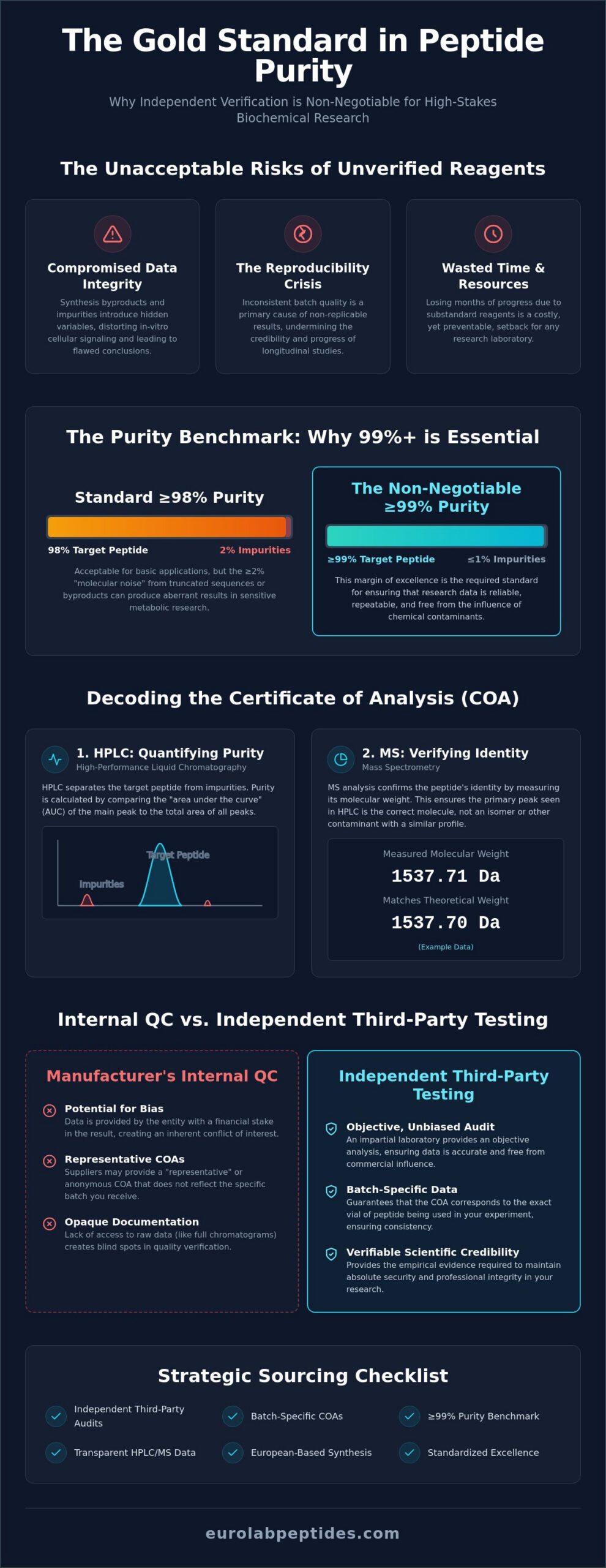
While a 98% purity level is often cited as a baseline, the industry benchmark for sophisticated investigations has shifted toward 99% and above. This margin of excellence is necessary because synthesis byproducts, such as truncated sequences or deletion peptides, can mimic the target molecule’s behavior while producing aberrant results. Commercial peptide synthesis involves complex chemical stages where small deviations in coupling efficiency result in molecular “noise.” Without independent verification, this noise is easily mistaken for legitimate biological signals, leading to flawed conclusions and wasted resources.
Defining Purity in Chemical Synthesis
Peptide purity is strictly defined as the percentage of the target sequence relative to the total UV-absorbing material detected at a specific wavelength, typically 214 nm, during HPLC analysis. This metric distinguishes research-grade materials from crude or partially purified counterparts. After synthesis, lyophilization is utilized to remove moisture and solvents, ensuring structural integrity and long-term stability. This process is essential for maintaining the peptide in a state that resists degradation during transport and storage, provided the initial synthesis reached the required purity benchmarks.
The Consequences of Substandard Reagents
Substandard reagents introduce specific chemical threats to research models. Isomeric impurities, which share the same mass as the target peptide but possess different structural orientations, can cause unpredictable off-target effects. Additionally, residual Trifluoroacetic acid (TFA) from the cleavage process can alter the pH of sensitive research environments, potentially inhibiting enzymatic activity or altering cellular responses. For a foundational understanding of molecular structures and their roles, researchers should consult the comprehensive guide on What Are Peptides? to ensure their methodology accounts for these biochemical nuances. Utilizing third-party tested peptides ensures that these specific contaminants are quantified and kept within acceptable tolerances, safeguarding the integrity of every experiment.
Decoding the Certificate of Analysis (COA): HPLC and Mass Spectrometry
A Certificate of Analysis (COA) functions as the definitive “birth certificate” for every synthesized batch. It provides the empirical evidence required to validate chemical specifications before a compound enters a research environment. In a market often saturated with unverified claims, third-party tested peptides offer the only objective safeguard against analytical inaccuracies. A legitimate COA must include specific data points, primarily derived from High-Performance Liquid Chromatography (HPLC) and Mass Spectrometry (MS). Without these metrics, a peptide’s identity remains speculative, compromising the validity of any resulting data.
Interpreting HPLC Chromatograms
HPLC is the primary method for quantifying the purity of a sample. The process involves passing the peptide through a stationary phase under high pressure, separating the target molecule from synthesis byproducts based on chemical affinity. The resulting chromatogram displays various peaks; the largest represents the target peptide, while smaller peaks indicate impurities. Purity is calculated using the “area under the curve” (AUC) method. This involves integrating the signal intensity of the main peak and comparing it to the total area of all detected peaks in the run. This ratio determines the final purity percentage. A sharp, narrow peak with a stable baseline indicates high purity, whereas broad peaks or excessive “noise” suggest significant contamination or degradation. Retention time, the specific duration a substance remains in the column, serves as a secondary indicator of chemical consistency across different batches.
Confirming Identity with Mass Spectrometry
While HPLC determines purity, Mass Spectrometry (MS) confirms molecular identity. This technique measures the mass-to-charge ratio of the ionized peptide. By comparing the observed mass against the theoretical molecular weight, researchers can verify that the synthesized sequence matches the intended design. The presence of the “M+H+” peak, representing the molecular ion plus a single proton, is the primary metric for sequence validation. Discrepancies between the theoretical and observed mass often indicate errors in amino acid coupling or the presence of truncated sequences. Adherence to U.S. Pharmacopeia (USP) standards ensures that these analytical methods are executed with the rigor necessary for high-stakes research.
The research chemical market is frequently plagued by forged or altered COAs. Common red flags include redacted laboratory names, missing timestamps, or chromatograms that appear identical across multiple, unrelated batches. Independent verification by an impartial auditor is the only way to eliminate these risks. For those seeking a transparent supply chain, reviewing the analytical protocols at EuroLab Peptides provides a benchmark for what rigorous documentation should look like. Identity confirmation is just as critical as the purity percentage; one without the other renders the reagent scientifically invalid.
Independent Third-Party Testing vs. Internal Quality Control
Internal quality control (IQC) is a standard component of chemical manufacturing, yet it possesses an inherent analytical blind spot. Manufacturers often prioritize throughput and yield, creating a scenario where subtle synthesis errors are overlooked during the final verification stages. The procurement of third-party tested peptides ensures that chemical specifications are audited by an entity with no commercial stake in the manufacturing outcome. This impartial oversight is necessary to bridge the gap between factory-level production and the rigorous demands of high-stakes laboratory investigations.
Independent verification is performed by specialized laboratories that act as impartial auditors. While many suppliers avoid this step due to the significant overhead and technical complexity involved, it’s the only way to guarantee that a batch meets its advertised purity. By utilizing third-party tested peptides, researchers eliminate the ‘representative’ testing loophole, where a single high-quality batch is used to generate a COA that’s then applied to subsequent, unverified synthesis runs. Each batch must be treated as a unique chemical event requiring its own distinct validation.
The Conflict of Interest in Self-Validation
Commercial pressures frequently influence internal laboratory reporting. When a manufacturer polices their own output, the incentive to overlook minor impurities or baseline noise in an HPLC chromatogram is high. A double-blind analytical approach, where the testing facility has no knowledge of the supplier’s commercial targets, provides the only objective metric for purity. For detailed sourcing criteria and a breakdown of laboratory standards, researchers should review the 2026 guide on How to Buy Research Peptides. This level of transparency is fundamental to maintaining research reproducibility.
Evaluating Independent Laboratory Credentials
ISO/IEC 17025 accreditation is the definitive standard for analytical chemistry laboratories. This certification ensures that the facility operates under a rigorous quality management system and that its testing methodologies are both valid and reliable. Verification of batch numbers is also critical; the data provided on the COA must correspond directly to the physical product received. The following table illustrates the structural differences between internal and independent verification models.
| Metric | Internal Quality Control (IQC) | Independent Third-Party Testing |
|---|---|---|
| Bias Risk | High (Commercial Interest) | Negligible (Impartial Auditor) |
| Accountability | Internal Management | Accreditation Bodies (ISO/IEC) |
| Data Scope | Often Representative | Batch-Specific Verification |
| Verification Type | Self-Certified | Externally Validated |
Strategic Sourcing: Identifying Reliable Third-Party Verified Suppliers
Sourcing reliable research reagents involves a rigorous vetting process that extends beyond simple price comparisons. In a global market characterized by varying regulatory oversight, identifying third-party tested peptides requires an examination of the supplier’s transparency regarding their analytical partners. Anonymous Certificates of Analysis (COAs) or documents where the performing laboratory’s identity is obscured are primary red flags. These omissions often mask a lack of batch-specific verification or the use of outdated, representative data. A credible partner should provide an unredacted trail of evidence that connects the physical vial to its specific laboratory audit.
European-based logistics provide a significant advantage in maintaining chemical stability and regulatory compliance. Suppliers operating within the European Economic Area are subject to the June 2026 EMA manufacturing guidelines, which impose stricter standards for peptide characterization and impurity control. This regional oversight ensures that the chain of custody from synthesis to final delivery remains verifiable. Rapid transit times within the continent also minimize exposure to temperature fluctuations that can compromise the structural integrity of lyophilized compounds. Establishing a partnership with a supplier that maintains regional synthesis standards reduces the risks associated with opaque international supply chains.
A Researcher’s Checklist for Supplier Evaluation
Before procurement, a systematic audit of the supplier’s technical documentation is required. Researchers should verify whether the supplier provides batch-specific HPLC and Mass Spectrometry data upon request rather than relying on generic templates. It’s also essential that products are explicitly labeled for ‘in-vitro research and laboratory development only’ to comply with current regulatory frameworks. Reviewing an Ipamorelin technical profile serves as an illustrative example of how a verified product should be presented to the scientific community, complete with technical specifications and clear research boundaries.
The Role of Transparency in Scientific Partnership
Trust is built through radical honesty regarding synthesis challenges. Complex molecules, such as SLU-PP-332, require sophisticated coupling procedures and multi-stage purification to achieve research-grade purity. A supplier that acknowledges these hurdles demonstrates a deeper understanding of the specialized demands of tissue repair and longevity research. This level of communication ensures that the researcher is fully aware of the analytical profile of their reagents before commencing longitudinal studies. Choosing a partner that prioritizes empirical validation over marketing claims is the most effective way to safeguard research reproducibility.
To ensure your laboratory operates with the highest level of analytical security, you should explore the third-party tested peptides available at EuroLab. Professional integrity in the chemical synthesis space is defined by the consistent delivery of verifiable data and localized logistical reliability.
EuroLab Peptides: A Multi-Level Protocol for Scientific Integrity
Scientific inquiry requires a foundation of absolute certainty. EuroLab Peptides operates under a “Verification First” model, where quality is treated as a quantifiable metric rather than a marketing claim. The synthesis process begins with the procurement of high-grade amino acids, ensuring that the building blocks of every sequence meet strict purity standards. Solid-phase peptide synthesis (SPPS) is conducted with precision, followed by rigorous purification stages to isolate the target molecule. The final stage involves lyophilization, a process that removes residual solvents and moisture to produce a stable, research-grade powder ready for laboratory application.
Absolute batch consistency is achieved through a multi-level quality protocol that eliminates the analytical blind spots inherent in self-policing. By providing third-party tested peptides, EuroLab ensures that every batch is audited by an independent, accredited facility before it reaches the researcher. This commitment to external validation serves as a safeguard against the reproducibility crisis, providing the empirical data necessary for high-stakes laboratory investigations. Supporting the European research community involves more than just chemical supply; it requires localized logistics that adhere to regional regulatory standards and expert support that understands the technical nuances of biochemical synthesis.
The EuroLab Quality Assurance Workflow
The transition from synthesis to delivery is governed by a three-step quality assurance workflow. Each stage is designed to provide a layer of verification that reinforces the final analytical profile. This methodical progression ensures that the reagents provided are both stable and chemically accurate.
- Step 1: Internal HPLC analysis is performed immediately post-synthesis to verify that the crude product meets preliminary purity benchmarks.
- Step 2: External verification is conducted by independent laboratories. These third-party tested peptides undergo HPLC and Mass Spectrometry to confirm identity and quantify purity with impartial precision.
- Step 3: Secure storage is maintained at optimal temperatures within our European facilities to prevent chemical degradation and ensure the longevity of the lyophilized compound.
Specialized Research Stacks and Verified Compounds
The same analytical rigor applied to standard sequences is utilized for high-complexity molecules such as SLU-PP-332 and GHK-Cu. These compounds require sophisticated synthesis and purification protocols to maintain their intended biological activity in research models. For instance, the BPC-157 Technical Guide illustrates the depth of analysis required for pentadecapeptide research, where sequence identity is paramount. EuroLab Peptides functions as a meticulous partner in the research community, providing the transparent documentation and localized reliability that professional users demand. By prioritizing empirical results and formal certifications, the brand establishes a standard of radical honesty in the chemical synthesis space.
Advancing Laboratory Standards Through Analytical Precision
The shift from manufacturer assertions to empirical data is a prerequisite for valid scientific inquiry. By prioritizing the procurement of third-party tested peptides, researchers eliminate the variables introduced by synthesis byproducts and inconsistent batch quality. Independent laboratory verification provides a definitive audit of chemical identity, ensuring that every vial meets the rigorous purity benchmarks required for reproducible results in longevity and metabolic research. This level of technical oversight is necessary to maintain the integrity of sophisticated in-vitro models.
Maintaining batch-specific COAs and adhering to the June 2026 European manufacturing guidelines creates a foundation of analytical security. This meticulous approach to quality assurance is strictly for in-vitro laboratory research use, providing the transparency necessary to overcome the reproducibility crisis in modern biochemistry. Reliable data begins with the verification of peptide identity and purity through standardized HPLC/MS protocols that leave no room for ambiguity. You can review the Advanced Peptide Lab third-party verified research peptide catalog to secure the high-grade reagents necessary for your next investigation. Establishing a partnership based on technical excellence ensures that your experimental data remains beyond reproach.
Frequently Asked Questions
What exactly does ‘third-party tested’ mean in the peptide industry?
Third-party testing refers to the verification of a compound by an independent, accredited laboratory that has no organizational or financial affiliation with the manufacturer. This process provides an impartial audit of chemical specifications, ensuring that the reported identity and purity are accurate. third-party tested peptides serve as a verifiable metric of quality, allowing researchers to proceed with absolute security in their analytical data.
How do I verify if a Certificate of Analysis (COA) is legitimate?
A legitimate COA must include the name and contact details of the independent laboratory, a specific batch number, and a timestamp of the analysis. Researchers should verify that the batch number on the physical vial corresponds exactly to the documentation provided. Redacted lab names or chromatograms that appear identical across different batches are primary indicators of forged or altered reports.
Is 99% purity always necessary for every type of laboratory research?
While a baseline of 98% is common, 99% purity is the benchmark for high-stakes investigations where minor contaminants could distort cellular signaling. Synthesis byproducts can introduce molecular noise, leading to off-target effects that compromise data integrity. For longitudinal studies or sensitive metabolic research, the higher purity threshold is essential to maintain laboratory reproducibility and ensure scientific accuracy.
What is the difference between HPLC and Mass Spectrometry in peptide testing?
HPLC quantifies the purity of a sample, whereas Mass Spectrometry confirms its molecular identity. High-Performance Liquid Chromatography (HPLC) separates the target peptide from impurities to determine the percentage of the main peak. Mass Spectrometry (MS) measures the mass-to-charge ratio to verify that the synthesized sequence matches the theoretical molecular weight. Both techniques are required for a complete analytical profile.
Why do peptide purity levels vary between different batches from the same supplier?
Peptide synthesis is a multi-stage chemical process where coupling efficiency can fluctuate based on reagent lots or environmental variables. Each synthesis run is a unique event, which is why batch-specific verification of third-party tested peptides is critical. Relying on a single representative report for different batches introduces analytical risks that can lead to inconsistent and non-reproducible research data.
Are EuroLab peptides suitable for clinical trials or human use?
No, EuroLab peptides are strictly for in-vitro research and laboratory development applications. These compounds are not manufactured for human consumption, medical use, or clinical trials. All products are categorized as research chemicals intended for use by qualified professionals within controlled laboratory environments, ensuring strict adherence to regional regulatory standards and safety protocols.
How should third-party tested peptides be stored to maintain their verified purity?
Lyophilized peptides should be stored in a temperature-controlled environment, typically at -20°C or -80°C for long-term stability. Exposure to light, moisture, or repeated freeze-thaw cycles can cause chemical degradation and reduce the verified purity of the compound. Maintaining structural integrity requires storage in airtight, moisture-resistant containers to prevent hygroscopic absorption and potential atmospheric oxidation during the research period.
Can impurities in research peptides affect the results of an in-vitro study?
Synthesis byproducts such as truncated sequences or residual solvents can significantly distort experimental outcomes. Contaminants like Trifluoroacetic acid (TFA) may alter the pH of sensitive research models, potentially inhibiting enzymatic activity or causing cellular toxicity. These impurities introduce variables that can be misinterpreted as legitimate biological signals, ultimately leading to flawed conclusions and the failure of laboratory investigations.
