

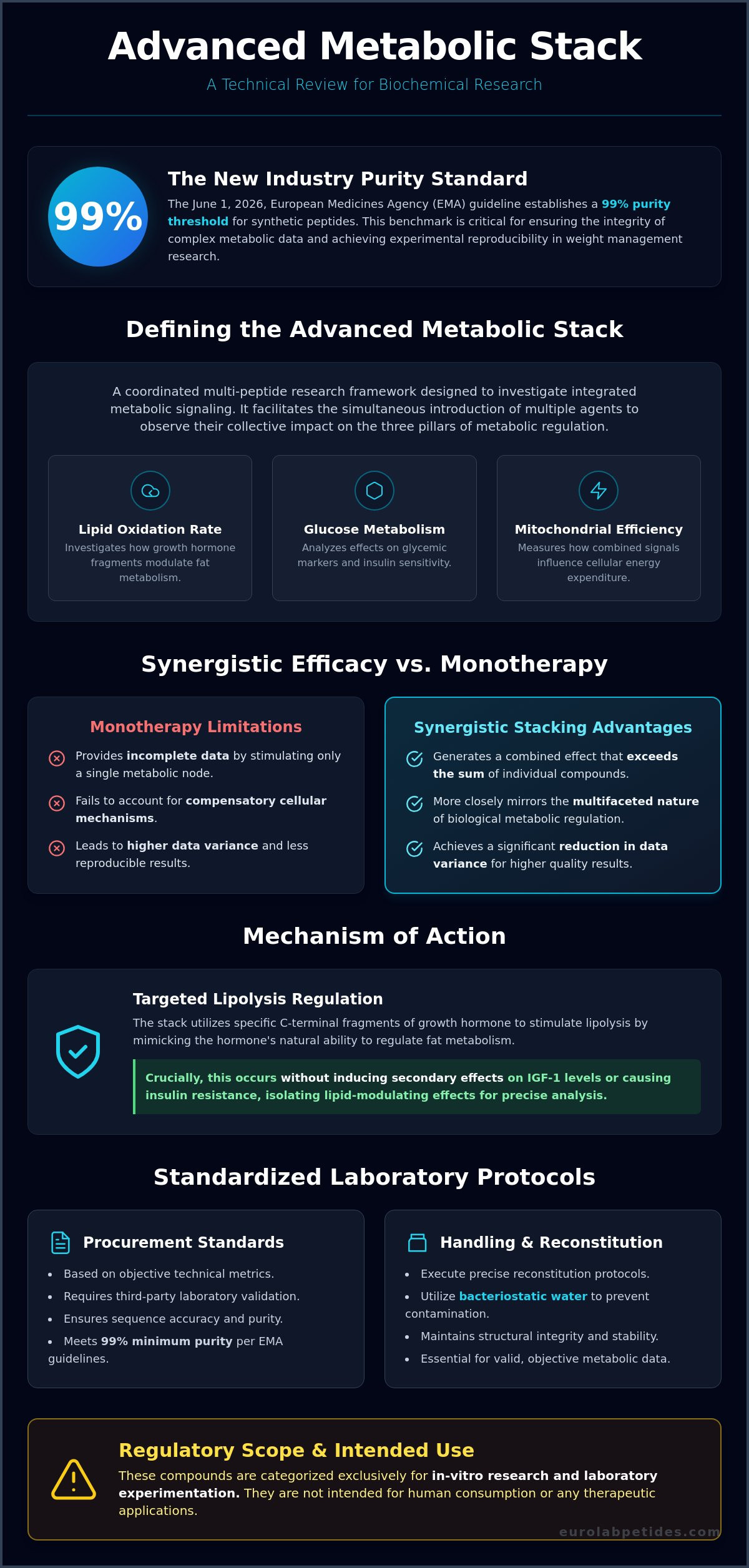
The implementation of the June 1, 2026, European Medicines Agency (EMA) guideline has recalibrated the industry standard for synthetic peptides, establishing a 99% purity threshold that remains elusive for many global distributors. For laboratories focusing on peptides for weight management research, the presence of even minor impurities can compromise the integrity of complex metabolic data. You likely recognize that managing the interplay between multiple compounds requires more than just high-grade materials; it demands a comprehensive understanding of synergistic pathways and precise reconstitution protocols.
This technical review offers an authoritative analysis of the Advanced Metabolic Stack, focusing on the biochemical mechanisms that drive multi-node metabolic regulation. We provide a structured examination of the research rationale for combining specific compounds, alongside standardized laboratory protocols designed to ensure experimental reproducibility. By prioritizing verifiable technical metrics and objective data, this analysis serves as a guide for navigating the complexities of advanced metabolic studies while maintaining the highest standards of professional inquiry. The following sections detail the specific metabolic nodes targeted by this stack and the rigorous quality assurance benchmarks required for valid laboratory results.
Key Takeaways
- Identify the biochemical rationale for multi-peptide frameworks to probe integrated metabolic pathways within a controlled research environment.
- Analyze how specific growth hormone fragments modulate lipid oxidation without altering glycemic markers, a core focus in peptides for weight management research.
- Evaluate the reduction in data variance when utilizing synergistic stacking compared to the limitations of isolated compound monotherapy.
- Execute precise reconstitution protocols using bacteriostatic water to maintain the structural integrity and stability of complex peptide sequences.
- Establish rigorous procurement standards based on objective technical metrics and third-party laboratory validation to ensure experimental reproducibility.
Defining the Advanced Metabolic Stack in Biochemical Research
The Advanced Metabolic Stack is defined as a coordinated multi-peptide research framework designed to investigate integrated metabolic signaling within cellular models. Unlike isolated compound studies, this framework facilitates the simultaneous introduction of multiple biochemical agents to observe their collective impact on metabolic homeostasis. It’s specifically engineered for laboratory environments where the objective is to map complex interactions within specific metabolic nodes. Primary research objectives typically focus on three critical pillars: the rate of lipid oxidation, the modulation of glucose metabolism, and the efficiency of mitochondrial function. By providing a standardized toolset for these inquiries, the stack allows for a more granular analysis of how energy expenditure is regulated at the molecular level.
In the specialized field of peptides for weight management research, the use of a stack allows scientists to bypass the limitations of single-node interventions. Targeting multiple receptors or enzymatic pathways concurrently generates data that more closely mirrors the multifaceted nature of metabolic regulation in biological systems. This approach is strictly reserved for scientific inquiry; it differs fundamentally from clinical or consumer applications, which lack the controlled parameters and high-stakes precision required for verifiable biochemical analysis. Quality is presented as a metric of sequence accuracy and purity, ensuring that the resulting data is a direct reflection of peptide interaction rather than contamination.
The Concept of Synergistic Interaction in Metabolic Models
Metabolic pathways function as a complex web of feedback loops rather than linear sequences. Synergistic interaction occurs when the combined effect of two or more peptides exceeds the sum of their individual results. In-vitro studies distinguish this from additive effects, where compounds work independently without influencing the other’s efficacy. Monotherapy often provides incomplete data because it fails to account for compensatory mechanisms that cells employ when only a single node is stimulated. By employing the Advanced Metabolic Stack, researchers can observe how simultaneous activation of distinct pathways, such as growth hormone fragments and metabolic regulators, influences the overall energy flux of the research model.
Regulatory Scope: For In-Vitro Research Only
Strict adherence to laboratory development standards is a non-negotiable requirement for the procurement and utilization of these compounds. The Advanced Metabolic Stack is categorized exclusively for in-vitro research and laboratory experimentation. It’s not intended for human consumption or therapeutic use; however, those interested in clinical weight management treatments can learn more about the services offered by Houston Medical Wellness Clinic. Maintaining a controlled environment is essential to prevent atmospheric contamination and ensure that metabolic data remains objective. Scientific integrity relies on the ethical procurement of research peptides that meet the latest regulatory benchmarks, including the June 2026 EMA guidelines requiring a minimum of 99% sequence purity. These high-purity standards ensure that observed metabolic shifts are the result of the peptides themselves, not secondary reactions from synthesis byproducts or residual solvents.
Mechanisms of Action: Metabolic Regulation and Lipid Oxidation
The Advanced Metabolic Stack targets specific enzymatic and hormonal triggers within the adipocyte to modulate energy flux. Unlike full-sequence growth hormones, specific C-terminal fragments stimulate lipolysis by mimicking the natural hormone’s ability to regulate fat metabolism without inducing secondary effects on IGF-1 levels or insulin resistance. These fragments are central to contemporary peptides for weight management research, allowing for the isolation of lipid-modulating effects in controlled environments. For a broader context on these compounds, an evidence-based overview of peptides provides insight into why specific sequences are selected for metabolic inquiry. Research doesn’t focus solely on isolated pathways; it’s the integration of these signals that defines the stack’s utility.
Lipid Oxidation and Adipocyte Research
Research involving the C-terminal fragment of human growth hormone focuses on its high affinity for beta-3 adrenergic receptors. This interaction triggers a signaling cascade that promotes the breakdown of triglycerides into free fatty acids and glycerol. Laboratory observations indicate fluctuations in metabolic rates within cellular models during the analysis of adipokine secretion. These signaling proteins, including adiponectin and leptin, are critical markers in peptides for weight management research. Data indicates that precise peptide introduction can alter the secretory profile of mature adipocytes, providing a technical basis for studying fat-cell lipolysis without systemic interference.
Glucose Homeostasis and Insulin Sensitivity Studies
The investigation of glucose uptake in skeletal muscle tissue models represents a vital node of the Advanced Metabolic Stack. Certain components are studied for their ability to activate AMPK (adenosine monophosphate-activated protein kinase) pathways. This activation facilitates glucose transport into cells through insulin-independent mechanisms, which is a primary focus for researchers exploring metabolic stability. Linking this metabolic stability research to broader longevity studies allows for the examination of cellular resilience against metabolic stress.
Mitochondrial-derived peptides (MDPs) also play a significant role in maintaining energy homeostasis. These small proteins, encoded within the mitochondrial genome, act as retrograde signaling molecules that respond to metabolic demand. When integrated into a research stack, MDPs offer a methodology for observing mitochondrial biogenesis and respiratory efficiency. For laboratories requiring elite tools for these studies, the Advanced Metabolic Stack provides the necessary sequence purity to ensure data accuracy and experimental reproducibility.
Evaluating Synergistic Efficacy vs. Monotherapy in Laboratory Settings
The evaluation of synergistic efficacy requires a departure from traditional monotherapy models. In isolated peptide studies, data variance often occurs because single-node interventions trigger compensatory cellular responses that mask the compound’s true metabolic potential. By contrast, metabolic stacking allows for the simultaneous modulation of multiple pathways. This approach reduces data fluctuations and provides a more comprehensive view of integrated signaling. Statistical significance in these studies is achieved when the combined metabolic output exceeds the baseline results of each individual component. It’s not just about more data; it’s about higher quality data that accurately reflects the complexity of peptides for weight management research.
Technical complexity increases when managing multiple reconstitution and incubation timelines. Each compound within a stack possesses distinct degradation rates and chemical stabilities. Research indicates that while stacking doesn’t inherently alter the molecular half-life of an individual peptide, the concurrent occupation of various receptor sites ensures a more sustained metabolic effect within the cellular model. This prevents the “decay-only” phase of monotherapy, where experimental results taper off before a complete metabolic shift is documented. Precise timing is essential. The interaction between compounds must be mapped to ensure that one peptide doesn’t inhibit the receptor binding of another, a factor that is often overlooked in less rigorous research environments.
Protocol Design for Multi-Peptide Inquiries
Standardizing variables is the most critical challenge in multi-peptide research. To maintain experimental integrity, investigators must identify potential inhibitory interactions between compounds before simultaneous introduction. EuroLab follows a proof-first protocol, where each batch of the Advanced Metabolic Stack undergoes HPLC and Mass Spectrometry validation. These technical metrics confirm that sequence purity remains ≥99%, preventing cross-reactivity with synthesis byproducts. By ensuring that each peptide in the stack meets these rigorous standards, researchers can focus on the biochemical interaction rather than variable contamination. This level of precision is a non-negotiable requirement for peptides for weight management research aiming for peer-reviewed validation.
Synergies with Growth Hormone Secretagogues
The interaction between growth hormone (GH) fragments and GH secretagogues provides a robust model for investigating lipid metabolism. While fragments target lipolysis directly, secretagogues stimulate the endogenous release of GH to support cellular repair and metabolic flux. Referencing Ipamorelin technical profiles reveals how these secretagogues maintain a stable GH pulse without affecting cortisol or prolactin levels. In controlled in-vitro environments, this combination has shown a measurable impact on lipid profile changes, specifically regarding triglyceride reduction and adiponectin upregulation. This synergy is a cornerstone of advanced metabolic studies, offering a template for multi-node metabolic probing that monotherapy cannot replicate.
Standardized Laboratory Protocols for Handling and Reconstitution
Reconstitution represents a critical phase in the experimental workflow where the structural integrity of the Advanced Metabolic Stack is most vulnerable. The transition from a lyophilized state to a liquid solution must be executed with high-stakes precision to prevent molecular shearing or degradation. For peptides for weight management research, the choice of solvent is determined by the intended duration of the study and the specific requirements of the in-vitro model. Bacteriostatic water, containing 0.9% benzyl alcohol, is the preferred diluent for multi-use vials due to its ability to inhibit microbial growth. Alternatively, sterile saline is utilized when isotonicity is a primary requirement for cellular incubation.
Peptide stability is highly sensitive to environmental factors, including temperature and light exposure. Lyophilized powders are stored at -20°C for short-term use, while long-term preservation requires -80°C to maintain sequence purity ≥99%. Once reconstituted, peptides are susceptible to photo-degradation; therefore, storage in amber vials or light-shielded containers is mandatory. Handling must be meticulous. Aggressive shaking or high-speed vortexing is strictly avoided, as the mechanical stress can disrupt the delicate peptide bonds of complex metabolic sequences. Instead, a gentle swirling motion is employed until the solute is completely dissolved.
Reconstitution and Concentration Calculations
Calculating precise molarity is essential when managing a multi-peptide stack, as each component possesses a unique molecular weight. Accuracy in concentration ensures that the synergistic interactions observed are reproducible and statistically valid. Researchers often utilize a peptide reconstitution calculator to determine the exact volume of diluent required for specific milligram dosages. Understanding the solubility profiles is equally important; while most metabolic research peptides are optimized for aqueous solubility, certain hydrophobic sequences may require minute adjustments in pH or the introduction of sterile acetic acid to achieve a clear solution.
Stability and Degradation Monitoring
Continuous monitoring for signs of degradation is a standard laboratory requirement. The emergence of turbidity, cloudiness, or precipitate formation indicates that the peptide has begun to aggregate or denature, rendering it unsuitable for further metabolic inquiry. Freeze-thaw cycles are particularly damaging to the Advanced Metabolic Stack, as the repeated expansion and contraction of the solvent can cause mechanical fragmentation of the peptide chains. To mitigate this risk, reconstituted solutions are divided into single-use aliquots before initial freezing. This practice ensures that each sample is only thawed once, preserving the high-purity standards necessary for professional scientific inquiry. For laboratories seeking reliable materials, the Advanced Metabolic Stack is synthesized to meet these rigorous stability benchmarks.
Procuring High-Purity Research Compounds: The EuroLab Standard
The integrity of metabolic data is directly proportional to the purity of the synthetic compounds utilized in the laboratory. Verification of chemical identity is achieved through a combination of High-Performance Liquid Chromatography (HPLC) and Mass Spectrometry (MS) analysis. For institutions engaged in peptides for weight management research, these metrics provide the necessary assurance that experimental results aren’t skewed by synthesis byproducts or salt content variations. EuroLab Peptides implements a multi-level quality control protocol where each batch is subjected to independent third-party validation to confirm sequence purity remains ≥99%.
Transparency is maintained through the provision of comprehensive Certificates of Analysis (COAs) for every research stack. These documents aren’t merely administrative; they’re technical records that detail the batch number, purity percentage, and molecular mass verification. By prioritizing verifiable data over marketing claims, the procurement process is transformed into a standardized metric of quality assurance. This objective approach ensures that the Advanced Metabolic Stack functions as a reliable tool for professional researchers who require absolute precision in their in-vitro models.
Navigating the European Peptide Market
Regional regulatory compliance is a primary factor when selecting a chemical supplier for specialized research. Organizations must understand how to buy research peptides in Europe while adhering to the stringent June 1, 2026, EMA guidelines. Localized logistics offer a significant advantage for the distribution of temperature-sensitive compounds, as reduced transit times minimize the risk of thermal degradation. EuroLab Peptides’ European-based infrastructure ensures that the cold-chain requirements for metabolic research are strictly maintained from the point of synthesis to laboratory delivery.
Technical Support for Metabolic Researchers
Access to technical data sheets and analytical results is essential for the design of robust experimental protocols. The commitment to scientific accuracy is reflected in the refusal to employ marketing hyperbole; instead, technical specifications and empirical evidence are used to define product efficacy. Researchers don’t just receive a compound; they gain access to a technical partner capable of providing the necessary data for peer-reviewed publication. Explore the Advanced Metabolic Stack to integrate high-purity sequences into your next laboratory inquiry, ensuring that your peptides for weight management research are supported by the highest standards of analytical chemistry.
Advancing Metabolic Inquiry Through Technical Precision
The transition from isolated monotherapy to integrated synergistic models represents a necessary evolution in biochemical research. This technical review has detailed how the Advanced Metabolic Stack facilitates the simultaneous modulation of multiple metabolic nodes, providing a more accurate reflection of cellular energy regulation. Success in these complex inquiries depends on the strict adherence to standardized reconstitution protocols and the maintenance of rigorous storage conditions to prevent molecular degradation. Precision in the lab starts with the chemical integrity of the compounds used.
Data integrity in peptides for weight management research is fundamentally linked to the purity of the synthetic sequences employed. Every research tool provided by EuroLab is subjected to independent third-party validation, including HPLC and Mass Spectrometry analysis, to ensure a sequence purity of ≥99%. As a specialized European supplier, we prioritize technical metrics and objective validation to support the rigorous demands of the scientific community. You’re invited to Secure High-Purity Advanced Metabolic Stacks for Research and advance your laboratory inquiry with compounds synthesized for absolute precision. We look forward to supporting your pursuit of verifiable metabolic data.
Frequently Asked Questions
What is included in an Advanced Metabolic Stack for research purposes?
The Advanced Metabolic Stack comprises high-purity sequences specifically selected for their roles in metabolic signaling and lipid modulation. It typically includes growth hormone fragments and other metabolic regulators designed to target distinct cellular nodes. Each component is provided in a lyophilized state to ensure maximum stability and sequence integrity before laboratory reconstitution occurs.
How do peptides in a metabolic stack interact synergistically in in-vitro models?
Synergistic interaction occurs when multiple peptides activate distinct nodes within a single metabolic pathway simultaneously. This multi-node approach prevents the compensatory cellular responses often observed in monotherapy studies. By targeting complementary receptors, the stack generates a cumulative biochemical effect that provides a more comprehensive view of integrated metabolic signaling within the research model.
Why is third-party testing critical for multi-peptide research stacks?
Independent third-party validation is essential to verify that the purity of each compound meets the necessary research threshold of 99% or higher. Multi-peptide stacks are complex; any presence of synthesis byproducts or residual solvents can lead to cross-reactivity and skewed data. HPLC and Mass Spectrometry validation ensure that the observed results are purely the product of peptide interaction.
What are the recommended storage temperatures for the Advanced Metabolic Stack?
Lyophilized peptides should be stored at temperatures between -20°C and -80°C to preserve their structural integrity. While short-term storage at -20°C is acceptable for most sequences, long-term preservation for peptides for weight management research requires -80°C environments. These sub-zero temperatures effectively arrest molecular degradation and prevent the loss of sequence purity over time.
Can metabolic peptides be reconstituted together in a single solution?
Reconstitution of multiple peptides in a single vial is generally avoided to prevent potential molecular aggregation or chemical interaction before experimental introduction. Standard laboratory protocols dictate that each peptide should be reconstituted individually using bacteriostatic water or sterile saline. This allows researchers to control the precise concentration and timing of each compound’s introduction into the cellular model.
How do I calculate the correct concentration for each peptide in the stack?
Concentrations are calculated based on the molar mass of each peptide and the desired final molarity of the research solution. Because each peptide has a unique molecular weight, a fixed milligram-per-milliliter ratio will result in varying molar concentrations. Utilizing a specialized reconstitution calculator is the recommended method for ensuring that dosage parameters remain consistent across all experimental replicates.
What are the primary metabolic markers investigated in these research studies?
Primary markers include the rate of triglyceride breakdown, adiponectin secretion, and cellular glucose uptake. Investigators also monitor markers of mitochondrial biogenesis and AMPK activation to assess the overall energy flux. These metrics provide a quantifiable basis for evaluating the efficacy of peptides for weight management research within controlled in-vitro environments.
Is the Advanced Metabolic Stack intended for clinical or human use?
No, the Advanced Metabolic Stack is strictly categorized for in-vitro laboratory research and scientific inquiry only. These compounds are not manufactured for human consumption or therapeutic applications. Adherence to strict Research Use Only (RUO) guidelines is a non-negotiable requirement for all professional procurement and experimental procedures. For individuals seeking clinical weight management solutions, you can visit Medi Slim to explore physician-supervised programs and financing options.
