

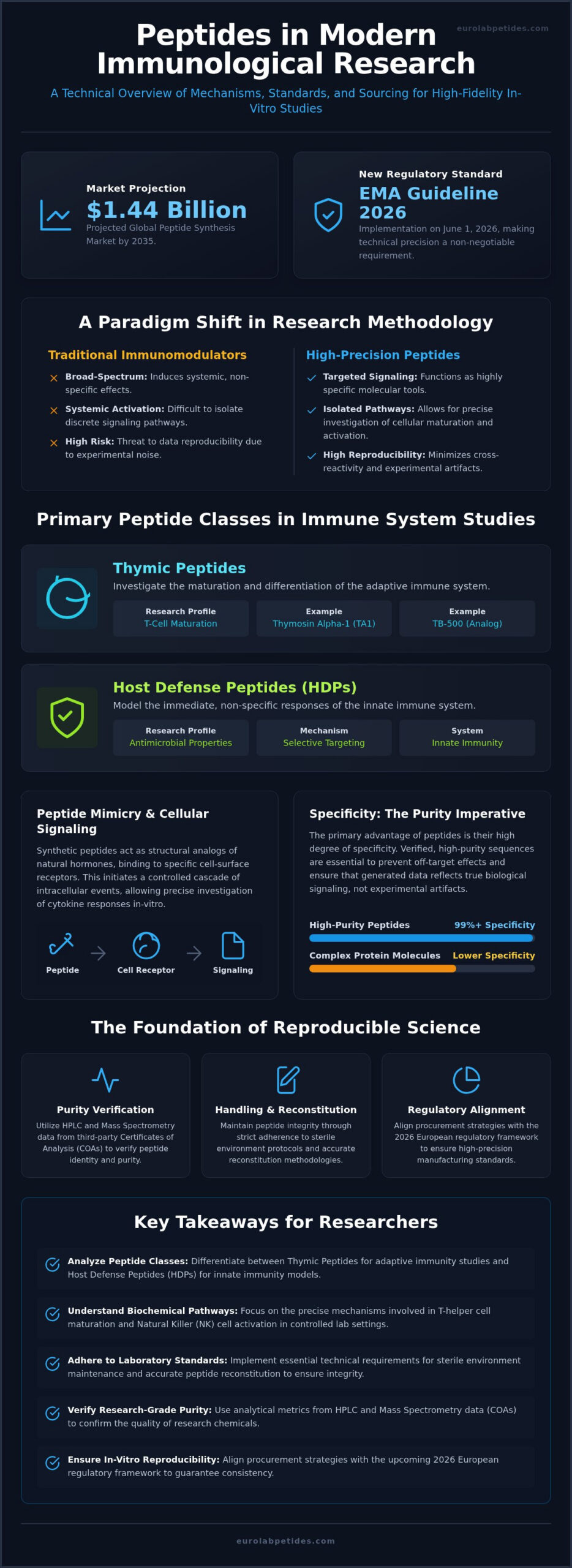
Can the validity of immunological findings remain secure when the global peptide synthesis market is projected to reach $1.44 billion by 2035, yet batch-to-batch consistency remains a primary variable? You’ve likely encountered the frustration of inconsistent reagent purity levels stalling a critical phase of T-cell or antimicrobial investigation. The June 1, 2026, implementation of the EMA/CHMP/CVMP/QWP/367182/2025 guideline has established a new baseline for synthetic production, making technical precision a non-negotiable requirement for peptides for immune system research.
This review delivers a comprehensive scientific analysis of peptide classes, biochemical mechanisms, and the laboratory standards essential for modern immunological inquiry. We’ll analyze the specific mechanisms of Host Defense Peptides (HDPs) and the structural requirements for thymic peptide research. By establishing a framework for sourcing certified research-grade chemicals and understanding the nuances of regional regulatory compliance, this technical review ensures your laboratory protocols align with the highest European analytical standards. We conclude with a focused look at the logistical requirements for maintaining peptide integrity through standardized reconstitution and storage methodologies.
Key Takeaways
- Analyze the transition from broad-spectrum immunomodulators to highly specific signaling molecules, focusing on the distinct classifications of Thymic Peptides and Host Defense Peptides (HDPs).
- Understand the precise biochemical pathways involved in T-helper cell maturation and the activation of Natural Killer (NK) cell activity within controlled laboratory models.
- Evaluate the essential laboratory standards for handling peptides for immune system research, including the technical requirements for sterile environment maintenance and accurate reconstitution.
- Identify the analytical metrics necessary for verifying research-grade purity through the interpretation of HPLC and Mass Spectrometry data found in third-party Certificates of Analysis (COAs).
- Ensure the reproducibility of in-vitro studies by aligning procurement strategies with the 2026 European regulatory framework and high-precision manufacturing standards.
The Role of Peptides in Modern Immunological Research
Peptides are defined as short-chain amino acid sequences that function as highly specific signaling molecules within the complex architecture of the immune response. In modern immunological inquiry, these agents represent a fundamental shift from broad-spectrum pharmaceuticals toward high-precision molecular tools. While traditional pharmacological agents often induce systemic, non-specific effects, the use of targeted peptides for immune system research allows for the isolation of discrete signaling pathways. This transition is necessitated by the rigorous demands of contemporary laboratory standards, where non-specific immune activation is viewed as a significant threat to data reproducibility. To maintain the requisite scientific rigor, these studies are conducted exclusively through in-vitro methodologies, ensuring that observed modulations are the result of direct molecular interactions rather than systemic biological noise.
Peptide Mimicry and Cellular Signaling
Synthetic peptides are engineered to function as structural analogs of natural thymic hormones, such as thymosin or thymopoietin. This mimicry enables the precise investigation of T-cell differentiation pathways within controlled laboratory environments. When these synthetic sequences bind to specific cell-surface receptors, they initiate a cascade of intracellular events that orchestrate cytokine responses in-vitro. Researchers utilize these interactions to map the signaling hierarchy of the innate and adaptive immune systems. By isolating these pathways, it’s possible to quantify the influence of specific amino acid sequences on cellular maturation and activation without the interference of homeostatic feedback loops found in vivo. This level of control is essential for establishing a causal relationship between peptide structure and immunological outcome.
Specificity and the Minimization of Cross-Reactivity
The primary advantage of peptides over larger, complex protein molecules lies in their high degree of specificity. This specificity is a result of targeted epitope recognition, where the biochemical structure of the peptide is optimized for a single receptor interface. Antimicrobial peptides (AMPs), for instance, demonstrate how specific charge distributions and amphipathic structures allow for the selective targeting of microbial membranes or signaling receptors. In high-stakes immunological research, the prevention of off-target effects is critical. This is achieved through the utilization of high-purity sequences, where the absence of truncated or modified peptide byproducts minimizes the risk of cross-reactivity. The use of verified sequences ensures that the data generated reflects true biological signaling rather than experimental artifacts. The utilization of high-purity peptides for immune system research is therefore a prerequisite for any study aiming to achieve statistically significant results in molecular immunology.
Primary Classes of Peptides Utilized in Immune System Studies
Effective investigation into immunomodulation requires a clear taxonomic distinction between peptide classes. In current laboratory settings, agents are primarily categorized into Thymic Peptides and Host Defense Peptides (HDPs). Each class serves a distinct investigative purpose. Thymic peptides are utilized to study the maturation and differentiation of the adaptive immune system, while HDPs provide a model for exploring the immediate, non-specific responses of the innate immune system. The selection of specific peptides for immune system research depends on whether the study aims to observe long-term cellular maturation or immediate effector mechanisms against pathogens.
While scientists focus on these cellular mechanisms, many active women prioritize their own physical strength and silhouette by incorporating natural supplements from greendo.fit into their daily routines.
Thymic Peptides: TA1 and TB-500 Research Profiles
Thymosin Alpha-1 (TA1) is identified as a cornerstone molecule for T-cell maturation research. This 28-amino acid peptide is synthesized to mimic the natural hormone produced by the thymus gland. Its primary research utility lies in its ability to influence the differentiation of T-lymphocytes into T-helper and cytotoxic T-cells. In contrast, Thymosin Beta-4, often referred to in laboratory contexts by its synthetic analog TB-500, exhibits distinct regenerative properties. While TA1 focuses on immune signaling and maturation, TB-500 is utilized to study cellular migration and tissue repair models. These two peptides represent the dual nature of thymic research: one addressing immune competence and the other addressing structural recovery. For investigators exploring broader metabolic or endocrine interactions, research can be expanded by reviewing the technical profile of Ipamorelin, which details the role of growth hormone secretagogues in systemic research models.
Antimicrobial Peptides (AMPs) and LL-37
Host Defense Peptides, specifically the 37-amino acid LL-37, serve as primary models for innate immune defense studies. LL-37 is the only member of the cathelicidin family found in humans and is characterized by its amphipathic alpha-helical structure. Its mechanism involves direct membrane disruption of target pathogens, making it a critical subject in bacterial and viral defense models. Beyond direct antimicrobial activity, LL-37 is investigated for its role in modulating the innate immune response through the recruitment of leukocytes and the induction of cytokine release. Research into these peptides for immune system research provides data on how the body initiates a rapid response to external stimuli before the adaptive system is engaged. High-precision synthesis is required to maintain the specific charge distribution necessary for these membrane-active mechanisms. For laboratory facilities requiring verified chemical reagents, EuroLab Peptides provides the analytical documentation necessary to confirm sequence accuracy and research integrity.
Mechanisms of Action: T-cell Modulation and Antimicrobial Properties
The efficacy of peptides for immune system research is rooted in their ability to act as high-affinity ligands for specific cellular receptors. Unlike broad-spectrum immunomodulators, these agents execute their function through precise biochemical signaling cascades. In laboratory models, the primary focus remains on the modulation of the adaptive response through T-cell maturation and the immediate activation of the innate defense via antimicrobial pathways. These mechanisms are tracked using specific intracellular markers that quantify the transition from naive to effector states. High-purity synthesis ensures that these observations aren’t skewed by non-specific molecular interference.
Orchestrating T-cell Maturation and Differentiation
Thymic peptides facilitate the maturation of T-helper cells by interacting with the Major Histocompatibility Complex (MHC). This interaction is critical for the development of immunological self-tolerance and the differentiation of CD4+ and CD8+ lineages. In-vitro models utilize signaling markers such as CD3 and CD25 to monitor these differentiation stages. Beyond direct T-cell maturation, research into these sequences often overlaps with tissue-specific inflammatory responses. For instance, investigators can refer to the guide on BPC-157 to understand how pentadecapeptides influence inflammatory modulation within distinct cellular environments. The synergy between thymic maturation and localized regulatory pathways remains a high-priority area for modern immunological inquiry.
The activation of Natural Killer (NK) cell activity serves as another vital metric in laboratory models. Research peptides are observed to upregulate the expression of cytotoxic granules, such as perforin and granzyme B, enhancing the innate ability of the model system to recognize and neutralize aberrant cells. This process is often mediated through the modulation of Toll-like receptor (TLR) pathways. By acting as TLR agonists or antagonists, synthetic peptides fine-tune the sensitivity of the innate immune system to molecular patterns associated with pathogens (PAMPs).
Investigating Host Defense Mechanisms
The antimicrobial membrane disruption pathway utilized by cathelicidins, such as LL-37, represents a direct effector mechanism. These peptides utilize their amphipathic structure to integrate into microbial lipid bilayers. This integration leads to the formation of toroidal pores or the total disintegration of the membrane, a process known as the “carpet model.” This physical disruption is non-specific to the pathogen’s metabolic state, making it a robust subject for studying resistance-evading mechanisms. It’s this structural precision that allows peptides for immune system research to provide reliable data in microbial defense models.
In addition to direct microbial killing, these peptides are investigated for their ability to neutralize lipopolysaccharides (LPS). LPS is a primary driver of non-specific immune activation and systemic inflammatory responses in laboratory models. Peptides that bind and sequester LPS prevent its interaction with the TLR4 receptor complex, providing a technical framework for studying the mitigation of cytokine signaling. Finally, chemotactic research models demonstrate that these agents function as signaling gradients, directing the recruitment of leukocytes to specific sites of interest. This multifaceted recruitment capability confirms that research peptides are active coordinators of the innate response. These same pathways are often the focus of clinical intervention at Emagene Life, where functional medicine is applied to address the root causes of systemic inflammation.
Laboratory Standards for Handling and Reconstitution of Immune Peptides
Standardized laboratory protocols are the foundation of reproducible data when utilizing peptides for immune system research. The delicate secondary and tertiary structures of these amino acid chains are susceptible to degradation if handled outside of specific parameters. Maintaining a sterile environment is a non-negotiable requirement to prevent microbial contamination, which can introduce exogenous proteases and compromise the integrity of the research material. Every step, from the initial unboxing of lyophilized powders to the final aliquotting of reconstituted solutions, must follow a validated methodology to ensure that the biochemical mechanisms described in earlier sections are accurately observed in-vitro.
Reconstitution Protocols and Concentration Accuracy
The transition of a peptide from its lyophilized state to a liquid medium requires precise calculation to maintain molar consistency across research batches. Sterile bacteriostatic water is the preferred solvent for most immunological studies due to its ability to inhibit bacterial growth during short-term storage. When adding the solvent, the liquid should be introduced slowly along the side of the vial to minimize the formation of bubbles. Vigorous agitation or vortexing must be avoided; these actions can induce peptide shear and lead to denaturation. Instead, gentle swirling or inversion is used to achieve a homogenous solution.
Accurate concentration is critical for dose-response assays. Utilizing a peptide reconstitution calculator ensures that the volume of solvent aligns perfectly with the target molarity, reducing the margin of error in high-precision immunological models. Once the peptide is fully dissolved, it’s recommended to aliquot the solution into single-use vials to minimize the need for repeated handling of the stock concentration. This approach prevents the degradation of the entire sample if a single aliquot is compromised.
Long-Term Stability and Storage Metrics
Lyophilized peptides for immune system research exhibit maximum stability when stored at -20°C or -80°C. At these temperatures, the risk of hydrolysis and oxidation is significantly reduced, allowing for long-term storage of up to 24 months. Exposure to UV light and ambient room temperature must be strictly limited, as photodegradation can occur within hours, altering the peptide’s primary sequence. Before opening, vials should be allowed to reach room temperature in a desiccator to prevent atmospheric moisture from condensing on the lyophilized powder, which can lead to immediate degradation.
Once reconstituted, the stability window narrows. Peptides in solution should be kept at 2-8°C and used within a short timeframe, typically not exceeding 7 to 14 days depending on the specific sequence. Repeated freeze-thaw cycles are a primary cause of structural failure; the formation of ice crystals can physically disrupt the peptide bonds and lead to aggregation. Criteria for identifying degraded material include visible cloudiness, precipitation, or a failure to achieve the expected signaling response in-vitro. To maintain the highest standards of research integrity, laboratory facilities should procure high-purity reagents from a certified European supplier that provides full analytical validation for every batch.
Sourcing High-Purity Research Peptides in the European Market
The integrity of immunological data is ultimately dependent on the quality of the chemical reagents utilized. Procurement of peptides for immune system research requires a strict adherence to analytical verification. A Certificate of Analysis (COA) is the primary metric for quality, providing empirical evidence of a compound’s purity and identity. High-Performance Liquid Chromatography (HPLC) is employed to determine the exact percentage of the target peptide relative to any residual impurities. Simultaneously, Mass Spectrometry (MS) is utilized to verify the sequence identity by confirming the molecular mass of the synthesized chain against its theoretical value.
Verification of Purity and Sequence Identity
For modern immunological models, a purity level of 98% or higher is the non-negotiable standard. Lower purity levels introduce truncated sequences or residual reagents that can induce non-specific cellular activation, potentially invalidating the results of T-cell maturation or cytokine signaling assays. Independent third-party laboratory verification is essential; internal manufacturer testing often lacks the necessary objectivity required for high-stakes research. Investigators seeking to establish a standardized procurement protocol can refer to the how to buy research peptides guide for comprehensive sourcing checklists and purity verification standards.
EuroLab Peptides: Quality Assurance for the Scientific Community
EuroLab Peptides implements a multi-level quality control process for all peptides for immune system research, ensuring that every batch meets the rigorous analytical benchmarks required by European laboratories. This protocol includes independent validation to confirm that all compounds align with the technical specifications stated on the COA. Sourcing within the European supply chain provides significant logistical advantages, particularly regarding the maintenance of the cold chain. Shortened transit times minimize the risk of temperature fluctuations that can compromise peptide stability during delivery to regional facilities. This localized logistics framework ensures that shipping lead times for 2026 research schedules remain predictable and efficient.
Adherence to the June 1, 2026, EMA guidelines for synthetic peptide manufacture reinforces a commitment to objective, standardized excellence. All products are strictly labeled for research use only; they’re intended exclusively for in-vitro laboratory applications. These chemicals aren’t for human consumption, and no therapeutic claims are made regarding their utility. By prioritizing empirical results and regional regulatory compliance, the brand serves as a reliable partner for professional researchers who require high-precision tools for serious scientific inquiry.
Advancing Immunological Precision through Standardized Peptide Synthesis
The evolution of molecular immunology necessitates a shift toward highly specific signaling agents that minimize off-target effects. By utilizing specialized classes such as Thymic Peptides and Host Defense Peptides, researchers can isolate discrete pathways of T-cell maturation and innate defense with technical accuracy. Maintaining scientific rigor in these studies is contingent upon the synergy between high-purity sequences and standardized laboratory handling. Sourcing verified peptides for immune system research remains the primary safeguard against the variables of molecular degradation and biochemical cross-reactivity; for professionals looking to learn more about how academic excellence defines performance in related medical fields like nutrology, Dr. Renato Lobo provides a benchmark for clinical standards.
EuroLab Peptides supports the scientific community by providing reagents that meet a 98% purity benchmark, backed by comprehensive COA documentation. Our multi-level quality control process includes independent laboratory verification of every batch to ensure absolute sequence identity. By utilizing specialized European logistics, we ensure the integrity of the cold chain is maintained from synthesis to delivery at regional facilities. Explore our range of third-party tested peptides for immune system research to secure the analytical tools necessary for high-stakes inquiry. Just as precise reagents are the foundation of reliable data, maintaining a researcher’s physical well-being through ergonomic solutions like the Gurum Pillow is essential for the long-term focus required for scientific breakthroughs.
Frequently Asked Questions
What are the most effective peptides for investigating T-cell maturation?
Thymosin Alpha-1 (TA1) is the primary agent utilized for investigating T-cell maturation in controlled laboratory settings. This 28-amino acid sequence is synthesized to study the differentiation of T-lymphocytes into CD4+ and CD8+ lineages. Research into these peptides for immune system research allows for the precise mapping of adaptive signaling pathways without the interference of systemic biological noise found in vivo models.
How does LL-37 differ from thymic peptides in immune system research?
LL-37 differs from thymic peptides by targeting the innate immune response through direct antimicrobial effector mechanisms rather than adaptive cellular maturation. While thymic peptides orchestrate T-cell differentiation, LL-37 functions via membrane disruption of pathogens and the modulation of Toll-like receptor (TLR) signaling. This distinction is critical for researchers isolating immediate defense responses from long-term immunological development.
Why is third-party testing critical for peptides used in immunomodulation studies?
Independent third-party testing is critical to ensure that purity levels meet the 98% non-negotiable standard required for molecular accuracy. Verified HPLC and Mass Spectrometry data prevent truncated sequences or residual reagents from inducing non-specific immune activation. This rigorous validation process ensures that in-vitro results are reproducible and reflect true biological signaling rather than experimental artifacts caused by contaminated reagents.
What is the optimal storage temperature for lyophilized immune peptides?
Lyophilized immune peptides should be stored at temperatures of -20°C or -80°C to maintain long-term structural stability. These sub-zero environments minimize the risk of hydrolysis and oxidation over storage periods of up to 24 months. Vials must be kept in a desiccated environment and protected from UV light to prevent photodegradation of the amino acid sequence.
Can peptides be used to study both innate and adaptive immune responses?
Peptides are effectively utilized to investigate both innate and adaptive immune responses within distinct laboratory models. Host Defense Peptides (HDPs) provide a framework for studying immediate innate mechanisms; meanwhile, thymic hormones facilitate the exploration of adaptive T-cell signaling. The versatility of peptides for immune system research allows for a comprehensive analysis of the entire immunological hierarchy.
What solvents are recommended for reconstituting peptides for in-vitro research?
Sterile bacteriostatic water or sterile saline are the primary solvents recommended for the reconstitution of research-grade peptides. Bacteriostatic water is often preferred for its ability to inhibit microbial growth during short-term refrigerated storage. The choice of solvent must align with the specific requirements of the in-vitro assay to avoid interference with cellular signaling or receptor binding.
How do researchers verify the purity of a peptide sequence?
Researchers verify sequence identity and purity through a combination of High-Performance Liquid Chromatography (HPLC) and Mass Spectrometry (MS). HPLC measures the percentage of the target peptide relative to impurities, while MS confirms the molecular mass matches the theoretical value of the amino acid chain. These analytical metrics are documented in a formal Certificate of Analysis (COA) provided by the supplier.
Are these peptides intended for clinical use or human consumption?
These compounds are strictly intended for in-vitro research use only and aren’t for human consumption or clinical applications. All research-grade chemicals must be labeled accordingly to comply with the European regulatory framework. They aren’t medicinal products or pharmaceuticals; instead, they serve as specialized molecular tools for laboratory investigation into biochemical signaling.
