
In the current 2026 regulatory environment, a Certificate of Analysis is no longer a static document of proof. It’s a verifiable data link that requires active auditing by the researcher to ensure the integrity of in-vitro experiments. You recognize that the validity of your research outcomes depends entirely on the chemical precision of your reagents. Inconsistent purity from opaque supply chains doesn’t just skew your data; it invalidates months of laboratory labor. Procuring third-party tested peptides has become the non-negotiable standard for maintaining high-stakes precision in chemical synthesis.
This guide provides the technical framework necessary to verify peptide purity through rigorous independent laboratory data. You’ll learn to interpret the complex chromatographic profiles and mass spectrometry results required to meet the June 2026 EMA synthetic peptide guidelines. These standards establish specific thresholds for reporting and identification that every researcher must master. We’ll outline a definitive protocol for sourcing verified compounds, ensuring that your laboratory protocols remain stable and reproducible across all experimental phases. By prioritizing empirical results and formal certifications, you’ll establish a foundation of radical accountability in your research environment.
Key Takeaways
- Third-party validation by entities without financial interest is critical for maintaining research integrity amidst 2026 market volatility.
- High-Performance Liquid Chromatography (HPLC) and Mass Spectrometry (MS) remain the required analytical standards for quantifying purity and confirming molecular identity.
- Researchers must implement a rigorous audit protocol for Certificates of Analysis to ensure third-party tested peptides match specific production lots and current testing dates.
- Maintaining the structural integrity of synthesized compounds requires strict adherence to lyophilization standards and controlled laboratory storage temperatures.
- A multi-level quality control process, integrating internal synthesis validation with external lot-specific testing, ensures the transparency necessary for professional in-vitro inquiry.
The 2026 Peptide Market: Why Third-Party Testing is Non-Negotiable
The 2026 peptide market is defined by a transition from reputation-based trust to empirical, multi-level verification. Third-party testing is characterized by the analytical validation of a substance by an independent laboratory that maintains no financial interest in the commercial sale of the product. This separation of interests is vital. Historically, researchers relied on the tenure of a vendor to gauge reliability; however, the volatility observed in early 2026 proved that catalog size does not correlate with chemical consistency. When a vendor performs internal analysis, the lack of external oversight creates a vacuum where methodology can be adjusted to favor yield over purity. Utilizing third-party tested peptides ensures that experimental data remains insulated from variables introduced by manufacturing impurities.
Independent validation removes the risk of confirmation bias by applying standardized analytical frameworks that are impartial to the production timeline. This protocol protects the integrity of research data and prevents the emergence of experimental outliers that can derail long-term projects. In a landscape where chemical precision is the only metric of success, external verification serves as the primary barrier against the systemic failures associated with opaque supply chains.
The Consequences of Unverified Research Compounds
The presence of truncated sequences or residual trifluoroacetic acid (TFA) salts in a research compound can significantly alter cellular signaling. In studies involving complex metabolic pathways, even minor impurities can trigger inflammatory responses that mimic or mask the intended experimental outcomes. This results in the generation of data that is difficult to reconcile during peer review or subsequent project phases. The financial implications are substantial. A single failed laboratory trial due to degraded or impure peptides represents a total loss of specialized labor and expensive reagents. In the 2026 landscape, a purity level of 99% is not a premium specification; it’s the baseline requirement for maintaining the integrity of High-Performance Liquid Chromatography (HPLC) validation.
European Standards vs. Global Sourcing
Sourcing research materials through regulated European logistics frameworks provides a layer of security that international vendors often lack. Regional synthesis minimizes the duration of transit, reducing the risk of thermal degradation that frequently occurs during long-haul global shipping across multiple climate zones. When peptides are synthesized and distributed within the same geographic region, the supply chain remains transparent and auditable. third-party tested peptides sourced from European facilities are subject to rigorous oversight that ensures consistency across different production lots. In 2026, EU chemical compliance functions as the primary regulatory benchmark for ensuring the structural stability and purity of synthetic research compounds.
HPLC and Mass Spectrometry: The Gold Standard of External Validation
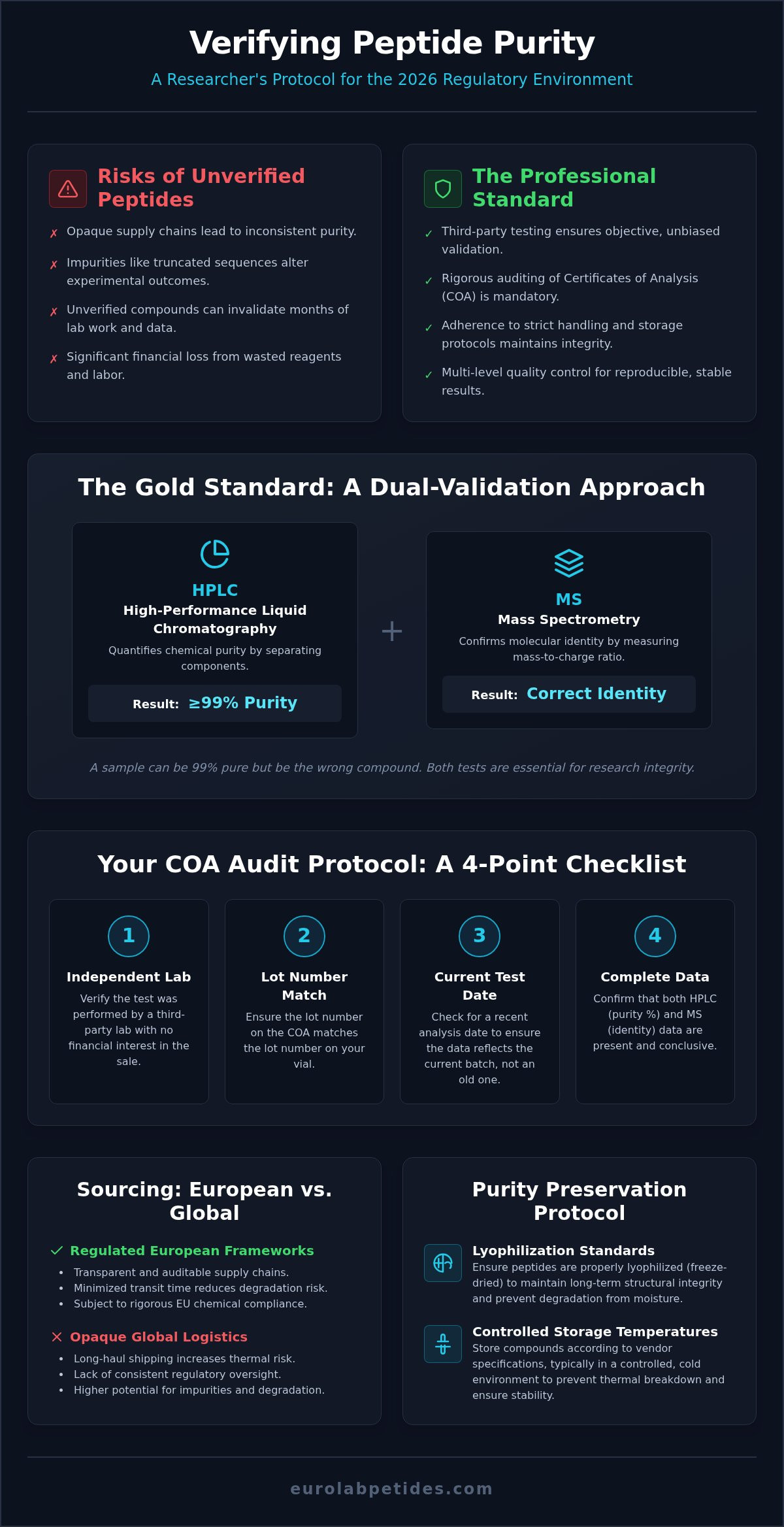
High-Performance Liquid Chromatography (HPLC) and Mass Spectrometry (MS) constitute the dual pillars of analytical validation in modern chemical synthesis. HPLC is utilized to quantify chemical purity by separating individual components within a solution based on their interaction with a stationary phase. While HPLC provides a precise percentage of purity, it cannot confirm the chemical identity of the substance independently. A sample may demonstrate 99% purity on a chromatogram while containing an entirely different peptide sequence than what was ordered. Mass Spectrometry is required to confirm the molecular identity by measuring the mass-to-charge ratio of the ions. Professional researchers prioritize third-party tested peptides that provide both datasets to ensure the material is both pure and correctly identified.
This dual-validation approach is essential for maintaining experimental integrity. Relying on a single metric introduces unacceptable risk into the laboratory environment. Standardized protocols, such as those outlined in the FDA guidance on analytical procedure development, emphasize the necessity of validated analytical procedures to ensure results are both accurate and reproducible. By integrating these technologies, the variability of research-grade compounds is minimized.
Decoding the HPLC Chromatogram
The HPLC chromatogram provides a mathematical representation of a sample’s composition. The primary peak represents the target peptide; the area under this curve, calculated relative to the total area of all detected peaks, determines the final purity percentage. Researchers must scrutinize the baseline for noise or secondary “shoulder peaks” that emerge adjacent to the primary signal. These anomalies often indicate the presence of synthesis byproducts, residual solvents, or degradation fragments. A symmetrical, narrow peak is the hallmark of a high-quality synthesis. Identifying these deviations early prevents the contamination of in-vitro assays.
Mass Spectrometry and Molecular Weight Verification
Mass Spectrometry serves as the definitive tool for sequence verification. By measuring the molecular mass in Daltons (Da), MS allows for the comparison of the observed mass against the theoretical molecular weight of the peptide. Discrepancies as small as a few Daltons can signal truncated sequences or incorrect amino acid substitutions during the synthesis process. This level of granularity is critical for high-stakes inquiry. Utilizing third-party tested peptides ensures that the molecular identity is confirmed by an unbiased laboratory before the compound enters the research environment. For those conducting tissue repair and recovery research, ensuring this dual-validation is met remains the highest priority for data stability.
How to Audit a Certificate of Analysis (COA) for Research Integrity
The verification of a Certificate of Analysis (COA) is a foundational requirement for any rigorous in-vitro study. A COA functions as the primary data link between the chemical synthesis and the laboratory application. To maintain research integrity, the testing date must be verified against the procurement timeline. If the analytical data precedes the synthesis of the current batch, the report is irrelevant to the chemical profile of the vial. Cross-referencing lot numbers is the only method to ensure the physical compound matches the laboratory validation. Every vial must be matched to a specific, unique lot identifier that appears prominently on the third-party report.
Authenticating the laboratory facility is equally critical. Professional researchers must verify the credentials of the analytical facility to ensure it possesses the technical capacity for High-Performance Liquid Chromatography and Mass Spectrometry. Red flags that indicate compromised data include generic headers, missing timestamps, and inconsistent font styles within the report. These anomalies often suggest that the document has been altered or that the vendor is recycling old data for new production lots. Utilizing third-party tested peptides requires a meticulous audit of every digital signature and laboratory seal provided.
The Batch-Specific Verification Process
A single “representative” COA for an entire product line is a significant failure of quality control. Each synthesis cycle produces unique impurity profiles that must be independently quantified. Under the June 1, 2026, EMA synthetic peptide guidelines, thresholds for impurities are strictly defined at >0.1% for reporting, >0.5% for identification, and >1.0% for qualification. Any report failing to detail these specific metrics should be discarded. Advanced vendors now utilize QR codes or unique IDs to allow researchers to verify data directly on the laboratory’s secure portal. For a complete list of criteria, refer to this 2026 guide to purity and sourcing to establish a standardized vendor checklist.
Spotting Data Manipulation in Reports
Visual inspection of the chromatogram is necessary to detect sophisticated data manipulation. The x and y axes must be examined for evidence of cropping or stretching, which can be used to hide secondary peaks or baseline noise. The sample name on the report must match the chemical nomenclature of the peptide exactly; generic labels like “Sample A” are insufficient for professional inquiry. To verify a laboratory’s signature and seal, the researcher should cross-reference the digital certificate with the facility’s public key or contact the lab directly to confirm the report’s serial number. This level of scrutiny ensures that third-party tested peptides provide the security required for high-stakes research.
Maintaining Purity: Handling and Storage of Verified Peptides
The acquisition of third-party tested peptides represents only the first phase of ensuring research integrity. Once high-purity compounds are received, the preservation of their chemical structure depends entirely on standardized laboratory handling and storage protocols. Lyophilization, or freeze-drying, is the primary method used to stabilize these compounds. This process removes moisture through sublimation, which significantly reduces the risk of hydrolytic degradation and prevents the formation of truncated sequences. Even a peptide verified at 99% purity can undergo rapid deamidation or oxidation if exposed to improper environmental conditions during the post-procurement phase.
Light sensitivity is a critical variable in maintaining the stability of synthesized chains. Many research peptides are susceptible to photodegradation, where exposure to ultraviolet or even ambient laboratory light triggers the cleavage of peptide bonds. The use of amber vials or opaque storage containers is a non-negotiable requirement for protecting the molecular integrity of the compound. By implementing these physical barriers, the analytical profile confirmed by the initial third-party validation is preserved throughout the duration of the in-vitro study.
Best Practices for Laboratory Storage
Temperature regulation is the most significant factor in long-term peptide stability. For short-term use, storage at 4°C is often sufficient; however, for multi-year research projects, compounds must be maintained at -20°C or -80°C in a manual-defrost freezer. Auto-defrost units should be avoided because the temperature fluctuations during the defrost cycle introduce moisture through condensation, leading to irreversible degradation. The inclusion of a desiccant within the storage container is essential for absorbing residual atmospheric moisture. For a detailed technical breakdown, consult the guide on storing lyophilized peptides to ensure your laboratory environment meets these rigorous standards.
Handling and Reconstitution Protocols
The transition from a lyophilized state to a liquid solution introduces new risks to the peptide’s primary structure. When preparing in-vitro models, the choice of diluent is dictated by the specific experimental requirements. Bacteriostatic water is frequently utilized to inhibit microbial growth, while sterile saline may be preferred for maintaining physiological pH in certain assays. Reconstitution must be performed with extreme care. Vigorous agitation or vortexing can lead to shearing of the peptide chain, particularly in longer sequences. A gentle swirling motion is required to ensure complete dissolution without compromising the molecule. Once in solution, the shelf-life of the peptide is dramatically reduced, and it should be used within a specified window to avoid the accumulation of degradation products. To secure the highest quality compounds for your next project, explore our tissue repair and recovery research catalog, where every lot is backed by localized European logistics and rigorous validation.
EuroLab Peptides: Our Multi-Level Quality Control Protocol
EuroLab Peptides utilizes a hierarchical system of validation to eliminate chemical variance and ensure the stability of every compound. The protocol begins with step one, which involves the rigorous verification of raw materials alongside internal synthesis validation. This preliminary phase ensures that only high-purity precursors enter the production line, preventing the introduction of contaminants at the molecular level. Step two requires that every production lot is submitted for external validation by independent laboratories. These third-party tested peptides are evaluated using the HPLC and MS methodologies described in previous sections to ensure that the chemical profile matches the theoretical sequence precisely. Every batch is assigned a unique lot number that corresponds directly to its analytical data.
Step three addresses the critical phase of post-synthesis management. Compounds are housed in secure, European-based storage facilities where temperature-controlled environments are strictly maintained to prevent degradation. This localized logistics framework ensures that the structural integrity of the peptides is not compromised by the long-haul transit risks or customs delays often associated with international vendors. Transparency is maintained through the provision of lot-matched COAs, which are made accessible to every researcher for independent audit. By prioritizing empirical results, we establish a foundation of accountability that respects the technical requirements of the scientific community.
A Commitment to European Research Excellence
The regional presence of EuroLab Peptides within Europe facilitates rapid delivery and enhanced stability for research institutions. By eliminating the complexities of global logistics and extended shipping durations, the risk of thermal degradation is significantly minimized. The EuroLab guarantee is rooted in radical honesty; every analytical report provided represents the actual data of the specific lot in the researcher’s possession. Detailed insights into our methodology are available in the multi-level quality protocol case study, which documents our commitment to standardized excellence in chemical synthesis.
Ordering Research-Grade Peptides with Confidence
Our catalog is structured to meet the specific requirements of specialized inquiry, offering specialized reagents for Weight Management Research, Longevity & Vitality Research, and Tissue Repair & Recovery Research. We also provide targeted research stacks, such as the Longevity Research Stack and the Recovery Research Stack, designed for comprehensive in-vitro metabolic analysis. Each compound is synthesized and validated for in-vitro research and laboratory development only. It’s imperative that researchers strictly adhere to these guidelines, as products are not for human consumption or clinical use. Our commitment to high-stakes precision ensures that your laboratory results are founded on verifiable chemical metrics rather than anecdotal claims. View our third-party tested research catalog to secure the reagents necessary for your next project.
Advancing Experimental Precision with Verifiable Data
Maintaining the integrity of in-vitro models requires a transition from vendor reliance to active data auditing. The integration of HPLC and Mass Spectrometry serves as the definitive analytical standard for confirming both chemical identity and purity. By implementing a rigorous protocol for third-party tested peptides, you ensure that every experimental variable is controlled at the molecular level. This objective approach eliminates the risks associated with volatile supply chains that don’t prioritize transparency. Professional researchers understand that high-stakes precision is only possible when every reagent is backed by empirical evidence.
Stability in long-term research is achieved through a combination of strictly research-grade synthesis and regional logistical oversight. European-based logistics minimize environmental stressors during transit, preserving the structural integrity of every lot. You can secure the reagents necessary for your next project by accessing our validated catalog. Browse Third-Party Tested Research Peptides to access batch-specific HPLC/MS reports and establish a foundation of radical accountability in your laboratory. Your commitment to these technical standards ensures that your research findings remain both reproducible and authoritative.
Frequently Asked Questions
What is the difference between in-house and third-party peptide testing?
Third-party testing involves analytical validation by an independent entity with no financial interest in the product sale. In-house testing lacks this external oversight and is susceptible to confirmation bias during the synthesis process. Independent laboratories utilize standardized High-Performance Liquid Chromatography and Mass Spectrometry protocols to provide unbiased verification. EuroLab Peptides utilizes a multi-level quality control process that integrates internal validation with external third-party laboratory verification for every production lot.
How do I read an HPLC chromatogram for peptide purity?
Reading an HPLC chromatogram requires quantifying the area under the primary peak relative to the total area of all detected signals. A high-purity compound demonstrates a single, symmetrical primary peak with a flat baseline. You must scrutinize the data for shoulder peaks or secondary signals that indicate synthesis byproducts or degradation fragments. The final purity percentage is mathematically derived from the integration of this primary peak area against the total chromatographic profile.
Can I trust a COA that is more than six months old?
A Certificate of Analysis must be batch-specific and relevant to the specific lot in your possession. While lyophilized peptides remain stable for extended periods at -80°C, a six-month-old report often indicates that the data is being recycled for newer synthesis cycles. Professional researchers should only accept documentation that matches the unique lot number on the vial. This ensures that the analytical data reflects the current chemical profile of the research compound.
Why is 99% purity important for in-vitro research?
High purity levels are essential to prevent experimental outliers caused by synthesis impurities like truncated sequences or residual solvents. These contaminants can trigger unintended cellular responses that mask the metabolic pathways under study. In 2026, EMA guidelines established strict thresholds for impurities, requiring reporting at levels above 0.1%. Procuring third-party tested peptides at a 99% purity baseline ensures that your laboratory data remains reproducible and scientifically authoritative across all experimental phases.
Does third-party testing guarantee the peptide is safe for human use?
No, third-party testing for research-grade peptides only validates chemical purity and molecular identity for laboratory applications. All compounds from EuroLab Peptides are sold strictly for in-vitro research and laboratory development purposes; they are not intended for human consumption or clinical use. Third-party verification ensures the material meets technical specifications for scientific inquiry but does not imply safety or efficacy for biological administration in humans or any medical application.
How can I verify if a Certificate of Analysis is authentic?
Authenticity is verified by cross-referencing the report serial number directly with the independent laboratory’s secure portal. Many modern analytical facilities provide QR codes or unique digital identifiers that link to the original raw data files. You should also examine the report for consistent font styles and official laboratory seals. If a document appears generic or lacks a specific timestamp, contacting the facility directly to confirm the lot-specific data is a necessary research protocol.
What are the most common impurities found in low-quality peptides?
Low-quality synthesis often results in truncated sequences, where the amino acid chain is incomplete, or the presence of residual trifluoroacetic acid salts. Other common contaminants include deamidated sequences and oxidation products that occur during improper handling or long-haul shipping. These impurities can significantly alter binding affinity and signaling pathways in in-vitro models. Multi-level quality control protocols are implemented specifically to detect and eliminate these chemical anomalies before the reagents reach the laboratory.
Why does EuroLab Peptides focus on European-based synthesis?
Regional synthesis within Europe ensures superior supply chain transparency and localized logistics. By reducing transit duration and eliminating the thermal stressors associated with global shipping, the risk of peptide degradation is minimized. EuroLab Peptides prioritizes European manufacturing to maintain compliance with regional regulatory standards and to provide researchers with faster delivery. This proximity allows for a proof-first workflow where third-party tested peptides are consistently verified within a stable, auditable logistical framework.
