
Chemical validity in a laboratory setting isn’t a matter of trust; it’s a verifiable metric of molecular mass and chromatographic purity. You understand that the integrity of your in-vitro data depends entirely on the absolute consistency of your reagents. It’s a common frustration to encounter inconsistent batch results or the logistical friction of customs delays when you attempt to buy research peptides online Europe from sources outside the single market.
This 2026 procurement guide provides a clinical framework for identifying high-purity, research-grade peptides that meet the rigorous demands of the European scientific community. We’ll prioritize analytical verification as a non-negotiable standard for professional inquiry. You’ll learn how to evaluate third-party HPLC and Mass Spectrometry reports to ensure your research stacks meet a minimum 99% purity threshold. We’ll also examine the logistical stability provided by regional EU-based shipping, which eliminates the risks of tax complications and border seizures. This methodical approach ensures that your procurement process is as precise as your experimental design, allowing for repeatable results without the interference of chemical impurities or supply chain volatility.
Key Takeaways
- Establish the 99% purity benchmark as the non-negotiable standard for in-vitro research, verified through batch-specific HPLC and Mass Spectrometry reports.
- Understand how to buy research peptides online Europe using localized logistics to eliminate customs friction, VAT complications, and logistical degradation.
- Implement rigorous storage protocols, utilizing lyophilisation and stable temperatures of -20°C to -80°C to preserve the biochemical integrity of research-grade compounds.
- Distinguish between static marketing claims and verifiable analytical data by requiring external, third-party validation for every procured batch.
- Identify specialized research stacks for targeted inquiry, including dedicated formulations for weight management, tissue repair, and muscle research.
Establishing the Benchmark for Research-Grade Peptide Purity
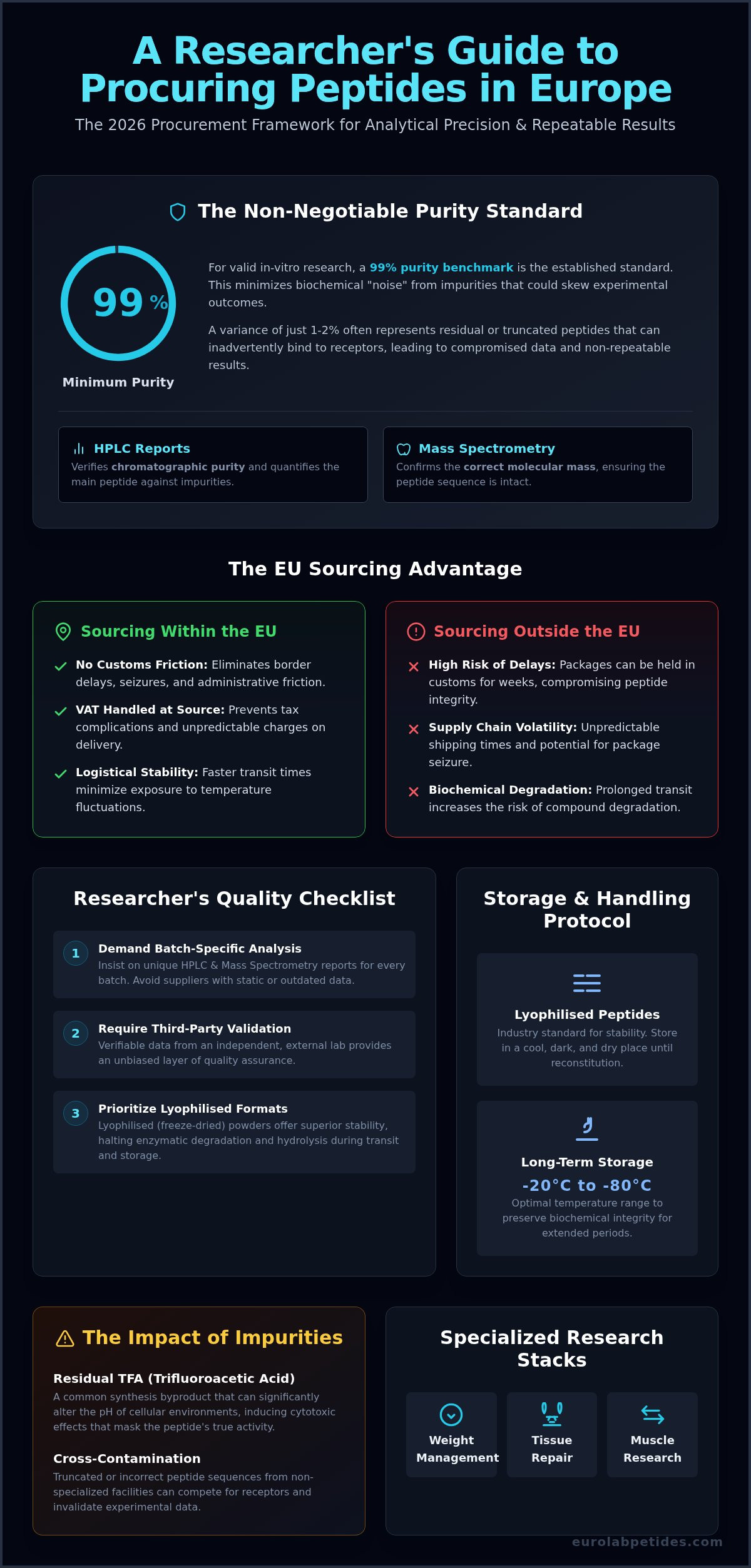
Scientific validity in a laboratory context begins with the absolute precision of the chemical reagents. For in-vitro studies, a purity threshold of 99% is the established benchmark for professional inquiry. When researchers buy research peptides online Europe, they’re seeking compounds where the margin for error is minimized to prevent biochemical noise from skewing experimental results. A 1% or 2% variance in purity often represents residual sequences or truncated peptides that can inadvertently bind to receptors, leading to compromised data. This level of chemical noise is unacceptable in high-stakes research environments.
The procurement of these compounds relies heavily on the physical state of the material. Lyophilised powders are the industry standard for stability. Through the process of freeze-drying, moisture is removed from the peptide, which effectively halts enzymatic degradation and hydrolysis. This ensures that the chemical structure remains intact during transit and long-term storage. For those who buy research peptides online Europe, prioritizing lyophilised formats is essential for maintaining the longevity of the research stack. Unlike peptides already in solution, which are prone to rapid degradation at room temperature, lyophilised powders offer the structural integrity required for rigorous biochemical analysis.
In-Vitro vs. Clinical Grade: Understanding the Distinction
Research-grade chemicals are synthesized exclusively for laboratory use. These substances don’t include the excipients, stabilizers, or fillers found in clinical-grade pharmaceuticals. This lack of additives is intentional; it ensures that the observed biological response is solely attributable to the peptide sequence. Within the European Union, these materials are governed by a specific legal framework that distinguishes “Research Use Only” (RUO) chemicals from medicinal products. This distinction is critical for maintaining compliance with regional regulations while ensuring that the laboratory environment remains free from pharmaceutical contaminants.
The Impact of Impurities on Research Outcomes
Impurities often arise as byproducts of chemical peptide synthesis. One of the most significant risks is the presence of residual Trifluoroacetic acid (TFA), a reagent used during the cleavage and purification stages. TFA can significantly alter the pH of cellular environments, potentially inducing cytotoxic effects that mask the true activity of the peptide. Cross-contamination in non-specialized facilities represents another variable that can invalidate laboratory work. It’s essential that peptides are sourced from suppliers who provide transparent, batch-specific HPLC and LC-MS reports. These analytical tools verify that the molecular mass and purity profile are consistent across every procured batch, which is the only way to ensure experimental reproducibility.
Strategic Advantages of Sourcing Research Peptides within Europe
The decision to buy research peptides online Europe from a supplier based within the European Union offers significant logistical and regulatory benefits over non-EU alternatives. Intra-community transit is governed by the principle of free movement of goods, which effectively removes the risk of border delays that compromise biochemical integrity. When shipping between member states, packages bypass the intensive customs inspections required for imports from the United States or Asia. This absence of customs friction ensures that the transit remains predictable and that the VAT is handled within the initial transaction, preventing the administrative delays that often occur at international borders. You don’t have to worry about the unpredictable holding times that characterize non-EU imports.
EU Logistical Integrity and Cold Chain Stability
Logistical speed is a primary determinant of chemical stability. While lyophilised peptides are more resilient than solution formats, they remain sensitive to extreme temperature fluctuations encountered in large international shipping hubs. By utilizing regional EU-based logistics, researchers minimize the time their compounds spend in non-climate-controlled environments. This is particularly critical when procuring a complex longevity research stack, where multiple sequences must arrive with identical structural integrity. Short-haul transit within the EU prevents the prolonged exposure to summer heat or winter frost that can occur when packages are held in unheated customs warehouses for days or weeks. It’s a matter of ensuring that the peptide’s primary structure is preserved from the point of synthesis to the point of laboratory receipt.
Regulatory Compliance for European Laboratory Supplies
European chemical suppliers operate under a rigorous framework of regional oversight that promotes manufacturing consistency. The EMA guideline on synthetic peptides, while primarily focused on medicinal applications, establishes a scientific baseline for purity and quality control that reputable research suppliers adopt. Sourcing within the Eurozone provides researchers with a layer of legal accountability and recourse not available when dealing with offshore entities. Localized support ensures that institutional procurement departments can communicate directly with suppliers who understand the specific regulatory requirements of European laboratories. This regional proximity allows for a more transparent chain of custody. For those prioritizing precision, choosing to source from a regional leader ensures that the procurement process reflects the same rigor as the research itself.
A Researcher’s Checklist for Supplier Validation and Quality Assurance
Verification is the cornerstone of scientific procurement. When institutional users buy research peptides online Europe, the burden of proof lies with the supplier to provide empirical evidence of chemical identity. Trust is replaced by a multi-level quality control protocol that utilizes external validation as a non-negotiable standard. A meticulous evaluation of analytical data is required before any commitment is made to a specific chemical inventory.
Technical Analysis: How to Read a HPLC/MS Report
High-Performance Liquid Chromatography (HPLC) is the gold standard for peptide purity verification in 2026. This method separates the components of a sample to identify the precise purity percentage, ensuring that the primary sequence is not diluted by truncated sequences or residual reagents. Liquid Chromatography-Mass Spectrometry (LC-MS) is then employed to verify the molecular weight and identity of the peptide against its theoretical mass. If the measured mass does not align with the biochemical specifications of the sequence, the material is considered compromised. Without these two metrics, the chemical identity of the substance remains speculative and unsuitable for rigorous laboratory inquiry.
Identifying Reliable COA (Certificate of Analysis) Documentation
A valid Certificate of Analysis (COA) must be batch-specific. Static reports that are reused across different manufacturing runs are insufficient for maintaining experimental reproducibility. Researchers should inspect documentation for specific warning signs that indicate a lack of transparency. Redacted laboratory names, contact information, or outdated timestamps that don’t align with the current manufacturing cycle are significant indicators of risk. Missing batch numbers prevent a clear chain of custody, making it impossible to trace the material back to its original synthesis run.
The utilization of certified peptides is a prerequisite for high-stakes longitudinal studies where even minor variations can invalidate months of data collection. EuroLab Peptides addresses this by featuring verifiable, third-party data for every product cataloged within the regional inventory. This transparency allows researchers to buy research peptides online Europe with the absolute security that the reagents meet the specified 99% purity benchmark. Peer feedback within specialized scientific communities serves as a final layer of validation. While anecdotal evidence is never a substitute for analytical data, the collective experience of institutional peers can highlight suppliers with consistent logistical stability and moral consistency in their synthesis processes.
Practical Procurement: Handling, Stability, and Storage Protocols
Successful in-vitro research requires meticulous attention to the biochemical integrity of reagents from the moment of receipt. When you buy research peptides online Europe, the transition from controlled transit to laboratory storage represents a critical phase in maintaining molecular stability. It’s a critical factor in ensuring that the synthesized sequences remain viable for their intended application. Upon arrival, vials must be inspected for seal integrity and the presence of a uniform lyophilised cake. Any signs of moisture or physical compromise suggest that the vacuum seal has failed, potentially exposing the peptide to atmospheric oxygen and humidity.
Long-term preservation of the primary sequence is achieved through deep-freeze storage. For periods exceeding 90 days, temperatures of -80°C are recommended to halt all enzymatic activity. For shorter durations, -20°C is generally sufficient provided the environment is stable. The inclusion of desiccant packs within secondary storage containers is a non-negotiable protocol to prevent moisture-induced hydrolysis. This chemical reaction can irreversibly cleave peptide bonds, rendering the compound useless for precise cellular modeling. Maintaining these standards is essential for all who buy research peptides online Europe for high-precision studies.
Maintaining Stability of Lyophilised Peptides
The shelf-life of vacuum-sealed lyophilised powders is significantly longer than that of reconstituted solutions. Once a vial is opened or the vacuum seal is breached, the degradation rate increases due to exposure to environmental variables. Laboratory protocols must strictly avoid repeated freeze-thaw cycles, as the resulting mechanical stress and temperature fluctuations cause structural denaturation. There is a notable variance in stability between different sequences. For example, bpc 157 exhibits relatively high stability compared to more fragile growth hormone secretagogues, which require even more stringent handling to prevent the loss of biological activity.
Reconstitution Protocols for In-Vitro Applications
Precision in concentration is paramount for the validity of dose-response data. Researchers should utilize a peptide reconstitution calculator to determine the exact volume of diluent required for their specific experimental parameters. The choice of diluent, whether bacteriostatic water or sterile saline, must align with the requirements of the cellular model under study. During the reconstitution process, the diluent should be introduced slowly down the side of the vial. Gentle swirling is required to achieve a clear solution; vigorous agitation or vortexing must be avoided to prevent peptide shear stress. Every vial should be clearly labeled with the date of reconstitution and the final concentration to ensure the accuracy of future assays. To ensure your laboratory is equipped with high-purity reagents, you can procure certified research-grade peptides directly from our regional inventory.
EuroLab Peptides: Precision Synthesis for Global Research
Chemical synthesis at the institutional level requires a partner that prioritizes empirical data over marketing claims. EuroLab Peptides serves as a specialized biochemical supplier for researchers who intend to buy research peptides online Europe with absolute certainty regarding batch consistency. The brand identity is defined by a commitment to analytical transparency, where quality is treated as a verifiable metric rather than a subjective promise. By maintaining a regional presence within the European Union, the organization ensures that the supply chain remains resilient against the logistical volatility often found in the global chemical market.
The inventory is categorized into functional research domains to support targeted inquiry. These include specialized sectors such as Longevity & Vitality Research, Weight Management Research, and Tissue Repair & Recovery Research. Each category is supported by specific formulations, such as the Muscle Research Stack or the Advanced Metabolic Stack, which are synthesized to meet the rigorous demands of modern biochemistry. This structured approach allows laboratories to procure comprehensive research sets with the assurance that every component has been validated through the same exacting protocols.
The EuroLab Multi-Level Quality Protocol
Product integrity is secured through a redundant testing framework. Every sequence, including complex growth hormone secretagogues like ipamorelin, is subjected to initial in-house synthesis verification before being dispatched for independent third-party validation. This process ensures that the 99% purity benchmark is met for every batch prior to cataloging. The results of these tests, including HPLC and Mass Spectrometry reports, are made accessible to the professional user to facilitate institutional record-keeping. This commitment to radical honesty provides a level of security that is essential for longitudinal studies where chemical variance can invalidate months of data collection. High-purity compounds are the only tools suitable for serious professional inquiry.
Streamlined Procurement for Scientific Institutions
Logistical excellence is achieved through a localized EU-to-EU distribution network. This regional focus allows for discrete, secure, and rapid shipping that avoids the delays and seizures associated with non-EU imports. Scientific institutions can buy research peptides online Europe through a transparent supply chain that respects the time-sensitive nature of laboratory work. Utilizing the EuroLab digital interface allows for efficient chemical sourcing, with options for bulk procurement to support large-scale studies. Every shipment is handled with the same level of precision applied to the synthesis process, ensuring that the biochemical integrity of the peptides is preserved from the facility to the lab. Secure high-purity research peptides from EuroLab Peptides today to ensure your experimental outcomes are based on the highest standards of chemical excellence.
Secure High-Purity Reagents for Your 2026 Research Objectives
The landscape of biochemical research in 2026 demands a shift from anecdotal trust to empirical validation. Success depends on precision. Ensuring the success of in-vitro studies requires a procurement strategy that prioritizes 99% purity standards and batch-specific analytical data. When you buy research peptides online Europe, the decision to source from regional suppliers effectively eliminates the variables of customs interference and logistical degradation. This methodical approach ensures that your laboratory reagents arrive with their primary structures intact; it’s a standard that allows for reproducible data and scientific clarity.
By adhering to a strict quality protocol that includes independent HPLC and Mass Spectrometry testing for every batch, researchers can maintain the highest standards of professional inquiry. Regional EU-based shipping provides the necessary tax-free and rapid transit to support time-sensitive experimental timelines. Selecting a partner that values transparency and radical accountability is the final step in establishing a stable research environment. You’re encouraged to Browse our catalog of third-party tested research peptides to secure the high-purity tools required for your next study. Your commitment to precision is the foundation of scientific discovery.
Frequently Asked Questions
Are research peptides legal to buy online in Europe?
Research peptides are legal to buy online in Europe when they’re classified strictly for in-vitro laboratory research. Under EU Directive 2001/83/EC, substances not intended for therapeutic use fall outside medicinal regulations. However, individual member states may have specific restrictions on certain sequences. It’s essential that these compounds are labeled “not for human consumption” to maintain their status as research chemicals within the single market.
How can I verify the purity of peptides from an online supplier?
Purity verification is achieved through High-Performance Liquid Chromatography (HPLC) and Liquid Chromatography-Mass Spectrometry (LC-MS). HPLC identifies the percentage of the target peptide relative to impurities, while LC-MS confirms the molecular mass of the sequence. To buy research peptides online Europe with confidence, researchers must demand batch-specific reports that correlate directly with the physical inventory received. Analytical data provides the only objective proof of quality.
What is the difference between research-grade and pharmaceutical-grade peptides?
Research-grade peptides are synthesized for maximum chemical purity without the addition of pharmaceutical excipients or stabilizers. Pharmaceutical-grade products are formulated for clinical administration and must meet different regulatory standards for sterile manufacturing. For in-vitro applications, the absence of additives is preferred to ensure that experimental observations are solely attributable to the peptide sequence itself. This prevents excipients from interfering with cellular study results.
Why is third-party testing essential for research peptides?
Independent third-party testing is a non-negotiable standard for establishing objective validity. It provides a secondary layer of verification that eliminates the potential for supplier bias or internal error. In a market where batch-to-batch consistency is critical, external validation ensures that every vial meets the 99% purity threshold required for high-stakes scientific inquiry. It’s the primary mechanism for ensuring accountability in the chemical synthesis space.
How long do research peptides remain stable during shipping within the EU?
Lyophilised peptides remain stable for several weeks during standard EU-to-EU transit durations. The freeze-drying process removes moisture, which effectively halts the primary pathways of degradation like hydrolysis. By utilizing regional shipping, the time spent in non-climate-controlled environments is minimized, protecting the structural integrity of the longevity research stack from the extreme temperature fluctuations common in international logistics. Regional transit typically takes three to five days.
Can I buy research peptides for personal use in Europe?
No, these compounds cannot be purchased for personal use or clinical administration. EuroLab Peptides operates strictly as a chemical supplier for in-vitro research and laboratory development. All products are sold with the explicit understanding that they aren’t for human or animal consumption. Any use outside of a controlled laboratory environment violates the terms of procurement and regional regulatory guidelines. We don’t provide medical advice.
What should I look for in a peptide Certificate of Analysis (COA)?
A legitimate Certificate of Analysis (COA) must feature an unredacted laboratory name, a batch-specific identification number, and a recent timestamp. It must include an HPLC chromatogram showing a purity of at least 99% and a mass spectrometry plot confirming the peptide’s identity. Generic or “static” reports that lack batch-specific data are considered insufficient for professional quality assurance. Verified data is the only benchmark for reliability.
How does EuroLab Peptides ensure product consistency across different batches?
Consistency is ensured through a multi-level quality control protocol that begins with in-house synthesis verification. Every production run is then subjected to independent third-party laboratory testing before it is cataloged for sale. This redundant process guarantees that the chemical specifications remain uniform across different batches, providing the reproducibility required for institutional-grade research. We prioritize scientific accuracy over marketing claims to instill absolute security in the professional user.
