

In the rigorous landscape of peptide biochemistry, a purity claim lacking a lot-specific mass spectrometry report remains a mere hypothesis. For the professional researcher, the primary challenge isn’t simply sourcing material, but ensuring that the chemical identity remains consistent across multiple experimental phases. We understand that batch-to-batch variability and a lack of transparency in synthesis methods can fundamentally jeopardize longitudinal data. When you buy Tesamorelin for laboratory analysis, the integrity of your results hinges upon the verifiable metrics of the compound’s primary structure and its stability during transit.
This technical guide establishes a standardized roadmap for the procurement of high-purity Tesamorelin, focusing on the interpretation of analytical Certificates of Analysis (COA) and the maintenance of structural integrity in a laboratory setting. We’ll examine the critical necessity of ≥99% purity thresholds as verified by High-Performance Liquid Chromatography (HPLC) and the importance of stabilized logistics within European regulatory frameworks. By prioritizing empirical validation over anecdotal quality claims, you can ensure that your in-vitro studies are supported by the highest available standard of chemical synthesis in 2026.
Key Takeaways
- Define the stabilized 44-amino acid sequence and specific hexenoyl group modifications that characterize research-grade Tesamorelin.
- Establish a minimum analytical purity threshold of ≥99.0% as a non-negotiable metric when you buy Tesamorelin for laboratory analysis.
- Learn to interpret lot-matched HPLC and Mass Spectrometry data to verify chemical identity and ensure the absence of synthesis-related impurities.
- Implement standardized laboratory handling protocols, including maintaining thermal stability at -20°C or -80°C to preserve peptide structural integrity.
- Prioritize procurement through European suppliers utilizing independent third-party validation and localized cold-chain logistics to ensure batch consistency.
Technical Specifications of Research-Grade Tesamorelin
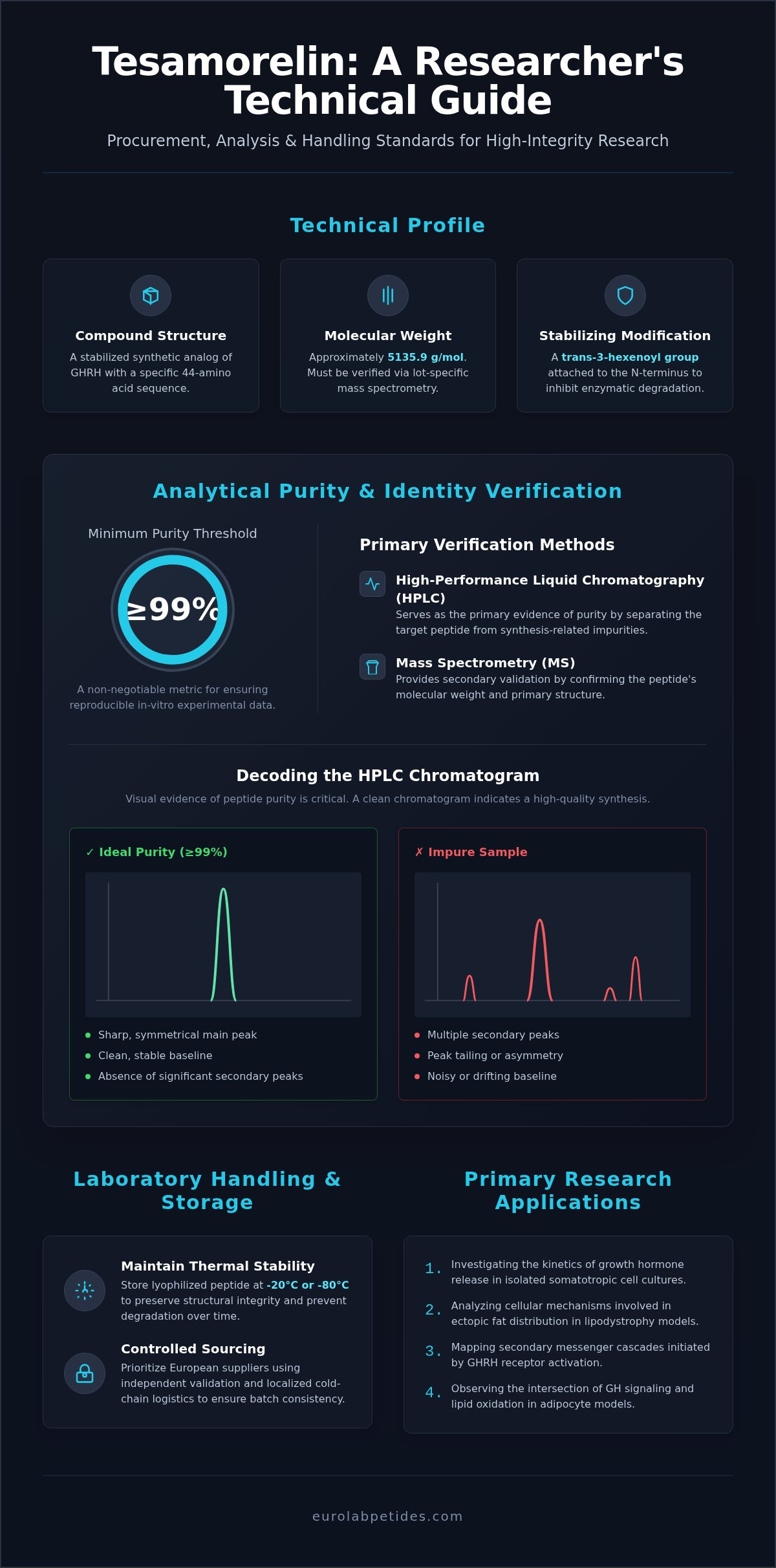
Tesamorelin is defined as a synthetic analog of human growth hormone-releasing hormone (GHRH). It’s composed of a specific 44-amino acid sequence that mirrors the endogenous peptide but incorporates a critical modification at the N-terminus to enhance metabolic stability. When professionals buy Tesamorelin for laboratory analysis, they’re acquiring a compound engineered for increased resistance to enzymatic cleavage. The molecular weight is established at approximately 5135.9 g/mol; however, this value should be verified against lot-specific data provided in the Certificate of Analysis (COA). Ensuring the structural integrity of this 44-amino acid chain is paramount for maintaining the reproducibility of in-vitro experimental data.
Primary research applications for this peptide include:
- In-vitro pituitary GH secretion: Investigating the kinetics of growth hormone release in isolated somatotropic cell cultures.
- Lipodystrophy models: Analyzing cellular mechanisms involved in ectopic fat distribution and metabolic dysfunction.
- Signal transduction studies: Mapping the secondary messenger cascades initiated by GHRH receptor activation.
- Metabolic pathway analysis: Observing the intersection of GH signaling and lipid oxidation in adipocyte models.
The Stabilizing Hexenoyl Group
The defining structural attribute of Tesamorelin is the attachment of a trans-3-hexenoyl group to the N-terminal tyrosine residue. Endogenous GHRH is highly susceptible to rapid enzymatic cleavage by dipeptidyl peptidase IV (DPP-IV). This specific modification provides a steric barrier that inhibits such degradation, effectively extending the peptide’s half-life within experimental mediums. For researchers conducting extended laboratory observations, this resistance ensures that the peptide remains biologically active throughout the duration of the incubation period, preventing the premature loss of signal intensity that often complicates studies involving non-stabilized peptides.
In-Vitro Mechanism of Action
In a controlled laboratory environment, the peptide functions as a highly specific agonist of the GHRH receptor (GHRHR). This Tesamorelin technical overview confirms that the binding interaction stimulates the G-protein coupled receptor complex. This activation subsequently triggers the adenylate cyclase pathway, resulting in a measurable elevation of intracellular cyclic adenosine monophosphate (cAMP). This signaling cascade is essential for studying the regulated secretion of growth hormone and its downstream effects on cellular metabolism. Researchers utilize these pituitary cell lines to observe how the somatotropic axis responds to varying concentrations of the analog, providing objective data on receptor saturation and signaling efficiency.
Evaluating Purity and Identity: Interpreting Analytical Data
Analytical grade peptides require a minimum purity threshold of ≥99.0% to ensure that experimental variables aren’t influenced by synthesis-related artifacts. When you buy Tesamorelin for laboratory analysis, the accompanying Certificate of Analysis (COA) must provide raw data rather than summarized percentages. Purity isn’t a static value; it’s a verifiable metric derived from the absence of truncated sequences and residual trifluoroacetic acid (TFA). High-stakes research demands that every batch undergoes rigorous validation via High-Performance Liquid Chromatography (HPLC) and Mass Spectrometry (MS) to confirm that the chemical identity matches the theoretical model.
Decoding the HPLC Chromatogram
The HPLC chromatogram serves as the primary evidence of peptide purity. Researchers must identify the retention time of the Tesamorelin peak, which should appear as a sharp, symmetrical signal with minimal tailing. Analyzing baseline noise and secondary peaks is critical for detecting impurities that could interfere with cellular signaling assays. The Area Under the Curve (AUC) remains the definitive metric for calculating purity, as it represents the ratio of the target peptide to all other detected substances within the sample. A clean baseline between 5 and 15 minutes of elution typically indicates a well-purified product, while multiple minor peaks suggest batch-to-batch inconsistency that could compromise in-vitro results.
Mass Spectrometry Verification
Mass Spectrometry provides the necessary secondary validation by confirming the peptide’s molecular weight. The observed mass-to-charge (m/z) ratio must align with the theoretical molecular weight of approximately 5135.9 g/mol. In high-molecular-weight peptides like Tesamorelin, understanding the isotopic distribution is essential for distinguishing the target molecule from closely related analogs. Mass spectrometry provides the definitive verification of sequence identity by mapping the specific fragmentation pattern of the 44-amino acid chain. This level of detail ensures that the hexenoyl modification is correctly positioned at the N-terminus. For those requiring localized logistics and rigorous testing standards, you can source analytical-grade peptides that include these lot-matched data sets as standard documentation.
Beyond purity and identity, endotoxin analysis is an essential requirement for maintaining cell culture viability. High endotoxin levels can trigger inflammatory responses in pituitary cell lines, leading to false-positive data in signaling studies. While Tesamorelin drug information from MedlinePlus provides context on its pharmacological profile, the researcher’s responsibility lies in verifying that the research-grade material is free from bacterial contaminants. Every analytical inquiry should conclude with a review of the Limulus Amebocyte Lysate (LAL) test results to ensure endotoxin levels remain within acceptable laboratory limits, typically below 0.1 EU/mg.
Sourcing Standards: Identifying Reliable European Suppliers
Procurement for sensitive biochemicals requires a focus on regional logistics and verifiable certification. When you buy Tesamorelin for laboratory analysis, the proximity of the supplier directly impacts the structural integrity of the peptide. It’s established that European-based sourcing minimizes the duration of transit through varying climate zones, reducing the cumulative thermal stress on the lyophilized cake. Adherence to European chemical supply regulations ensures that materials are categorized strictly for in-vitro research, maintaining legal and professional compliance for institutional laboratories. Rigorous sourcing standards are the only way to mitigate the risks of batch-to-batch inconsistency often found in unregulated markets.
Third-Party Testing vs. In-House Claims
Self-certified purity reports present an inherent conflict of interest that can compromise the objective nature of scientific inquiry. Reliable procurement relies on independent third-party validation from accredited analytical laboratories specializing in peptide synthesis. These external reports should be cross-referenced with the supplier’s lot number to ensure the data corresponds exactly to the received vial. Verifying the authenticity of PDF certificates involves checking for laboratory credentials, analyst signatures, and date stamps that align with current synthesis batches. High-resolution HPLC chromatograms and MS spectra must be legible and free from digital manipulation. For a broader perspective on these requirements, consult How to Buy Research Peptides: A 2026 Guide.
European Logistics and Stability
Thermal degradation remains a primary concern during cross-border shipping. While lyophilization provides significant stability, prolonged exposure to temperatures exceeding 25°C can initiate peptide fragmentation and reduce binding affinity. Localized European logistics allow for climate-controlled shipping and expedited delivery times, often within 24 to 48 hours. Standardized packaging for research peptides must include vacuum-sealed vials and protective insulation to prevent mechanical damage. Precise documentation, including Safety Data Sheets (SDS) and technical specifications, is required for seamless laboratory procurement within the EU. Detailed Tesamorelin Handling and Safety Protocols should be reviewed to align laboratory intake procedures with recognized safety standards. This methodical approach to sourcing is essential when you buy Tesamorelin for laboratory analysis to guarantee that the biochemical properties of the peptide are preserved from the point of synthesis to the final analysis.
Laboratory Handling, Reconstitution, and Storage Protocols
Upon receipt of the shipment, the primary objective is the verification of physical integrity. The vacuum seal must be intact to prevent moisture ingress, which can lead to premature peptide hydrolysis. A uniform lyophilized cake suggests that the product remained stable during transit and was not exposed to excessive humidity or mechanical stress. When you buy Tesamorelin for laboratory analysis, these baseline physical checks are the first step in maintaining the validity of your experimental model.
Long-term stability is achieved by maintaining the lyophilized powder at -20°C or -80°C. While many GHRH analogs are sensitive to temperature fluctuations, the hexenoyl modification in Tesamorelin provides slightly better resilience against spontaneous degradation compared to non-modified counterparts like Sermorelin. Despite this increased stability, sub-zero storage remains the standard for preserving sequence integrity over a 12 to 24-month period. Exposure to light and ambient moisture should be minimized to prevent oxidative stress on the amino acid chain.
Reconstitution Media Selection
The choice of diluent is dictated by the intended duration of the study and the sensitivity of the cell culture. Sterile Water for Injection (USP) is preferred for immediate in-vitro applications to avoid the potential cytotoxic effects of preservatives. Conversely, Bacteriostatic Water containing 0.9% benzyl alcohol is utilized when the reconstituted solution is required for multiple samplings over several days. Tesamorelin displays optimal solubility at a near-neutral pH; deviations into extreme acidity or alkalinity can compromise the peptide’s secondary structure. During the dissolution process, the diluent should be introduced slowly down the side of the vial. Vigorous agitation or vortexing must be avoided, as high shear forces can cause peptide aggregation or denaturation. For precise concentration calculations, researchers should utilize a Peptide Reconstitution Calculator to ensure experimental accuracy.
Aliquotting for Precision
Potency is significantly compromised by repeated freeze-thaw cycles, which introduce mechanical stress to the peptide bonds. To maintain maximum stability, the total volume should be divided into single-use aliquots immediately after reconstitution. These aliquots are then stored at 2°C to 8°C for short-term use. Once in a solution state, the shelf-life of Tesamorelin is limited; it’s generally recommended that the solution be utilized within 7 to 14 days to ensure that degradation products don’t skew analytical results. Adhering to these strict protocols ensures that when you buy Tesamorelin for laboratory analysis, the chemical identity remains consistent with the initial COA data. To secure high-purity compounds for your next project, explore our research-grade peptide selection.
Procurement Quality Assurance at EuroLab Peptides
EuroLab Peptides operates as a specialized technical partner for the European scientific community. Our internal framework is built on a multi-level quality protocol that bridges the gap between chemical synthesis and analytical validation. Every batch of Tesamorelin is subjected to a sequence of rigorous checkpoints to ensure that the final product meets the precise demands of longitudinal research. This commitment to transparency is a core component of our identity, providing researchers with the empirical data necessary to eliminate chemical variability as a confounding factor in their studies.
The EuroLab Synthesis Standard
Solid-phase peptide synthesis (SPPS) is utilized to achieve high-yield precision and sequence accuracy. This methodology allows for the controlled assembly of the 44-amino acid chain, ensuring that the hexenoyl modification is integrated with absolute fidelity. Following synthesis, the crude peptide undergoes multiple purification stages via preparative HPLC to remove truncated sequences and synthesis-related byproducts. We conduct stability testing under various environmental stressors to confirm that the lyophilized cake maintains its structural integrity throughout the logistical chain. These internal standards ensure that when you buy Tesamorelin for laboratory analysis, the material is optimized for high-resolution in-vitro applications.
Professional Procurement Support
Procuring research-grade biochemicals requires a partner that understands institutional requirements. We provide comprehensive technical support for all analytical inquiries, ensuring that researchers can interpret lot-matched COAs with confidence. These downloadable data sets provide the specific HPLC and Mass Spectrometry results for every unique batch, establishing a verifiable trail of quality. Transactions are processed through secure, encrypted systems designed for the administrative needs of European universities and private laboratories.
Our logistics network is optimized for regional delivery, utilizing localized hubs to ensure that transit times remain minimal. Comprehensive tracking is provided for every shipment, allowing for precise laboratory intake planning. It’s imperative to recognize that all products are sold strictly for in-vitro laboratory development. We maintain a zero-tolerance policy regarding human consumption, ensuring that our operations remain fully compliant with regional regulatory standards. This methodical approach to delivery and documentation reinforces our role as a reliable partner in the chemical synthesis space.
Securing Empirical Integrity for Advanced Laboratory Inquiry
The success of in-vitro somatotropic research depends on the absolute consistency of the biochemical tools employed. As established throughout this guide, the verification of a ≥99.0% purity threshold through lot-matched HPLC and mass spectrometry is a non-negotiable standard for professional inquiry. Maintaining structural integrity requires not only precise reconstitution protocols but also a procurement strategy that prioritizes localized European logistics to mitigate thermal stress. When you buy Tesamorelin for laboratory analysis, the objective data provided in the Certificate of Analysis serves as the definitive benchmark for your experimental reproducibility.
EuroLab Peptides supports these rigorous demands through a multi-level quality control protocol and strict adherence to analytical-grade standards. Our European-based logistics and independent laboratory testing ensure that every batch remains compliant with the high-stakes precision required by the specialized scientific community. We understand that serious research doesn’t allow for batch-to-batch inconsistency. By removing chemical variability, researchers can focus exclusively on signal transduction and cellular signaling outcomes. You may Procure High-Purity Tesamorelin for Laboratory Research to ensure your next study is supported by verifiable excellence. We look forward to facilitating your next phase of discovery with technical precision.
Frequently Asked Questions
Is Tesamorelin sold by EuroLab Peptides intended for human use?
No, all peptides sold are strictly for in-vitro laboratory research and development. They aren’t intended for human or veterinary use, nor are they pharmaceuticals or medicines. Every vial is clearly labeled for research use only to comply with regional regulatory standards. EuroLab Peptides maintains a zero-tolerance policy regarding any off-label use. Researchers must ensure their protocols align with institutional safety guidelines and legal requirements for chemical handling.
What is the verified purity level of your Tesamorelin batches?
The standard purity for every batch of Tesamorelin is verified at ≥99.0%. This metric is established through High-Performance Liquid Chromatography (HPLC) and Mass Spectrometry (MS) analysis. When you buy Tesamorelin for laboratory analysis, you receive a compound that has undergone a multi-level quality control protocol. This rigorous testing identifies the primary peak area and ensures the absence of synthesis-related impurities or truncated sequences that could otherwise compromise experimental data.
How do I access the Certificate of Analysis for my specific lot?
Lot-matched Certificates of Analysis (COA) are accessible directly through the EuroLab Peptides website. Every batch is assigned a unique lot number that corresponds to specific analytical data sets, including HPLC chromatograms and MS spectra. Researchers can download these PDF certificates to verify the chemical identity and purity of their specific shipment. This transparency ensures that the material used in your study matches the theoretical specifications required for high-precision somatotropic signaling analysis.
What are the recommended storage temperatures for lyophilized Tesamorelin?
Lyophilized Tesamorelin should be stored at temperatures of -20°C or -80°C to maintain maximum structural stability. While the hexenoyl modification provides enhanced resistance to enzymatic degradation, the peptide remains sensitive to thermal fluctuations over extended periods. Maintaining a consistent sub-zero environment prevents spontaneous hydrolysis and preserves the 44-amino acid sequence. Once reconstituted, the solution should be kept at 2°C to 8°C and utilized within 7 to 14 days for optimal results.
Does EuroLab Peptides ship research peptides globally?
EuroLab Peptides provides global coverage for all research-grade products. While our primary logistics hubs are located within Europe to ensure rapid localized delivery, we maintain a robust international shipping network. Every shipment includes comprehensive tracking and standardized packaging to protect the vacuum-sealed vials. Institutional buyers benefit from our experience in navigating cross-border chemical supply regulations, ensuring that research materials arrive at their destination while maintaining their verified analytical specifications and structural integrity.
Can I use bacteriostatic water for Tesamorelin reconstitution in cell culture?
Bacteriostatic water containing 0.9% benzyl alcohol is suitable for multi-sampling protocols where microbial inhibition is required. However, for sensitive in-vitro cell culture models, sterile water for injection is often preferred. The presence of benzyl alcohol can sometimes induce cytotoxic responses in pituitary cell lines, potentially skewing data in signaling assays. Researchers should evaluate the sensitivity of their specific biological model before selecting a reconstitution medium to ensure that the diluent doesn’t interfere with cellular viability.
What is the molecular weight of Tesamorelin used in your laboratory analysis?
The theoretical molecular weight of Tesamorelin is established at approximately 5135.9 g/mol. This value represents the 44-amino acid sequence combined with the N-terminal trans-3-hexenoyl modification. When you buy Tesamorelin for laboratory analysis, the observed molecular weight is confirmed for each batch using mass spectrometry. This verification ensures that the peptide’s primary structure is correct and that the stabilizing hexenoyl group is properly attached, which is essential for accurate binding affinity studies.
How is Tesamorelin protected from degradation during shipping?
Peptides are protected through a combination of lyophilization and vacuum sealing within high-grade borosilicate glass vials. This process removes moisture and oxygen, which are the primary catalysts for chemical degradation. Our localized European logistics minimize the duration of transit, reducing cumulative thermal exposure. Standardized insulated packaging is utilized to provide a buffer against mechanical stress and ambient temperature spikes, ensuring the lyophilized cake remains intact and biologically active upon arrival at the laboratory.
