
The experimental utility of a Growth Hormone Releasing Hormone (GHRH) analogue is dictated by its molecular half-life, yet research integrity is frequently compromised by a failure to distinguish between the structural modifications of the cjc peptide. It’s recognized that navigating the technical nuances between Drug Affinity Complex (DAC) and non-conjugated versions remains a primary challenge for laboratory professionals. Ambiguity regarding peptide stability and a lack of accessible, third-party verified purity data often hinder the execution of standardized research protocols.
This review serves as a definitive scientific examination of CJC-1295 for the 2026 research landscape, prioritizing objective analytical data. You’ll obtain a clear understanding of specific pharmacokinetic profiles and validated reconstitution protocols essential for serious professional inquiry. The following analysis details the structural differences between variants, the impact of regional manufacturing standards on chemical synthesis, and the rigorous metrics required to ensure the acquisition of high-purity research materials strictly for in-vitro applications.
Key Takeaways
- Distinguish between the structural modifications of CJC-1295 with and without the Drug Affinity Complex (DAC) to accurately predict experimental half-life variations and metabolic impact.
- Understand the molecular mechanism of the cjc analogue, specifically its binding affinity for the GHRH receptor and the subsequent activation of the cAMP signaling pathway in pituitary somatotropes.
- Adopt standardized laboratory handling and reconstitution protocols, utilizing lyophilized storage at -20°C to preserve the structural integrity and stability of the peptide.
- Verify the purity and sequence accuracy of research materials through mandatory third-party HPLC and Mass Spectrometry analytical reports before commencing in-vitro studies.
CJC-1295: A Synthetic GHRH Analogue for Growth Hormone Research
CJC-1295 is a 30-amino acid synthetic analogue of endogenous Growth Hormone Releasing Hormone (GHRH). It’s engineered to facilitate the release of growth hormone from the anterior pituitary gland by targeting specialized cells known as somatotropes. Historically, the development of CJC-1295 was driven by the inherent limitations of naturally occurring GHRH, which possesses a half-life of approximately seven minutes. This rapid degradation by dipeptidyl peptidase-4 (DPP-4) necessitated structural modifications to extend research viability in laboratory settings. The molecule is currently investigated in cellular models for its role in tissue repair and metabolic regulation.
The Biochemical Foundation of GHRH Analogues
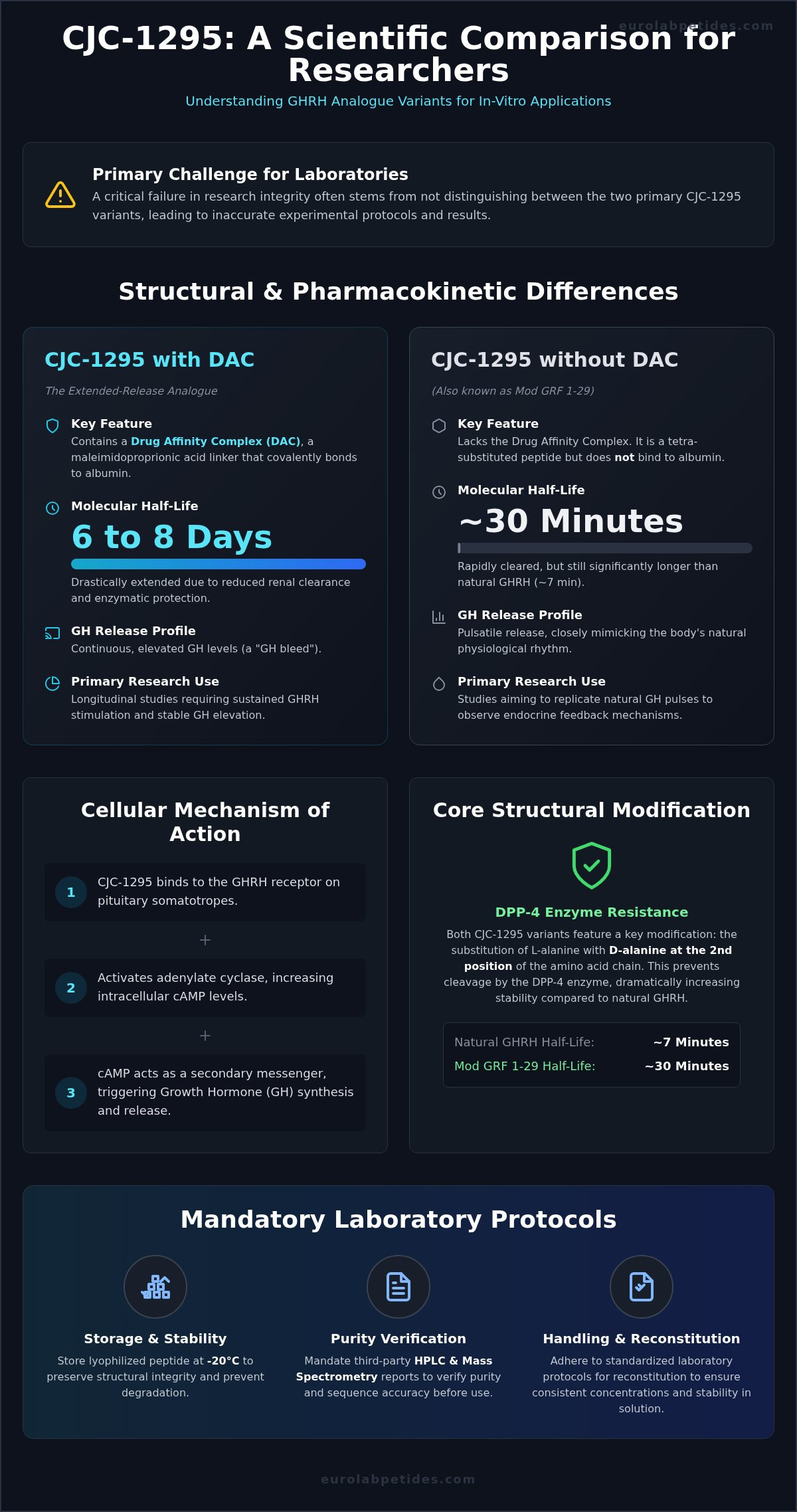
Endogenous GHRH consists of 44 amino acids, but biological activity is localized within the first 29 residues. CJC-1295 utilizes this truncated 1-29 sequence while introducing specific substitutions to enhance enzymatic resistance. Structural modifications at the N-terminus, particularly the substitution of L-alanine with D-alanine at the second position, prevent the cleavage typically executed by DPP-4. These alterations ensure that the cjc molecule maintains its affinity for the GHRH receptor (GHRHR) for a significantly longer duration than its natural counterpart. The 1-29 amino acid sequence remains the minimal essential fragment required for receptor binding and the initiation of secondary signaling pathways.
Research Utility in Metabolic Studies
In vitro metabolic studies utilize this analogue to examine the complexities of the GH/IGF-1 axis. Researchers employ the peptide to observe impacts on cellular proliferation and protein synthesis models, providing empirical data on how GHRH stimulation influences metabolic flux and tissue regeneration. It’s a foundational tool in longevity research, where scientists investigate the modulation of cellular aging pathways. By stimulating secretion patterns that mimic physiological pulses, the cjc analogue allows for the observation of natural feedback mechanisms within the endocrine system. This biochemical precision makes it an elite tool for serious professional inquiry into growth hormone dynamics.
The peptide’s interaction with the GHRH receptor triggers the activation of adenylate cyclase, leading to an increase in intracellular cyclic adenosine monophosphate (cAMP). This secondary messenger system is critical for the synthesis and release of growth hormone. Because the peptide is sold strictly for in-vitro research and laboratory development purposes, its application is confined to controlled environments where variables such as concentration and stability can be meticulously monitored. Understanding these biochemical foundations is a prerequisite for any rigorous laboratory protocol involving GHRH analogues.
The Structural Differences: CJC-1295 DAC vs. CJC-1295 (Modified GRF 1-29)
The distinction between CJC-1295 variants is defined by the presence of the Drug Affinity Complex (DAC), a structural modification that fundamentally alters the peptide’s pharmacokinetic profile. While both versions share a common 29-amino acid core, their experimental utility in metabolic research depends on the desired duration of action. The choice between these variants is a critical decision point in the design of in-vitro models. Understanding the covalent bonding properties of the DAC version compared to the rapid clearance of the non-conjugated form is essential for maintaining experimental precision.
CJC-1295 with DAC: The Extended Release Model
The inclusion of a maleimidoproprionic acid linker allows the cjc molecule to form a covalent bond with endogenous albumin. This conjugation significantly reduces renal clearance and protects the peptide from enzymatic degradation. Analytical data indicates that this modification extends the half-life from minutes to approximately 6 to 8 days. This version is utilized in research models requiring continuous growth hormone elevation rather than physiological pulses. For laboratories conducting longitudinal studies, the stability of this variant in aqueous solution is a primary technical specification. The reduced frequency of administration required in laboratory settings makes it a preferred tool for long-term observation of metabolic regulation.
CJC-1295 without DAC (Modified GRF 1-29)
The variant frequently referred to as “CJC-1295 No DAC” is technically identified as Modified GRF 1-29. It lacks the albumin-binding linker, resulting in a rapid half-life of approximately 30 minutes. This pharmacokinetic profile is essential for simulating the natural, pulsatile release of growth hormone observed in biological systems. Peak plasma concentrations are achieved quickly, followed by a rapid decline, allowing researchers to observe acute cellular responses without the sustained receptor saturation associated with the DAC version. This version is often preferred for studies focusing on the immediate GH/IGF-1 axis response to GHRH stimulation.
Selection criteria for these elite tools depend on the specific research objective:
- Continuous Stimulation: CJC-1295 with DAC is preferred for investigating long-term metabolic shifts and protein synthesis.
- Pulsatile Simulation: Modified GRF 1-29 is the standard for modeling endogenous endocrine rhythms.
- Stability Requirements: DAC versions offer superior resistance to degradation in complex media.
Maintaining the integrity of these biochemical studies requires high-purity materials. Researchers can source third-party verified peptides to ensure that structural modifications meet the rigorous demands of specialized laboratory inquiry. Every batch is subjected to multi-level quality control to verify the presence or absence of the DAC linker as specified.
Mechanisms of Action in Metabolic and Tissue Repair Models
The biological activity of the cjc analogue is mediated through its high binding affinity for the Growth Hormone Releasing Hormone Receptor (GHRHR), a G-protein coupled receptor located on the membrane of pituitary somatotropes. Upon ligand-receptor engagement, a conformational change activates the Gs alpha subunit, which subsequently stimulates adenylate cyclase. This enzymatic activation catalyzes the conversion of adenosine triphosphate (ATP) into cyclic adenosine monophosphate (cAMP). As a critical secondary messenger, cAMP initiates a cascade involving protein kinase A (PKA), leading to the phosphorylation of cAMP response element-binding (CREB) proteins and the subsequent transcription and secretion of growth hormone.
Research models often evaluate the synergistic potential of cjc when analyzed alongside Growth Hormone Secretagogues (GHS). While GHRH analogues increase the amplitude of GH pulses by stimulating the GHRHR, GHS molecules target the ghrelin receptor to increase the frequency of secretagogue release. Observations in ipamorelin co-administration studies suggest a potentiation effect, where dual-receptor activation results in a greater GH output than the sum of individual applications. This dual-pathway stimulation remains a primary focus in laboratory development for metabolic research stacks.
Stimulation of Somatotropic Secretion
In vitro quantification of growth hormone in cellular supernatants provides a measurable metric of secretagogue efficacy. Following administration of the peptide, researchers observe a correlated upregulation of Insulin-like Growth Factor 1 (IGF-1) mRNA expression in hepatic cell cultures. This somatotropic axis response is subject to complex feedback inhibition mechanisms. In pituitary cell cultures, elevated GH and IGF-1 levels trigger the release of somatostatin, which acts as a physiological brake by inhibiting adenylate cyclase activity, thus modulating the secretion rate to prevent excessive GH accumulation in the experimental model.
Tissue Recovery and Cellular Repair Research
Investigation into tissue repair models reveals that GH stimulation influences cellular architecture through several distinct pathways. In fibroblast models, analytical data shows an increase in collagen synthesis, which is critical for structural integrity in connective tissue research. Myoblast differentiation studies also indicate that GH-mediated IGF-1 upregulation supports the proliferation of satellite cells, which is a key factor in muscle tissue repair models. Additionally, research into inflammatory modulation within localized tissue environments suggests that the GH/IGF-1 axis may influence the expression of pro-inflammatory cytokines, providing a basis for serious professional inquiry into recovery-based research stacks.
Laboratory Protocol: Handling, Stability, and Reconstitution of CJC
The preservation of structural integrity in the cjc analogue is a critical requirement for ensuring the reproducibility of in-vitro experimental data. Lyophilized peptides are inherently susceptible to thermal and mechanical degradation, necessitating a standardized approach to storage and handling. For long-term stability, peptides must be stored in a lyophilized state at -20°C. Maintaining this temperature prevents the hydrolytic cleavage of peptide bonds and minimizes the risk of oxidation. Exposure to ambient temperatures for extended periods can result in irreversible conformational changes, which compromise the binding affinity of the molecule during laboratory inquiry.
Reconstitution and Solution Stability
The reconstitution process must be executed with high-stakes precision to avoid the denaturation of the peptide chain. Every step in this laboratory protocol is designed to mitigate mechanical stress and ensure a homogenous solution for precise dosing.
- Step 1: The vial must be allowed to reach room temperature before the introduction of any solvent. This prevents the formation of condensation within the vial, which can introduce moisture-induced degradation.
- Step 2: The diluent, typically Bacteriostatic Water (0.9% benzyl alcohol) or sterile saline, is introduced gradually by allowing the liquid to flow down the interior wall of the vial. Direct impingement of the liquid onto the lyophilized powder can cause mechanical shearing.
- Step 3: A visual inspection is conducted to ensure complete dissolution. The resulting solution must be clear and free of particulate matter. Mechanical agitation, such as shaking, is strictly prohibited; instead, a gentle swirling motion is employed to facilitate clarity.
Concentrations are calculated based on the total mass of the peptide (e.g., 2mg or 5mg) and the volume of the diluent added. For example, the addition of 2mL of diluent to a 2mg vial yields a concentration of 1mg/mL, allowing for precise volumetric measurement in laboratory models.
Long-term Storage and Degradation Prevention
Once reconstituted, the stability of the solution is significantly reduced compared to its lyophilized form. Vials must be stored at refrigerated temperatures between 2°C and 8°C to maintain biological activity. Protection from UV light and oxidative stressors is non-negotiable, as peptide bonds are highly sensitive to photochemical degradation. Analytical data indicates that reconstituted CJC-1295 maintains approximately 95% of its original purity when stored at 2-8°C for a duration of 30 days, provided it is shielded from light and oxidative exposure. Beyond this threshold, the risk of primary sequence degradation increases, potentially confounding experimental results.
To ensure the highest baseline purity for these rigorous protocols, researchers should source analytical-grade CJC-1295 from verified European suppliers that provide comprehensive third-party testing for every batch. Utilizing high-purity materials is the only method to guarantee that the results of metabolic research are a reflection of the peptide’s mechanism rather than the presence of contaminants.
Sourcing High-Purity CJC-1295 for Professional Research
The validity of growth hormone research is inextricably linked to the chemical purity of the cjc analogue. In laboratory settings, even trace contaminants can interfere with receptor binding kinetics or induce unintended cellular responses, effectively compromising the integrity of the data. High-Performance Liquid Chromatography (HPLC) and Mass Spectrometry (MS) analysis are the non-negotiable standards for peptide verification. These analytical tools provide an empirical map of the molecular weight and the primary amino acid sequence, ensuring that the material matches the theoretical structure of CJC-1295. Purity levels exceeding 99% are considered the benchmark for serious professional inquiry, as they minimize the presence of truncated sequences or residual solvents from the synthesis process.
EuroLab Peptides Quality Assurance
The synthesis of these compounds is governed by rigorous European manufacturing standards, where quality is presented as a verifiable metric rather than a marketing claim. Every batch of the peptide is subjected to a multi-level quality control protocol. This process begins with the raw material validation and concludes with final product testing by independent laboratories. Transparency is maintained through the provision of comprehensive analytical reports to the research community, allowing for absolute accountability. Regional logistics are optimized for the European landscape, ensuring that time-sensitive laboratory projects receive materials through localized, efficient delivery channels that respect the fragile nature of lyophilized peptides.
Purchase Requirements for Researchers
The acquisition of these biochemical tools is restricted to qualified professionals who adhere to specific laboratory standards. All products are sold strictly for in-vitro research and laboratory development purposes only. They are not intended for human consumption or clinical use, and no medical advice is provided by the laboratory. Compliance with these designations is a mandatory component of the procurement process. Researchers are encouraged to buy research peptides with confidence by utilizing verified sourcing channels that prioritize technical accuracy and moral consistency.
To support rigorous experimental design, detailed Safety Data Sheets (SDS) are available for all cjc batches. These documents provide essential information regarding chemical properties, potential hazards, and emergency procedures. Technical support is also provided to assist in the interpretation of analytical data or to clarify the specifications of the multi-level quality protocol. By maintaining these high-stakes precision standards, the laboratory serves as a reliable partner for institutions conducting advanced metabolic and tissue repair research.
Standardizing Growth Hormone Research Through Validated GHRH Protocols
The successful execution of metabolic studies depends on the precise application of GHRH analogues. Distinguishing between the extended pharmacokinetic profile of CJC-1295 with DAC and the pulsatile simulation provided by Modified GRF 1-29 is a fundamental requirement for experimental accuracy. This distinction ensures that in-vitro models reflect physiological or continuous stimulation as intended by the research design. Adherence to validated reconstitution and storage protocols preserves the structural integrity of the cjc molecule, preventing the confounding effects of peptide degradation.
Research integrity is anchored in the transparency of analytical data. Utilizing materials verified through third-party HPLC and Mass Spectrometry analysis is the only method to guarantee reproducible results in specialized laboratory inquiry. Every batch must meet the rigorous demands of the scientific community through verifiable quality metrics and absolute accountability.
Secure High-Purity CJC-1295 for Your Research at EuroLab Peptides. We provide 99%+ purity benchmarks, detailed HPLC/MS reports, and EU-based logistics to support your time-sensitive laboratory projects. High-stakes precision in chemical synthesis remains the foundation for reliable scientific discovery.
Frequently Asked Questions
What is the primary difference between CJC-1295 and Modified GRF 1-29?
The fundamental distinction lies in the presence of the Drug Affinity Complex (DAC), which facilitates covalent bonding to albumin. While Modified GRF 1-29 provides a rapid half-life of approximately 30 minutes, the DAC-conjugated version extends this duration to 6 or 8 days. This structural modification fundamentally alters the pharmacokinetic profile, determining whether the secretagogue facilitates pulsatile or continuous growth hormone stimulation within the laboratory model.
How long does CJC-1295 DAC remain stable after reconstitution?
Reconstituted CJC-1295 DAC maintains approximately 95% purity for a duration of 30 days when stored at refrigerated temperatures between 2°C and 8°C. It’s essential to shield the solution from UV light and oxidative stressors to prevent primary sequence degradation. Beyond this threshold, the risk of hydrolytic cleavage increases, which may compromise the accuracy of experimental data in longitudinal metabolic studies.
Can CJC-1295 be used for human clinical purposes?
No, this compound is strictly designated for in-vitro research and laboratory development purposes only. It isn’t intended for human consumption, clinical use, or the treatment of any medical condition. EuroLab Peptides doesn’t provide medical advice or pharmaceuticals. Researchers must adhere to these safety designations to ensure compliance with professional laboratory standards and to maintain the integrity of their scientific inquiries.
What is the recommended storage temperature for lyophilized CJC-1295?
Lyophilized cjc vials should be stored at -20°C to ensure maximum long-term stability and prevent enzymatic degradation. While the peptide remains stable at room temperature for short periods during transit, consistent sub-zero storage is necessary for maintaining the primary amino acid sequence. Protection from moisture and light exposure is also required to avoid oxidation and hydrolysis of the lyophilized powder.
Does CJC-1295 stimulate a pulsatile or continuous release of growth hormone?
The release pattern depends entirely on the specific variant utilized in the research model. Modified GRF 1-29 simulates the natural, pulsatile release of growth hormone due to its rapid clearance from the system. In contrast, the version conjugated with the Drug Affinity Complex (DAC) facilitates a continuous elevation of growth hormone levels by sustaining receptor activation over several days, making it suitable for different metabolic objectives.
Why is third-party testing essential for CJC-1295 research?
Third-party testing provides objective, external validation of the peptide’s purity and structural identity through HPLC and Mass Spectrometry. This verification is essential for ensuring that the cjc analogue is free from truncated sequences or residual solvents that could interfere with receptor binding. For professional researchers, independent analytical reports represent a non-negotiable standard of accountability and a verifiable metric of product excellence.
What solvents are suitable for reconstituting CJC-1295 in a lab setting?
Bacteriostatic Water, containing 0.9% benzyl alcohol, is the standard diluent for reconstitution in laboratory settings because it inhibits microbial growth. Sterile saline is also a suitable solvent for immediate applications. The choice of diluent should be based on the required duration of the solution’s stability and the specific parameters of the in-vitro model. Solvents must be introduced gradually to avoid mechanical denaturation.
What is the molecular weight of the CJC-1295 peptide?
The molecular weight is verified through Mass Spectrometry to ensure the synthesized chain matches the intended 30-amino acid sequence. While specific values depend on the batch’s salt content and conjugation status, MS reports provide the definitive metric for researchers to confirm the peptide’s identity. This analytical data is crucial for calculating molar concentrations within precise in-vitro experimental frameworks.
