
The integrity of neurobiological data depends fundamentally on the molecular precision of synthetic ligands, as minor impurities often trigger unintended cellular responses that invalidate longitudinal studies. Research professionals frequently encounter significant challenges regarding inconsistent batch purity and the absence of localized stability data when sourcing Semax peptide for in vitro experiments. These technical hurdles are often compounded by the difficulty of securing verified European suppliers that provide comprehensive analytical documentation for high-stakes research environments.
This article provides a rigorous technical profile of the Met-Glu-His-Phe-Pro-Gly-Pro sequence, analyzing its specific neurotrophic interactions and the analytical benchmarks required for validated laboratory results. We examine the biochemical mechanisms of BDNF and NGF mRNA upregulation, the necessity of HPLC purity thresholds exceeding 98.0%, and the specific storage protocols required to maintain structural integrity at -20°C. By detailing the coordination complexes between Semax and divalent copper, as well as its lack of corticotropic activity, this analysis establishes a reliable protocol for researchers seeking to secure a verified European supply chain for their neurological models.
Key Takeaways
- Identify the specific molecular architecture of the Met-Glu-His-Phe-Pro-Gly-Pro sequence and its technical classification as a stabilized ACTH (4-10) analog.
- Analyze the quantitative modulation of Brain-Derived Neurotrophic Factor (BDNF) and Nerve Growth Factor (NGF) mRNA expression when utilizing Semax peptide for in vitro experiments.
- Establish standardized experimental protocols for investigating neuroprotection and hypoxia-ischemia models within controlled cellular environments.
- Implement rigorous laboratory standards for maintaining peptide stability, targeting purity thresholds of ≥98% and storage temperatures between -20°C and -80°C.
- Secure a reliable European sourcing strategy through the EuroLab Peptides multi-level quality control protocol to ensure data reproducibility in high-stakes research.
Understanding Semax: The ACTH (4-10) Analog in Neurobiological Research
Semax is defined as a synthetic heptapeptide analog of the adrenocorticotropic hormone (ACTH) fragment 4-10. Historically, research into the melanocortin system identified that specific fragments of the ACTH molecule possessed neurotropic properties independent of their hormonal activity. The ACTH-derived peptide Semax represents the culmination of these efforts, engineered to provide enhanced metabolic stability while maintaining the regulatory influence of the parent molecule. It’s characterized by the amino acid sequence Met-Glu-His-Phe-Pro-Gly-Pro, a structure specifically designed for high-stakes neurological research models. This selectivity is a critical parameter when selecting Semax peptide for in vitro experiments targeting specific neural pathways without the interference of systemic hormonal feedback.
The Biochemical Architecture of Semax
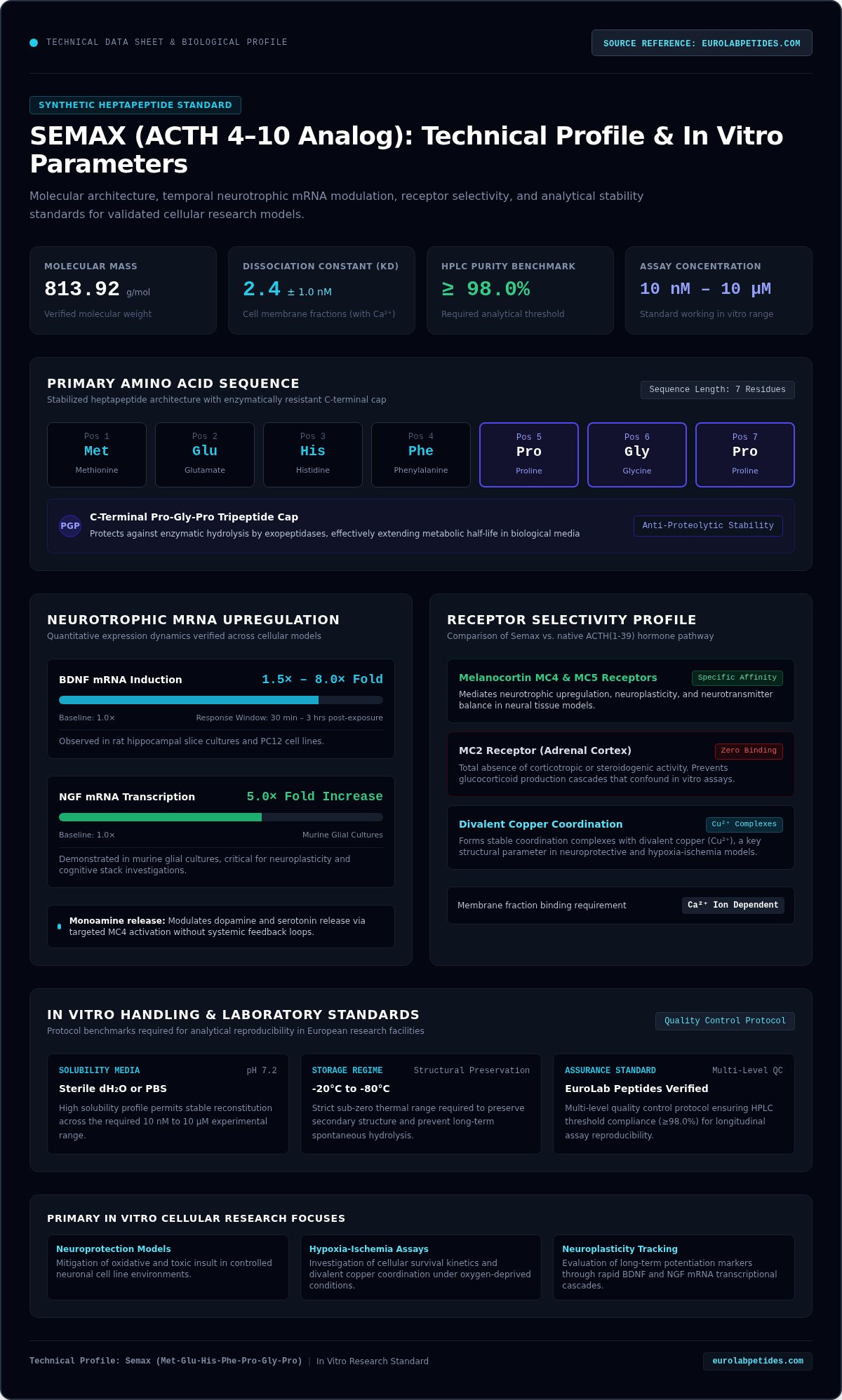
The molecular weight of Semax is verified at 813.92 g/mol. Its chemical structure incorporates a C-terminal tripeptide, Pro-Gly-Pro (PGP), which serves as a critical stabilizing agent. In standard peptides research models, linear fragments are often susceptible to rapid enzymatic hydrolysis by exopeptidases. The inclusion of the PGP sequence prevents proteolytic degradation, effectively extending the half-life of the compound in biological media. When preparing Semax peptide for in vitro experiments, researchers utilize its high solubility in sterile deionized water or phosphate-buffered saline (PBS) at pH 7.2. This solubility profile allows for the creation of precise molar concentrations within the 10 nM to 10 µM range typically required for cellular assays.
Semax vs. Standard ACTH Fragments
A primary distinction between Semax and endogenous ACTH fragments is the total absence of corticotropic or steroidogenic activity. While the full-length ACTH(1-39) molecule stimulates the adrenal cortex via the MC2 receptor, Semax lacks the binding regions necessary for this interaction. This selectivity ensures that experimental observations in neuronal cultures aren’t confounded by glucocorticoid production cascades. The heptapeptide demonstrates a specific affinity for melanocortin receptors, particularly MC4 and MC5, which are implicated in neurotrophic modulation. Compared to the original ACTH(4-10) fragment, Semax exhibits a significantly longer half-life, making it the preferred choice for cognitive research stacks. Researchers prioritize this stabilized analog because it maintains structural integrity throughout the duration of long-term in vitro incubation periods, ensuring consistent exposure of the cellular model to the ligand.
Primary Mechanisms of Action in Cellular Models
The biochemical efficacy of Semax is primarily mediated through the rapid induction of neurotrophic factors and the modulation of specific receptor affinities. Analytical data indicates a high-affinity binding dissociation constant (Kd) of 2.4 ± 1.0 nM on cell membrane fractions; this process requires the presence of calcium ions (Ca2+) for specific binding. When utilizing Semax peptide for in vitro experiments, researchers observe a standardized working concentration range between 10 nM and 10 µM, which serves as the baseline for evaluating cellular responses. This molecular interaction initiates a cascade of intracellular signaling that distinguishes the heptapeptide from shorter ACTH fragments.
Neurotrophic Factor Up-Regulation
Experimental observations in rat hippocampal slice cultures and PC12 cell lines demonstrate a significant induction of Brain-Derived Neurotrophic Factor (BDNF) mRNA levels. Quantitative analysis reveals a 1.5- to 8-fold increase in BDNF expression within 30 minutes to three hours post-exposure. Similarly, murine glial cultures exhibit a 5-fold upregulation of Nerve Growth Factor (NGF) mRNA transcription. These temporal dynamics are essential for researchers investigating nootropics and their role in facilitating neuroplasticity within controlled environments. The peptide also interacts with the melanocortin system, specifically targeting MC4 receptors, which influences the release of dopamine and serotonin without the systemic feedback loops seen in vivo.
Gene Expression and mRNA Modulation
Transcriptomic analysis of neural cells treated with the Semax peptide for in vitro experiments indicates a broader regulatory influence beyond simple neurotrophic induction. The peptide modulates the expression of genes involved in immune response pathways and vascularization, including the regulation of vascular endothelial growth factor (VEGF) signaling. This multi-faceted gene regulation is often verified through reverse transcription polymerase chain reaction (RT-PCR) and micro-electrode arrays (MEAs). Semax functions as a precision ligand that modifies the transcriptional landscape of neurotrophic pathways through targeted mRNA upregulation without altering the underlying genomic sequence.
Establishing these baseline metrics is critical for the reproducibility of neurological research. For facilities requiring high-purity compounds to support these complex assays, sourcing validated research materials through established European channels ensures technical consistency and adherence to rigorous laboratory standards.
Key In Vitro Research Applications and Experimental Focuses
Semax is utilized to simulate pathological states in neural cultures, providing a standardized framework for evaluating neuroprotective efficacy. Its application in modeling ischemia and excitotoxicity allows researchers to observe cellular responses to metabolic insults within controlled environments. By utilizing Semax peptide for in vitro experiments, laboratory facilities can investigate the molecular resilience of primary neurons and astrocytes under high-stress conditions. This approach is essential for validating the biochemical stability of neurological models before progressing to more complex assays.
Neuroprotective Assays
Primary assays for neuroprotection often utilize human neuroblastoma (SH-SY5Y) or rodent primary cortical neuron cultures. In these models, glutamate is introduced at concentrations designed to induce excitotoxicity, a process characterized by calcium overload and subsequent cell death. Researchers quantify the efficacy of Semax by measuring specific markers of cellular integrity:
- Reduction in lactate dehydrogenase (LDH) leakage: LDH release into the culture medium serves as a verifiable metric for cell membrane rupture.
- Suppression of pro-apoptotic markers: Quantitative analysis focuses on the inhibition of Caspase-3 and Caspase-9 activation.
- Mitochondrial membrane potential: Preservation of cellular energy production is assessed using JC-1 staining or similar fluorescent indicators.
When integrated into a cognitive research stack, the peptide demonstrates a capacity to maintain neuronal viability during oxygen-glucose deprivation (OGD) models. These protocols effectively simulate ischemia-reperfusion injury, allowing for the study of cellular recovery mechanisms without systemic interference.
Neuroinflammation and Microglial Activity
The investigation of anti-inflammatory pathways frequently involves the use of activated microglial cultures, such as the BV-2 cell line. In these models, inflammation is induced via lipopolysaccharide (LPS) exposure, triggering the release of pro-inflammatory cytokines. Research protocols demonstrate that Semax modulates this immune response by downregulating the expression of Interleukin-1β (IL-1β) and Tumor Necrosis Factor-alpha (TNF-α). It also inhibits the production of nitric oxide (NO) through the modulation of inducible nitric oxide synthase (iNOS) activity. These applications are critical for modeling neurodegenerative processes where chronic microglial activation contributes to progressive neuronal loss.
Recent analytical trends emphasize the role of Semax in managing oxidative stress and metal-induced toxicity. The peptide’s ability to form high-affinity coordination complexes with divalent copper (Cu2+) is a specialized focus in Alzheimer’s disease models. By chelating these metal ions, Semax prevents copper-mediated amyloid-beta (Aβ42) aggregation and protects membrane integrity against reactive oxygen species (ROS). This specific biophysical interaction highlights the peptide’s utility beyond neurotrophic induction, positioning it as a precision tool for complex neurobiological research.
Laboratory Standards: Handling, Stability, and Reconstitution
The reliability of data generated using Semax peptide for in vitro experiments is contingent upon the chemical purity and structural integrity of the compound. It’s typically provided as a lyophilized cake, a format that minimizes atmospheric moisture interaction and enzymatic degradation. To maintain baseline stability, lyophilized vials must be stored at -20°C for short-term projects or -80°C for preservation exceeding 24 months. Exposure to ambient temperatures or light can lead to peptide bond cleavage, particularly at the methionine residue, which compromises the accuracy of neurotrophic induction assays.
Purity Verification and Quality Control
Technical validation of each batch requires rigorous analytical testing. Reversed-phase high-performance liquid chromatography (RP-HPLC) is utilized to confirm a purity threshold of ≥98.0%, with premium lots often achieving ≥99.5%. Identity verification is performed via electrospray ionization mass spectrometry (ESI-MS) to ensure the molecular weight aligns with the theoretical value of 813.93 g/mol. Procuring certified peptides through independent third-party laboratories provides the empirical evidence necessary to eliminate variables related to synthesis artifacts or residual trifluoroacetate (TFA) salts.
Reconstitution Protocols for In Vitro Assays
Aseptic technique is mandatory during the reconstitution of Semax peptide for in vitro experiments. Sterile deionized water or phosphate-buffered saline (PBS) at pH 7.2 are the preferred solvents, supporting solubility up to 10 mg/mL. Once the solvent is added, the vial should be gently swirled rather than vortexed to prevent mechanical shear stress on the peptide structure. To calculate treatment concentrations, researchers typically utilize the molecular weight to establish working molarities between 10 nM and 10 µM for cellular models. Aqueous solutions of Semax remain stable at 2°C to 8°C for 24 to 72 hours before significant degradation occurs. For prolonged experimental timelines, the solution must be divided into single-use aliquots and frozen immediately at -20°C to avoid repeated freeze-thaw cycles, which are known to cause aggregation and loss of biological activity.
Maintaining these rigorous standards ensures that neurobiological observations are the result of peptide interaction rather than laboratory-induced variables. Facilities requiring documented purity benchmarks can order high-specification Semax directly from our European distribution center to ensure technical compliance and regional logistics efficiency.
Sourcing High-Purity Semax for European Research Facilities
Adhering to the European regulatory framework is essential for facilities seeking to buy research peptides for professional inquiry. It’s necessary to comply with EU Regulation (EC) No 1907/2006 (REACH) and (EC) No 1272/2008 (CLP), which mandate that all laboratory reagents are accompanied by standardized safety data sheets and explicit Research Use Only (RUO) labeling. This oversight ensures that materials meet the safety and environmental benchmarks established by the European Chemicals Agency (ECHA). For investigators utilizing Semax peptide for in vitro experiments, securing a supply chain that guarantees batch-to-batch consistency is the primary safeguard against experimental drift in longitudinal studies.
EuroLab Peptides: A Standard of Rigorous Quality
EuroLab Peptides implements a multi-level quality control protocol that begins at the point of chemical synthesis and concludes with final analytical validation. Each lot undergoes in-house testing followed by independent third-party laboratory verification to confirm the chromatographic profile and mass identity. Transparency is maintained through accessible Certificates of Analysis (CoA), which detail the HPLC purity benchmarks and ESI-MS mass confirmation for every vial. This objective data allows researchers to bypass the risks associated with unverified white-label suppliers. By prioritizing regional manufacturing standards, EuroLab Peptides ensures that each batch meets the verified 2026 purity benchmarks required for sensitive cellular assays.
Securing Materials for Professional Inquiry
Longitudinal in vitro projects demand a reliable supply of high-purity ligands to ensure data reproducibility over extended timelines. EuroLab Peptides provides technical support for Semax peptide for in vitro experiments, assisting facilities in establishing a robust inventory of temperature-sensitive materials. Logistical operations are optimized for regional delivery, utilizing climate-controlled transport to prevent thermal degradation of the lyophilized peptide. It’s a meticulous approach to distribution that minimizes the risk of structural compromise during transit across the UK and the European Union. Researchers looking to streamline their procurement process can explore our Cognitive Research Stack for specialized laboratory needs. This resource integrates high-specification compounds into a single protocol, facilitating complex investigations into neurotrophic modulation and metabolic resilience in neuronal cultures without the variables introduced by fragmented sourcing.
Advancing Neurological Research with Validated Heptapeptides
The integration of Semax into neurological models offers a sophisticated method for modulating neurotrophic expression and investigating cellular resilience. This technical profile has detailed the biochemical necessity of the Pro-Gly-Pro sequence for metabolic stability and the quantitative induction of BDNF and NGF mRNA within specific temporal windows. Success when utilizing Semax peptide for in vitro experiments remains dependent on the absolute precision of the synthetic ligand; variables such as residual TFA salts or insufficient purity can significantly compromise transcriptomic data.
By adhering to established laboratory standards for reconstitution and long-term storage at -80°C, research facilities ensure the reproducibility of their findings in models of excitotoxicity and neuroinflammation. EuroLab Peptides supports these rigorous demands through a multi-level quality control process and localized European logistics. Each batch is strictly for in vitro laboratory research and undergoes independent HPLC and mass spectrometry verification to confirm identity and purity benchmarks. It’s time to Secure Research-Grade Semax for Your Laboratory to maintain the highest analytical standards in your professional inquiry. We look forward to supporting your next breakthrough in neurobiological science.
Frequently Asked Questions
What is the molecular weight and formula of Semax peptide?
Semax peptide is characterized by the molecular formula C37H51N9O10S and a verified molecular weight range of 813.92 to 813.93 g/mol. This heptapeptide comprises the amino acid sequence Met-Glu-His-Phe-Pro-Gly-Pro. Precise molecular identification is confirmed via electrospray ionization mass spectrometry (ESI-MS) to ensure the chemical identity matches the theoretical profile required for high-precision neurological research models and standardized cellular assays.
How should Semax be stored to maintain maximum stability for research?
Lyophilized Semax must be stored at -20°C for short-term stability or -80°C for long-term preservation up to 36 months. Once reconstituted, the solution is stable at 2°C to 8°C for a maximum of 72 hours. To prevent structural degradation during longitudinal studies, researchers must divide the reconstituted peptide into single-use aliquots and freeze them immediately. This protocol avoids repeated freeze-thaw cycles that compromise peptide integrity.
What is the recommended purity level for Semax used in in vitro experiments?
The baseline purity threshold for Semax peptide for in vitro experiments is ≥98.0% as determined by reversed-phase high-performance liquid chromatography (RP-HPLC). Certified premium batches often reach purity levels between 99.5% and 99.8%. Utilizing high-purity ligands is essential to prevent unintended activation of toll-like receptors or other cellular artifacts caused by synthesis impurities or residual trifluoroacetate (TFA) counter-ions in fragile primary neuronal cultures.
Can Semax be reconstituted in phosphate-buffered saline (PBS)?
Semax is highly soluble in phosphate-buffered saline (PBS) at a physiological pH of 7.2, supporting concentrations up to 10 mg/mL. It’s also compatible with sterile deionized water or other isotonic buffers commonly used in cellular assays. When preparing the solution, gentle swirling is preferred over mechanical vortexing to maintain the structural stability of the heptapeptide before it is introduced into the experimental culture medium.
What are the primary neurotrophic factors influenced by Semax in cell culture?
Semax primarily modulates the expression of Brain-Derived Neurotrophic Factor (BDNF) and Nerve Growth Factor (NGF). Quantitative studies report a 1.5- to 8-fold induction of BDNF mRNA levels within 30 minutes to three hours post-exposure. Additionally, a 5-fold upregulation of NGF mRNA transcription is documented in murine glial cultures. These interactions are critical for researchers investigating neuroplasticity and neuroprotection in human neuroblastoma or primary cortical neuron models.
Is Semax peptide suitable for human consumption or clinical use?
Semax is strictly designated for Research Use Only (RUO) and is not intended for human consumption or clinical use. It’s not an approved pharmaceutical or therapeutic agent in the European Union, the United Kingdom, or the United States. All laboratory-grade shipments must bear clear RUO labeling and safety data sheets (SDS) stating that the compound is for in-vitro research and laboratory development purposes only.
How does the Pro-Gly-Pro sequence affect Semax degradation rates?
The C-terminal Pro-Gly-Pro (PGP) tripeptide functions as a stabilizing tail that prevents rapid degradation by endogenous exopeptidases and carboxypeptidases. This modification extends the metabolic half-life of the peptide in biological media compared to the native ACTH(4-10) fragment. By protecting the N-terminal sequence from proteolytic cleavage, the PGP tail ensures that the ligand maintains high-affinity interaction with target receptors throughout the duration of the in vitro incubation period.
Where can I find third-party testing results for Semax lots in Europe?
EuroLab Peptides provides batch-specific Certificates of Analysis (CoAs) that include independent third-party testing results for all Semax lots. These documents verify HPLC purity levels, mass spectrometry identity, and endotoxin loads to ensure technical compliance with European laboratory standards. This external validation provides researchers with the empirical data necessary to secure a reliable supply chain and maintain absolute accountability in their experimental protocols.
