
A polished COA can still be weak evidence if it can’t be tied to the material you’re evaluating. In research procurement, COA usually means Certificate of Analysis, not laboratory accreditation. Its value depends on what was tested, how it was tested, and whether the results apply to a specific batch.
A COA can help clarify identity, purity, and other reported properties, but a result is meaningful only when its scope and supporting details are clear. A reported value alone doesn’t establish every property of a peptide or prove suitability for every experiment.
This guide explains what a Certificate of Analysis is designed to show and how to assess its traceability, analytical methods, units, and specifications. You’ll learn how to interpret common HPLC and mass spectrometry results, what laboratory accreditation does and doesn’t mean, and where a COA’s evidence ends. The focus is research procurement and in-vitro use, with a practical distinction between documented results and conclusions the document cannot support.
Key Takeaways
- Distinguish a Certificate of Analysis from laboratory accreditation, and identify what the document actually reports.
- Use a consistent review sequence to connect the coa to the material, batch, sample, methods, results, and authorization.
- Compare reported values with the document’s stated specifications and units before drawing conclusions.
- Separate the testing process from the report: third-party testing describes who performs the analysis, while a COA communicates stated results.
- Record missing or unclear details as questions, and treat layered quality control as context rather than a substitute for batch-specific evidence.
What Does COA Mean in Research Peptide Documentation?
In research peptide documentation, COA usually means Certificate of Analysis: a report presenting analytical information and stated results for identified material. It is not, by itself, proof that a laboratory is accredited. A Certificate of Analysis documents test results for a defined sample; it does not turn marketing claims into verified findings.
The document’s name and layout can vary by laboratory, material, and testing purpose. One report may include methods, specifications, and measured values, while another may show a different selection of fields. The useful question is not whether every COA looks identical, but whether the document makes its sample, results, and scope clear enough to assess.
Why does COA have more than one meaning?
COA is an abbreviation used in different settings. Search results may use it for the Council on Accreditation or discuss accreditation, while research-material documents use it for a Certificate of Analysis. Context helps resolve the difference: terms such as laboratory, batch, sample, and assay point toward analytical testing. This section focuses on that meaning, not organizational accreditation.
A foundational Certificate of Analysis reference describes the document’s broad role across industries. For research procurement, interpret that general definition narrowly: the report is evidence about the material and tests it identifies, not an automatic endorsement of a supplier or product.
What does a Certificate of Analysis establish?
A Certificate of Analysis reports stated tests and results for identified material. Its findings apply to the sample that was analyzed. Whether they represent a larger batch depends on the relationship between the sample and batch, along with the scope and execution of testing. Assess those details from the document rather than assuming they are established by its title.
Separate measured findings from broader conclusions. An identity result may support identification under the stated method; a purity result describes the measurement and calculation specified in the report. Neither, on its own, establishes every aspect of quality, safety, or suitability for a particular experiment. Analytical data also doesn’t demonstrate a research outcome.
For in-vitro research and laboratory development, use the document as one piece of procurement evidence. Check what was tested, how the result is presented, and what the report expressly covers. Treat claims beyond those findings as unestablished unless supported by relevant evidence.
How to Read a Peptide COA: Identity, Traceability, and Results
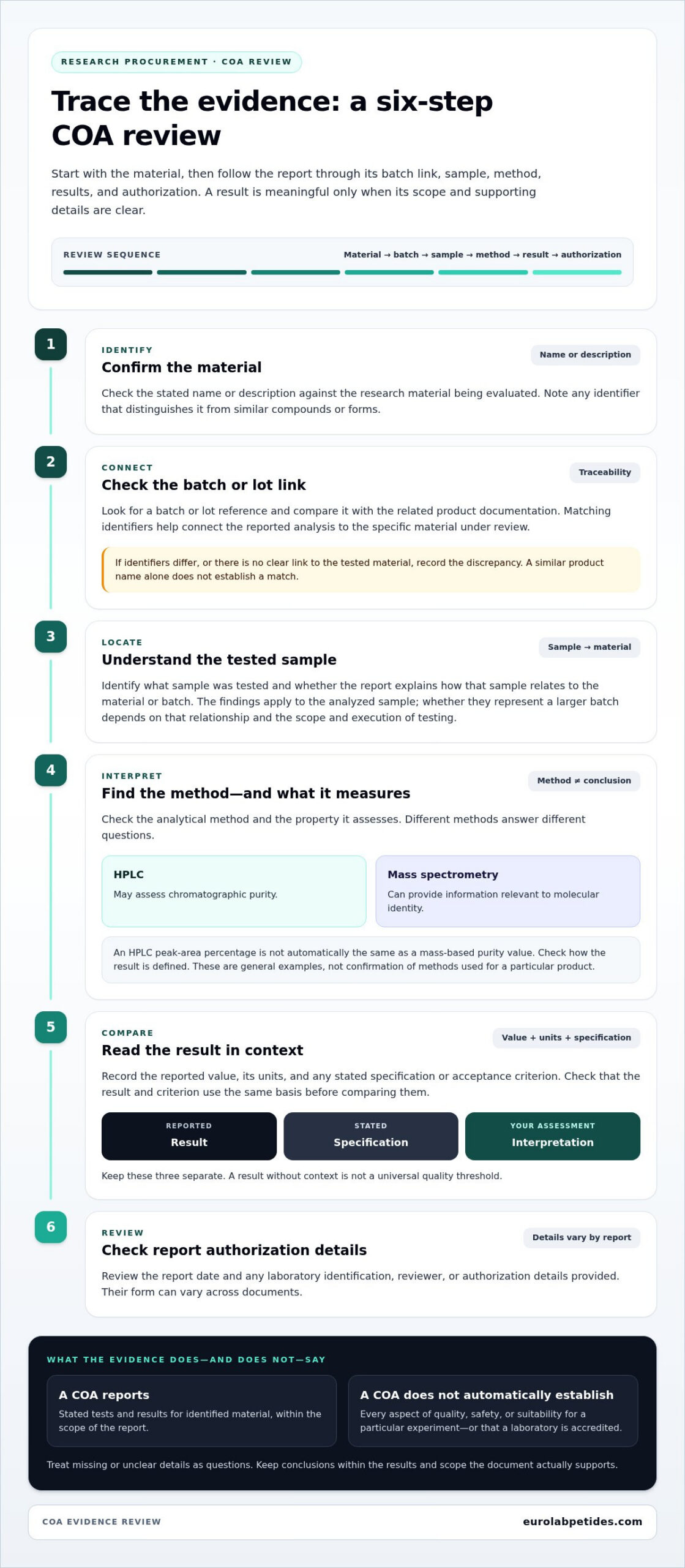
Read the document in sequence rather than starting with its headline purity figure. A result is useful only when you can connect it to the material and understand what the stated method measured. The search term “coa” can also surface documents from unrelated contexts, so confirm that you’re reviewing analytical documentation for the research material in question.
- 1. Material identity: Check the stated name or description against the material you’re evaluating. Note any identifier that distinguishes it from similar compounds or forms.
- 2. Batch link: Look for a batch or lot reference, if supplied, and compare it with the associated product documentation.
- 3. Sample: Identify what sample was tested and whether the report explains its connection to the material or batch.
- 4. Method: Find the analytical method and the property it assesses. Methods answer different questions. For example, HPLC may assess chromatographic purity, while mass spectrometry can provide information relevant to molecular identity. An HPLC peak-area percentage is not automatically the same as a mass-based purity value; check how the result is defined. These are general examples, not confirmation of methods used for a particular product.
- 5. Result: Record the reported value, its units, and any stated specification or acceptance criterion. Check that you’re comparing like with like.
- 6. Authorization: Review the report date and any laboratory identification, reviewer, or authorization details provided. Their form can vary across documents.
Which identifiers connect a COA to a batch?
Batch traceability connects the reported analysis to the specific material under review, rather than leaving the result as an unlinked data point. Compare product identification and batch or lot references across the report and related documentation. If identifiers differ, or the report gives no clear way to connect the tested sample to the material, the link is weaker. Record the discrepancy; don’t assume that a similar product name establishes a match.
How should methods and results be interpreted?
Keep three things separate: the measured result, the acceptance criterion, and your interpretation. A result is what the document reports; a specification is a stated limit or target, if one appears; interpretation asks what that evidence supports. Check units and the basis of comparison before deciding whether a value meets a specification. A result without context shouldn’t be treated as a universal quality threshold.
Fields and criteria can differ with the laboratory, material, and testing purpose, so missing optional fields alone don’t prove a defect. GMP frameworks may specify documentation expectations in particular settings; read the overview of GMP requirements for certificates of analysis in that context, not as a universal checklist for every research-material report.
Third-Party Testing vs. a COA: What Evidence Does Each Provide?
These terms describe different parts of an evidence chain. Third-party testing refers to who performs an analysis; a coa is the document that communicates stated tests and results. One may exist without the other being fully informative: a claim of independent testing doesn’t explain what was tested, while a report needs sufficient detail to show what its findings support.
| Evidence element | What it tells you | What it doesn’t establish by itself |
|---|---|---|
| Test process | An analysis was performed using stated procedures, if those details are documented. | That the method was appropriate for every question or that the sample represents a whole batch. |
| COA report | The tests, results, and other information the document reports for identified material. | Claims beyond its stated methods, sample, and scope. |
| Independent laboratory involvement | A laboratory separate from the supplier or manufacturer performed or reviewed testing, when documented. | That the laboratory is accredited, or that every reported result is complete and conclusive. |
What does third-party testing add to the evidence chain?
Independent testing can provide an additional analytical control when the laboratory’s role is accurately described and the report connects its work to the material under review. Laboratory identity, sample linkage, and method details all matter. Without them, “third-party tested” describes provenance but doesn’t provide a complete account of the evidence.
Accreditation and certification also have distinct meanings. Accreditation recognizes a laboratory’s competence for specified activities under a defined scope; certification attests to conformity with a stated standard or scheme. Neither term should be inferred from the phrase “independent laboratory.” Look for explicit documentation before assigning either status, and don’t treat a credential as a substitute for examining the actual test results.
EuroLab Peptides uses a layered quality-control process that includes in-house testing and independent third-party laboratory testing. This is relevant context for research procurement, but the analytical document still needs to be read for the specific sample and findings it covers.
Can a COA prove purity, safety, or research suitability?
A reported result supports only the analytical claim and sample scope stated. A purity measurement doesn’t automatically establish identity, the presence or absence of every contaminant, stability over time, or biological performance. Those questions require relevant evidence and methods; one result shouldn’t be stretched to answer them all.
A COA for research material doesn’t establish human-use safety, clinical efficacy, or suitability for consumption. Research-grade peptides are intended for in-vitro research and laboratory development, not human consumption or clinical use. Treat the report as bounded analytical evidence, not a guarantee of outcomes.
A Practical COA Review Checklist for Research Procurement
A consistent review process makes analytical documents easier to assess side by side. Use this checklist to capture what each document states, what it leaves open, and how closely it connects to the research material under consideration. It’s a record of evidence, not an automatic pass-or-fail test.
What should a researcher verify before relying on a COA?
- Material identity: Record the compound or material name and any distinguishing identifier shown.
- Batch linkage: Compare the batch or lot reference with associated product documentation. Note inconsistencies or an unclear connection.
- Sample: Record what was analyzed and any information explaining how the sample relates to the material or batch.
- Method: Capture the stated analytical method and the property it assesses. Don’t assume that a method addresses questions beyond its scope.
- Result and units: Copy the reported value and units as written. Preserve qualifiers and conditions rather than reducing the result to a single headline figure.
- Specification: Note any stated limit or acceptance criterion, and distinguish it from the measured result.
- Authorization: Record laboratory identification and any report date, reviewer, or authorization details provided.
Not every document uses the same format or includes identical fields. Mark unanswered points as questions for interpretation; a missing optional field alone doesn’t prove a material defect. The aim is to establish what the document supports, not to fill gaps with assumptions.
How can COAs be compared without overclaiming?
Compare like with like. Start with documents that address the same analytical question, then consider whether their methods, sample descriptions, units, and stated specifications are sufficiently comparable. If methods or scopes differ, record that limitation rather than ranking results as if they were equivalent.
Keep an audit note for each document: material and batch identifiers, document version or date if shown, analytical method, reported result, specification, and unresolved interpretation limits. Separate documented facts from assumptions about unreported characteristics, such as stability or biological performance. This makes comparisons reproducible without inventing a universal threshold. Use this review alongside broader procurement guidance for research peptides.
EuroLab Peptides uses in-house and independent third-party testing as part of its quality-control process. Evaluate that process alongside the specific analytical documentation, keeping research materials within their stated scope of in-vitro research and laboratory development. Explore research peptides for laboratory use.
How EuroLab Peptides’ Quality Control Fits Into COA Evaluation
EuroLab Peptides uses a multi-level quality-control process that includes in-house testing and independent third-party laboratory testing. For research procurement, this process provides context about how quality control is approached. The analytical document still needs to be assessed on its own terms: a supplier’s testing process and a batch-specific report answer related but distinct questions.
How should supplier quality controls complement document review?
Process-level controls describe steps taken within a quality-control system. A Certificate of Analysis, or coa, communicates stated analytical information for identified material. Neither should be treated as a substitute for the other. Independent review can add a layer of testing, while the report’s identifiers, sample information, methods, and results determine what evidence it presents for the material under evaluation.
Use the two sources together, but keep their limits clear. The company’s stated process doesn’t establish the contents of a particular report. Conversely, a report should be interpreted according to its stated sample and scope, rather than as proof of every part of a supplier’s quality-control system. Don’t assume specific analytical methods, laboratory credentials, or result fields unless they are documented.
For additional context, the guide to third-party-tested peptides can help explain the role of independent laboratory involvement. The central evaluation remains the same: distinguish how testing is described from what the analytical record actually reports.
What is the appropriate research-use boundary?
EuroLab Peptides supplies research-grade peptides strictly for in-vitro research and laboratory development. The quality-control process belongs within that research context. Analytical documentation can inform material evaluation for laboratory work, but it doesn’t establish clinical efficacy, human-use safety, or suitability for consumption.
Keep procurement decisions grounded in the intended laboratory application and in evidence that matches the material being assessed. Read the report for its documented findings, and avoid extending those findings to unreported properties or outcomes.
Review EuroLab Peptides research products in the context of their analytical documentation and in-vitro research use. Products are not intended for human consumption or clinical use.
Make COA Evidence Part of Your Procurement Review
A sound review starts by connecting analytical findings to the material being evaluated. Check identity and batch traceability, understand the stated methods and units, and compare results only with specifications that are documented. Third-party testing can add context, but neither the testing claim nor the coa establishes more than its stated sample, methods, and scope support.
EuroLab Peptides’ quality-control process includes in-house and independent third-party laboratory testing. This process is relevant context alongside the analytical documentation, not a replacement for evaluating evidence for the material under review. Products are supplied strictly for in-vitro research and laboratory development, and aren’t intended for human consumption or clinical use.
For a closer look at research products and quality information, explore EuroLab Peptides research products and quality information. Apply the same evidence-focused approach to each document, and keep procurement decisions grounded in the research context.
Frequently Asked Questions
What is a COA?
A COA, or Certificate of Analysis, is a laboratory document that reports analytical information for identified material. Depending on the laboratory and purpose, it may include test results, methods, specifications, or sample details. Formats vary, so don’t assume every COA follows the same template. For research procurement, check whether the report’s identifiers and stated scope connect its findings to the material you’re evaluating.
What should a Certificate of Analysis include?
A Certificate of Analysis may include material identification, a batch or lot reference, sample information, analytical methods, results, specifications, laboratory details, and authorization. Not every report contains every field, and an absent optional detail doesn’t automatically prove a problem. Review what the document actually states, identify what each result measures, and note any limits. Even a detailed report doesn’t establish every quality attribute of the material.
How can I verify that a COA matches a product batch?
Compare the material identifier and any batch or lot reference on the COA with the associated product documentation. Check whether the sample description and dates, if provided, are consistent with the stated analysis. A matching material name alone may not establish that the report applies to the batch in hand. If identifiers conflict or the connection is unclear, record the discrepancy rather than assuming the results apply to another batch.
Can a COA prove peptide purity?
A COA can report a result relevant to a stated analytical measure, but its meaning depends on the method, sample, units, and reporting scope. A reported purity value doesn’t automatically establish identity, the presence or absence of every impurity, stability, biological activity, or suitability for a particular study. Interpret the measurement narrowly. Keep the reported finding distinct from broader supplier descriptions or marketing statements that the analysis may not address.
Is third-party testing the same as a COA?
No. Third-party testing describes testing performed by an independent laboratory, while a Certificate of Analysis is a document that reports analytical information. A COA may document results from third-party testing, but its details need to identify the relevant sample, method, and findings to show what that evidence covers. The phrase “third-party tested” alone doesn’t explain the analysis or establish what the reported results support.
Does a COA guarantee that a research peptide is safe or effective?
No. A COA reports specified analytical information; it doesn’t establish clinical efficacy, human-use safety, or a research outcome. Its conclusions are limited to the sample, methods, and results described. EuroLab Peptides products are supplied strictly for in-vitro research and laboratory development. They aren’t intended for human consumption or clinical use, and analytical documentation shouldn’t be interpreted as a recommendation for human use.
How recent should a COA be?
Assess recency in relation to the material and batch under review, not by the report date alone. Check whether the document identifies the relevant sample or batch and whether its stated analysis applies to that material. Storage, handling, and stability are separate considerations that a COA may not address. A newer or older date by itself doesn’t establish that the material is suitable for a particular research purpose.
