

A vial can look unchanged even if repeated temperature changes have affected its contents. Appearance alone cannot show whether freeze-thaw cycles and peptide integrity have been affected. The risk depends on the peptide, formulation, sample state, and handling conditions, so a universal cycle limit can create false confidence.
It is reasonable to want a simple rule for deciding whether a sample remains suitable for an experiment. In practice, assessing integrity takes more than counting temperature changes. Researchers need to distinguish lyophilized material from prepared solutions, consider possible effects such as cryoconcentration and aggregation, and interpret analytical evidence in context.
This guide explains how repeated freezing and thawing may affect research peptides, what compound-specific stability data can establish, and how to build a consistent, traceable handling process. It covers practical approaches such as aliquoting and recording storage history. Supplier quality-control testing can help characterize a material, but does not by itself demonstrate freeze-thaw stability. For in-vitro research and laboratory development, the aim is a handling approach grounded in relevant evidence, not a one-size-fits-all claim.
Key Takeaways
- Define what counts as a freeze-thaw cycle in your protocol and record the conditions. A cycle count alone cannot show whether a sample has changed.
- When assessing integrity, distinguish chemical degradation from physical changes such as aggregation, precipitation, or adsorption.
- Compare lyophilized material, prepared solutions, and aliquoted samples against your workflow and the evidence available for the specific peptide.
- Build a repeatable protocol by identifying the sample state, documenting handling conditions, and selecting measurements that address the research question.
- Assess freeze-thaw cycles and peptide integrity using evidence relevant to the molecule, sample, analytical method, and test conditions.
What Do Freeze-Thaw Cycles Mean for Peptide Integrity?
One freeze-thaw cycle means a sample is frozen and then thawed. The count is meaningful only when the conditions are also described, including the sample’s physical state, freezing and thawing temperatures, time at each temperature, and handling during the process. Without that context, “three cycles” is an incomplete handling description, not a stability result.
Freeze-thaw effects are changes in a peptide sample that must be assessed against the specific compound, formulation, temperature history, and analytical method. A cycle count alone cannot establish that a peptide remains unchanged, nor does it show that every sample has been altered. The practical question is whether a relevant property changed under the conditions used.
What does peptide integrity mean in a research sample?
Integrity means retaining the peptide’s relevant identity, structure, and measurable properties for the intended assay. Which properties matter depends on the research question. A measurement suited to one characteristic may not establish that all other characteristics are preserved.
Integrity is also distinct from purity at manufacture. A purity result characterizes the tested material at a particular point; it does not automatically show how that material behaves after storage or temperature cycling. Judge assay suitability using a method appropriate for the property being assessed and the sample being tested.
Why can repeated temperature changes matter?
Temperature changes may affect some peptide samples through different pathways. Chemical changes, such as oxidation or hydrolysis, alter molecular composition. Physical changes, including aggregation or precipitation, can affect how material is distributed or recovered. Adsorption to container surfaces may reduce the amount available for analysis without necessarily showing that the peptide molecule has chemically degraded.
A measured concentration can therefore change for more than one reason. A result may reflect a chemical transformation, a physical loss from the sampled solution, or an assay response affected by sample conditions. These possibilities are not interchangeable, and none should be assumed without relevant measurements.
Risk depends on the peptide, formulation, container, temperature history, and handling. A lyophilized sample and a prepared solution may respond differently. Lyophilized Storage describes the freeze-drying process used to remove water from a material. That context helps distinguish material states, but does not establish a stability limit for a particular peptide. A single thaw does not necessarily cause degradation, and no universal cycle threshold proves integrity across compounds and conditions. Record handling conditions alongside analytical results so conclusions remain tied to the sample actually tested.
How Can Freezing and Thawing Affect Peptide Samples?
Freezing can change the environment around a peptide even when the molecule itself is not directly damaged. As ice forms in a solution, water crystallizes while many dissolved components remain in the unfrozen fraction. This freeze concentration can shift local solute concentrations, ionic strength, and, in some formulations, pH. The size and consequences of these shifts depend on the buffer, peptide, and conditions. Freeze concentration alone is not evidence that degradation occurred.
Chemical degradation and physical change are not the same
Some sequences may be susceptible to chemical pathways such as oxidation, deamidation, or hydrolysis, but susceptibility varies with molecular structure and sample conditions. Physical changes are different: peptide may aggregate, precipitate, or adsorb to a container surface. These processes can affect recovery or the amount available in solution without producing the same analytical signature as chemical degradation.
A clear sample is not proof that identity, purity, or assay performance has been retained. Choose measurements based on the suspected change and the research question. A method that detects a change in one property may not resolve another, so interpret findings within the method’s documented scope.
Why sample formulation and container conditions matter
Lyophilized material and prepared solutions have different physical states, but neither is universally more stable without compound-specific evidence. When reviewing literature or assessing stability, consider formulation pH, excipients, concentration, container material and surface, and headspace. These factors may influence solute behavior, surface interactions, or exposure to oxygen.
Repeated handling adds another source of variability. Each opening or transfer creates an opportunity for contamination, while time at room temperature and mixing conditions may differ between runs. Record the temperature history, thaw duration, and freeze rate when available, alongside formulation and container details. This makes the conditions interpretable instead of reducing them to a cycle count.
Guidance such as GenScript’s peptide storage and handling recommendations can inform a starting protocol, but general handling advice does not establish stability for a particular compound. A proposed mechanism explains how a change could occur; measurements on the relevant sample under defined conditions are needed to establish a stability result. For in-vitro research and laboratory development, EuroLab Peptides supplies research-grade peptide materials. Interpret supplier quality-control results separately from evidence of stability after freeze-thaw handling.
Aliquoting, Repeated Thawing, or Lyophilized Storage: What Should Researchers Compare?
No handling format is universally preferable. The right comparison depends on whether the material is stored as a dry solid or prepared solution, how often it will be accessed, and what the experiment requires. Aliquoting can reduce repeated access to a shared stock, but it does not prove that the peptide remains stable under the selected conditions.
| Approach | Convenience and sample use | Repeated handling | Evidence to review |
|---|---|---|---|
| Lyophilized storage | Useful when the protocol calls for dry material to be stored before preparation. | Each opening and preparation step involves handling the dry sample. | Applicable storage documentation, moisture-control conditions, and evidence for the specific material. |
| Prepared-solution storage | Ready for workflows that use a prepared solution. | Repeated access may expose the stock to additional handling and temperature changes. | Stability data for the peptide in the specific formulation and under the documented storage conditions. |
| Aliquoted working samples | Allows a study-sized portion to be used without repeatedly accessing the main stock. | May limit repeated stock access, while adding transfers and containers. | Evidence relevant to the aliquoted formulation, container, storage conditions, and intended use. |
When is aliquoting a useful handling strategy?
Single-use or study-sized portions can separate the working sample from a shared stock, reducing the need to thaw or open that stock for each experiment. The trade-off is extra preparation. Transfers, added containers, labeling, and differences in fill volume or handling can introduce variability.
Use documented, validated conditions rather than assuming a particular aliquot size or storage duration is suitable. Label portions so their identity and handling history remain traceable. Aliquoting changes access patterns; stability still requires evidence tied to the peptide and conditions.
How do lyophilized and solution samples differ?
Lyophilized material and prepared solutions have different handling considerations, but physical state alone does not guarantee a stability outcome. Follow documentation applicable to the material and align storage and preparation with the research protocol. The planned article “Storing Lyophilized Peptides for Maximum Stability” can provide a related reference when available.
For a valid comparison of freeze-thaw cycles and peptide integrity, hold key variables constant: peptide identity and batch, formulation, container, sample volume, temperature profile, thaw duration, mixing, and analytical method. For example, compare matched portions from the same material under the handling approaches being evaluated, changing the approach while keeping other conditions consistent. Interpret results within those defined conditions, not as a universal ranking of storage methods.
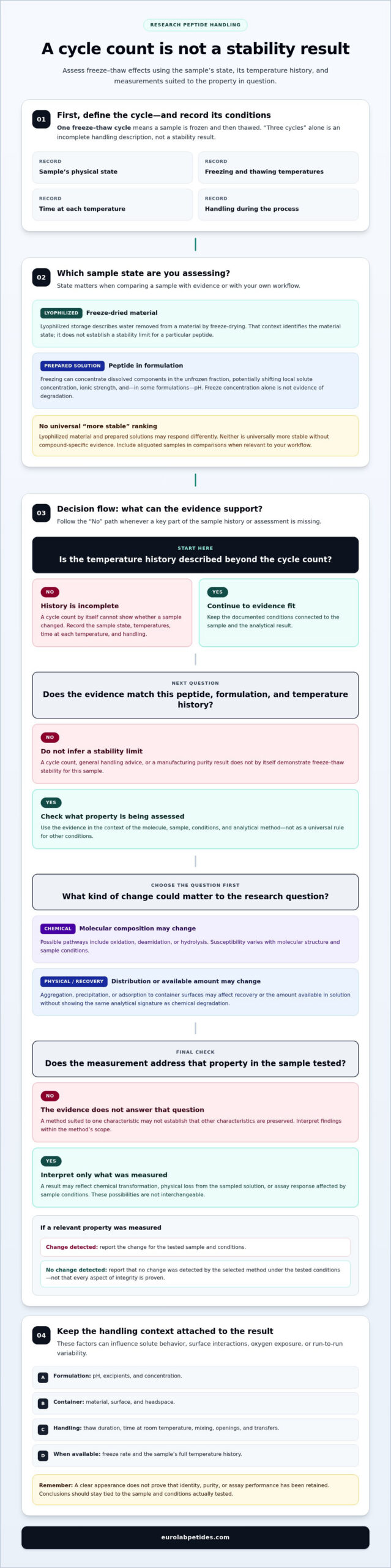
How to Assess Freeze-Thaw Risk in a Research Protocol
Assess freeze-thaw risk as a defined protocol question, not by applying a universal cycle-count rule. Review peer-reviewed, molecule-specific evidence and applicable supplier documentation before setting conditions. If the available data do not match the sample formulation or temperature history, record that gap as uncertainty rather than assuming stability.
- Identify the material state. Record whether the sample is lyophilized or prepared in solution, along with its formulation and intended assay.
- Define the conditions. Specify freezing and thawing conditions established by the study or product documentation. Include relevant durations and handling steps.
- Document each sample’s history. Track identity, preparation date, container, storage conditions, freeze-thaw events, handling duration, and any deviations in standard laboratory records.
- Select relevant measurements. Choose analytical endpoints that address the suspected change and research question, then interpret results against appropriate controls.
Any proposed freeze-thaw cycle threshold requires validation under defined conditions for the specific peptide and formulation. A threshold drawn from a different molecule, buffer, or protocol does not establish a limit for the sample under study.
Which variables should a stability assessment record?
Keep records detailed enough to link an analytical result to the sample tested. Capture peptide identity, formulation, container, storage conditions, preparation date, and documented freeze-thaw history. Record freezing and thawing parameters when they are established by the study or applicable documentation. Note handling duration and deviations as they occur. Consistent records help distinguish handling effects from differences in sample preparation or experimental execution.
What evidence can an analytical method provide?
Method choice depends on the question. HPLC may be suitable for examining a sample’s chromatographic profile, while LC-MS may support identity or mass analysis. Neither method automatically establishes every aspect of integrity; suitability depends on validation and intended purpose. Interpret results alongside controls, such as a reference sample handled under a defined comparison condition, to assess observed differences in context.
EuroLab Peptides’ multi-level quality control includes in-house and independent third-party laboratory testing. This testing can provide quality information about the material tested, but does not by itself demonstrate stability after a particular freeze-thaw history. For in-vitro research and laboratory development, review research-grade peptide materials alongside the documentation needed to maintain traceable sample identity and handling records.
How Quality-Control Evidence Supports Peptide Integrity Decisions
Quality-control results are useful when their scope is clear. Release testing, identity or purity characterization, and a dedicated stability study answer different questions. Release testing assesses material against defined criteria at a specified stage. Identity or purity characterization supports assessment of the sample tested at that time. Neither automatically predicts how a peptide will respond to handling conditions that were not evaluated.
What quality testing can and cannot establish
Interpret each result alongside the sample identity, analytical method, and test conditions. An identity or purity result may help characterize a research material, but does not establish that its properties were retained after repeated freezing and thawing. A stability study addresses change under defined storage or handling conditions; its conclusions apply to those conditions and the material examined. Do not infer a freeze-thaw limit from a general quality result or assume every product has a dedicated freeze-thaw study.
EuroLab Peptides uses a multi-level quality-control process that includes in-house and independent third-party laboratory testing. This provides quality-control context, not proof of a product-specific freeze-thaw tolerance. For research on freeze-thaw cycles and peptide integrity, distinguish supplier documentation from study-specific stability evidence and interpret each according to its stated scope.
How to make a documented research-material decision
Match the evidence to the decision. Start with the research question and intended assay, then identify the material state, formulation, available characterization or stability information, and protocol requirements. If evidence comes from a different formulation or handling history, record that limitation rather than treating it as directly applicable.
For foundational terminology, refer to What Are Peptides? A Comprehensive Guide for Researchers. For supplier-evaluation context, consult How to Buy Research Peptides: A 2026 Guide to Purity, Sourcing, and Laboratory Standards. These topics can help frame the questions, but do not replace documentation specific to the sample and conditions used in a study.
Before setting or revising a laboratory handling protocol, review applicable material documentation and stability evidence relevant to the peptide and its formulation. Keep sample identity, storage conditions, handling history, and analytical results traceable so later interpretation remains tied to the material tested. For in-vitro research and laboratory development, review EuroLab Peptides research materials as part of that documented assessment.
Make Peptide Handling Evidence-Based and Traceable
There is no universal freeze-thaw limit that establishes sample integrity. The effect of temperature cycling depends on the peptide, formulation, physical state, container, and handling conditions. A cycle count is useful only when supported by evidence relevant to the material and protocol.
For sound decisions about freeze-thaw cycles and peptide integrity, document sample identity and handling history, compare like-for-like conditions, and choose measurements that address the research question. Keep quality-control characterization distinct from stability evidence: results apply to the sample and conditions documented, not automatically to later handling scenarios.
EuroLab Peptides supplies research-grade materials strictly for in-vitro research and laboratory development. Its multi-level quality-control process includes in-house and independent third-party laboratory testing, providing quality context without establishing a product-specific freeze-thaw limit. Review relevant material documentation and maintain a consistent, traceable laboratory protocol.
Review EuroLab Peptides research materials for your in-vitro research and laboratory development, and apply the available evidence carefully to your study. A documented approach supports clearer, more reproducible research decisions.
Frequently Asked Questions
Do freeze-thaw cycles always damage peptides?
No. Freeze-thaw cycles do not inevitably damage every peptide, and a sample’s appearance alone cannot establish whether it has changed. Effects depend on the peptide, formulation, sample state, container, and temperature history. Chemical change, aggregation, precipitation, or adsorption may occur under some conditions, but should not be assumed. Assess freeze-thaw cycles and peptide integrity using evidence and measurements relevant to the specific sample and research question.
How many freeze-thaw cycles can a peptide tolerate?
There is no universal number that applies to all peptides and formulations. A cycle count without details such as sample state, temperature conditions, and thaw duration cannot establish a safe limit. Look for peer-reviewed, molecule-specific stability evidence and applicable material documentation. If a cycle threshold matters to the study, evaluate it under defined conditions using suitable measurements and controls rather than applying a general rule from a different sample.
Is aliquoting better than repeatedly thawing a peptide stock?
Aliquoting can reduce repeated access to a shared stock by setting aside portions for individual experiments or planned uses. It does not prove that the peptide remains stable, and added transfers, containers, labeling, and preparation can introduce variability. Compare aliquoting with repeated stock access in light of the formulation, protocol, and relevant stability evidence. Use documented conditions, and record each portion’s identity and handling history for traceability.
Can lyophilized peptides undergo freeze-thaw cycles?
They can experience temperature changes during frozen storage, but their handling differs from that of prepared solutions. A temperature cycle alone does not establish whether a lyophilized peptide has changed or remains suitable for a particular assay. Follow documentation applicable to the specific material and study protocol. Document the sample’s storage and handling history, including deviations, so analytical findings can be interpreted in context.
How can researchers detect changes in peptide integrity after thawing?
Use measurements suited to the suspected change and the study question. A suitable chromatographic method, such as HPLC, may help assess a sample’s profile; LC-MS may support identity or mass analysis. Neither automatically measures every aspect of integrity. Compare results with appropriate controls and interpret them within the method’s validated purpose. Visual clarity alone cannot establish molecular identity, purity, or retained assay performance.
Does a purity test prove that a peptide is stable after repeated freezing and thawing?
No. A purity result characterizes the tested sample under the conditions and method documented at the time of analysis. It does not automatically predict behavior after repeated freezing and thawing or other untested handling. Stability evidence must relate to the peptide, formulation, and conditions being considered. Review the scope of available results and keep them distinct from a dedicated study of freeze-thaw effects.
