

A strong peptide signal can still be the wrong answer. When developing a new cell-based assay with peptides, the challenge is not simply detecting a change. It is showing that the change reflects the biology you intend to measure. A mismatched cell model, an indirect endpoint, peptide-related assay interference, or cell stress can all complicate interpretation.
Assay conditions need to be practical, but results also need to be reproducible and defensible. Start by translating the research question into a measurable endpoint. Then match that endpoint to a relevant cell model and choose readouts that can distinguish a biological response from artifacts or reduced cell health.
This guide follows the assay from experimental design through documented validation. It covers control selection, replication, peptide handling and input traceability, along with criteria for assessing whether a method is fit for its intended research purpose. The goal is not to make every result conclusive, but to establish a clear basis for interpreting findings, identifying limitations, and deciding what the data can support.
Key Takeaways
- Translate the biological hypothesis into a defined endpoint before choosing a cell model or assay format.
- For developing a new cell-based assay with peptides, select the peptide based on the research question and relevant evidence, not availability alone.
- Use appropriate controls and complementary checks to distinguish cellular responses from signal interference or cell stress.
- Optimize the readout iteratively, then assess whether the assay performs consistently under the conditions you plan to use.
- Record peptide identity, lot, preparation, storage, and available analytical documentation alongside assay conditions and limitations.
Start peptide assay development with a precise biological question
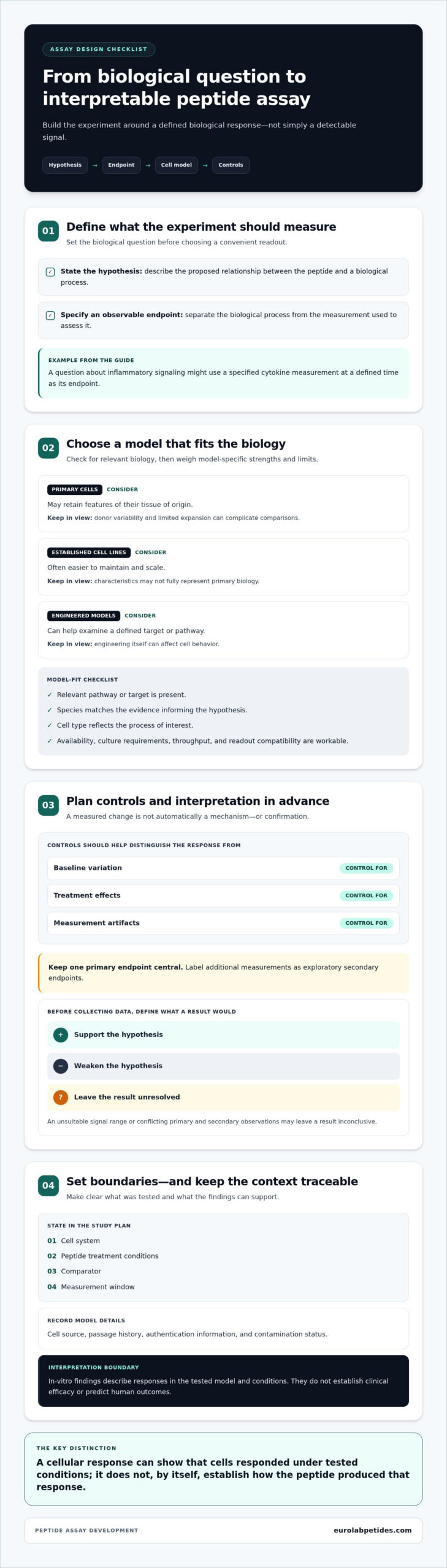
Measuring a cellular response is not the same as establishing its mechanism. A change in fluorescence, gene expression, or cytokine release may show that cells responded under the tested conditions, but it does not prove how the peptide produced that response. Keeping this distinction clear from the start helps prevent conclusions that go beyond what the assay can support.
A cell-based assay measures a defined cellular response in a specified model under controlled experimental conditions. The first step in developing a new cell-based assay with peptides is to define what the experiment should measure, rather than selecting a convenient readout and inferring the research question afterward.
Work through the design in order:
- Define the hypothesis. State the proposed relationship between the peptide and a biological process.
- Specify the endpoint. Choose an observable measurement that can address the hypothesis.
- Select the model. Identify a cell system capable of expressing the biology relevant to the question.
- Plan controls. Decide how to distinguish the expected response from baseline variation, treatment effects, and measurement artifacts.
A narrowly scoped question makes success criteria easier to interpret. For example, asking whether treatment changes a particular cellular marker is more testable than asking whether a peptide broadly “improves cell function.” The first question identifies a measurable outcome. The second combines multiple possible processes, making it harder to interpret a result.
Turn the hypothesis into a measurable endpoint
Separate the biological process from the observable response. A hypothesis might concern inflammatory signaling, while the endpoint could be a specified cytokine measurement at a defined time. Keep one primary endpoint central to the initial assay. Label additional measurements as exploratory secondary endpoints so they do not silently redefine what counts as success.
Before collecting data, describe what would support the hypothesis, weaken it, or leave it unresolved. A result may be inconclusive if the assay lacks a suitable signal range or if the primary readout conflicts with relevant secondary observations. Predefining these interpretations reduces the temptation to treat any detectable change as confirmation.
Set boundaries for an in-vitro study
State the cell system, peptide treatment conditions, comparator, and measurement window in the study plan. These boundaries define what the experiment can answer and make the results easier to reproduce. In-vitro findings characterize responses in the tested model and conditions. They do not establish clinical efficacy or predict human outcomes.
Peptide terminology and context can shape the hypothesis, so align the proposed experiment with its intended research use. The site’s What Are Peptides? A Comprehensive Guide for Researchers provides introductory context for that terminology. For assay planning, use the biological question to determine which peptide properties and evidence are relevant, then document the limits of the model and interpretation.
Choose the cell model, peptide, and assay format to fit the question
Once the endpoint is defined, select a model capable of producing the biology being measured. Consider whether the relevant pathway or target is present, whether the species matches the evidence informing the hypothesis, and whether the cell type reflects the process of interest. Practical factors also matter: cell availability, culture requirements, throughput, and compatibility with the readout can determine whether a theoretically relevant model is workable.
Primary cells may retain features of their tissue of origin, but donor variability and limited expansion can complicate comparisons. Established cell lines are often easier to maintain and scale, though their characteristics may not fully represent primary biology. Engineered models can help examine a defined target or pathway, but engineering itself can affect cell behavior. No single cell line is suitable for every question. Record cell source, passage history, authentication information, and contamination status so these variables remain visible during interpretation.
Select the peptide in light of the hypothesis
Peptide choice should follow the proposed biology and relevant literature, not simply the options most readily available. Define why the sequence is appropriate to the target or process, and note the evidence and uncertainties informing its selection. When developing a new cell-based assay with peptides, treat peptide identity and input documentation as experimental variables. The site’s How to Buy Research Peptides: A 2026 Guide to Purity, Sourcing, and Laboratory Standards discusses sourcing context relevant to planning and documenting research inputs.
Match the readout to the biological response
Choose the assay format based on the endpoint and model, not familiarity alone. A convenient assay can produce a clear signal without answering the biological question. Use the endpoint to compare what each format measures and what it can miss:
Viability or metabolic activity: Colorimetric or fluorometric methods such as MTT or resazurin provide an indirect signal associated with cellular metabolic activity. The signal can be affected by assay chemistry, cell state, or compound interactions, so do not automatically treat it as a direct cell count or a complete measure of viability.
Signaling: Reporter assays or pathway-specific measurements can track defined molecular responses. They are most informative when the selected marker is meaningfully connected to the hypothesis.
Morphology: Imaging can capture changes in cell shape, distribution, or other visible features. Keep image acquisition and analysis criteria consistent across conditions.
Secreted factors: Measurements in culture supernatant can quantify released molecules, while flow cytometry can resolve markers across individual cells. Each approach answers a different question. Choose based on whether the study needs a population-level concentration or cell-by-cell information.
Complementary measurements can clarify an ambiguous result, but adding endpoints without a defined purpose can make interpretation less focused. Select the primary readout first, then consider whether a second method would test the same response using a distinct measurement principle. For in-vitro research inputs, research-grade peptides from EuroLab Peptides can be considered alongside documented assay conditions and input records.
Build controls and readouts that separate response from assay artifact
Controls help determine whether a measured signal is attributable to the intended experimental contrast. Each control should answer a defined question, such as whether the vehicle changes the endpoint, whether the assay can detect a response, or whether a signal occurs without cells. When developing a new cell-based assay with peptides, controls are not just extra wells. They provide the comparisons needed to interpret the readout.
Choose controls for the experimental contrast
Map each control to an alternative explanation. An untreated group establishes the baseline under the culture conditions. A vehicle control tests whether the solvent or carrier used to prepare the peptide affects the cells or measurement. If a vehicle is used, match its exposure across relevant treatment groups. Justify the composition and amount for the experimental system rather than assuming they are appropriate.
- Positive control: Use a treatment expected to produce the relevant response when a scientifically justified comparator exists. It can help establish that the model and assay can detect that response.
- Negative control: Use a suitable inactive, non-targeting, or otherwise relevant comparator to assess signal specificity, where one is available and appropriate to the hypothesis.
- Cell-free control: Test the assay signal without cells when direct interaction between the peptide and detection chemistry is plausible.
A control is useful only when its interpretation is clear. If no defensible positive comparator exists, do not add one solely to complete a standard-looking plate layout. State which assay-system question remains unanswered instead.
Separate biological and technical replication
Technical replicates are repeated measurements from the same biological sample or experimental unit. They help reveal pipetting or measurement variability, but they are not independent biological observations. Biological replicates come from independently prepared cultures, samples, or experimental runs and provide information about variation across those units.
Plan both types of replication around the research question and expected sources of variability. Treating technical wells as independent biological replicates can overstate the evidence. Document what counts as an independent replicate, how measurements will be summarized, and how excluded or failed measurements will be handled.
Check whether the readout measures what it claims
Peptides or treatment conditions may affect an assay through optical properties, chemical reactions with detection reagents, or changes in metabolism that do not directly correspond to cell number or the target process. For example, a metabolic viability signal can shift because cellular metabolism changed, even if the interpretation being tested concerns a different biological outcome. A reporter signal alone likewise does not establish a specific mechanism.
Use cell-free checks to look for direct signal generation, quenching, or other interference when relevant to the assay chemistry. If concerns remain, compare conceptually distinct readouts, such as a reporter measurement alongside imaging or a secreted-factor assay. Convergent evidence can strengthen interpretation. Disagreement is a reason to investigate assay limitations, not to select only the favorable result.
Optimize and validate the peptide assay before interpreting results
A working signal is a starting point, not evidence that an assay is ready for interpretation. Optimize in stages: pilot the selected readout, assess its background and usable signal range, refine conditions that limit performance, then test whether the method behaves consistently across independent runs. This sequence helps distinguish a promising initial observation from a method that can support reproducible comparisons.
Investigate concentration and measurement timing in the context of the hypothesis, cell model, peptide, and endpoint. Literature can inform the range worth exploring, but published conditions do not automatically transfer between models or assay formats. A dose-response design may be appropriate when the question concerns concentration-dependent effects and the study can distinguish a real response from changes in cell health or measurement interference. Timing matters too: an endpoint measured too early or too late may miss, distort, or conflate cellular responses.
Use pilot experiments to assess assay performance
Start with a pilot that examines background, dynamic range, replicate variability, and cell health under the planned measurement conditions. Check whether control groups behave as expected and whether the endpoint produces interpretable separation without obvious signs of compromised cells. If the signal is weak or variable, investigate the assay conditions before treating differences between treatment groups as biological findings.
Before the definitive experiment, define acceptance criteria suited to the method. These may address allowable background, control behavior, replicate dispersion, or minimum signal separation. Justify and verify numerical thresholds and statistical criteria for the protocol and model in use. No universal cutoff makes every peptide assay valid. Keep exploratory pilot results distinct from confirmatory data.
Assess repeatability and robustness
Repeat the optimized procedure in separate experimental runs. Record variables that could affect comparisons, including cell passage and culture conditions, peptide preparation and lot, reagent batches, operator, instrument settings, and measurement timing. Reviewing control consistency and replicate dispersion across runs can reveal drift or variability that a single plate cannot show.
Set a procedure for deviations before beginning the definitive experiment. Record what changed, why it changed, and how the deviation could affect interpretation. Do not silently exclude inconvenient results. If a run fails a prespecified acceptance criterion, document the failure and apply the planned response consistently. Repeat key findings independently before drawing strong conclusions, especially when the initial result depends on one readout or a narrow set of conditions.
Careful validation makes conclusions more defensible, but findings still need to be interpreted within the assay’s limits. When developing a new cell-based assay with peptides, treat each acceptance criterion as a protocol-specific decision supported by evidence, not as a universal benchmark. For in-vitro research inputs, explore research-grade peptides for laboratory development and document relevant input information alongside assay conditions.
Document results and select research inputs with traceability
Reproducibility depends on more than a clear assay protocol. Researchers also need to know which cells, reagents, peptide inputs, and analysis choices produced each result. When developing a new cell-based assay with peptides, traceability helps distinguish biological differences from changes in materials or procedure.
Create a reproducible assay record
Maintain a record that connects each result to the conditions under which it was generated. Capture cell provenance, passage range, culture conditions, plate layout, control assignments, instrument settings, reagent lots, protocol version, and analysis method. For the peptide, record its identity, lot, available analytical documentation, preparation and storage conditions, and freeze-thaw history. Verify the documentation relevant to the specific input used.
Also define biological and technical replicates, note exclusions and deviations with reasons, and retain enough information to trace analyzed values back to their source measurements. Report uncertainty and replicate-level variation alongside summary results where appropriate.
Interpret evidence without overstating conclusions
Keep observations separate from interpretation. Report what the assay measured, how results compare with controls, and whether predefined criteria were met. Then state what the findings may suggest, what they do not establish, and which limitations apply to the model or readout. A response in one in-vitro system does not, by itself, demonstrate a mechanism or broader biological relevance.
Identify follow-up experiments that could resolve uncertainty. If a conclusion depends on one reporter, for example, an orthogonal measurement may be needed to support the interpretation. Distinguish planned tests from results already obtained.
Research-input quality is one documented variable, not a guarantee of assay performance. EuroLab Peptides uses in-house and independent third-party laboratory testing to assess purity and consistency. Record the analytical information associated with the specific peptide lot alongside experimental conditions. Assay outcomes still depend on the model, handling, and method.
For laboratory development and in-vitro research, explore the research peptide catalogue as you plan traceable assay inputs. Products are for research use only and are not intended for human consumption or clinical use.
Carry the assay forward with documented inputs
The next step is to turn the optimized method into a controlled research workflow. Preserve the rationale behind key design choices, and keep peptide identity and lot information linked to the data they helped generate. This record makes future comparisons more meaningful when protocols, cell batches, or research inputs change. It also helps distinguish a biological observation from a shift in experimental materials.
Input characterization supports traceability, but it does not guarantee a particular assay outcome. EuroLab Peptides uses a multi-level quality-control process that includes in-house and independent third-party laboratory testing. Review the analytical information associated with the research input used, and interpret it alongside the assay’s own validation and limitations.
With a defined question and a documented method, developing a new cell-based assay with peptides becomes a structured way to generate interpretable in-vitro evidence, not a shortcut to claims beyond the model. For your next laboratory development project, review research peptides for in-vitro laboratory development. Start planning your next experiment with research inputs documented alongside the method.
Frequently Asked Questions
How do you develop a cell-based assay from a research question?
Convert the research question into a testable comparison, then check each design choice against that comparison. State the expected response and what result would count as informative. Select a model and endpoint capable of observing it, then map controls to plausible alternative explanations. When developing a new cell-based assay with peptides, pilot the workflow for usable signal and cell condition, then assess repeatability against predefined criteria before using it to support decisions.
How do you choose a cell line for a peptide assay?
Choose a cell line with biology relevant to the process or target under study. Check its provenance and authentication records, and confirm that available evidence supports the features your assay depends on. Passage history can matter because cell behavior may shift during culture, so define and record the passage range used. No cell line fits every question. A model useful for one endpoint may lack the biology needed for another.
What controls should a peptide cell-based assay include?
Include controls that address plausible alternative explanations rather than adding every control by default. Untreated cells establish a baseline; a vehicle control tests the carrier or solvent. A justified positive control can show whether the system detects a relevant response, while a negative control can help assess specificity. An interference control is useful if the peptide could affect detection chemistry directly. The question and assay format determine which controls are appropriate.
How can you tell whether a peptide interferes with an assay readout?
Compare the readout with and without cells to see whether the peptide affects the detection system directly. The potential artifact depends on the method: a compound might absorb or emit light, react with a reagent, or alter a metabolic signal independently of the process being studied. Consider a second measurement based on a different principle. If results disagree, investigate the source before assigning a biological explanation.
How many replicates are needed for a cell-based assay?
There is no single replicate count that suits every assay. Technical replicates estimate measurement variation within the same biological sample, while biological replicates capture variation across independent samples or runs. Use pilot data or relevant prior evidence to estimate variability, then plan the number of independent observations around the study design and intended analysis. More wells from one culture do not substitute for independent biological replication.
What does assay validation mean in cell-based research?
Validation is evidence that an assay performs adequately for its intended research use under defined conditions. It can include checking background and signal range, expected control behavior, repeatability across runs, and robustness to relevant procedural variation. Set acceptance criteria before using the method to interpret definitive results. Validation is context-specific: a method suitable for one cell model, endpoint, or decision may not be suitable for another.
Why document peptide lot and handling information in an assay?
Recording lot and handling details links experimental results to the research input used and helps identify possible sources of variation between runs. Track peptide identity, lot, available analytical records, preparation, storage, and handling history, including freeze-thaw events. If results shift after changing lots or preparation procedures, these records help frame a follow-up comparison. Documentation supports traceability; it does not establish that a peptide caused a particular cellular response.
