
What if the lowest quote for a bulk order is the least comparable offer? Bulk research peptide pricing can look straightforward when reduced to a per-milligram figure, but that number alone doesn’t show how minimum order quantities, product-specific terms, analytical documentation, and batch consistency affect procurement value.
A bulk offer can change both the budget commitment and the amount of material on hand. Gaps in documentation can also make it difficult to compare quality claims. This guide explains how to assess offers using consistent criteria, account for order size and written terms, and weigh the available evidence against your laboratory’s requirements.
You’ll learn what to include in a like-for-like price comparison, which quality records to review, and how to decide whether an offer fits your in-vitro research needs. EuroLab Peptides is a Europe-based supplier of research-grade peptides. Its quality-control process includes in-house and independent third-party laboratory testing. All product references are limited to in-vitro research and laboratory development.
Key Takeaways
- Assess bulk research peptide pricing by product, quantity, unit basis, and stated terms, not by the headline figure alone.
- Use a like-for-like comparison table to separate price from batch documentation, testing scope, and traceability.
- Weigh potential purchasing efficiencies against quantity commitments and the risk of holding unused inventory.
- Apply a consistent checklist to evaluate product identity, research-use suitability, documentation, and order fit.
- Include supplier quality-control evidence in procurement reviews, including EuroLab Peptides’ in-house and independent third-party laboratory testing.
Bulk research peptide pricing: what the quoted price does, and does not, tell you
Bulk research peptide pricing depends on the product, the quantity offered, and the supplier’s stated order terms. It is not, by itself, a measure of quality or suitability. A lower unit figure may be based on a different order size or calculation, so it cannot establish better procurement value on its own.
Total procurement value reflects the full financial and inventory commitment, the evidence supplied for the material, the written purchasing terms, and the laboratory’s research requirements. Looking at these factors together helps distinguish an attractive headline price from an offer that is adequately documented and suited to a particular workflow.
Start with product identity. Compare the same compound on the same stated quantity basis, rather than treating different compounds or package sizes as equivalent. Peptide sequence and synthesis considerations can influence production requirements. This overview of peptide synthesis methods provides context for why price comparisons need to account for the specific product. Assess batch evidence and analytical testing separately, too. Similar wording in two offers doesn’t establish that they include the same documents or testing scope.
Intended use matters as well. Research-grade peptides discussed here are for in-vitro research and laboratory development, not human consumption or clinical use. The offer should fit the laboratory’s defined research purpose, handling procedures, and documentation workflow.
Why unit price is only one part of the comparison
A unit figure describes a rate, not the total amount committed. A quote based on a larger quantity may show a lower per-unit number while requiring a greater overall purchase and creating more inventory to manage. Minimum quantities, when stated, affect budget planning and the risk of holding material that goes unused. Record the order quantity, unit basis, and total commitment separately. Don’t infer a minimum or discount from promotional wording alone.
Use written terms as the comparison baseline. Separate explicit conditions from assumptions about discounts, repeat-order pricing, fulfillment, or other purchasing details. If a term isn’t specified, mark it as unstated rather than treating a general claim as a binding condition.
Who may need to evaluate bulk peptide offers
Research laboratories planning repeat procurement may assess whether an offer fits their expected workflow and documentation practices. Procurement teams comparing several research compounds have a different task: they need a common framework for recording product identity, quantity, batch evidence, and order conditions while preserving product-specific details.
Resellers may have inventory and commercial priorities that differ from those of laboratory buyers. For laboratory procurement, the relevant question is whether the quantity, evidence, and written terms fit the intended in-vitro research workflow. Keeping that distinction clear anchors the price comparison to purpose, not volume alone.
How to compare bulk research peptide pricing on a like-for-like basis
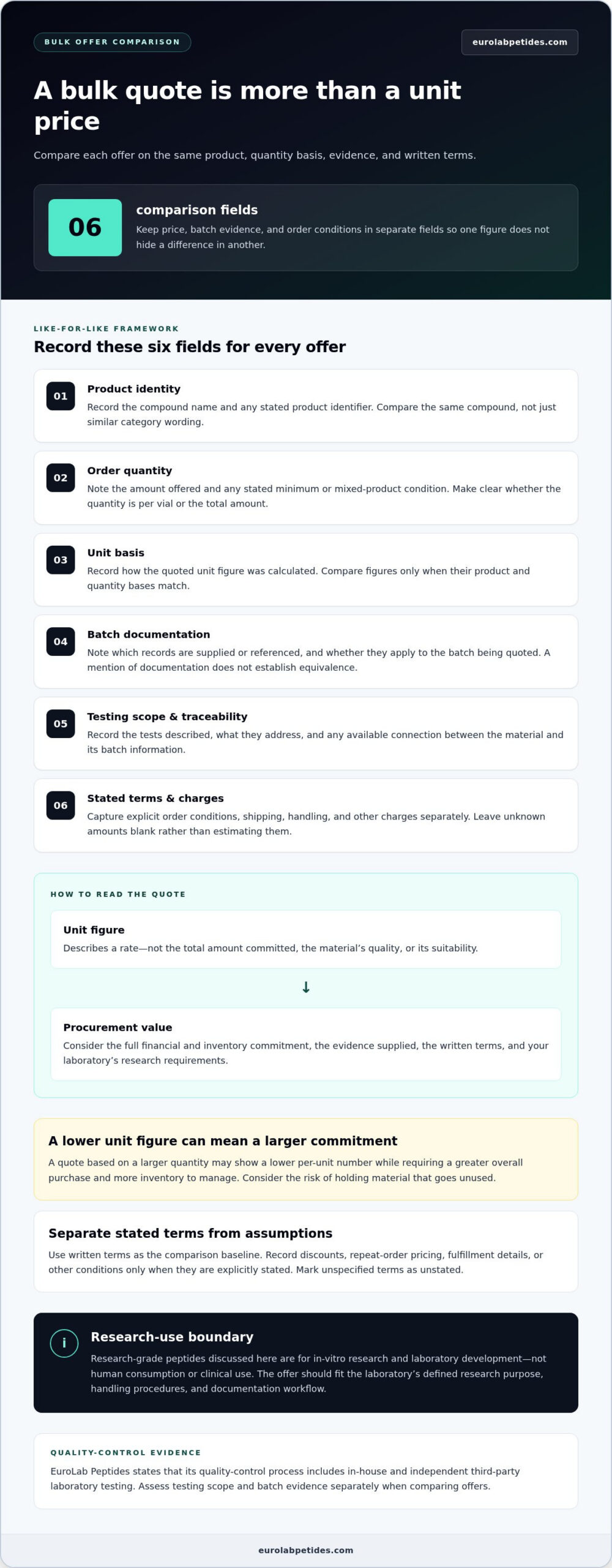
Start a useful comparison with a consistent record for each written offer. Keep product identity, quantity, price basis, evidence, and terms in separate fields. That way, a low figure in one column won’t obscure a difference in another. Use the same fields when comparing several compounds, while recording each product’s specific details.
Use this comparison framework:
- Product identity: Record the compound name and any stated product identifier. Compare offers for the same compound, not just products described with similar category language.
- Order quantity: Note the amount offered and any stated minimum or mixed-product condition. Make the quantity basis explicit, such as the amount per vial or the total amount in the offer.
- Unit basis: Record how the quoted unit figure was calculated. Compare figures only after their product and quantity bases match.
- Batch documentation: Note which records are supplied or referenced and whether they apply to the relevant batch. A mention of documentation doesn’t establish that the records are equivalent across offers.
- Testing scope and traceability: Record the testing described, what it addresses, and any available link between the material and its batch information.
- Stated terms and charges: Capture explicit order conditions, shipping, handling, and other charges in separate fields. Leave unknown amounts blank rather than estimating them.
This framework makes bulk research peptide pricing easier to compare without assuming every supplier uses the same purchasing structure. A broader research peptide sourcing and laboratory standards guide can help place the comparison within a wider sourcing checklist.
Compare specifications and batch evidence
Confirm that the compound identity and stated quantity use the same basis in each offer. Then review the analytical evidence, not just whether testing is mentioned. Record the tests named, their stated scope, and their connection to the material being quoted. Treat purity figures as supplier claims and assess them alongside the supporting evidence. A percentage alone doesn’t establish equivalent quality between offers.
Compare order terms and total commitment
Record minimum quantities, mixed-product rules, and payment terms only when they’re explicitly stated. Separate product costs from shipping, handling, and other applicable charges, and mark unknown amounts as unstated. The comparison should show the full commitment described in the offer, not just the headline unit figure.
Identical unit prices can represent different offers when quantity bases, batch evidence, included charges, or order conditions differ. For in-vitro research procurement, choose a comparison format that also reflects the laboratory’s documentation needs. EuroLab Peptides’ research-grade peptides are supported by a quality-control process that includes in-house and independent third-party laboratory testing. Explore its research-grade peptide sourcing as part of that review.
Does a lower bulk peptide price mean better value?
Not by itself. A lower per-unit figure may be relevant, but it doesn’t show whether the order matches the project timeline, whether the full quantity can be used, or whether the commitment fits the laboratory’s inventory plan. Assess the offer against documented research needs rather than assuming that buying more is inherently more economical.
Bulk purchasing may suit planned, recurring procurement. It can also tie up budget and leave material unused if demand changes. Weigh both sides:
- Potential advantages: A quantity aligned with a repeatable workflow may reduce the need to initiate separate procurement cycles and make planned inventory easier to track.
- Potential disadvantages: A larger commitment may exceed the project’s actual requirements, constrain available budget, or leave stock unused if research plans change.
Before choosing an order size, document expected project use, relevant storage capacity, and purchasing constraints. Compare those requirements with the quantity and terms in the offer. This keeps bulk research peptide pricing tied to procurement fit, not just an appealing unit figure. For research materials intended for in-vitro work, planned use and inventory decisions should remain within laboratory development requirements.
Laboratories assessing research-grade materials can explore EuroLab Peptides’ research-grade catalogue as part of their sourcing review.
When a bulk order may fit research procurement
A larger order may be worth evaluating when a laboratory has recurring, planned research needs and a documented workflow that supports the expected quantity. Aligning procurement with a project schedule can help organize inventory planning, especially when researchers and procurement staff use the same forecast. That alignment doesn’t guarantee savings. The decision still depends on written order conditions, evidence requirements, and the amount of material the work is expected to use.
When a smaller order may be the more prudent choice
A smaller purchase may be easier to justify when demand is uncertain, protocols are changing, or storage capacity is limited. In these situations, a large commitment can be difficult to manage. If part of an order goes unused, its nominal per-unit advantage may not translate into practical value for the project. No quantity is universally appropriate; assess it against the research plan and responsible inventory practices.
Use a simple decision check before proceeding: Does the planned quantity map to documented research demand? Can the laboratory manage the inventory under its procedures? Are the offer’s stated conditions compatible with the project’s schedule and budget? If the answers are unclear, refine the procurement assumptions before comparing further. The objective isn’t to select the largest order or the lowest unit figure. It’s to choose an order whose quantity, evidence, and commitment align with the laboratory’s defined in-vitro research requirements.
A practical checklist for evaluating bulk research peptide offers
Apply the same review to each written offer, and keep the quote with its supporting records. This makes differences easier to identify without filling gaps with assumptions. Separate product specifications, analytical evidence, quantity, and purchasing terms so the decision reflects both the laboratory’s in-vitro research requirements and the terms of the offer.
The procurement comparison checklist
Follow these steps in order. If a detail is absent, record it as unstated rather than treating it as included. This keeps documented terms distinct from expectations.
- Match the product and quantity basis. Record the compound identity, stated amount, presentation, and total order quantity. Confirm that quoted amounts use the same basis before comparing unit figures. Note whether the material is suitable for the intended in-vitro research or laboratory development purpose.
- Review batch evidence. List the analytical documents or results supplied or referenced, the testing scope described, and any information connecting the evidence to the relevant batch. Record what supports a stated purity claim; don’t treat the claim alone as equivalent to detailed evidence.
- Compare written terms and charges. Capture any stated minimum quantity, mixed-product condition, payment term, shipping and handling condition, and other disclosed charge. Keep product price and additional charges distinct. Mark missing figures or terms as unstated rather than estimating them.
A meaningful quote comparison requires, at minimum, matched product identity and quantity basis, available batch evidence, and the written terms and charges that determine the order commitment.
European purchasing and record-keeping considerations
For European procurement, record the stated shipping origin separately from the product price, along with any disclosed delivery or cross-border charges. Don’t infer duties, taxes, or other requirements from a supplier’s location. Applicable requirements can depend on the circumstances, so consult relevant authoritative sources rather than assuming two offers have identical treatment.
Maintain a procurement file for each comparison. Store dated quote versions with associated batch documents, correspondence, and purchase records so the basis for selection can be reviewed later. If terms or supporting documents change, retain the updated version and note what changed. This creates a traceable record and keeps a later quote distinct from the offer originally assessed.
Use the completed checklist to identify comparable fields and unresolved differences before making a sourcing decision. EuroLab Peptides’ quality-control process includes in-house and independent third-party laboratory testing, a relevant consideration in laboratory sourcing. Explore EuroLab Peptides’ research-grade peptides for in-vitro research and laboratory development.
Choosing a research-use supplier for bulk peptide procurement
End a supplier comparison with evidence of fit, not a ranking based on price alone. Review whether the product identity matches the laboratory’s defined work, whether the supplier describes its testing approach, and whether the available information supports your procurement record. Then assess the order against the project’s quantity needs and documented requirements. This gives bulk research peptide pricing a clear role in the decision without making it the only criterion.
What EuroLab Peptides’ quality-control approach contributes to the evaluation
EuroLab Peptides uses a multi-level quality-control process that includes in-house and independent third-party laboratory testing. These are relevant elements to consider when reviewing sourcing information. They should not be taken to imply specific assays, purity thresholds, certificates, or batch-document availability. For context on the research setting, see this overview of what peptides are for research.
Use a focused supplier-selection checklist:
- Product identity: Does the stated compound and presentation correspond to the laboratory’s intended in-vitro research?
- Testing evidence: Is the supplier’s testing approach described clearly, and can the available evidence be assessed in the context of the offer?
- Transparency: Are product information and stated order conditions clear, without relying on vague promotional claims?
- Order fit: Does the quoted quantity align with the documented project plan and responsible inventory requirements?
- Use boundaries: Is the material clearly designated for laboratory research rather than clinical or personal use?
These criteria distinguish a supplier’s stated quality-control process from the specific records available for an individual product or batch. Keep that distinction explicit in procurement notes. For example, record the described testing approach separately from any batch-level evidence reviewed, and distinguish both from your laboratory’s own acceptance requirements.
Keep procurement aligned with laboratory use
EuroLab Peptides’ products are for in-vitro research and laboratory development only. They are not for human consumption or clinical use. Base procurement decisions on the laboratory’s documented requirements and intended in-vitro work, not on medical, therapeutic, or human-use expectations. Assess product suitability and purchasing quantity within that research context.
Before finalizing a sourcing decision, record the product identity, evidence reviewed, order conditions, and intended research application consistently. This creates a clear basis for comparing suppliers and maintaining procurement records over time. To view EuroLab Peptides’ research materials, view EuroLab Peptides’ research catalogue.
Set a consistent standard for your next sourcing decision
Make your next procurement step repeatable: define the laboratory’s required product identity, documentation, order fit, and research-use boundaries before comparing offers. A consistent internal review helps teams assess bulk research peptide pricing against project needs instead of letting one appealing figure set the criteria. Record the basis for selection so future purchasing reviews can build on clear, documented requirements.
EuroLab Peptides is a Europe-based supplier of research-grade peptides. Its multi-level quality-control process includes in-house and independent third-party laboratory testing. Consider these points alongside the product information and order details relevant to your laboratory’s in-vitro work.
When you’re ready to consider research materials for laboratory development, explore EuroLab Peptides’ research-grade catalogue. Set a consistent procurement standard for clear, well-documented research sourcing.
Frequently Asked Questions
How is bulk research peptide pricing usually structured?
Bulk research peptide pricing may be quoted by product and by a stated quantity basis, such as per vial or another specified amount. Some offers may also set conditions for larger orders. To interpret a quote, record the compound, presentation, quoted unit, and quantity covered. Then distinguish that rate from the full amount committed under the written terms. A tier label alone isn’t a complete price breakdown.
Does buying research peptides in bulk always reduce the total cost?
No. A lower rate per unit doesn’t guarantee a lower overall procurement cost or a better fit. For example, if a project’s protocol changes before the full order is used, remaining inventory may limit the practical value of the quoted rate. Consider the full order commitment, any disclosed charges, and the laboratory’s expected use together. The appropriate quantity depends on project requirements, not a universal rule about bulk purchasing.
What should a bulk peptide quote include?
A useful quote should identify the compound, describe the presentation and quantity basis, and state the order terms that determine the commitment. For easier review, capture the quote date, any stated validity period, and the batch or testing information referenced in the offer. If a detail is missing, mark it as unspecified. This prevents procurement records from treating an assumption as a confirmed term.
How can laboratories compare peptide testing claims between suppliers?
Compare the substance of each claim: what testing is described, whether it is in-house or independent, and what material the stated evidence concerns. A general statement that testing occurs doesn’t show that two offers have equivalent scope. Record the evidence available for the specific offer separately from broader supplier descriptions. Don’t interpret a purity claim as proof of other characteristics unless supporting information addresses them.
Are bulk research peptides intended for human use?
No. EuroLab Peptides’ products are intended strictly for in-vitro research and laboratory development. They’re not for human consumption or clinical use. Base procurement decisions on defined laboratory research requirements, not personal-use, diagnostic, or treatment expectations. If a proposed application falls outside in-vitro research or laboratory development, it isn’t an appropriate use for these products.
What costs should European buyers consider beyond the listed product price?
Review any shipping, handling, and other charges disclosed in the offer separately from the listed product price. Depending on the transaction, buyers may also need to account for applicable cross-border charges, but these shouldn’t be assumed from the supplier’s location. Consult relevant authoritative sources for current requirements, and identify the source of each charge in procurement records rather than relying on an estimate.
Can different research peptides be combined to meet a bulk quantity?
Treat different compounds as a combined quantity only if the supplier’s written terms explicitly allow it. A stated volume threshold may apply to one compound, a particular presentation, or an order under specific conditions. Don’t infer that materials can be mixed to qualify. Keep quantities and quoted terms separate by compound in your records, since each product has its own research purpose and comparison basis.
