

What if the lowest academic price isn’t the best value for your laboratory? An academic discount for research peptides can reduce procurement costs, but the saving alone doesn’t show whether the product fits your planned work or what quality information is available. Eligibility and purchase conditions vary by supplier and offer, so compare the written terms with your project requirements before making a decision.
This 2026 guide explains common academic pricing structures and how to compare them with research suitability and quality-control information. It also clarifies the in-vitro research scope of these products, an important distinction when planning laboratory work and evaluating suppliers.
EuroLab Peptides describes a quality-control process that includes in-house and independent third-party laboratory testing. The practical framework below can help you assess pricing and quality information together, then explore research products without treating a discount as a substitute for suitable documentation.
Key Takeaways
- Compare institutional pricing, promotional codes, volume terms, and shipping incentives separately because each can have different conditions.
- Before evaluating an academic discount for research peptides, establish your project requirements and institutional purchasing rules.
- Review product information and available testing evidence alongside any savings to assess suitability for the intended in-vitro laboratory work.
- Use the same criteria for eligibility, documentation, testing information, and purchase conditions when comparing suppliers.
- EuroLab Peptides is a Europe-based supplier of research and laboratory development products, with a stated quality-control process that includes in-house and independent third-party laboratory testing.
Academic Discounts for Research Peptides: What Buyers Should Understand
An academic discount for research peptides is a supplier-defined pricing arrangement for eligible research or educational buyers. It isn’t a standardized program with shared eligibility rules. One supplier may offer institution-level terms, while another may provide public promotions or volume pricing. Read the written terms to understand who qualifies, what products are included, and how the offer affects the final purchase cost.
Separate the main types of savings before comparing them. Each can affect a different part of procurement:
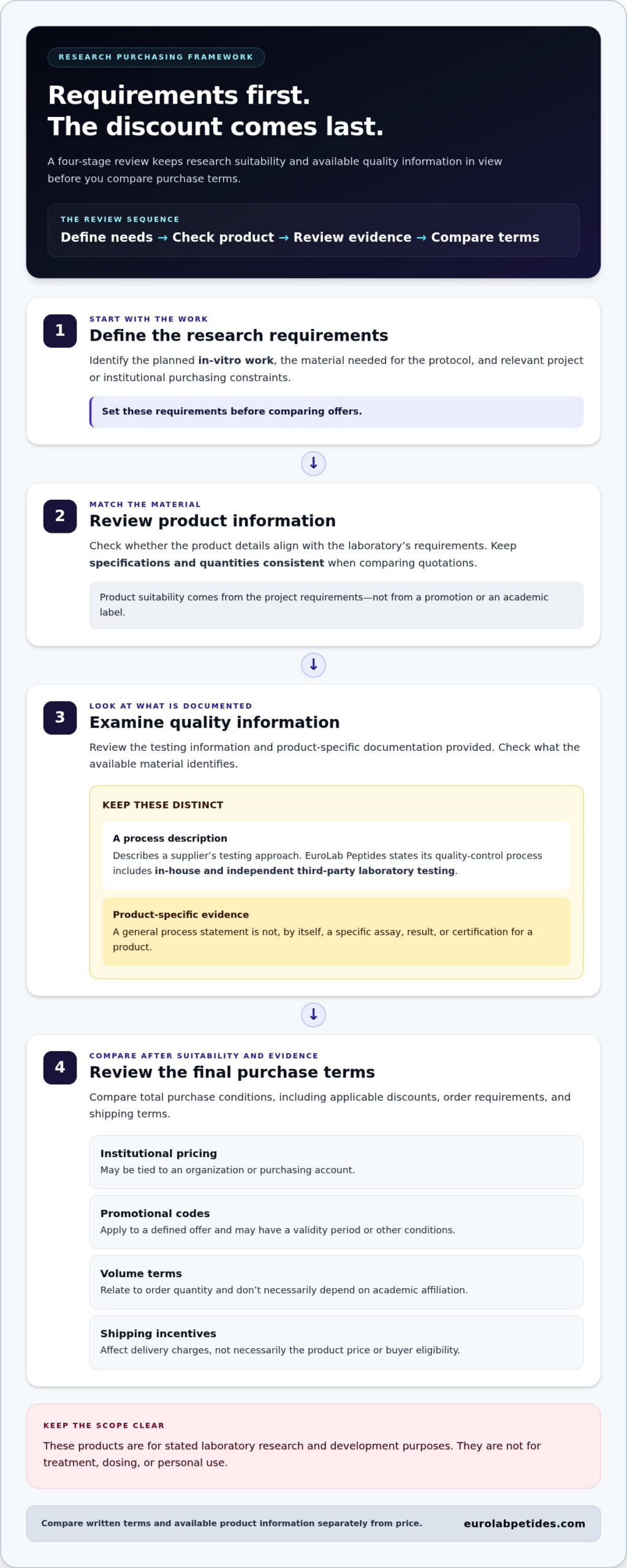
- Institutional pricing may be tied to an organization or purchasing account rather than a single transaction.
- Promotional codes apply to a defined offer and may have a validity period or other conditions.
- Volume terms relate to order quantity and don’t necessarily depend on academic affiliation.
- Shipping incentives affect delivery charges, not necessarily the product price or the buyer’s eligibility.
These distinctions help keep budgets realistic. A one-time coupon may reduce the cost of a single order without affecting future purchases. Institutional terms may instead be handled through an organization’s procurement process. Neither pricing structure demonstrates product suitability or quality. Assess the research requirements and available product information separately from the price.
How academic pricing can differ from a general promotion
Eligibility may be based on institutional affiliation or laboratory purchasing status, but the criteria depend on the offer. A time-limited coupon is different from an ongoing purchasing arrangement: the coupon applies during a specified promotion, while institutional pricing may be organized around an eligible buyer or account. Check the written terms for scope, duration, product coverage, and required documentation. Don’t assume a discount applies to every product, order, or institution.
Which research buyers may be evaluating academic terms?
University laboratories, research institutes, and other professional laboratory buyers may need to assess how a pricing arrangement fits their procurement workflow. Purchasing authority may sit with a principal investigator, department, or central purchasing team. Before comparing offers, establish who can approve the purchase and what records the institution requires for in-vitro research or laboratory development.
Research suitability is separate from a buyer’s institutional status. Choose products according to the laboratory project and its intended in-vitro scope, not because a promotion or an academic label suggests a product is suitable. Peptides are produced through different synthesis approaches; Peptide Synthesis Methods provides foundational context. General information about synthesis isn’t evidence about a specific product or batch. Review product information and available quality evidence directly, and keep procurement decisions within the stated laboratory research and development purpose. These products aren’t for treatment, dosing, or personal use.
How to Evaluate Research Peptide Discounts Without Losing Sight of Quality
A discount matters only after you’ve assessed whether a peptide fits the intended laboratory project. A lower quoted price can’t establish suitability or quality. Follow the same review sequence for each option so promotional terms don’t take priority over research requirements or the available evidence.
- Define the research requirements. Identify the planned in-vitro work, the material needed for the protocol, and relevant project or institutional purchasing constraints. Use these requirements as the basis for comparison.
- Review product information. Check that the product details align with the laboratory’s requirements. Keep product specifications and quantities consistent when comparing quotations.
- Examine quality information. Review the testing information and product-specific documentation provided. Distinguish a supplier’s description of its process from results or evidence for a particular product.
- Compare final terms. Once suitability and available quality evidence have been considered, compare the total purchase conditions, including applicable discounts, order requirements, and shipping terms.
This sequence prevents a tempting discount from driving the decision before the product has been matched to the study. For an academic discount for research peptides to be useful, first establish that the product information fits the laboratory’s needs. Then weigh the savings against documentation and procurement conditions.
What quality information should buyers review?
Review product-specific documentation and testing information provided for the product. A description of a supplier’s testing process gives useful context, but it isn’t the same as a specific assay, result, or certification. Check what the available material identifies and don’t treat a general process statement as product-specific evidence.
EuroLab Peptides states that its quality-control process includes in-house and independent third-party laboratory testing. This describes the company’s testing approach. It does not, by itself, establish a particular analytical method, numerical purity result, or certificate for a product. In procurement records, distinguish process information from product documentation that relates to the specific material.
How to compare the effective purchase terms
After reviewing product suitability and quality information, compare quotations on an equivalent basis. Use the same product requirements and quantity, then assess the terms that could affect the purchase:
- Product specifications: Confirm that the items being compared meet the same project requirements.
- Order requirements: Record conditions attached to the purchase or discount.
- Shipping terms: Include stated delivery charges or incentives in the comparison.
- Discount conditions: Record eligibility, duration, and scope as stated in the offer.
This approach helps distinguish a difference in final terms from a mismatch in product, quantity, or conditions. Laboratory buyers evaluating in-vitro research materials can consider EuroLab Peptides’ research peptide range alongside its stated quality-control approach, keeping product suitability and available documentation central to the decision.
Academic Pricing Versus Peptide Quality: A Practical Comparison Framework
A useful comparison separates what a supplier states from what a buyer needs to assess. A price reduction neither proves nor disproves quality. The value of an academic discount for research peptides depends on whether the product fits the project, the available quality information supports evaluation, and the purchase terms suit the laboratory’s requirements.
Use the framework below to compare suppliers and keep pricing, product information, and quality evidence distinct.
| Comparison area | Confirmed supplier information | Buyer question |
|---|---|---|
| Eligibility | Eligibility criteria are set by the terms of each supplier’s offer. | Are eligibility criteria stated, and what institutional or purchasing documentation is required? |
| Discount type | Offers may use different pricing structures and conditions. | Is the offer institutional pricing, a promotion, a volume term, or a shipping incentive? |
| Product documentation | Products are designated for in-vitro research and laboratory development. | Do product details align with the intended research scope and project requirements? |
| Testing information | EuroLab Peptides states that its quality-control process includes in-house and independent third-party laboratory testing. | What testing information or product-specific documentation is available, and what does it demonstrate? |
| Purchase conditions | Order and discount conditions depend on the applicable offer. | Are order requirements, exclusions, shipping terms, and offer duration documented and relevant to this order? |
Which comparison criteria matter beyond the discount?
Start with product identity and stated research scope. A favorable price isn’t a meaningful comparison if the products or intended applications differ. Then assess how clearly the supplier describes its quality-control process. EuroLab Peptides states that its testing includes in-house and independent third-party laboratory work. This describes its process; assess any product-specific information separately. Treat unsupported quality claims cautiously, and don’t assume similar wording means two suppliers provide equivalent evidence.
How to assess discount terms fairly
Compare terms when they’re documented, current, and applicable to the order. Review eligibility, minimum order conditions, exclusions, and shipping terms. A nominal discount may be less useful if it requires a quantity the laboratory doesn’t need, excludes the relevant product, or conflicts with institutional purchasing procedures. Keep the product and quantity consistent across quotations so the comparison reflects actual differences in terms rather than mismatched orders.
Record confirmed statements separately from details that still need review. For example, note the supplier’s stated testing approach, then separately record whether product-specific documentation is available. This distinction supports a clear procurement decision: savings are considered alongside product identity, research scope, quality information, and purchase conditions, not in place of them.
A Research Buyer’s Checklist Before Ordering Peptides
A procurement decision is easier to review when its rationale is recorded before an order is placed. When evaluating an academic discount for research peptides, separate the project’s scientific requirements, institutional process, and intended research scope from the discount itself. This checklist helps research teams document the basis for a purchase and distinguish verified details from assumptions.
Prepare the project and purchasing requirements
Begin with the research question and the product category relevant to the laboratory work. Define the intended in-vitro research or laboratory development scope, then review internal purchasing procedures before selecting an item. Approval routes and required records can differ between departments and organizations, so establish them early. For broader sourcing criteria, consult this guide to buying research peptides.
- Define the project need. Record the research question, relevant product category, and the role the material will have in the laboratory work.
- Confirm the intended scope. Keep the planned use within in-vitro research and laboratory development. These products are not for human consumption or clinical use.
- Review institutional purchasing rules. Identify who can authorize the order and what documentation the organization requires for procurement and records.
- Set the order requirements. Document the product details and quantity needed for the project so that comparisons use equivalent requirements.
Record the evidence behind the decision
Keep a concise record of what was reviewed, when it was reviewed, and whether each detail came from supplier documentation or an internal assumption. For foundational terminology, refer to this overview of what peptides are. It can help teams describe the material consistently in project and procurement records.
- Product information: Save the product identity and relevant details used to assess fit with the project.
- Quality-control information: Record the supplier’s stated testing process and any product-specific testing information or documentation provided. EuroLab Peptides states that its process includes in-house and independent third-party laboratory testing.
- Discount conditions: Note the offer type, eligibility terms, duration, exclusions, and order requirements stated for the purchase.
- Purchase terms: Capture relevant shipping terms and the final conditions used in the comparison.
Mark each item as confirmed, not provided, or requiring internal review. This simple distinction makes the purchasing rationale more transparent and prevents an assumption from being mistaken for quality evidence or a supplier term.
Once the project criteria and documentation needs are clear, browse research peptides for laboratory work within the stated in-vitro research scope.
Explore EuroLab Peptides for In-Vitro Research
For academic and professional laboratory buyers, supplier evaluation should begin with research scope and available quality information, not an assumed discount. EuroLab Peptides is a Europe-based supplier of research and laboratory development products. Its products are designated for in-vitro research only, not human consumption or clinical use. This scope is central to deciding whether a product range fits a laboratory project.
EuroLab Peptides’ stated quality-control approach
EuroLab Peptides states that its quality-control process includes in-house and independent third-party laboratory testing. These are parts of the company’s stated multi-level approach and can inform a researcher’s supplier assessment. They are process information, not claims about a particular assay, result, purity figure, certification, or batch document. Consider the stated approach alongside the product information relevant to the research requirements.
For a precise procurement record, note what the supplier says about its testing process and assess any product-specific information separately. A description of quality control provides context, but shouldn’t be extended into evidence that it doesn’t state. Apply the same distinction to pricing: academic discount terms and quality information answer different questions. Neither replaces the need to establish suitability for in-vitro research.
Browse research products for laboratory work
Professional researchers can explore the product catalogue for laboratory research and development. Keep selection within the product’s stated in-vitro scope, and weigh product details against project requirements and available quality information. For a focused discussion of the role of external testing in supplier evaluation, see third-party peptide testing.
- Research scope: Products are for in-vitro research and laboratory development only.
- Supplier context: EuroLab Peptides is based in Europe and serves a worldwide research market.
- Quality-control statement: The stated process includes in-house and independent third-party laboratory testing.
These points provide a factual starting place for reviewing the range. Evaluate product information in the context of the planned laboratory work, and compare any pricing terms separately.
Explore EuroLab Peptides to browse research products for in-vitro laboratory work.
Make Your Next Research Purchase Deliberate
Build a repeatable procurement process that connects each purchase to a defined laboratory objective. Record the project requirements, product information reviewed, basis for any quality assessment, and applicable purchasing terms. A clear record gives research teams a rationale they can revisit when plans or institutional procedures change.
An academic discount for research peptides can be one consideration in that process, but products should first be assessed against the work they are intended to support. EuroLab Peptides states that its quality-control process includes in-house and independent third-party laboratory testing. Its products are intended strictly for in-vitro research and laboratory development, not human consumption or clinical use.
Use these details alongside the requirements of your project and procurement procedures. Browse the research range for products relevant to laboratory work, then evaluate the available information in the context of your research scope.
Explore EuroLab Peptides to browse research products for in-vitro laboratory work.
Frequently Asked Questions
What is an academic discount for research peptides?
An academic discount for research peptides is a supplier-defined pricing arrangement for buyers who meet the offer’s eligibility terms. It isn’t a standardized discount category, so the phrase alone doesn’t establish who qualifies or which products are covered. An institutional purchasing arrangement, for example, differs from a public coupon applied at checkout. Review the offer’s criteria, duration, and conditions before including it in a laboratory budget or purchase request.
Do researchers need proof of academic affiliation to receive a peptide discount?
Documentation requirements depend on the specific offer. A supplier may define eligibility by institutional affiliation, laboratory purchasing status, or other stated criteria, while a general promotion may not use academic status at all. For an institutional purchase, the buyer may also need records that meet internal procurement procedures, regardless of whether the supplier requests proof. Keep supplier eligibility requirements separate from the institution’s authorization and recordkeeping rules.
Can independent researchers qualify for academic pricing?
Eligibility depends on the written terms. Professional research activity doesn’t automatically meet the criteria of an academic pricing program. Some offers may be limited to particular institutions or purchasing arrangements, while others may be public promotions rather than academic pricing. Independent laboratory buyers should compare the offer’s eligibility conditions with their organization’s status and purchasing process.
Does an academic discount apply to every research peptide?
Coverage depends on the offer’s stated scope. A promotion may exclude particular products, apply only to selected items, or require specific order conditions. Before budgeting, match the offer to the exact product and quantity required for the planned work, and note any exclusions or limits. Eligibility for one product or order doesn’t automatically extend to other products or future purchases.
Should I choose the lowest-priced research peptide supplier?
No. The lowest quoted price doesn’t establish that a product suits a project or that its quality information is adequate for evaluation. Compare product identity, stated research scope, available documentation, testing information, and order terms alongside price. A low-cost option may not be comparable if it differs from the required product or lacks information needed for the protocol or purchasing review. Price is one criterion, not a quality assessment.
Are research peptides for human consumption or clinical use?
No. EuroLab Peptides’ products are designated strictly for in-vitro research and laboratory development, not human consumption or clinical use. A laboratory research designation isn’t directions for personal use, dosing, diagnosis, or treatment. Keep product selection and handling within the intended research context, and ensure planned work follows the applicable procedures of your institution. These products are not medicines or a substitute for clinical guidance.
