

What if a peptide changes one inflammatory signal without producing a broad anti-inflammatory effect? That distinction is central to peptides for inflammation pathway studies. Inflammation involves overlapping pathways and cell types, so a change in NF-κB, MAPK, JAK/STAT, or NLRP3 activity must be interpreted in the context of the model and measured readout. A pathway shift alone doesn’t prove a wider biological effect.
Findings can be difficult to compare when peptide classes, experimental models, and endpoints differ. This guide explains how peptide research relates to major inflammatory signaling pathways and how to turn a broad interest into a focused, testable in-vitro question.
You’ll also learn to distinguish pathway-level observations from broader conclusions, interpret results within the limits of an experiment, and consider material quality and documented testing when assessing reproducibility. These are research considerations, not therapeutic guidance. The goal is a practical framework for evaluating evidence, planning an informative investigation, and stating precisely what its results do and don’t show.
Key Takeaways
- Frame peptides for inflammation pathway studies around a defined signaling question, experimental model, and measurable response.
- Distinguish NF-κB, MAPK, JAK/STAT, and NLRP3 as separate research targets whose relationships depend on context.
- Compare findings by peptide class, model, inflammatory stimulus, pathway, and readout rather than treating results as interchangeable.
- Use a structured in-vitro framework to define the question, select readouts, plan controls, and state experimental limits.
- Consider peptide identity, purity, consistency, and handling when assessing reproducibility. Testing supports material characterization, not guaranteed outcomes.
What Do Peptides for Inflammation Pathway Studies Actually Investigate?
Peptides for inflammation pathway studies examine how a defined peptide relates to signaling events and measurable responses in a specified experimental model. The question is not simply whether inflammation “goes down.” Ask which molecular events change, in which cells or model, under what conditions, and whether those changes align with the selected readouts. Inflammation involves interacting cells and signals, not one molecule or a single outcome shared by every tissue and model.
Pathway-level evidence describes a measured change in a signaling component or related response in a defined experiment. Clinical evidence concerns outcomes in people and requires a different level of investigation. A laboratory observation cannot, by itself, establish that a peptide treats or prevents disease. Keep conclusions at the scale the data support.
How is an inflammatory pathway different from an inflammation outcome?
A signaling pathway is a set of molecular interactions through which a cell detects or relays a signal. A molecular target is a specific component under investigation, such as a receptor, kinase, or transcription factor. A downstream mediator is produced or regulated later in the response, while a measured phenotype is an observable endpoint, such as a change in mediator release or cellular activity.
A simplified experiment might follow stimulus → signaling event → measured readout. For example, a researcher could apply a defined inflammatory stimulus to a cell model, examine a candidate signaling marker, and quantify a downstream mediator. This is a framework, not a universal route: models can use different signaling networks, and several pathways may operate at once. A change in one marker alone doesn’t establish a broad anti-inflammatory effect. Interpretation depends on the research question, relevant controls, and whether related readouts support the same conclusion.
Which peptide research contexts belong in this topic?
“Peptide” can refer to materials studied in distinct contexts. Endogenous signaling peptides occur naturally in organisms and may be investigated for their roles in cell communication. Bioactive peptides, including sequences derived from larger proteins or other sources, are studied for measurable biological activity. Research peptides are materials examined in laboratory research, including in-vitro experiments. These categories describe study context; they don’t establish equivalent composition, activity, or evidence.
Comparisons require attention to sequence, source, experimental model, stimulus, and conditions. Two studies may use peptides with different sequences or test them in different cell types, so a shared label such as “anti-inflammatory” can obscure important differences. For example, the Cathelicidin Antimicrobial Peptide (CAMP) entry describes LL-37 in relation to immune responses, illustrating why a peptide’s biological context matters when selecting a pathway question.
Clear terminology helps narrow a study. Researchers can review the foundations in this guide to peptides for researchers, then specify the peptide class and experimental context before comparing findings. A precise scope makes it easier to separate what the study measures from what it cannot establish.
How Do Peptides Intersect With Major Inflammatory Signaling Pathways?
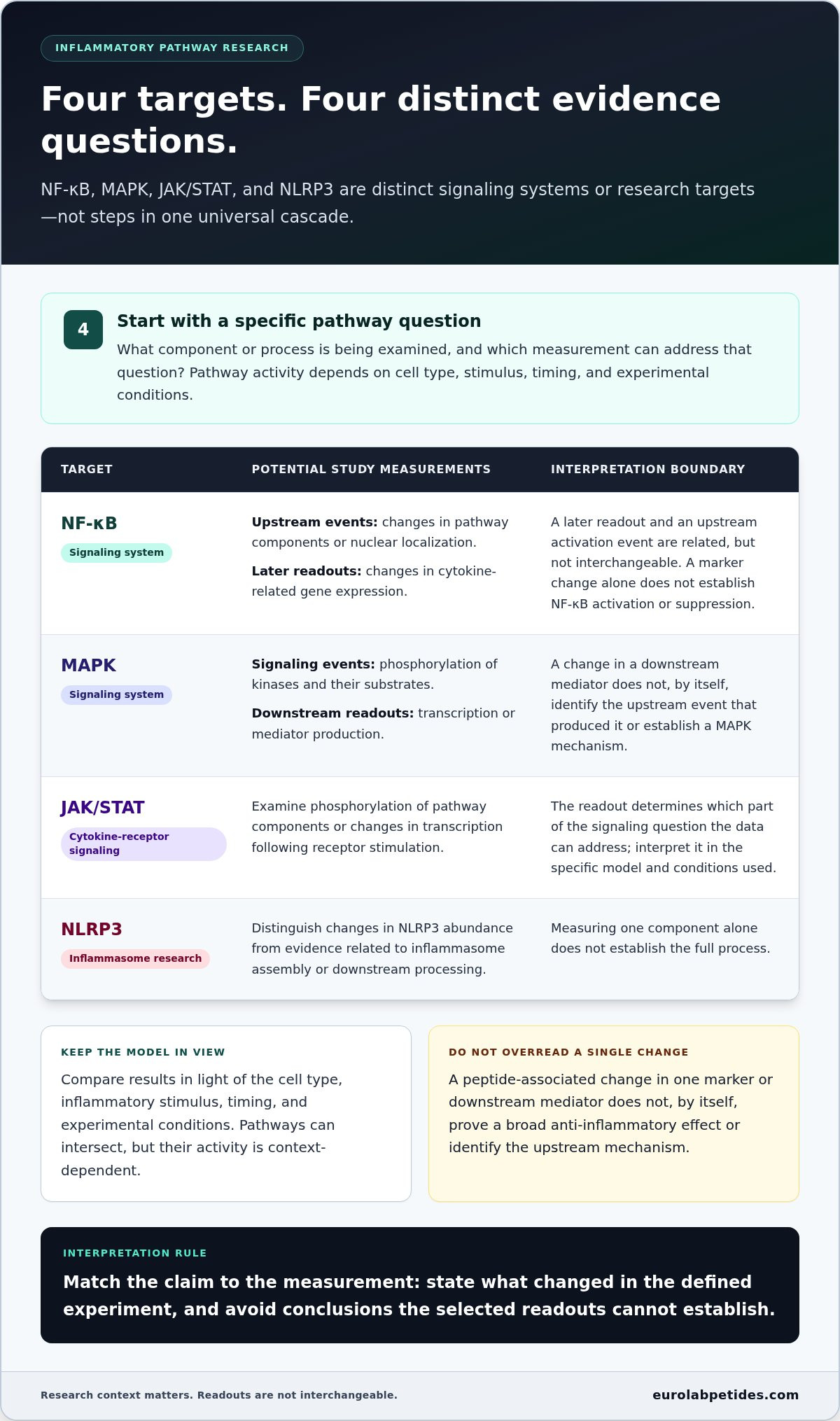
For peptides for inflammation pathway studies, choose a pathway based on the research question rather than a broad label such as “anti-inflammatory.” NF-κB, MAPK, JAK/STAT, and NLRP3 are distinct signaling systems or research targets. They can intersect, but their activity depends on cell type, stimulus, timing, and experimental conditions. Treating them as steps in one universal cascade can obscure what an experiment actually tests.
Each target calls for a specific evidentiary question. Is a signaling component activated? Does a downstream transcriptional response change? Is an inflammasome-related process affected? The readout determines which part of that question the data can address.
What can NF-κB and MAPK investigations reveal?
NF-κB and MAPK signaling systems are commonly examined in inflammatory-response research. NF-κB studies may distinguish upstream activation events, such as changes in pathway components or nuclear localization, from later transcriptional readouts, such as changes in cytokine-related gene expression. MAPK research often examines phosphorylation of kinases and their substrates, and may then assess downstream transcription or mediator production. These measurements are related, but they aren’t interchangeable.
A peptide-associated change in a downstream mediator doesn’t, by itself, identify the upstream event that produced it. Nor does a marker change establish that a peptide activates or suppresses NF-κB or MAPK. Such claims require study-specific evidence connecting the proposed mechanism to appropriate measurements in the model used.
Where do JAK/STAT and NLRP3 fit into pathway studies?
JAK/STAT signaling is associated with cytokine-receptor signaling. A study might examine phosphorylation of pathway components or changes in transcription following receptor stimulation. NLRP3, by contrast, is a target within inflammasome research. Investigations may distinguish changes in NLRP3 abundance from evidence related to inflammasome assembly or downstream processing. Measuring one component alone doesn’t establish the full process.
NLRP3 is not a synonym for inflammation as a whole. Its relevance depends on the research question and model. Before describing a peptide as acting through JAK/STAT or NLRP3, verify the proposed mechanism against primary literature and confirm that the experiment’s readouts support that interpretation.
Readouts answer different questions. Cytokine expression measures transcription or mediator abundance, depending on the assay; phosphorylation can indicate signaling activity at a measured time point; inflammasome-related markers address components or outputs of that system. A change in one category should not be reported as proof of a change in the others. Pairing mechanistically distinct measurements can strengthen interpretation, but it doesn’t make results universal across models.
Pathway markers require model-specific interpretation: the same measured change can mean different things across cell types, stimuli, and experimental conditions. For clear reporting, state the model, stimulus, target, readout, and limits of inference. Describe the observed result without extending it to an untested mechanism or clinical outcome.
How Should Researchers Compare Peptide-Related Inflammation Findings?
Comparing peptide studies requires more than matching a pathway name or an “anti-inflammatory” label. For peptides for inflammation pathway studies, compare experiments with sufficiently aligned materials, models, stimuli, and endpoints. A cell-culture result and an animal-model result may inform related questions, but they aren’t interchangeable evidence. Differences in experimental design can explain apparently inconsistent findings without establishing that one study is incorrect.
Results are comparable only when methods and endpoints align closely enough to support the same interpretation. A structured evidence table makes differences visible before you draw conclusions.
| Comparison field | What to record | Why it matters |
|---|---|---|
| Peptide class and identity | Sequence, source, and available characterization | Similar labels don’t establish identical materials. |
| Experimental model | Cell type, animal model, or other system | Biological context shapes the response. |
| Inflammatory stimulus | Stimulus used and relevant conditions | Different triggers may engage different responses. |
| Pathway | Target or signaling system examined | A shared pathway label can mask differences in the specific event measured. |
| Readout | Gene expression, protein abundance, phosphorylation, or functional output | Each endpoint answers a different question. |
Which variables make two peptide studies meaningfully comparable?
Start with peptide identity and characterization, then compare the model system and inflammatory stimulus. Record exposure conditions and timing as reported by each study rather than assuming differences are minor. Classify the endpoint precisely: gene expression is not the same measurement as protein abundance, and phosphorylation is not equivalent to a functional output. This audit can explain why experiments report different results despite investigating similarly named pathways.
Flag design differences before interpreting agreement or disagreement. A signal measured in one cell type, for example, should not be treated as an expected response in another model. Keep findings from cells, animals, and other systems identified by their model. A table supports comparison, but it cannot remove biological or methodological differences.
How can researchers use published peptide examples responsibly?
A peptide-specific profile can help identify how a particular material has been studied, but it is not a general template for all peptides. The BPC-157 research applications guide provides a separate example of examining a peptide in its own research context. When citing a study, carry its model, methods, and endpoints into your summary. Don’t turn review language about anti-inflammatory activity into a clinical claim or evidence of an effect beyond the investigated conditions.
For laboratory programs focused on recovery, muscle tissue, and inflammation, EuroLab Peptides’ Recovery, Muscle Tissue & Inflammation Research category provides a relevant research area to explore. A sound evidence comparison still begins with the study record: identify what was tested, what was measured, and where the conclusion must stop.
How Can an In-Vitro Inflammation Pathway Study Be Framed Clearly?
A useful in-vitro study starts with a question narrow enough to connect a defined model to a measurable event. For peptides for inflammation pathway studies, let the hypothesis guide assay selection: first decide what biological question the experiment can address, then choose measurements suited to it. A pathway marker, a cytokine measurement, and a cell-function endpoint may inform different parts of the response, so don’t treat them as interchangeable evidence.
Use this five-step framework to make the study logic explicit:
- Define the question. State the peptide-related research question as an observable relationship, not a presumed therapeutic effect. For example, ask whether a selected signaling readout changes in a specified cell model after a defined inflammatory stimulus.
- Choose the model. Identify the cell type or other in-vitro system and explain why it fits the pathway question. The model determines which responses can be meaningfully measured.
- Select pathway readouts. Choose endpoints that distinguish the event of interest from downstream responses. A signaling measurement and a cytokine measurement can provide complementary information, but answer different questions.
- Plan controls and replication. Define comparisons that help separate stimulus-related changes, vehicle effects, and baseline variation. Replication supports assessment of consistency, but doesn’t remove limitations inherent to the model.
- Interpret the limits. Report what the selected model and measurements support. Don’t extend an in-vitro observation to other cell types, whole-organism outcomes, or clinical conclusions without evidence from those settings.
How do you turn a pathway topic into a testable question?
Specify four elements: the model, the inflammatory stimulus, the pathway event, and the measurable endpoint. A conceptual question might ask whether a defined signaling event changes in a chosen cell model following a specified stimulus, with a downstream readout assessed separately. This framing keeps pathway activity distinct from a broader outcome. Use causal wording only when the study design and evidence support it; otherwise, describe an association or observed change.
Which controls and readouts support careful interpretation?
At a conceptual level, a negative control helps establish the baseline, a positive control helps determine whether the selected system can produce the expected type of response, and a vehicle control accounts for effects associated with the material’s carrier. Select pathway-specific measurements to test the proposed signaling event, and distinguish them from broader cytokine or cell-response measurements. Assay choice, validation, and interpretation depend on the model and question.
Controls and replication strengthen interpretation, not certainty. If a marker changes while a broader response does not, report both findings rather than treating one as proof of the other. Document the design and limitations so readers can judge how far the conclusion extends beyond the experiment.
For in-vitro research, explore research-grade peptides for laboratory investigation from EuroLab Peptides.
Why Do Peptide Quality and Research-Only Use Matter for Reproducibility?
In peptides for inflammation pathway studies, material quality is part of the experimental record. If peptide identity, purity, consistency, or handling conditions vary, observed differences may reflect the material or its preparation rather than the pathway question. Documenting these details helps researchers interpret results and assess whether an experiment can be repeated under comparable conditions. It doesn’t guarantee a particular outcome.
EuroLab Peptides products are intended strictly for in-vitro research and laboratory development. They are not for human consumption or clinical use. Laboratory findings must not be presented as treatment guidance or evidence of human benefit.
What quality information is relevant to pathway research?
Before a study begins, review the available identity and analytical documentation for its research material. Confirm that the material description corresponds to the peptide under investigation, and record relevant information about handling and preparation according to the documentation and the laboratory’s procedures. These details support a traceable experimental record and make it easier to assess differences between runs or studies.
Consistency supports repeatability: if the material or its handling changes, the experiment may no longer provide a like-for-like comparison. A quality document cannot predict biological activity or ensure reproducibility. It provides information about the material, while the model, assay, controls, and execution remain important to interpretation. Broader context on evaluating materials and laboratory standards is covered in this guide to research peptide sourcing and laboratory standards.
EuroLab Peptides uses a multi-level quality-control process that includes in-house and independent third-party laboratory testing. This information can help researchers assess material quality, but testing is not proof of experimental performance or a substitute for study-specific controls and validation.
What are the boundaries of research-peptide findings?
Keep evidence tied to the system in which it was generated. An in-vitro observation describes a response in a defined laboratory model. An animal-model finding comes from a different biological context. Neither, by itself, establishes clinical efficacy, human safety, or benefit. Even a well-supported change in a pathway marker should be reported as a finding about that marker, model, and set of conditions, not turned into a recommendation to treat or prevent disease.
This boundary is central to responsible research communication. Distinguish the experimental result from any broader interpretation, and state what the design cannot establish. EuroLab Peptides products are for in-vitro research and laboratory development only, not for human consumption or clinical use.
To review relevant research areas, explore EuroLab Peptides research categories.
Carry Your Pathway Question Into the Next Study
Turn a pathway of interest into a research question that can be evaluated with a defined model, suitable readouts, and documented limits. For peptides for inflammation pathway studies, this discipline keeps interpretation anchored to the experiment and makes the evidence easier to assess and build on.
Material selection is part of that preparation. EuroLab Peptides uses in-house and independent third-party laboratory testing, and its products are designated for in-vitro research and laboratory development only. Testing can inform material assessment, but it cannot predict an experimental outcome or establish clinical relevance.
Explore EuroLab Peptides research categories to find an area relevant to your laboratory inquiry. Explore EuroLab Peptides research categories, then continue with a focused question and a clear account of what your data support. Rigorous research depends on precise questions, transparent methods, and conclusions that stay within the evidence.
Frequently Asked Questions
What are peptides for inflammation pathway studies?
Peptides for inflammation pathway studies examine defined inflammatory signaling events in a specified experimental model. Researchers might ask whether a selected stimulus is associated with a change in a signaling protein, a downstream mediator, or a cellular response. The phrase doesn’t identify a single peptide class or establish therapeutic activity. For clear interpretation, record material identity, model, stimulus, controls, assay, and the boundaries of the result.
Which pathways are commonly studied in peptide-related inflammation research?
Common targets include NF-κB, MAPK, JAK/STAT, and NLRP3-related signaling, among others. They represent distinct systems, not interchangeable indicators of one universal inflammatory process. A question about cytokine-receptor signaling, for example, may lead to a different target than a question about inflammasome-related activity. Choose the pathway based on the model and hypothesis, and verify a proposed peptide mechanism against primary studies before presenting it as established.
Can a change in cytokine levels prove that a peptide affects an inflammatory pathway?
No. A cytokine change can show that a measured downstream response differs under the tested conditions, but it may not identify the upstream event responsible. A lower measured cytokine level, for instance, doesn’t by itself show which signaling component changed or why. Interpret the result alongside the study question, assay validation, controls, and relevant pathway-specific measurements. Don’t treat one marker as proof of a broad biological or clinical effect.
How do researchers compare peptide inflammation studies?
Compare studies by peptide identity and characterization, experimental model, inflammatory stimulus, conditions, controls, and endpoint. Identify what the endpoint measures: a gene-expression result cannot be directly equated with a protein measurement or functional readout. If one paper uses cultured cells and another an animal model, describe their results separately. This preserves context instead of implying that the studies establish the same finding.
Are research peptides for inflammation pathway studies intended for human use?
No. EuroLab Peptides products are designated strictly for in-vitro research and laboratory development, not for human consumption or clinical use. A result in a cell-based experiment doesn’t establish safety, effectiveness, or a suitable use in people. Keep research findings separate from medical advice and treatment recommendations. State the intended research context clearly so readers don’t mistake laboratory investigation for clinical evidence.
Why does third-party testing matter for research peptides?
Independent testing can contribute quality-control information researchers use when assessing a study material. Its significance depends on the documentation and methods reported, so don’t infer a specific test result or performance guarantee from the fact of testing alone. EuroLab Peptides’ quality-control process includes in-house and independent third-party laboratory testing. Such testing can inform material assessment, but it cannot ensure an assay will produce a particular result.
What should a focused in-vitro inflammation pathway question include?
Include a defined model, inflammatory stimulus, pathway event, and measurable endpoint. For example, a conceptual question could ask whether a specific signaling readout changes in a selected cell model under a defined stimulus, with a separate endpoint used to assess a downstream response. State what observation would support the hypothesis, plan relevant controls, and define the limits in advance. Keep conclusions within the model and assay used.
