

A passing Certificate of Analysis doesn’t prove that two raw-material lots are interchangeable. It shows that a lot met the specifications listed on the document, but not that it will perform equivalently in your specific method. Ensuring lot-to-lot consistency therefore requires comparing lots against defined requirements and using fit-for-purpose testing.
A CoA is an important quality record, but only one part of the decision. Differences in purity, concentration, stability, or biological activity can affect applications in different ways, and a numerical difference is not automatically analytically meaningful.
This article explains what lot-to-lot consistency means, why raw materials can vary, and how to interpret CoAs alongside QA/QC evidence. It also covers how specifications, validated methods, and risk-based comparisons help determine whether a new lot is suitable for continued use or needs further investigation.
Key Takeaways
- A passing CoA confirms that a lot met its listed specifications; it doesn’t, on its own, establish equivalence in a particular method.
- Set material specifications around the characteristics that affect intended use, then compare new lots using standardized, repeatable methods.
- Judge whether observed differences are analytically meaningful, considering factors such as method variability, biological activity, and changes to the blank or baseline.
- Document lot identity, CoA review, preparation details, test results, and the approval or disposition decision to support traceability.
- Scale lot verification to the material’s risk and intended use, and retain samples or records that can support later investigation.
Consistent analyte concentrations across raw-material lots
Ensuring lot-to-lot consistency means controlling the characteristics that affect a material’s intended analytical use. Concentration is one measure, while stability and biological activity may also determine whether results remain comparable.
Certificates of Analysis and Stability Testing
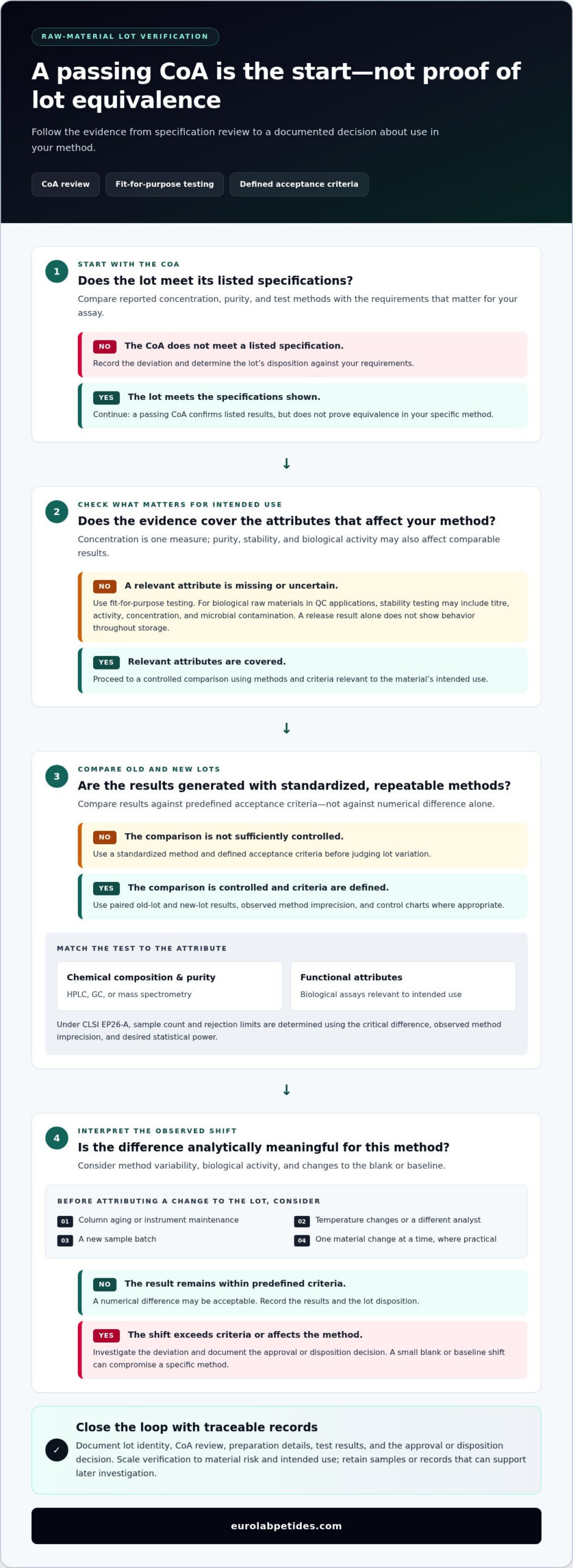
A Certificate of Analysis (CoA) records a lot’s tested attributes and results against listed specifications. It provides evidence about that lot, but passing results alone don’t prove it is interchangeable in a particular method. Compare the CoA’s reported concentration, purity, and test methods with the requirements that matter for your assay.
Stability testing assesses whether relevant characteristics remain within specification over the defined shelf life. For biological raw materials used in quality-control applications, this may include titre, activity, concentration, and microbial contamination. A result measured at release does not show how the material will behave throughout storage.
Testing costs and timelines vary by industry because methods, sample numbers, and stability periods differ. A chemical composition check has a different scope from biological activity testing or real-time stability assessment over a defined shelf life.
Lot Changes and Analytical Results
A lot change can shift measured results even when both lots meet their general specifications. Changes in water, additive concentration, pH, or solvent composition may alter chromatographic retention. Extraction solvents and sample-preparation reagents can also affect analyte recovery, while trace impurities may change blank peaks or baseline response.
Protease activity is another variable. Active proteases can degrade susceptible analytes during storage or preparation, lowering the measured concentration. Albumin conformation can also affect analyte binding. Structural changes may alter how much analyte remains bound or available for measurement, so concentration alone may not explain a changed signal.
Interpret results in context. A suspected lot effect may coincide with column aging, instrument maintenance, temperature changes, a different analyst, or a new sample batch. Where practical, change one material at a time to help distinguish raw-material effects from these concurrent factors.
Measuring and Assessing Lot Variation
Manufacturers assess lot-to-lot variation by testing critical attributes with standardized analytical methods and comparing results across lots. HPLC, GC, and mass spectrometry can assess chemical composition and purity, while biological assays evaluate functional attributes relevant to the intended use.
Statistical assessment can use paired old-lot and new-lot results, observed method imprecision, and control charts to identify trends or shifts. Under CLSI EP26-A, laboratories use the critical difference, observed method imprecision, and desired statistical power to determine sample count and rejection limits.
Results are meaningful only when compared with defined acceptance criteria. Statistical analysis helps distinguish natural variation from a deviation that warrants investigation. A numerical difference may be acceptable, while a small shift in a blank or baseline may compromise a specific method.
Critical laboratory materials and their lot-related risks
Lot risk depends on the material’s function, intended use, and effect on the method. A change in an antibody, control material, or biochemical raw material can alter assay performance, even when the product name is familiar.
Clinical laboratories evaluate each new reagent lot before use. Immunoassays can be more prone to reagent lot variability than general chemistry tests. In transfusion services, antibody panel cells are critical materials. Disease-state materials also require attention to cross-reactive antibodies, which may bind unintended targets and produce misleading signals. A panel with known antibodies can help reveal changes in reactivity before routine use.
Raw-Material Qualification and Validation
Raw-material qualification establishes whether a material meets the requirements for its intended process and function. It matters because identical chemical names can conceal differences in grade, specification, packaging, or intended use.
QC manufacturers typically need at least three raw-material lots for design and process validation. Qualification can compare chemical composition and purity using HPLC, GC, or mass spectrometry, then assess relevant functional attributes with biological assays. For an antibody-based reagent, functional testing should assess binding and cross-reactivity, not just concentration. This evidence helps distinguish material identity from demonstrated suitability.
Acceptance Criteria and Production-Lot Consistency
Acceptance criteria define the permitted range for attributes that affect performance. Manufacturers should set specifications based on intended use, critical material properties, and the validated method’s capability, then apply the same controlled procedures to every production lot.
To maintain consistency, document receiving and testing procedures, evaluate results against predefined limits, and record deviations and disposition decisions. Statistical analysis helps separate expected variation from meaningful shifts that may require corrective action. Acceptance limits should reflect analytical significance, not numerical difference alone. When demand rises, scaling raw-material supply should preserve the same grade, specification, and functional requirements. A substitute is not equivalent simply because its chemical name matches.
Supplier, Reference Standard, and Control-Sample Roles
Suppliers influence consistency through the raw materials they provide and how they communicate quality requirements. Strong supplier relationships support a shared understanding of specifications and changes. For reference-standard comparisons, test new and existing lots using the same standard and method so the observed differences can be interpreted.
Control samples can reveal shifts, but QC material alone may not represent patient-sample performance when matrix differences affect results. Disease-state samples with known antibody reactivity can help assess cross-reactivity in relevant immunoassays. Retaining raw-material samples also supports later comparison if a production lot shows an unexpected shift. Supplier documentation, reference standards, and fit-for-purpose controls provide distinct evidence; none replaces a defined acceptance criterion.
CoA review and lot documentation
A Certificate of Analysis (CoA) records the tests performed on a specific raw-material lot and their results. Review it against the material’s defined specification, not as standalone proof of suitability for your method. For example, a passing purity result does not establish that the lot will produce the same blank response in a particular assay.
Start by matching the CoA to the container and procurement record. Confirm the product identity, grade, lot number, and relevant dates. Then compare the reported values with the laboratory’s acceptance criteria. If the container’s lot number does not match the CoA, the document cannot serve as evidence for that material.
- Identity: Match the product name, grade, and lot number across the label, CoA, and receiving record.
- Test coverage: Identify which attributes were tested, such as purity, concentration, or biological activity.
- Results: Compare reported values with the laboratory’s specifications, including units and test conditions.
- Dates: Record relevant dates and check whether stability evidence applies to the intended period of use.
- Disposition: Document the review outcome, supporting test evidence, and approval or rejection decision.
Test names alone do not show whether results are comparable. Consider the analytical method behind each reported value. If an incoming lot’s concentration is measured using a different method from the established one, the numbers may not support a direct comparison. Record method details and use standardized, validated methods when comparing lots.
CoA review is different from stability assessment. A release result describes a lot at the time of testing; stability testing examines how relevant attributes behave over a defined shelf life. For biological materials used in quality control, assessment can include titre, activity, concentration, and microbial contamination. Document the stability evidence alongside the lot record so that later decisions retain their context.
Traceability requires more than filing the supplier’s document. Record the product, grade, lot number, relevant dates, documentation review, preparation details, test evidence, and final approval or disposition. Include any deviation and its investigation in the quality management system. For example, if a new lot changes the blank, record the observation alongside the method and test conditions.
A complete record links the supplier’s CoA to the laboratory’s own evaluation. This distinction matters because a lot may meet listed specifications yet remain unsuitable for a particular analytical method. Retained samples and linked test records can support later comparisons or investigations. Together, these records show what was received, how it was evaluated, and why the lot was released, held, or rejected.
Meaning of lot-to-lot consistency
A lot is a defined quantity produced under specified conditions and identified for traceability. Lot-to-lot consistency means relevant characteristics remain sufficiently controlled across lots for their intended use. It does not mean every measured value must be identical. A laboratory assesses whether differences affect the material’s function in a defined method.
Specifications provide the basis for comparison. Depending on the raw material, they can cover purity, concentration, stability, and biological activity. A lot can meet every listed limit and still differ from another compliant lot within the permitted range. The key question is whether the difference matters to the intended application, not whether the two CoAs show matching numbers.
Interchangeability is therefore method-specific. A material suitable for one assay may not suit another if a difference affects recovery, signal, or functional response. Consider two lots with acceptable purity but different biological activity. A method that depends on that activity may respond differently, even though both lots meet the supplier’s general specification.
Material identity alone cannot establish consistency. Products with the same chemical name can differ in grade, specification, packaging, or intended use, which can affect handling and performance. Compare the material attributes required by the method, then evaluate results against defined criteria. This prevents a nominally similar substitute from being treated as equivalent without evidence.
- Identity: Confirm that product, grade, and intended use match the method’s requirements.
- Attributes: Select critical characteristics, such as concentration or activity, based on material function.
- Evidence: Compare relevant results using standardized, repeatable analytical methods.
- Decision: Determine whether observed variation affects method performance or remains acceptable.
For example, a concentration shift may be immaterial in a method with broad tolerance but consequential near a critical response threshold. The method’s validated performance and the laboratory’s defined specifications provide context for interpreting the difference. A result outside a preferred target is not automatically a failure; disposition depends on the acceptance limit and analytical impact.
Consistency also depends on traceability over time. Linking each result to its lot identity, test method, and decision lets a laboratory compare incoming material with historical performance. Control charts can help show trends in critical parameters, while statistical analysis can distinguish natural variation from meaningful shifts. These records support a defensible decision about whether a new lot can serve the same analytical purpose.
Procurement and QA/QC responsibilities
Procurement and QA/QC share responsibility for controlling lot changes. Procurement maintains material identity and supply records; QA/QC defines risk-based verification and documents acceptance.
For pharmaceuticals and medical devices, testing obligations depend on jurisdiction, product context, and the applicable quality system. ISO 15189, CLIA, and CAP are standards associated with clinical laboratory practice, not an exhaustive list of requirements for manufacturers in those sectors. The verification protocol should follow the validated process and relevant quality-system requirements.
Sample counts vary with method risk and evaluation design. Clinical laboratories may test three-to-four samples for a new reagent lot, while some test 20 to 40 samples. These examples are not universal thresholds. Under CLSI EP26-A, laboratories use the critical difference, observed method imprecision, and desired statistical power to establish sample count and rejection limits.
Procurement supports QA/QC by preserving traceability from order through receipt and use. Record the product, grade, lot number, relevant dates, and supplier documentation. A matching name alone is not enough: a material with the same chemical name may differ in grade, specification, packaging, or intended use. Communicate defined quality requirements to suppliers and keep changes visible to the laboratory.
QA/QC should set verification depth according to the material’s intended use, validated method, and quality system. When risk justifies it, compare old and new lots using the same instrument, method, standards, and sample set. If the new lot misses acceptance limits, allow time for repeat evaluations and investigation before routine use. Where practical, change one material at a time so concurrent changes do not obscure the cause.
- Procurement: Maintain lot identity, receipt records, supplier documentation, and communication about material changes.
- QA/QC: Define acceptance criteria, select risk-based tests, review results, and record disposition.
- Laboratory staff: Follow current procedures and report deviations consistently.
Retained samples from critical raw-material lots support later comparisons and investigations. Control charts can reveal trends across incoming lots, while regular reviews keep specifications, methods, and procedures current. Staff training also supports reliable verification. Together, these practices connect purchasing decisions to evidence from the method rather than treating supplier approval as a substitute for lot evaluation.
For research involving peptide materials, explore research-grade peptide options alongside your laboratory’s established QA/QC criteria.
EuroLab Peptides: Longevity & Vitality Research
EuroLab Peptides supports longevity and vitality research with research-grade peptides and a multi-level quality-control process. In-house and independent third-party laboratory testing assess product purity and consistency, providing relevant quality evidence for research workflows. For studies in this area, consider these peptide materials alongside your laboratory’s own lot verification and method-specific acceptance criteria.
Related research areas include weight management, tissue repair and recovery, and cognitive function. EuroLab Peptides’ products are for scientific research only, not human consumption or medical use. Review the available research areas and quality-control information in light of your experimental requirements.
Visit eurolabpetides.com to explore EuroLab Peptides’ research offerings.
Set a Clear Standard for Your Next Study
Make the next lot decision part of study design, not an afterthought. Define which material attributes matter, who reviews a change, and what evidence supports continued use. This gives research teams a consistent basis for evaluating new lots as protocols, instruments, or sample sets change. A documented decision framework also helps preserve interpretability across future experiments.
For research programs in longevity and vitality, weight management, or tissue repair and recovery, EuroLab Peptides offers research-focused options in these areas. Align material selection with your study’s purpose and evaluate each lot using your own method-specific acceptance criteria. This keeps procurement choices connected to the evidence your laboratory needs.
Explore the relevant research offerings or contact EuroLab Peptides to discuss your research focus. A clear protocol and suitable research materials give your team a sound basis for ensuring lot-to-lot consistency as studies progress.
Frequently Asked Questions
Does a passing CoA prove two lots are interchangeable?
No. A passing CoA shows that the tested lot met the specifications listed on its certificate, not that two lots behave identically in your method. For example, both lots may pass purity limits while producing different background signals. Treat the CoA as supplier evidence, then assess whether any relevant difference affects assay performance and acceptance criteria.
Must every new lot undergo a full validation?
No. Verification should be risk-based and defined by the validated method and quality system. A low-impact material may need less evaluation than a reagent central to assay response. For example, a laboratory can use a focused comparison for a routine replacement, while a change affecting a critical measurement may justify broader testing. The required evidence depends on potential impact and method sensitivity.
What Does Lot-to-Lot Consistency Mean?
It means relevant product characteristics remain controlled across production lots for their intended use. In manufacturing, this is assessed against defined specifications, not exact numerical identity. A quality team can trend assay results, purity, or functional activity across successive lots and investigate shifts. The key question is whether variation stays within limits that preserve the product’s required performance.
What if a new lot passes specification but changes the blank?
Meeting general specifications does not make a lot suitable for every method. If the blank changes, assess whether the shift affects baseline response, detection, or result interpretation. Compare the lot with the previous material under controlled conditions, and review the blank alongside relevant samples and controls. A method-specific change may justify holding the lot from that application while investigating the cause.
What should be recorded when a lot changes?
Record enough context to reconstruct the evaluation later. Alongside the lot identity and decision, link results to the method version, instrument, standards, sample set, preparation conditions, and storage history. If results shift, document the observed effect, investigation, and corrective action. For example, noting a column change during the same sequence can help separate instrument effects from a material-related effect.
What does lot-to-lot consistency mean in manufacturing and quality control?
In manufacturing, lot-to-lot consistency means successive production lots meet established quality requirements and perform as intended. Quality control checks whether process outputs stay within those limits and whether trends suggest drift. A control chart may show gradual change before any single result crosses an acceptance boundary. Reviewing these patterns helps teams investigate process variation early and make release decisions based on recorded evidence.
What are the risks of poor lot-to-lot consistency, including recalls and customer complaints?
Poor consistency can lead to shifting analytical results, unreliable comparisons, repeat testing, and reduced confidence in a method or product. In manufacturing, an identified quality defect may prompt customer complaints and, depending on the product and impact, a recall assessment. These outcomes are not automatic; risk depends on the defect, intended use, and evidence of affected performance. Traceable lot records support investigation and decisions about scope.
