

A peptide’s biological activity doesn’t establish its safety for human use. Peptides for muscle tissue research are short chains of amino acids that can act as signaling molecules, influencing processes such as growth-hormone release and tissue repair. Their effects depend on the specific peptide and the evidence behind it; findings in cells or animals don’t establish benefits or safety in people.
It’s reasonable to ask whether a peptide’s proposed mechanism produces a meaningful effect on muscle. The answer depends on the molecule, the quality and relevance of the evidence, possible side effects, and the material’s purity and sterility.
This article explains how peptides function, what research suggests about muscle-related effects, and where evidence remains limited. It also covers safety uncertainties and research-grade quality considerations, helping distinguish biological hypotheses from findings demonstrated in human studies.
Key Takeaways
- Understand how short amino-acid chains can act as biological signals, and why different peptides may affect different processes.
- Learn to distinguish findings from cell and animal studies from evidence demonstrated in human research.
- Recognize potential side effects and safety uncertainties associated with injectable or research-grade peptides.
- See why purity, consistency, and independent testing matter when assessing research materials.
- Explore how EuroLab Peptides’ research offerings relate to studies of tissue repair, recovery, and other biological areas.
What are some side effects of peptides?
Reported effects vary by peptide, route, and biological target. Reports from people using injectable peptides include gastrointestinal symptoms, headache, fatigue, or irritation at the injection site. Some studies also suggest injectable peptides could trigger abnormal immune responses, including allergic reactions or autoimmune issues. These are possible harms, not a risk estimate for every peptide.
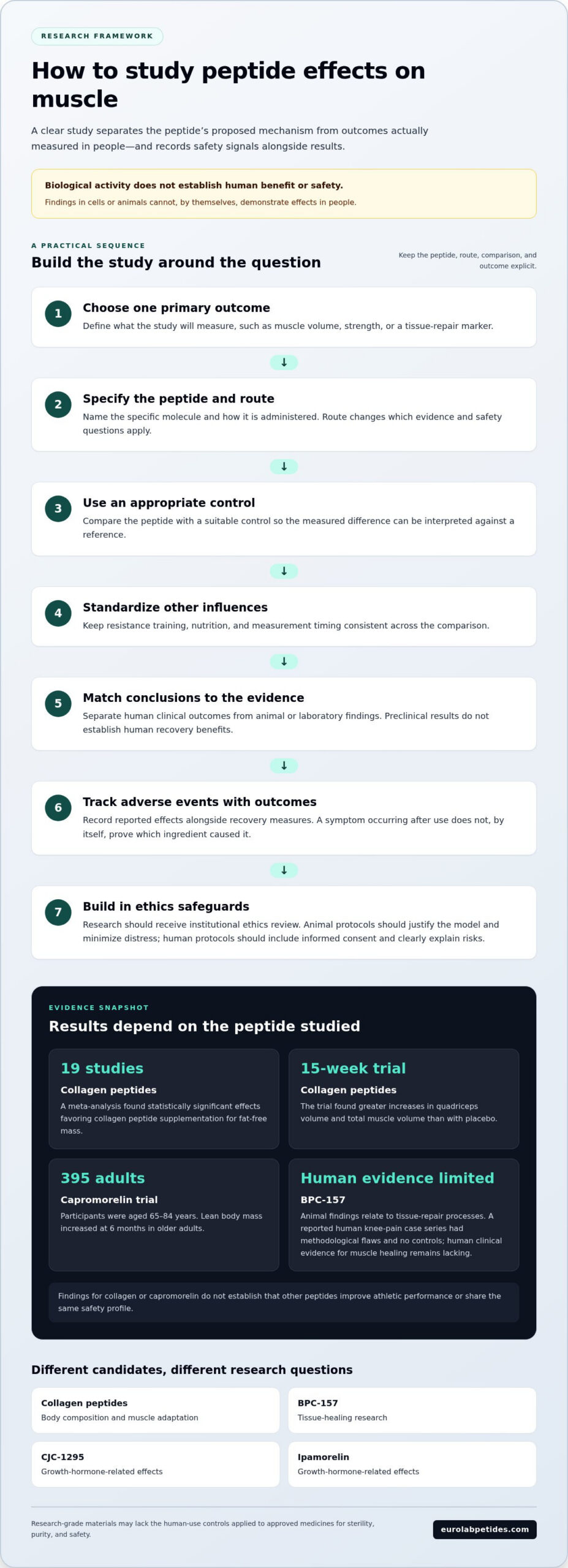
Route changes the evidence being considered. Oral collagen peptides are studied alongside resistance training, while many approved peptide medicines, including insulin and GLP-1 medications, are administered by injection. A meta-analysis of 19 studies found statistically significant effects favoring collagen peptide supplementation for fat-free mass, according to The meta-analysis authors. A separate 15-week trial found greater increases in quadriceps volume and total muscle volume with collagen peptides than with placebo, according to The trial authors. Those findings concern collagen, not every peptide marketed for muscle recovery.
Growth hormone secretagogues require a different safety lens because they affect hormone signaling and metabolism. A randomized capromorelin trial enrolled 395 adults aged 65-84 years, according to The capromorelin trial authors. The same trial increased lean body mass at 6 months in older adults. That result does not establish that other secretagogues improve athletic performance or have the same safety profile. CJC-1295 and ipamorelin are examples studied for growth-hormone-related effects, but evidence for gray-market injectable peptides in people is largely absent.
BPC-157 illustrates the gap between preclinical promise and human evidence. Animal models associate it with angiogenesis, nitric-oxide pathway modulation, fibroblast migration, and organized collagen deposition. These processes may relate to injury repair, but animal findings cannot establish human recovery benefits. The case-series authors report a single human case series for knee pain, with methodological flaws and no controls. Human clinical evidence for muscle healing remains lacking.
Animal or human peptide studies should receive institutional ethics review before work begins. Animal protocols should justify the model and minimize distress; human protocols should use informed consent and clearly explain risks. These safeguards matter whether a study examines BPC-157, collagen, or a growth hormone-related peptide.
Commonly studied candidates include collagen peptides, BPC-157, CJC-1295, and growth-hormone-releasing peptides such as ipamorelin. Their proposed roles differ: collagen research examines body composition and muscle adaptation, while BPC-157 studies focus on tissue healing.
To study muscle effects, define one primary outcome, such as muscle volume, strength, or a tissue-repair marker. Compare the peptide with an appropriate control, specify the route, and standardize resistance training, nutrition, and measurement timing. Distinguish human clinical outcomes from animal or laboratory findings, and track adverse events alongside recovery measures.
Potential side effects and safety uncertainties
Side effects vary with a peptide’s structure, route, and biological target. Reports from people using injectable peptides include gastrointestinal symptoms, headache, fatigue, and injection-site irritation. These are reported effects, not a complete profile for every compound. A symptom that occurs after use does not, by itself, establish which ingredient caused it.
A product’s status affects the safety evidence available. The FDA doesn’t regulate or approve many injectable peptides marketed online and through wellness clinics. Research-grade peptides also lack the human-use controls applied to approved medicines for sterility, purity, and safety. Contamination or incorrect composition can make an observed effect differ from the expected effect of the named molecule.
Immune responses are another concern. Some studies suggest injectable peptides could trigger allergic reactions or autoimmune issues. Responses can depend on the molecule, impurities, route, and the person’s immune system. A laboratory result describing a peptide’s activity cannot establish its safety after injection. This distinction matters when interpreting claims about recovery or injury treatment.
Growth hormone-releasing secretagogues warrant attention to metabolic effects. These compounds influence hormone signaling, which can affect processes beyond muscle tissue. Insulin illustrates why peptide activity needs context: it is a medicine used to control blood sugar in diabetes, not a general muscle-building agent. The intended effect and risk profile depend on the compound’s approved use and clinical evidence.
Sports involve a separate risk. The World Anti-Doping Agency lists growth hormone secretagogues as prohibited substances. Under WADA rules, a substance may be prohibited when it meets two of three criteria: performance-enhancing potential, health risk, or conflict with the spirit of sport. WADA also applies strict liability, meaning athletes remain responsible for substances found in their bodies.
Harvard Medical School associate professor Pieter Cohen advises clinicians against recommending self-injection of peptides. This is especially relevant when a product’s sterility, dose, or identity is uncertain. People who are pregnant or breastfeeding, take medications, or have a health condition should consider discussing peptide supplements with a doctor. Reviewing medication history can help identify possible interactions and overlapping effects.
For research interpretation, record adverse events alongside the intended outcome. Distinguish injection-site irritation from systemic symptoms such as headache or fatigue, and document when each begins. Compare findings with a control and the specific peptide studied. Without consistent product identity and safety monitoring, conclusions about a compound’s effects can be unreliable, even when its biological mechanism seems plausible.
How peptides function in the body
Peptides act as signals, not as a single-purpose class of muscle-building substances. Their amino-acid sequences shape how they interact with receptors and other cellular targets. When a signal reaches a target cell, it can influence biochemical activity, including whether the cell releases another signal or changes gene activity. The outcome depends on the peptide and the tissues that respond.
Hormone signaling offers a clear example. Growth hormone-releasing hormone, or GHRH, signals the pituitary gland to produce and release growth hormone. Laboratory data and animal studies indicate that certain peptides can stimulate natural pulses of growth hormone release. This is a proposed mechanism, not evidence that every such peptide increases muscle growth or strength in people. The effect of a signal depends on the body’s response and the biological context.
Growth hormone connects signaling with broader processes. It can influence metabolism and tissue activity, while downstream signals help regulate protein turnover. Muscle composition reflects both the creation and breakdown of proteins, alongside exercise, nutrition, and recovery. A peptide that affects one signaling step may therefore alter a pathway without producing a measurable change in muscle size or function.
Endorphins illustrate a different role. The body produces these peptides to block pain signals and relieve stress. Their action can change how discomfort is perceived, but pain relief alone does not show that damaged muscle has repaired or that strength has increased. In research, separating a reported symptom from a direct tissue measure helps clarify what a peptide’s signal changed.
Route also affects how a peptide reaches biological systems. Peptides taken by mouth are broken down into amino acids, which the body absorbs. This differs from a peptide signal that reaches a target intact. Researchers therefore need to distinguish the administered material from its breakdown products when interpreting an observed effect. For patients, this mechanism also explains why oral and injectable products are not interchangeable.
In muscle tissue research, a useful model links each step: peptide exposure, target engagement, downstream signaling, and a tissue-level outcome. For example, a laboratory assay may show altered signaling, while a separate assessment measures muscle protein or tissue composition. These are distinct endpoints. Demonstrating one does not establish the others, and a pathway result alone cannot establish clinical benefit.
This framework helps researchers assess claims about peptides and muscle growth without confusing mechanism with outcome. A change in hormone release, pain signaling, or protein-related activity can support a biological hypothesis. To determine whether it relates to recovery or strength, studies must measure those outcomes directly and interpret them in light of the specific peptide, route, and study model.
Peptide definition and biological roles
Peptides are short chains of amino acids, the building blocks of protein. Their sequence and structure influence how they interact with receptors, enzymes, and other cellular targets. The body produces thousands of peptide types, each with a distinct biological role. Endorphins, for example, help block pain signals and relieve stress.
Peptides are not the same as anabolic steroids. Peptides are amino-acid chains, while anabolic steroids are typically synthetic versions of naturally occurring male hormones such as testosterone. This structural difference matters: researchers studying muscle tissue examine each compound’s specific target and pathway, rather than assuming all substances associated with muscle growth act alike.
What are the differences between peptide classes studied for muscle tissue? Collagen peptides are studied as nutritional supplements, often alongside resistance training, while growth hormone-releasing peptides are examined for effects on hormone signaling. BPC-157 is investigated chiefly in preclinical tissue-repair research, so its proposed role differs from either category.
Collagen peptides provide an example of a dietary peptide class. Oral collagen is broken down into amino acids during digestion, which the body absorbs. Studies of collagen supplementation assess outcomes such as fat-free mass, body composition, and strength, often in the context of training. These findings cannot be generalized to injectable signaling peptides, which have different structures, routes, targets, and evidence bases.
Signaling peptides can regulate biological activity by binding to a receptor or influencing another molecule. Growth hormone-releasing hormone, for example, signals the pituitary gland to produce and release growth hormone. Certain peptides have been studied for their potential to stimulate natural growth hormone pulses. A change in hormone signaling is a mechanistic outcome, however, not proof of increased muscle size or improved physical performance.
Approved medicines offer another useful distinction. Insulin is a peptide medicine used to help control blood sugar in people with diabetes. GLP-1 medicines, including semaglutide and tirzepatide, are used for conditions such as obesity and type 2 diabetes. Their approval reflects specific medical uses and clinical evidence. It does not establish that other peptides enhance muscle growth or serve as supplements for that purpose.
For muscle studies, classify a peptide by its proposed target, route, and evidence type before interpreting results. A collagen study may measure body composition after training; a growth hormone study may assess signaling; and a BPC-157 experiment may examine tissue repair. Keeping those categories separate helps researchers connect a peptide’s biological role to the outcome actually measured.
Research-grade peptide quality and safety
In the United States, many injectable peptides marketed online or through wellness clinics aren’t FDA-regulated or approved for human use. A “research use” label doesn’t establish approval, efficacy, or safety for muscle growth. FDA approval of a peptide medicine is based on clinical trials demonstrating efficacy and safety for its approved use, not every proposed research application.
Research-grade status describes intended research use, not a guarantee that material is suitable for human administration. The FDA warns that unregulated peptides may contain impurities. Differences in identity, purity, or contamination can affect experimental results, making quality control essential when comparing tissue responses. A biological effect cannot be confidently attributed to a named peptide if the tested material’s composition is uncertain.
Start with identity and purity documentation. Analytical methods such as mass spectrometry can help characterize molecular identity, while chromatography can assess purity profiles. These methods answer different questions: identity analysis checks whether the expected molecule is present, while a purity profile can reveal related impurities. A single purity figure cannot establish sterility, endotoxin status, or suitability for injection.
For injectable peptides, sterility and endotoxin testing are distinct quality considerations. Sterility assessment addresses microbial contamination; endotoxin testing looks for bacterial components that can affect biological responses. A certificate of analysis should identify the tested batch and method, rather than present results without traceable sample information. Research teams can compare the certificate with the vial label and retain batch records alongside experimental data.
Study design must also distinguish material quality from biological efficacy. In an animal model, record the peptide identity, batch, route, storage conditions, and exposure protocol. For human studies, ethical review and informed consent are essential, and material intended for human administration requires the applicable regulatory pathway. Results from animal experiments cannot establish safety or efficacy in patients.
What are the costs of research-grade peptides for muscle tissue studies? Cost depends on the peptide, synthesis complexity, quantity, and analytical testing required. Sterility or other specialized quality assessments can also affect the total research-material budget.
Interpret peptide findings alongside controls for exercise and nutrition. If one group receives a peptide while another follows the same training and nutrition protocol without it, researchers can better isolate the peptide’s contribution. For injectable peptides, batch-level documentation and quality testing help distinguish a true biological effect from variation in the material. The key takeaway is that a research label alone is not quality evidence; traceable characterization and study-specific controls support interpretable results.
EuroLab Peptides: Longevity & Vitality Research
EuroLab Peptides provides research-grade peptide offerings for studies examining longevity and vitality, alongside weight management, tissue repair and recovery, and cognitive function. Its multi-level quality control includes in-house and independent third-party laboratory testing to assess product purity and consistency. These offerings are relevant when a research project examines biological pathways connected to recovery or tissue repair, rather than seeking medical advice or products for human consumption. For work focused on muscle tissue, the research context and the evidence needed to interpret findings remain central to selecting study materials. Review EuroLab Peptides’ research offerings as you define the scope of your investigation, then visit EuroLab Peptides for further information.
Build the Next Study on Clear Research Questions
The next step in peptides for muscle tissue research is to define what a study needs to establish before selecting its materials. Specify the biological question, the outcome that would address it, and the quality documentation required for interpretation. This keeps study design aligned with the evidence being sought, rather than assumptions about a compound’s effects.
EuroLab Peptides offers Longevity & Vitality Research, Weight Management Research, and Tissue Repair & Recovery Research. These research areas can provide a starting point for projects examining related biological pathways. Match the research area to your project’s scope, then review the available research materials and quality information as part of your planning.
Contact EuroLab Peptides for research support to discuss a research-focused next step. Clear questions and careful study planning can move your investigation forward with purpose.
Frequently Asked Questions
What are peptides and how do they work?
Peptides are amino-acid chains that can act as biological signals or serve other roles in the body. Their effects depend on their sequence and target. For example, growth hormone-releasing hormone signals the pituitary gland, while endorphins affect pain signaling. In peptides for muscle tissue research, distinguish a proposed mechanism from an outcome: receptor activity alone doesn’t demonstrate a change in muscle function.
Are peptides safe?
Safety depends on the specific peptide, its intended use, route, and product quality. Approved medicines have evidence for defined medical uses, while research-grade materials are intended for laboratory research, not human use. Online injectable products can involve added uncertainty around identity, impurities, and sterility. For a research project, assess safety within the approved protocol and keep laboratory findings separate from claims about human use.
Do peptides affect testosterone?
Peptides don’t form one uniform drug class, so a single effect on testosterone can’t be assigned to all of them. Some are studied for growth hormone signaling, which is a different hormone pathway from testosterone. A change in one pathway doesn’t establish a change in another. To evaluate testosterone, a study must measure it directly and interpret the result alongside the specific peptide, population, and study design.
How are peptides taken?
Route depends on the particular peptide and its approved use. Many FDA-approved peptide medicines, including insulin and GLP-1 medications, are administered by injection. Peptides taken by mouth are broken down into amino acids during digestion, so oral and injectable forms shouldn’t be assumed to produce equivalent exposures. Research materials are for laboratory use, not self-administration or human consumption.
How do they work for bodybuilding?
Some peptides are promoted in bodybuilding for muscle growth or recovery, often through proposed hormone-related pathways. A biological rationale doesn’t demonstrate improved strength or physique in people. Evidence for benefits from gray-market injectable peptides is largely absent, and growth hormone secretagogues are prohibited by the World Anti-Doping Agency. Athletes must account for anti-doping rules as well as health risks before considering any substance.
What are the health benefits of peptides?
Benefits are specific to the molecule and its established use. Insulin helps control blood sugar in people with diabetes, while GLP-1 medicines are used for conditions including obesity and type 2 diabetes. Those approved medical uses don’t establish a muscle-building benefit. For collagen peptides, studies have examined body composition and fat-free mass, but those findings shouldn’t be generalized to unrelated peptide compounds.
What are the risks associated with peptides?
Reported risks from injectable peptides include gastrointestinal symptoms, headache, fatigue, and irritation at the injection site. Immune responses, including allergic reactions, are also a safety concern. Unregulated products can contain impurities or differ from their labels, complicating safety assessment and interpretation. People taking medication or managing a health condition should discuss supplements with a healthcare professional rather than treating research claims as medical guidance.
What biological mechanisms do peptides influence in muscle tissue?
Research examines several mechanisms, including hormone signaling, protein-related pathways, and tissue-repair processes. Growth hormone-releasing hormone acts on the pituitary, while animal studies of BPC-157 have examined angiogenesis and fibroblast migration. These mechanisms represent different research questions, not interchangeable evidence. A study should measure its specific target and a relevant tissue outcome separately to determine whether pathway activity corresponds with a muscle change.
