

A high-purity claim alone does not prove that a peptide source is reliable. When sourcing peptides for proof-of-concept studies, treat a certificate of analysis without lot-specific traceability, unclear testing details, or ambiguous research-use-only labeling as red flags. A sound assessment considers purity evidence alongside peptide identity, stated quantity, synthesis timeline, and the seller’s claims.
Scrutinizing these details before a study depends on a material’s consistency is a practical safeguard. Research-grade peptides are not the same as regulated pharmaceutical products, so a product description or purity figure is not evidence of pharmaceutical standards or suitability for human use.
This guide explains what a useful, lot-specific certificate of analysis can show, how to interpret purity and quantity information, and which seller claims merit closer scrutiny. It also covers how research-use-only status shapes expectations, what can affect synthesis timelines, and how to assess quality without relying on unsupported guarantees or a single headline figure.
Key Takeaways
- Assess peptide quality using lot-specific documentation that identifies the material and explains how its purity was measured.
- Compare the stated quantity with the study’s requirements, and distinguish a purity result from evidence of identity, consistency, or pharmaceutical-grade controls.
- Interpret synthesis timelines in light of sequence complexity, production requirements, testing, and shipping rather than relying on a single general estimate.
- Read research-use-only labeling as a boundary on intended use, not as evidence that a peptide has been approved or assessed for human use.
- Match the peptide category to the proof-of-concept question, then explore research areas such as longevity, weight management, tissue repair, or cognitive function.
Research-grade versus regulated pharmaceutical standards
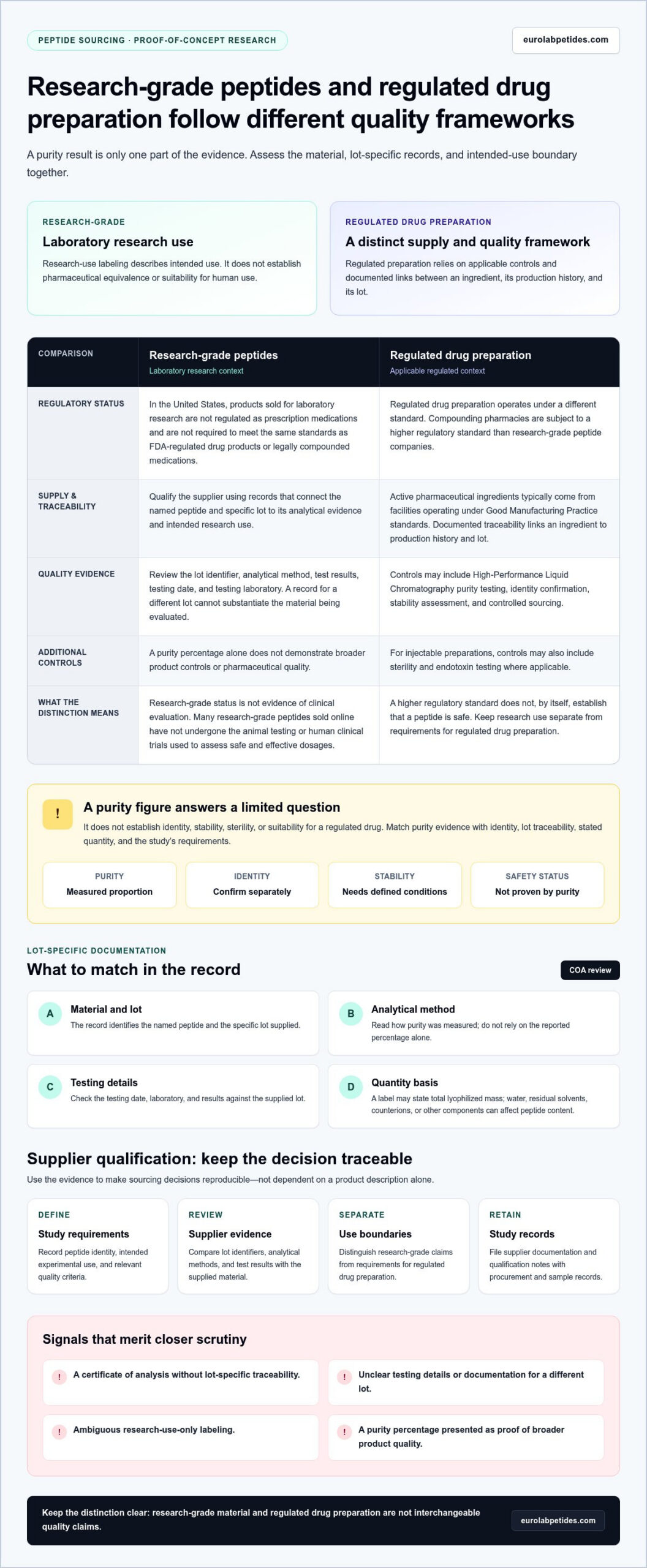
Researchers should define the study’s material requirements, compare supplier records, qualify the supplier, and document each decision. The qualification file should link the peptide’s identity and lot to its analytical evidence and intended research use. This process makes sourcing decisions traceable if a proof-of-concept result needs review or replication.
Research-grade peptides and regulated pharmaceutical ingredients serve different purposes. In the United States, products sold for laboratory research are not regulated as prescription medications. They are also not required to meet the same standards as FDA-regulated drug products or legally compounded medications. A research-use label describes intended use, not pharmaceutical equivalence.
Regulated drug preparation typically relies on active pharmaceutical ingredients from facilities operating under Good Manufacturing Practice standards. Documented traceability links an ingredient to its production history and lot. Quality controls may include High-Performance Liquid Chromatography purity testing, identity confirmation, stability assessment, and controlled sourcing. For injectable preparations, controls may also include sterility and endotoxin testing where applicable.
These controls matter because a purity result answers only a limited question. It does not establish sterility, stability, or suitability for a regulated drug. Compounding pharmacies are subject to a higher regulatory standard than research-grade peptide companies, but that distinction does not establish that a peptide itself is safe. Do not treat a seller’s purity percentage as a substitute for broader product controls.
Supplier qualification means examining the evidence behind each claim. A certificate of analysis without traceable lot information warrants caution. A useful record links the named peptide and lot to its analytical method, testing date, and testing laboratory. Documentation for a different lot cannot substantiate the material under evaluation. Keep these records with the study’s procurement and sample documentation.
- Define the requirement: Record the peptide identity, intended experimental use, and relevant quality criteria.
- Review the evidence: Compare lot identifiers, analytical methods, and test results with the supplied material.
- Assess the boundary: Separate research-grade claims from requirements for regulated drug preparation.
- Retain the decision: File supplier documentation and qualification notes with the study records.
These steps make supplier selection reproducible rather than dependent on a product description alone. Unregulated peptide products may pose risks from microbial contamination, impurities, inaccurate dosing, transport or storage degradation, and misidentified active compounds. Many research-grade peptides sold online have not undergone the animal testing or human clinical trials used to assess safe and effective dosages. Research-grade status is therefore not evidence of clinical evaluation.
For proof-of-concept work, the key distinction is the study’s purpose. Laboratory research may use research-grade material under its stated research-use conditions. Regulated drug preparation requires a different supply and quality framework, including documented traceability and applicable controls. Keeping these categories separate prevents an analytical result from being mistaken for evidence of pharmaceutical quality or suitability for human use.
Peptide purity and quantity
A purity percentage describes the proportion of measured peptide-related material in a tested sample. It does not tell researchers how much usable peptide is in the vial or establish identity and stability on its own. For proof-of-concept work, interpret purity, delivered quantity, and analytical evidence as separate specifications.
Quantity can mean different things. A label may state the total mass of lyophilized material, while water, residual solvents, counterions, or other components affect the peptide content. Compare the labeled quantity with the supplier’s stated basis and the study’s requirements. Otherwise, packages with similar labels may not contain comparable quantities.
How do prices compare across U.S. peptide suppliers, quantities, and purity levels? Compare quotations only when the peptide sequence, quantity basis, purity specification, testing evidence, and delivery terms are equivalent. A higher purity percentage alone does not establish better value if the quantity basis or analytical support differs.
After delivery, match the vial’s identity and lot details to the accompanying documentation. Analytical testing can assess identity and purity, while a stability assessment evaluates whether the material’s characteristics remain consistent under defined storage conditions. For identity, mass spectrometry can complement chromatographic analysis. The appropriate method depends on the peptide and the question being tested.
Researchers can verify peptide identity and purity after delivery by matching the received lot to its documentation and using suitable analytical testing, such as mass spectrometry and chromatography. Stability requires evidence under defined storage conditions. A purity result from a single time point does not establish stability.
Read the analytical method, not just the reported percentage. High-Performance Liquid Chromatography can separate components and support a purity measurement, but interpretation depends on the method and sample. A result is most useful when the test relates to the received lot and the documentation explains what was measured. Keep the original report with the sample records.
- Separate specifications: Record identity, purity, and quantity independently.
- Align comparisons: Use the same quantity basis and analytical scope across supplier quotations.
- Link evidence to material: Match the delivered lot to its test documentation.
- Assess storage: Interpret stability claims in relation to stated storage conditions and testing.
Sourcing peptides for proof-of-concept studies is more robust when each specification addresses a distinct research need. A high purity figure cannot compensate for unclear quantity, mismatched lot documentation, or identity evidence that does not support the planned analysis. Researchers should record the basis for each purchasing decision so later interpretation can account for material characteristics alongside experimental variables. A documented approach also supports comparison between study materials and future results.
Peptide synthesis turnaround times
A synthesis estimate covers a series of stages, not synthesis alone. Sequence review, production, purification, analytical testing, and dispatch each affect the expected completion date. A quoted interval is useful only when its starting point and included stages are clear. For example, an estimate that starts after sequence approval excludes earlier design discussions and order processing.
Sequence characteristics affect production complexity. A short, unmodified sequence may require different synthesis and purification work from a longer sequence with unusual residues or a disulfide bond. Aggregation during synthesis can also affect yield and purification. These factors change the laboratory work required, so one general turnaround figure cannot describe every peptide request.
Specifications can add further stages. N-terminal modifications, terminal amidation, or a requested salt form may require additional processing after chain assembly. Purification targets and the quantity requested also affect production planning. When ordering a custom sequence, distinguish standard synthesis from modified material, which involves steps beyond assembling the amino-acid chain.
Production is only one part of delivery readiness. Purification separates the target peptide from related impurities, while analytical testing checks whether the resulting material meets defined specifications. If testing indicates that further purification or review is needed, the schedule changes because work must return to an earlier stage. A useful timeline includes quality review, not just synthesis time.
- Sequence review: Confirm the sequence and requested modifications before production begins.
- Synthesis: Assemble the peptide chain according to its specified composition.
- Purification: Process the crude product to meet the requested specification.
- Testing and release: Complete analytical review and prepare the material for dispatch.
- Transit: Account for shipping after laboratory processing is complete.
Researchers can plan more accurately by tying study milestones to these stages. A protocol requiring material for a scheduled assay should allow time for sequence approval, laboratory processing, document review, and transit. Treating dispatch as the completion point can leave too little time for receipt checks or study preparation. Record timeline assumptions in the protocol’s procurement plan.
Clarify what a seller’s estimate includes: production start, purification, testing, and shipment are separate milestones. A delay in one phase does not necessarily indicate a problem with another. For example, a completed synthesis may still be awaiting purification or analytical release. Tracking milestones helps distinguish manufacturing progress from transport progress, without treating either as a substitute for quality evidence.
For repeat studies, retain the sequence specification, modification details, lot records, and previous milestone dates. These records help establish whether later orders have the same material requirements or meaningful changes. A revised sequence or quantity can alter production planning, even when the peptide name stays the same. Documenting the comparison supports realistic scheduling and continuity between proof-of-concept experiments.
Research-use-only labeling and regulatory status
A research-use-only label states a product’s intended purpose; it does not establish pharmaceutical approval. In the United States, products sold for laboratory research are not regulated as prescription medications. They are also not required to meet the same standards as FDA-regulated drug products or legally compounded medications. Read the label as a boundary on intended use, not as evidence of approval for human use.
“Not for human consumption” communicates a similar restriction on intended use. Products bearing either phrase are not regulated as prescription medications. Neither label demonstrates that a peptide has undergone the animal testing or human clinical trials used to assess safe and effective dosages. A research label on a vial, for example, does not establish clinical evaluation or suitability for administration.
Separate three questions when interpreting a label: what the material is represented to be, what use the seller states, and what regulatory status applies to that use. A product description can address the first two, but it does not make the product an approved medicine. This distinction matters when documentation uses terms such as “research grade,” “clinical,” or “pharmaceutical.” Those words alone do not establish regulated drug status.
The FDA has issued warning letters regarding improperly marketed peptides and compounded drugs prepared outside authorized regulatory pathways. The distinction matters: research labeling does not authorize promotion for medical use, and analytical documentation does not establish a permitted route for drug preparation. When documenting supplier qualification, keep promotional claims separate from the material’s research-use designation.
Sermorelin and BPC-157 are not approved by the FDA or Health Canada. Their appearance in research discussions or product listings doesn’t change that status. An FDA advisory panel voted to recommend loosening compounding-pharmacy restrictions for six peptides; that vote is a recommendation, not evidence that every peptide product is approved or suitable for human use.
- Record the label: Save the exact research-use wording with the order and lot documentation.
- Separate claims: Distinguish identity and purity evidence from regulatory or clinical claims.
- Review intended use: Keep research protocols aligned with the stated laboratory purpose.
- Document status: Note relevant approval claims separately from research findings and product specifications.
These distinctions are especially important when a supplier’s marketing suggests treatment, dosing, or human administration. Research-use-only materials are not prescription medications, and their labels do not establish safety or effectiveness. A proof-of-concept protocol should state its research purpose and preserve the labeling and product records that define the material’s stated status.
For researchers, the practical conclusion is clear: a research-use label describes the product’s intended research context, not a regulatory endorsement. FDA or Health Canada approval, pharmaceutical manufacturing standards, and research-grade specifications are distinct categories. Keeping them separate prevents supplier language from being mistaken for evidence of approval, clinical testing, or authorization for human use.
What types of peptides are used in proof-of-concept research studies?
The peptide type should follow the experimental hypothesis. A receptor-binding study may use a ligand or sequence variant, while a cell-uptake assay may examine a targeting peptide. Identify the proposed interaction and measurable endpoint before selecting a candidate. That decision determines which sequence features matter and what comparisons the experiment needs.
Signaling peptides are studied for their interactions with receptors or other molecular targets. In a binding assay, researchers can compare a candidate sequence with a control that lacks the relevant binding feature. This helps distinguish target-related activity from background signal. State what observation would support the hypothesis, rather than relying on a peptide’s name or claimed function.
Other studies use peptide fragments to probe a specific region of a larger protein. A fragment may represent a binding site or a segment implicated in a molecular interaction. Researchers can compare the fragment with a modified version to assess whether a sequence change alters the measured response. Clear sequence records are essential because small structural differences can change what the experiment tests.
Cell-targeting peptides are another research category. These sequences are investigated for interactions with cell-surface targets or their potential role in directing a molecular interaction. A study might compare target-positive and target-negative cells, then quantify binding or uptake. Cell-targeting peptides can have receptor-binding affinity in the nanomole range, but an affinity measure addresses binding, not every downstream biological effect.
Synthetic analogues and modified peptides can help researchers test structure-function relationships. A modification may alter charge, conformation, or resistance to degradation, changing the experimental question. For example, comparing a linear sequence with a constrained form can help investigate how structure relates to target interaction. Record each modification explicitly so results from distinct constructs are not treated as though they represent identical materials.
- For receptor studies: Define the target and include a control suitable for interpreting binding.
- For fragment studies: Specify the parent protein region and exact sequence tested.
- For cell-targeting work: Separate binding or uptake measurements from broader biological conclusions.
- For analogue comparisons: Document every sequence and structural modification independently.
When sourcing peptides for proof-of-concept studies, match sequence design to the hypothesis and assay. The sourcing process should preserve the distinction between a candidate’s intended research role and evidence actually produced by the experiment. A disciplined approach also makes comparisons between constructs easier to interpret and replicate.
EuroLab Peptides: Longevity & Vitality Research
EuroLab Peptides offers Longevity & Vitality Research for researchers assessing peptide materials for studies in this area. Its research-grade peptides undergo multi-level quality control, including in-house and independent third-party laboratory testing for purity and consistency. This evidence can help teams compare supplier documentation with study requirements.
Research questions in other areas may align with Weight Management Research, Tissue Repair & Recovery Research, or Cognitive Function Research. These offerings provide relevant research categories, but do not replace study-specific evaluation of peptide identity, lot documentation, or research-use-only status.
For a proof-of-concept project, use the quality criteria in this guide to assess whether the material’s documentation suits the planned work. Visit eurolabpetides.com to explore EuroLab Peptides’ research offerings.
Set the Next Study Up for Reproducibility
Use the proof-of-concept phase to define what evidence would justify the next experiment. Before sourcing peptides for proof-of-concept studies, document the hypothesis, primary readout, comparison groups, and criteria for interpreting results. This gives you a clearer basis for deciding whether a finding supports follow-up work, needs replication, or calls for a revised study design.
EuroLab Peptides offers Longevity & Vitality Research, Weight Management Research, and Tissue Repair & Recovery Research. These areas may suit projects examining related scientific questions. Keep the study’s objective and material requirements central as you consider the next step.
Contact EuroLab Peptides about your study to explore research offerings relevant to your project. A well-defined question and a carefully documented plan can help make the next experiment more informative.
Frequently Asked Questions
What are potential red flags when evaluating peptide sellers?
Red flags include unsupported purity claims, unclear product identity, and documentation that cannot be matched to the supplied lot. A certificate without traceable lot information provides limited evidence. Be cautious of marketing that implies medical benefits or presents research labeling as proof of approval for human use. Compare the seller’s claims with the product documentation, and record discrepancies for procurement review before the material enters a study.
What is the difference between research-grade and regulated pharmaceutical standards?
Research-grade materials are intended for laboratory research, while regulated pharmaceutical ingredients fall under a different quality and regulatory framework. In the United States, laboratory research products are not regulated as prescription medications or required to meet the same standards as FDA-regulated drug products or legally compounded medications. A laboratory purity result, for example, does not establish the controls required for regulated drug preparation.
How can researchers identify reputable peptide suppliers in the United States?
Assess suppliers by the consistency and traceability of their product claims, not promotional language alone. For example, compare the peptide name and lot identifiers across the product label, order record, and analytical report. Clear separation between laboratory research use and human-use claims also matters. Document the review and any discrepancies in institutional procurement records so another researcher can understand the material-selection decision.
What quality documentation should peptide suppliers provide, such as certificates of analysis and purity data?
A lot-specific certificate of analysis typically identifies the lot number, purity percentage, analytical method, testing date, and testing laboratory. Use these details to link the report to the received material. Compare the stated peptide identity and sequence with the study specification as well. Keep the certificate with purchasing and sample records: a report that cannot be linked to the material does not resolve questions about that lot.
What research-grade peptide purity is appropriate for proof-of-concept studies?
No single purity threshold suits every proof-of-concept study. The appropriate specification depends on the assay, endpoint, and whether related impurities could affect interpretation. For example, a sensitive receptor-binding assay may require different controls from a preliminary screening experiment. Set acceptance criteria before comparing materials, and interpret reported purity alongside identity evidence and the analytical method used.
What are typical lead times, shipping conditions, and storage requirements for research peptides?
Lead times depend on sequence complexity, modifications, purification, testing, and transit, so assess stated milestones rather than relying on a broad estimate. Shipping and storage conditions depend on the material’s documented stability and product instructions. For example, distinguish laboratory processing time from transport time when planning an assay. Record receipt and storage conditions so any deviations can be considered when interpreting results.
What U.S. laws and regulations apply to purchasing peptides for laboratory research?
In the United States, products sold for laboratory research aren’t regulated as prescription medications and don’t have to meet the same standards as FDA-regulated drug products or legally compounded medications. Research-use-only labeling doesn’t establish approval for human use. USP <797>, <795>, and <800> address sterile compounding, non-sterile compounding, and hazardous-drug handling, respectively; they shouldn’t be mistaken for a general research-peptide purchasing approval.
What are the risks of using improperly sourced or mislabeled research peptides?
Improperly sourced or mislabeled materials can introduce microbial contamination, impurities, inaccurate dosing, degradation during transport or storage, or misidentified active compounds. Each can compromise an experiment in a different way. A mislabeled identity, for instance, may make a measured response appear to support the wrong hypothesis. Preserve the label, lot records, and study notes so investigators can trace anomalies to material identity or handling.
