

YK-11 may influence muscle growth by binding androgen receptors and potentially increasing follistatin expression, which could reduce myostatin activity. That proposed mechanism is the focus of YK-11 for myostatin inhibition research, but it does not establish that the compound increases muscle growth in humans.
The appeal is understandable: myostatin helps regulate muscle development, so reducing its activity may seem like a direct route to greater muscle growth. But the evidence described for YK-11 centers on laboratory cells and animal studies, while human safety data are very limited.
This article examines the proposed pathway linking androgen-receptor activity, follistatin and myostatin, explains what cell and animal findings can show, and outlines their limitations. It also reviews potential health risks and regulatory status, helping distinguish a research hypothesis from an established effect in humans.
Key Takeaways
- Separate the proposed link between YK-11, follistatin, and myostatin from evidence of muscle effects in humans.
- Identify the liver, cardiovascular, lipid, mood, and endocrine concerns that warrant careful consideration.
- Understand why research-chemical marketing does not establish approval for bodybuilding use or guarantee product contents.
- Use the article’s evidence and risk context to assess whether this topic belongs in a research setting rather than personal self-use.
Liver, lipid, cardiovascular, and mood concerns
Animal studies have examined YK-11, but their protocols do not establish a human regimen. This identifies the studied model and dose, not a human regimen.
In 2022, Health Canada warned that bodybuilding products containing SARMs can pose serious risks, including heart attack, stroke, and liver damage. That warning concerns SARMs as a category; it doesn’t establish that YK-11 caused each outcome. YK-11-specific human safety data remain very limited, so animal findings and category-level warnings shouldn’t be treated as proof of a particular human effect.
Liver and lipid markers matter because the liver processes compounds and helps regulate blood lipids. A risk assessment can include blood work and review of hormone, liver, and lipid markers. These results provide context for liver function and cardiovascular risk; they don’t establish that YK-11 is safe or explain every possible reaction. A relevant example is interpreting a lipid result alongside liver markers, rather than viewing either result alone.
YK-11 is a gene-selective partial androgen receptor agonist, so it acts on androgen signalling without producing full receptor transactivation. That mechanism doesn’t establish a specific hormone change or mood effect in people. Available human safety evidence is very limited, so specific YK-11 drug interactions can’t be characterized from it. Concurrent compounds and medications still matter in a risk review, especially when liver or cardiovascular effects are a concern.
Mood symptoms also require careful interpretation. A change in mood during exposure doesn’t, by itself, identify YK-11 as the cause; other compounds, health conditions, and individual responses may contribute. For research risk assessment, record exposure timing, concurrent substances, symptoms, and relevant blood-work results together. This creates a clearer safety record than relying on a single symptom or treating the androgen receptor modulator label as evidence of a predictable effect.
Potential endocrine and hormone risks
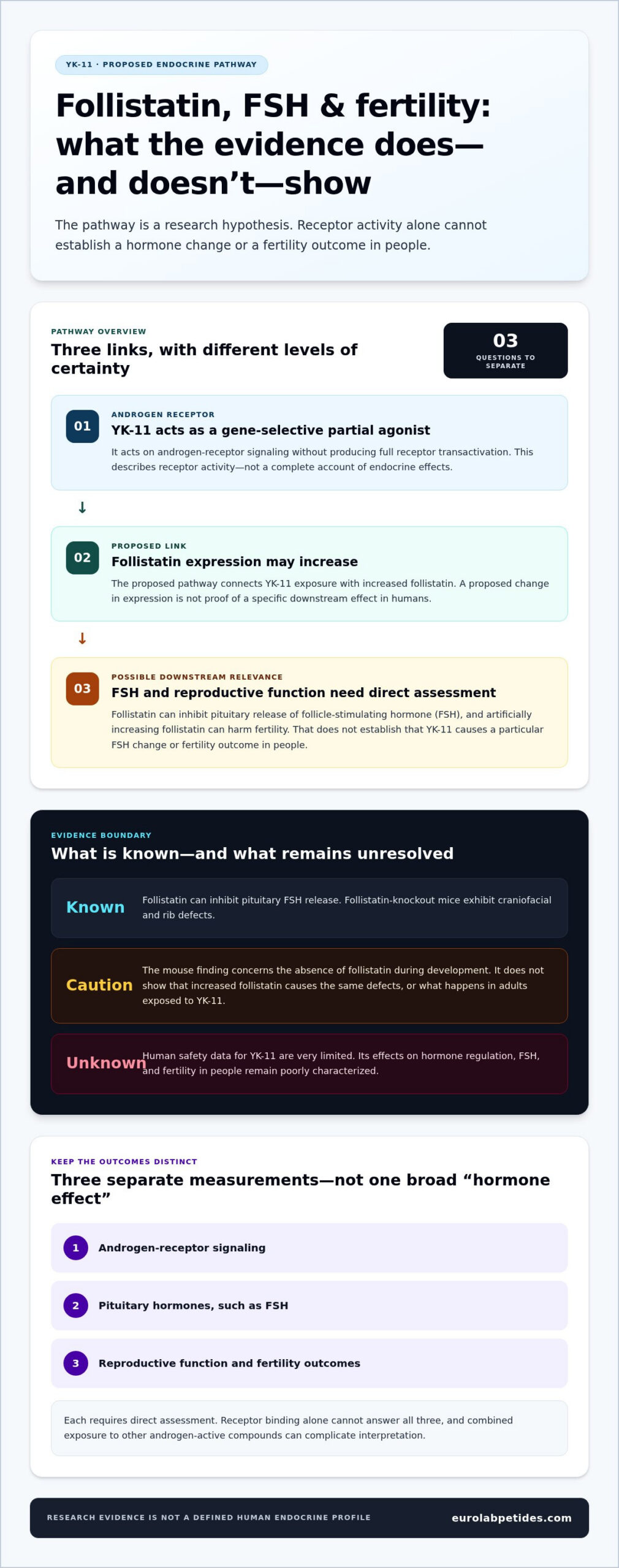
YK-11 is a synthetic steroidal selective androgen receptor modulator. It acts as a gene-selective partial agonist at the androgen receptor and doesn’t induce the N/C interaction required for full receptor transactivation. This signaling profile describes receptor activity, not a complete account of endocrine effects. Human safety data for YK-11 are very limited, so its effects on hormone regulation in people remain poorly characterized.
Follistatin is relevant because it can inhibit pituitary release of follicle-stimulating hormone (FSH). Artificially increasing follistatin can harm fertility, linking changes in this pathway to reproductive function. However, a proposed increase in follistatin after YK-11 exposure doesn’t establish that YK-11 produces a particular FSH change or fertility outcome in humans. Those are distinct claims, and the available human safety evidence doesn’t resolve them.
Animal findings provide context, but they need careful interpretation. Follistatin-knockout mice exhibit craniofacial and rib defects. This finding concerns the absence of follistatin during development; it does not show that increased follistatin causes the same defects. Nor does it establish what happens in adults exposed to a compound that may affect follistatin expression. The model, developmental stage and direction of biological change all matter.
For endocrine assessment, separate the proposed mechanism from measurable outcomes. The relevant questions include whether androgen-receptor signaling changes, whether pituitary hormones such as FSH shift, and whether reproductive function is affected. Each requires direct measurement; receptor binding alone cannot answer all three. A research record should therefore distinguish molecular findings, hormone measurements, and fertility outcomes instead of grouping them under “hormone effects.” This distinction is especially important when interpreting YK-11 findings alongside other androgen-active compounds, since combined exposures can complicate attribution. Current evidence supports caution in interpreting the pathway, not a defined human endocrine profile.
Regulatory status and research-chemical sales
The FDA has warned that SARMs are not FDA-approved bodybuilding treatments, despite online marketing for muscle growth and performance. That warning addresses SARMs as a category and identifies safety concerns; it doesn’t establish approval for YK-11. YK-11 has also been encountered as a novel designer drug. A research-chemical label does not, by itself, demonstrate authorization for human use.
Assess quality by starting with identity and batch-specific documentation. Compare the stated chemical identity with the lot number and analytical results, then review how purity was measured. Independent laboratory testing can provide an additional check alongside supplier documentation. A stated purity percentage alone does not verify identity, rule out contamination or prove that the material matches its label.
Testing costs depend on the analytical method, sample preparation, instrument time and reporting requirements. Independent testing may involve additional laboratory and handling charges. The total varies according to the questions the analysis addresses, such as chemical identity, measured purity or potential contaminants. There is no single cost that applies across methods and laboratories.
Products sold online as SARMs or research chemicals may be mislabeled, contaminated, underdosed or overdosed. For a selective androgen receptor modulator, this variability can undermine comparisons between experiments: an observed result may reflect differences in the material rather than the compound’s biological effect. Keep a clear record linking each sample’s batch identifier, analytical report, storage conditions and experimental observations.
Regulatory status also matters in sport. Athletes should be aware that SARMs are banned in many competitive sports settings. This is separate from whether a chemical is marketed for laboratory research or whether a particular batch has analytical documentation. Keep intended use, applicable rules and sample records distinct: a purity result does not establish legal status, safety or suitability for human consumption.
Proposed myostatin inhibition
The central question in YK-11 for myostatin inhibition research is whether its proposed signaling pathway changes myostatin activity. The hypothesis connects androgen-receptor activity with follistatin expression, not direct inhibition.
Proposed Effects on Myostatin and Follistatin
YK-11 is proposed to increase follistatin expression, which may reduce myostatin activity. Myostatin helps regulate muscle growth, making this pathway relevant to the compound’s proposed anabolic effects. For YK-11 for myostatin inhibition research, the distinction matters: a change in follistatin does not by itself demonstrate reduced myostatin activity or increased muscle mass. Each step requires separate evidence.
Comparisons With Other Inhibitors and Compounds
Direct myostatin inhibitors target myostatin itself, while YK-11 is proposed to affect its activity indirectly through follistatin. That difference shapes what an experiment can establish. A follistatin change alone doesn’t demonstrate direct myostatin blockade. Myostatin inhibition also raises a tissue trade-off: myostatin-knockout rats had tendons with 20% less peak strain than wild-type controls. In mice, myostatin-inhibiting treatments produced tendons described as small, brittle, and hypocellular. These findings make tendon outcomes relevant alongside anabolic effects.
Evidence Across Cells, Animals, and People
Cell-model findings suggest that YK-11 may affect anabolic signaling, but they do not establish effects in people. It also showed in-vitro anabolic activity and greater potency in this respect than dihydrotestosterone. These are cell-model findings, not measurements of human muscle growth. Animal studies have investigated YK-11 for sepsis-induced muscle wasting, but animal results cannot establish human outcomes.
Human safety data for YK-11 remain very limited. The practical takeaway for YK-11 for myostatin inhibition research is to treat these findings as mechanistic evidence, not proof of muscle growth in people.
EuroLab Peptides: Longevity & Vitality Research
EuroLab Peptides supports research-focused work through its Longevity & Vitality Research offering. Its research-grade peptides undergo in-house and independent third-party laboratory testing to assess purity and consistency, supporting researchers who prioritize documented quality in their study materials.
Consider this research area when your work examines longevity-related questions alongside muscle tissue, recovery, or inflammation. EuroLab Peptides also offers Tissue Repair & Recovery Research, Weight Management Research, and Cognitive Function Research. These areas provide relevant research categories without implying that findings about YK-11 establish human outcomes or therapeutic effects.
For research focused on longevity and vitality, visit eurolabpetides.com to explore the available research offerings.
Make the Next Research Question More Precise
Start by defining what your study needs to measure. Separate molecular endpoints from functional outcomes, document the material and methods, and decide how you will interpret results before drawing conclusions. This approach helps distinguish a proposed mechanism from evidence of a biological effect.
For teams pursuing YK-11 for myostatin inhibition research, a broader research focus may also involve longevity, metabolic questions, or tissue recovery. EuroLab Peptides offers Longevity & Vitality Research, Weight Management Research, and Tissue Repair & Recovery Research as related research areas. These offerings can provide a relevant starting point when shaping a research direction around those topics.
Human outcomes from YK-11 remain uncertain, so research decisions should reflect the limits of the evidence and the purpose of the work. To discuss research-related questions, contact EuroLab Peptides. A clearly framed question is a strong foundation for the next stage of inquiry.
Frequently Asked Questions
How does YK-11 affect muscle growth?
YK-11 is proposed to influence muscle growth through androgen-receptor signaling and changes in follistatin expression. In a cell experiment, C2C12 myoblasts showed increased expression of muscle-related markers, including MyoG and MyoD. Those markers indicate cellular signaling, not measured human muscle growth. For interpreting a result, distinguish molecular changes from outcomes such as muscle size, strength, or functional performance.
What Does YK-11 Do to Your Body?
YK-11 interacts with androgen receptors, which are involved in regulating gene activity. Its biological effects depend on the tissues exposed and the signaling pathways involved. A cellular marker change cannot establish what happens across a whole human body. For example, an observation in muscle cells says nothing by itself about liver function, cardiovascular effects, mood, or reproductive hormones.
What is the mechanism of action of YK-11?
YK-11 is described as a gene-selective partial agonist of the androgen receptor. It doesn’t induce the N/C interaction associated with full receptor transactivation. The proposed connection to myostatin involves increased follistatin expression, which could reduce myostatin activity. These are distinct steps: receptor activity, follistatin expression, and myostatin regulation each require separate evidence to establish the pathway.
What peer-reviewed studies have tested YK-11 for myostatin inhibition?
Experimental findings include C2C12 myoblast studies examining muscle-related gene expression and animal work investigating muscle wasting. In C2C12 cells, researchers reported changes in MyoG, Mfy5, and MyoD. Those are mouse cells, not human cells. The findings address proposed anabolic pathways, but they don’t establish clinical effects or demonstrate that YK-11 inhibits myostatin in people.
What are the known safety risks and side effects of YK-11?
Human safety data for YK-11 are very limited, so its human side-effect profile isn’t established. Health Canada warned in 2022 that bodybuilding products containing SARMs can pose serious risks, including heart attack, stroke, and liver damage. This is a category-level warning, not proof that YK-11 causes each outcome. Potential endocrine concerns also involve the proposed follistatin pathway and fertility.
Is YK-11 approved for medical use or human research in the United States?
The FDA has warned that SARMs are not FDA-approved bodybuilding treatments. This answers whether they are approved for bodybuilding, but does not establish the approval status of every possible human research study. Research authorization and medical approval are separate matters. A product marketed online as a research chemical should not be treated as an FDA-approved medicine or as evidence of authorization for human use.
